Lightning Protection Durability: Keeping Systems Effective
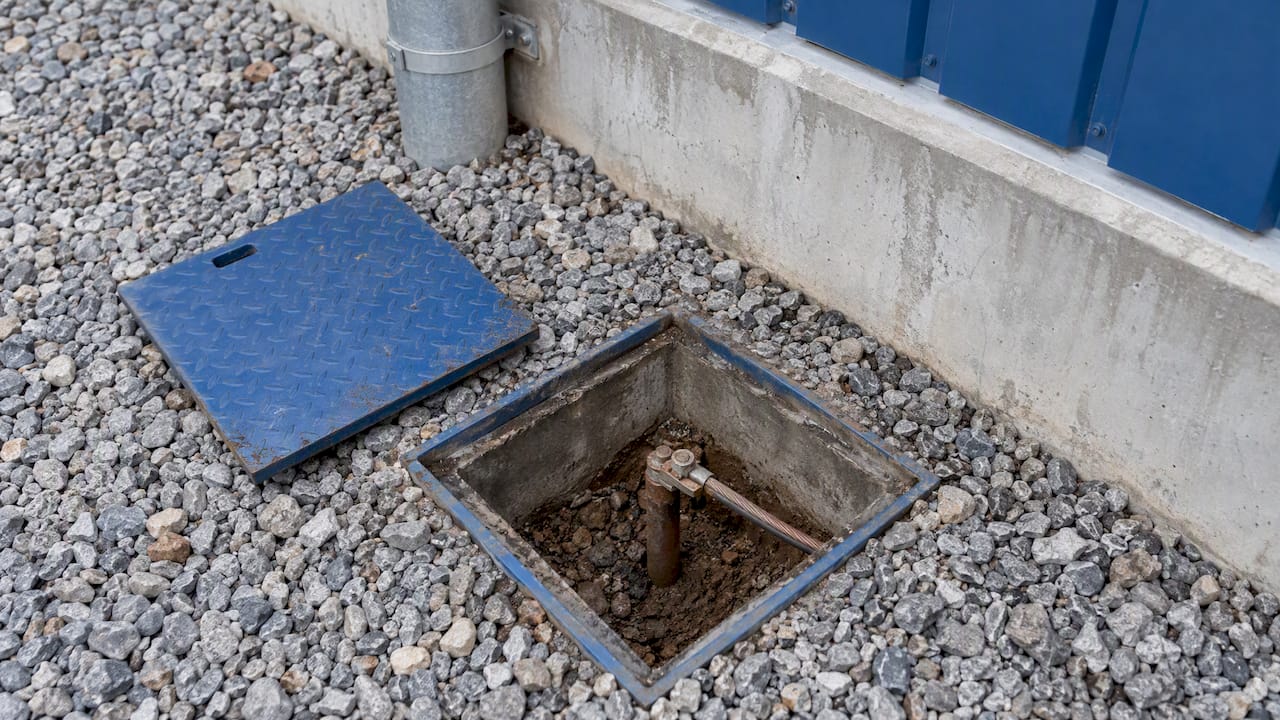
A lightning protection system is not a one-time purchase. Its durability depends on four things: the quality of the components, the quality of the design and installation, the wear of its consumable parts (surge protectors above all), and a disciplined inspection routine. In France, for many industrial sites that routine is set by regulation, with a strict deadline to repair anything a check turns up.
This guide is written for facility managers, contractors, architects, engineering consultancies and public infrastructure owners. It explains what ages, what does not, which checks apply and how to budget for the long term.
TL;DR
- Durability is a system property: air terminals, down conductors and earthing can last for decades, but surge protective devices wear with every surge they absorb.
- For ICPE sites subject to authorization in France, the rules require a complete check within six months of installation, a visual check every year, a complete check every two years and a visual check after every recorded strike.
- Any repair found necessary must be completed within one month, and protection must be installed within two years of the lightning risk analysis.
- The 2024 editions of IEC 62305-3 and 62305-4 raise the bar on material thickness and component stability, so specify against current requirements.
- Designing protection in from the start is cheaper to maintain than retrofitting a poorly conceived building.
Table of Contents
- What “durable” really means for lightning protection
- Where durability is won: design and materials
- The weak link: surge protective devices
- Earthing: the part you cannot see and must not forget
- The French inspection cycle for ICPE sites
- After a strike: what to check
- Beyond passive protection: anticipating storms
- Our perspective
- Planning a durable system: a checklist
- Working with Indelec on the long term
- FAQ
- Sources
What “durable” really means for lightning protection
When a buyer asks whether a lightning protection system is durable, two different questions are hiding in it.
The first is physical: will the metal, the joints and the earth electrodes survive corrosion, mechanical stress, thermal cycling and the strikes themselves? The second is functional: will the system still do its job in ten or twenty years, given that the building, its equipment and its risk profile will have changed?
A system can be physically intact and functionally obsolete. A new rooftop extension, a new rack of sensitive control equipment or a change in stored products can leave the original design inadequate. That is why the regulatory logic in France ties durability to verification and to updates of the risk analysis, not to a fixed lifespan in years.
It also helps to separate the subsystems, because they age at different speeds:
| Subsystem | Main ageing factors | Typical durability issue |
|---|---|---|
| Air terminals (lightning rods, masts, mesh cage) | Weather, corrosion, mechanical fixing loosening, strike erosion | Fixings and mast bases, loss of section at strike points |
| Down conductors and connections | Corrosion at joints, mechanical damage, thermal expansion | Loose or corroded connections, broken clamps |
| Earthing and grounding | Soil chemistry, moisture variation, civil works | Rising resistance, damaged or cut electrodes |
| Surge protective devices (SPDs) | Cumulative surges, heat, end-of-life of internal components | Degraded protection without visible sign |
| Lightning strike counters | Electronics, battery or sensor condition | Missing strike history |
The consequence is simple. You do not replace “the lightning protection system” on a schedule. You inspect each subsystem, and you replace what the inspection shows has degraded.
Where durability is won: design and materials
Most premature failures trace back to decisions made before the first rod is fixed to a roof.
Design before construction
INRS, the French occupational safety institute, makes the point that integrating lightning protection at the design phase of a building is more effective for safety and also more economical. A building that was poorly designed upstream becomes difficult and costly to maintain, which lowers equipment availability and increases the risk of the protection system degrading early. You can read the reasoning in the INRS publication on designing workplaces and work situations.
In practice, this means asking architects and contractors early for:
- safe, permanent access to roof-mounted air terminals and test joints;
- routes for down conductors that avoid sharp bends and areas exposed to impact or chemical attack;
- earthing planned with the foundations, since adding electrodes after slabs are poured is expensive;
- test points that let a technician measure without dismantling anything.
What the 2024 standards changed
The reference international standard series is IEC 62305. New editions of its parts 3 and 4 were published in 2024, on 12 September according to the research gathered for this article. Part 3 covers physical damage to structures and life hazard, and part 4 covers electrical and electronic systems within structures, including requirements for the design, installation, inspection, maintenance and testing of surge protection measures.
For durability, the relevant evolutions concern minimum thicknesses of metal sheets or pipes used as natural components, which helps prevent hot spots, references to the IEC 62561 series for the stability of components, and more precise methods for positioning conductors on complex structures. The takeaway for a specifier: ask suppliers for components tested to the IEC 62561 series and check that the study you commission references the current editions.

Indelec keeps a reference page on lightning protection standards if you need a quick orientation on how the standards fit together.
Why certified components and specialized engineering matter
An INRS documentation record summarizing the work of expert A. Bonamy stresses that optimizing protection systems remains difficult because lightning processes are complex. That is exactly why certified components and specialized engineering, meaning technical studies compliant with standards, are decisive for long-term effectiveness. The record is available on the INRS documentation portal. The same source notes that protection is mandatory in France for risky industrial installations, while for other installations the decision should rest on a cost-benefit assessment of the risk.
That second point matters for durability budgeting. If your building is not under a strict obligation, a durable system is one whose upkeep cost you accepted at the outset, not one you installed and forgot.
The weak link: surge protective devices
Air terminals and conductors are passive metal. Surge protectors are different: they act, and acting uses them up. Each surge diverted shortens the useful life of the device, and a unit that has reached end of life may leave your equipment unprotected without any visible change.
This is the single most common reason a system that looks fine on the roof is no longer protecting what matters indoors. Practical consequences:
- Treat SPDs as scheduled-replacement items, not permanent fixtures. Use the manufacturer’s end-of-life indicators and, where available, test equipment, rather than a calendar guess.
- Check them after any recorded strike or nearby storm damage, since one severe event can consume what years of small surges would.
- Coordinate the stages. An SPD at the main board, another at sub-distribution and a third near sensitive equipment share the load. If the first stage is worn, the downstream ones take hits they were not sized for.
- Keep a record of installation dates and replacements so that the next inspector can see the history.
Indelec publishes detailed guidance on surge protection for industrial facilities and on surge protection installation. The range itself is on the surge protection devices page.
Earthing: the part you cannot see and must not forget
Earthing is the buried foundation of every other protection measure. It is also the part most likely to be damaged by something unrelated to lightning: excavation, new foundations, utility works or changes in soil moisture.
A durable grounding system needs:
- Materials suited to the soil, because corrosion rates depend on its chemistry and moisture.
- Accessible inspection chambers or test joints, so resistance can be measured without digging.
- Documented baseline measurements at commissioning, so later readings mean something.
- Protection against third-party works, through plans on file and site rules for contractors.
Where surface conditions are poor (rock, dry or sandy soil, limited space), a deep electrode can give a more stable result over time than shallow conductors. Indelec’s page on deep earth grounding drilling explains that service, and its guide on how to maintain grounding systems covers upkeep. The earthing range is listed under earthing products.
The French inspection cycle for ICPE sites
For installations classified for environmental protection (ICPE) and subject to authorization, the French rules turn durability into a calendar. According to Article 21 of the order of 4 October 2010:
| When | What | Who |
|---|---|---|
| Within six months after installation | Complete verification | A competent body distinct from the installer |
| Every year | Visual verification | Per the order’s requirements |
| Every two years | Complete verification | A competent body distinct from the installer |
| After each recorded lightning strike | Visual verification | Per the order’s requirements |
| After any finding of need | Repair | Operator, within one month at most |
The scope of these provisions is defined in the July 2011 amending order, which lists the classified activities concerned wherever a lightning strike can cause a hazard. It also sets the other half of the timeline: the lightning risk analysis (ARF) must be updated after any substantial modification of the installation, at each revision of the hazard study, or for any change affecting the analysis input data, and the protective devices must be installed at the latest two years after the analysis is produced.
One point is easy to underestimate. The one-month repair deadline starts when a check identifies the need, or after a recorded strike. If you wait for the next budget cycle, you are out of compliance the moment an inspector asks. Build a repair reserve and a pre-qualified contractor into your maintenance plan so you can act within the window.
The verification and maintenance notice is also part of durability. Professionals holding the QUALIFOUDRE or F2C qualifications must draft it when they carry out the technical study, as the INERIS information note to lightning protection professionals explains. That notice is your site’s own maintenance manual. If you do not have it, ask for it.
If you want the compliance side in more depth, Indelec has guides on lightning protection for ICPE sites, on closing the six month, annual and two year gaps, on the documents that prove lightning conformity and on the two-year rule insurers apply.
After a strike: what to check
A recorded strike is the trigger for a visual check on regulated sites, and a sensible one for any other. A strike counter on the system makes the event objectively recorded, which removes the guesswork about whether a storm actually hit the structure. The lightning strike counters are one product line to look at here.
A practical post-strike sequence:
- Read the counter and note the date, then compare with weather records for the site.
- Inspect the air terminals and their fixings for melting, deformation or loosened mounts.
- Check visible down conductor connections and any bonding to metallic services.
- Check the SPDs’ status indicators and replace any that show end of life.
- Test the earthing resistance if the strike was severe or the readings are due.
- Look at secondary equipment: rooftop communication gear can be damaged even when the main system worked. Services such as antenna repair after storms are useful to know about for sites in the Paris region.
- Log everything and open a repair order within the one-month window if anything is deficient.
Beyond passive protection: anticipating storms
Durability also means fewer events reaching the system in the first place, or at least fewer surprises for people. For site managers, prevention goes beyond the lightning rod. Geolocated storm alert services, such as those used by campgrounds represented by the FNHPA, let operators anticipate dangerous episodes and secure property and people in real time, as described in this FNHPA testimonial page. It complements passive protection and helps reduce losses from indirect effects.
For an industrial site, that can mean a procedure that shuts down sensitive processes, suspends roof or crane work and moves people indoors when an alert is issued. It does not replace the system, and it reduces the demand placed on it.
Our perspective
We have been in lightning protection since 1955, and the pattern we see on sites is consistent: systems rarely fail because a metal part gave up after a few years. They fail because nobody owned the follow-up. The installation was compliant on day one, then the building changed, the surge protectors wore out, a contractor cut an earthing conductor, and no one checked.
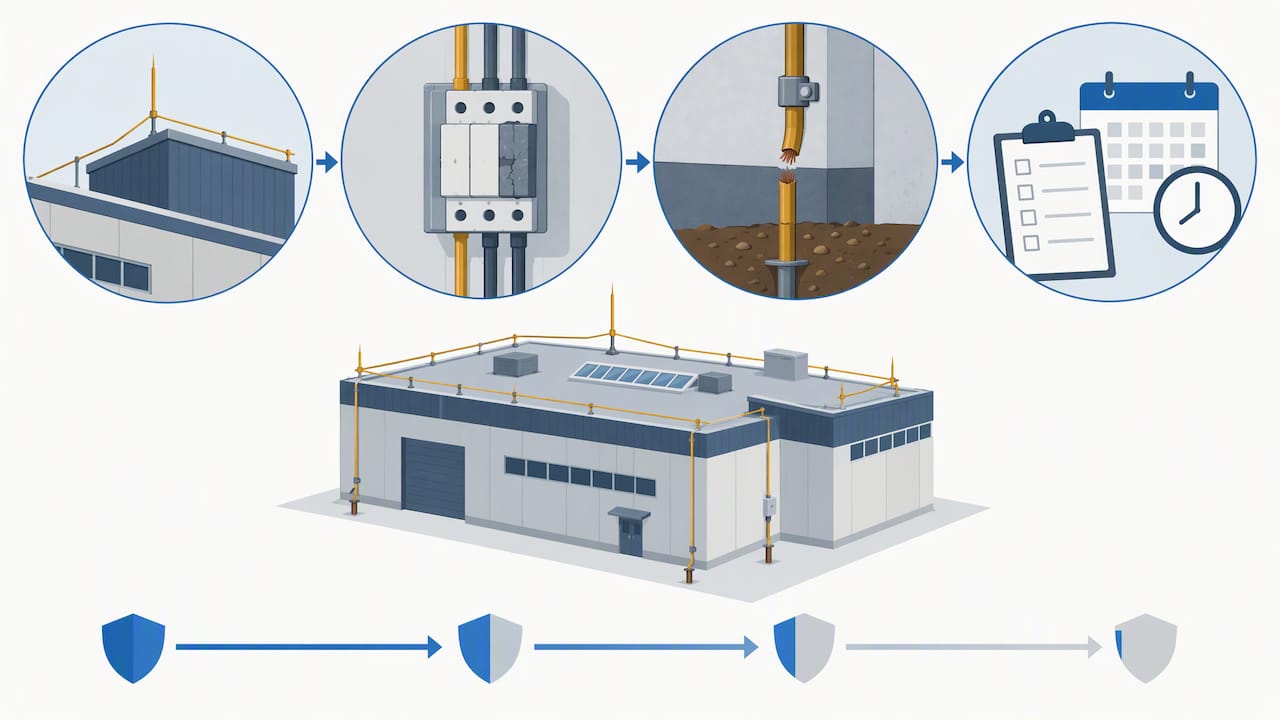
That is why we think about durability as a service relationship rather than a product specification. A good lightning rod, mast or earthing component matters, and so does an R&D effort that keeps components aligned with evolving standards. But the thing that keeps a site protected for decades is a risk analysis kept current, a technical study that matches the real building, an installation done to it, and a verification and maintenance routine with someone accountable.
Our advice to facility managers: ask for the maintenance notice at handover, put the verification dates in your maintenance system on day one, keep a repair reserve for the one-month window, and treat every surge protector as a part with a service life. With more than 280,000 installations behind us, the sites that stay protected are the ones that did these four things.
— INDELEC
Planning a durable system: a checklist
Use this when commissioning a new system or auditing an existing one.
- Documents: risk analysis (ARF), technical study, verification and maintenance notice, as-built drawings, commissioning measurements.
- Dates: first complete check within six months of installation if you are an authorized ICPE, then annual visual and biennial complete checks.
- Independence: the complete check is carried out by a body distinct from the installer.
- Triggers: substantial site modifications, hazard study revisions or changes to ARF input data call for an ARF update.
- Spare parts: know which SPDs, fixings and connectors you will need on short notice.
- Access: safe roof access and clear earthing test points. If roof work is involved, plan fall protection too.
- History: keep a log of strikes, checks, findings and repairs, since it is your proof of diligence for inspectors and insurers.
For teams still building the case, Indelec also explains why regular maintenance matters for facility managers and how to combine lightning safety and budget constraints.
Working with Indelec on the long term
We cover the full life cycle in one place: lightning risk analysis and technical study, installation, and verification and maintenance, along with the hardware: lightning rods, masts, mesh cages, down conductors, earthing and surge protection. If you want a system whose upkeep is planned from the start, start with our lightning protection services or contact us through the Indelec website to discuss your site.
FAQ
How long does a lightning protection system last?
There is no single lifespan. Passive elements such as air terminals, conductors and earth electrodes can remain serviceable for a long time if they are inspected and repaired when needed. Surge protective devices wear with use and should be replaced when they reach end of life or after severe events. For regulated sites the practical answer is the inspection calendar, not a number of years.
How often must lightning protection be checked in France?
For ICPE installations subject to authorization, the order of 4 October 2010 requires a complete check within six months of installation, a visual check every year, a complete check every two years and a visual check after each recorded strike. Other sites are not necessarily bound by this, but the same rhythm is a sound reference. Check your own classification and your insurer’s requirements.
How fast must repairs be made?
On ICPE sites covered by Article 21, repairs found necessary during a check or after a recorded strike must be completed within one month at most. Plan a budget and a contractor in advance, because ordering parts and scheduling work can easily take longer than that.
Do the 2024 IEC 62305 updates mean my existing system is non-compliant?
Not automatically. The new editions of parts 3 and 4 update requirements for new designs and studies, including material thicknesses and component stability. For an existing system, the legal obligations and your technical study remain your starting point. When you modify the site or revise the risk analysis, have the study reference the current editions.
Sources
- Article 21, order of 4 October 2010 (Juriblio)
- Order of 19 July 2011 amending the order of 4 October 2010 (Légifrance)
- IEC 62305-3:2024
- IEC 62305-4:2024
- INRS, designing workplaces and work situations
- INRS documentation portal, protecting installations against lightning
- INERIS, information note on the verification and maintenance notice
- FNHPA, weather services for campgrounds