IRVE Standards for Tertiary Buildings in France: 2026 Guide
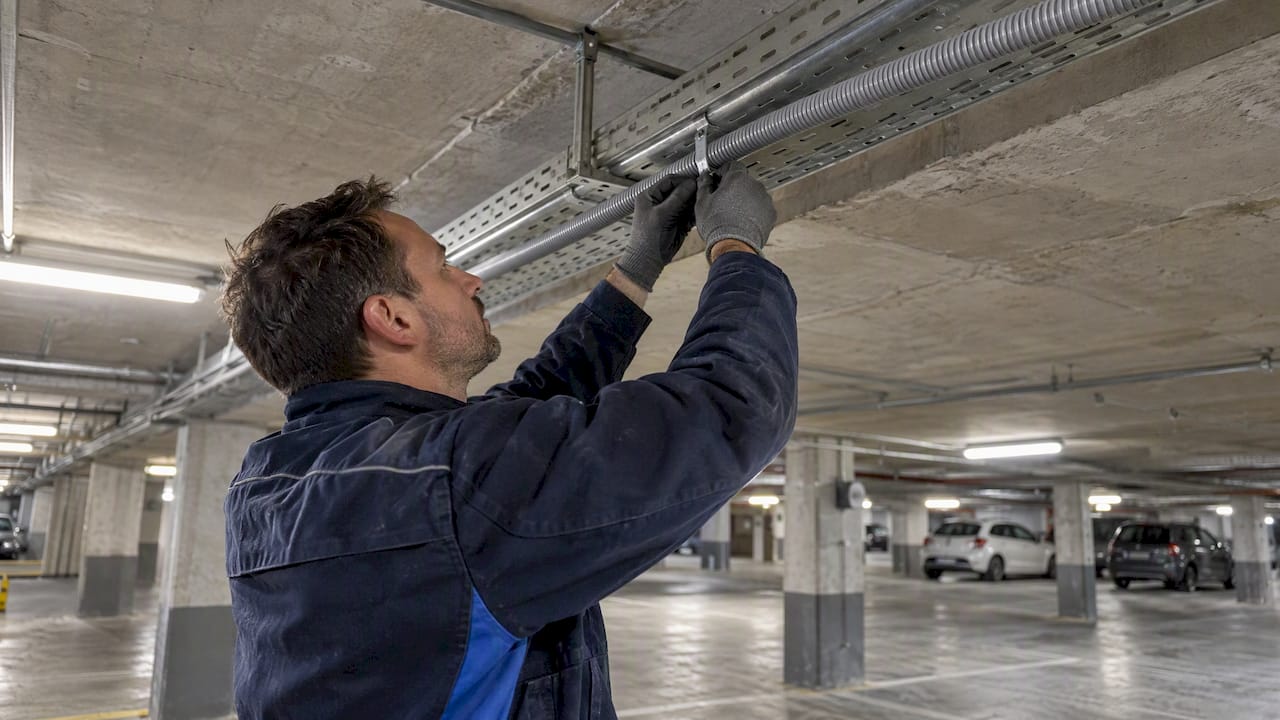
If you own or manage an office, retail, logistics or public building in France, three layers of rules apply to EV charging (IRVE, infrastructures de recharge pour véhicules électriques). The first is a legal obligation tied to parking size. The second is a technical standard, NF C 15-100 with its part 7-722. The third is installer qualification, which decides whether your project can receive public funding. This guide walks through each one and shows how they fit together on a real site.
TL;DR
- Non-residential parking lots with more than 20 spaces must offer at least one charging point on an accessible (PMR) space, plus one more for every 20 additional spaces, according to Service-Public Entreprendre.
- New tertiary buildings and those under major renovation (works of at least 25% of the building’s value) must also pre-equip 20% of their spaces.
- The electrical design follows NF C 15-100, part 7-722. Above 3.7 kW, the installer must hold an IRVE qualification to be eligible for Advenir funding.
- Charging is also an energy-reporting and fire-safety matter: plan the tertiary decree reporting and any e-bike charging zones from the start.
Table of Contents
- Which tertiary buildings must provide charging points
- The technical standard: NF C 15-100 and part 7-722
- Qualification IRVE: the requirement that decides funding
- Where tertiary buildings differ from other sites
- Fire safety: the risk most sites overlook
- Tax and accounting: charging works are real estate works
- Our perspective
- A practical sequence for facility managers
- How Indelec can help
- FAQ
- Sources
Which tertiary buildings must provide charging points
The obligation depends on the type of building and on the number of parking spaces. The reference page is the Service-Public Entreprendre sheet on mandatory charging infrastructure, last verified on 12 June 2026. Always check it again before you finalize a design, because thresholds and dates in this area have changed several times since the 2017 decree.
For non-residential buildings, the sheet distinguishes two situations.
Existing parking lots above 20 spaces
A non-residential parking lot with more than 20 spaces must provide at least one charging point on a space accessible to people with reduced mobility (PMR). It must then add one additional point for every 20 extra spaces.
A worked example from the same source: a building with 95 spaces must have at least four charging points, and one of them must be on a PMR-accessible space. The arithmetic is the first point, plus three more for the 75 spaces beyond the first 20.
New buildings and major renovations
For new non-residential buildings, or those undergoing major renovation (works costing at least 25% of the building’s value), the rule is about pre-equipment. At least 20% of the spaces must be pre-equipped, meaning the conduits, cable trays and electrical capacity are in place so that a charger can be added later without opening the slab or the walls again.
The practical difference matters for budgets. A charging point is the visible device. Pre-equipment is the civil and electrical work behind it, and it is by far the cheapest moment to do it. If you want a step-by-step method for counting spaces and sizing the supply, we cover it in our guide to sizing IRVE for French parking lots with the 20% rule.
Exemptions are possible, but they must be documented
The rules allow exemptions when the grid upgrade needed would be prohibitively costly. In practice, this is not something you can simply assert. The same Service-Public guidance points to the need for a robust technical file, and for early contact with the network operator to avoid surprises on grid capacity. Treat an exemption as an engineering deliverable: a load study, a quote from the network operator and a clear comparison against the cost of compliance.
The technical standard: NF C 15-100 and part 7-722
The obligation tells you how many points to provide. The standard tells you how to build them safely. French low-voltage installations follow NF C 15-100, and the specific rules for supplying electric vehicles sit in part 7-722, listed by AFNOR’s Norm’Info. This part is the one a designer, a contractor or a control body will refer to when they check a charging installation.
The standard is a paid document, so we do not reproduce it here. What you can expect to see in a design review, in general terms:
- A dedicated circuit for each charging point or group of points, with protection sized for the continuous load of a charger.
- Protection against electric shock and overcurrent adapted to vehicle charging.
- A clear upstream architecture: main switchboard, sub-distribution, load management where several chargers share a limited supply.
- Surge protection where the installation conditions call for it.
On that last point, surge protection is where we see the most avoidable rework. A charger is expensive electronics sitting outdoors or in an open car park, connected to long cables. If the protection is missing at commissioning, it usually has to be added afterwards. Two of our guides explain the stakes: how to avoid retrofit costs with surge rules under NF C 15-100 and how to avoid Consuel rejections on EV chargers.
Qualification IRVE: the requirement that decides funding
A compliant design is not enough if the wrong company installs it. The Advenir FAQ states that, under the decree of 12 January 2017, an installer must hold the IRVE qualification for the project to be eligible for a premium request. The requirement applies to installations above 3.7 kW, and the qualification can be obtained through bodies such as AFNOR, Qualifelec or Qualit’EnR.
Three consequences for a facility manager:
- Ask for the installer’s valid qualification certificate in the tender, not after signature.
- Check that the certificate covers the power level and type of installation you are buying.
- Keep it in the project file. Without it, you risk losing funding and may face questions from your insurer.
The qualification framework has evolved, so we keep a dedicated page on what to verify before signing: IRVE qualification in France: what to check before you sign.
Where tertiary buildings differ from other sites
The tertiary decree and energy reporting
Tertiary buildings above the decree’s thresholds already have an energy reduction trajectory: 40% by 2030, 50% by 2040 and 60% by 2050, compared with a reference year from 2010 onward. Service-Public Entreprendre (verified 9 September 2025) describes the scheme, and data must be declared each year on the ADEME OPERAT platform by 30 September.

For charging, the point to settle at design stage is metering. Our reading of the research we reviewed is that electricity used for charging can be accounted for separately from the building’s own consumption for these targets. Whether that applies to your site depends on your declaration, so confirm it with your energy manager or consultant. In either case, install sub-metering from day one. Retrofitting meters into a live switchboard costs more than specifying them at the start.
Building automation and load management
A tertiary site is rarely just a car park. It has heating, cooling, lighting and often photovoltaic production, and all of them draw on the same connection. The shift we see among facility teams is from isolated, ad hoc charger installs to a coordinated site-wide scheme that talks to the building management system. Smart charging lets you cap the combined demand, avoid a larger subscribed power and keep chargers from competing with HVAC at peak times.
If you are also adding solar, the rules interact. We summarized them in IRVE and photovoltaics for facility managers.
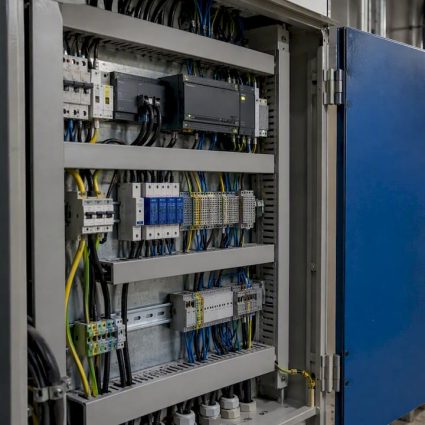
Technical rooms also deserve attention. Power electronics and communications cabinets generate heat, and undersized ventilation shortens equipment life. For a calculation method, see this engineering explainer on sizing control panel cooling, which sets out the heat balance you need to run for any enclosure.
Grid connection lead times
The constraint that most often derails a schedule is not the charger, it is the connection. On industrial and large tertiary sites, requests to the network operator can add months. We detail the typical pitfalls, including earthing, in how to avoid 6 to 12 month grid delays on industrial IRVE. Start the conversation as soon as you have a first estimate of the power you need.
Fire safety: the risk most sites overlook
Charging for company vehicles is regulated. Charging of employees’ e-bikes and scooters often is not, and it is a growing source of incidents. The French occupational safety institute INRS notes in its publication on intermediate-energy lithium-ion batteries that recent statistics show an increased and poorly controlled fire risk linked to small electric mobility equipment.
What this means in a tertiary building:
- Define dedicated charging zones for e-bikes and scooters rather than letting people plug in at their desks.
- Keep charging out of circulation areas such as corridors, entrances and emergency exits.
- Where you build an enclosed room, the INRS guidance points to fire-resistant walls rated for one hour.
- Give staff simple rules. INRS also publishes a short leaflet on charging a lithium battery safely, including never recharging a damaged, swollen or leaking battery.
If your site is an ERP (a building open to the public), the permits and public-protection obligations add another layer. Coordinate them with your fire safety adviser before the works begin.
Tax and accounting: charging works are real estate works
For the finance team, an IRVE installation is not simple movable equipment. French tax doctrine treats such works as travaux immobiliers, meaning permanent incorporation into the building. The BOFiP VAT doctrine explains how real estate works are distinguished from other operations. Ask your accountant how this classification affects VAT treatment and the way you book the costs, because the answer depends on your contract structure.
Our perspective

We have been protecting infrastructure against lightning and electrical disturbances since 1955, and we now bring that discipline to charging. A charging project in a tertiary building is, at heart, an electrical-protection project: long cable runs, exposed equipment, sensitive electronics and a lot of capital sitting in a car park.
Three convictions come from that background. First, protect the installation as a system. Surge protection, earthing and the electrical design should be specified together, not bolted on after the first failure. Second, audit before you buy. A review of your supply, your parking layout and the funding conditions costs far less than correcting a design afterward. Our guide on protecting Advenir funding with an IRVE audit explains what we check. Third, plan the lifecycle. Chargers need maintenance, and the level of service you contract should match how critical the chargers are. See how to match maintenance levels MA1, MA2 or MA3.
— INDELEC
A practical sequence for facility managers
- Count and classify. Total spaces, PMR spaces, and whether the building is new, under major renovation or existing. Apply the thresholds above.
- Check the supply. Subscribed power, switchboard capacity and the network operator’s constraints. Request a grid study early.
- Choose the architecture. Number of points, power per point, load management, sub-metering for the tertiary decree reporting.
- Specify protection. Surge protection and earthing under NF C 15-100 part 7-722.
- Select a qualified installer. Verify the IRVE qualification before you sign, and keep the certificate.
- Plan funding and cost. Review eligibility conditions with the installer. For cost drivers, read our breakdown of charging station costs for fleets and sites.
- Write the safety rules. Include micro-mobility charging zones.
- Commission and maintain. Test, document, then contract the maintenance level that matches the use.
How Indelec can help
We audit, install and supervise charging infrastructure for professional fleets and tertiary sites, and we bring our lightning, earthing and surge protection expertise to the same project. If you want a second pair of eyes on a design, or a turnkey installation, start with our electric vehicle charging services or see the full range on our services page. Our published pages do not list prices, so we scope each project on your site data.
FAQ
What is the IRVE standard for a commercial or office building?
The electrical installation follows NF C 15-100, including part 7-722 on supplying electric vehicles. The number of charging points is set separately by the legal obligation tied to parking size. Both apply, and a design review should cover each of them.
Is an IRVE qualification mandatory for installers?
For projects above 3.7 kW, the installer must hold the IRVE qualification to be eligible for an Advenir premium, according to the Advenir FAQ. Even outside funding, it is the proof of competence your insurer and your control body will expect.
How many charging points does a 95-space tertiary car park need?
According to the Service-Public Entreprendre example, a non-residential building with 95 spaces must provide at least four charging points, one of them on a PMR-accessible space. If the building is new or heavily renovated, the 20% pre-equipment rule applies as well.
Can we be exempted if the grid upgrade is too expensive?
The rules allow exemptions where the grid work would be prohibitively costly, but you need to document it with engineering evidence. Contact the network operator early and keep the quotes and the load study in your file.
Sources
- Infrastructures obligatoires de recharge des véhicules électriques, Service-Public Entreprendre
- Réduction de la consommation d’énergie dans les bâtiments à usage tertiaire, Service-Public Entreprendre
- NF C 15-100 part 7-722, AFNOR Norm’Info
- Foire aux questions et cas particuliers, Advenir
- Batteries lithium-ion d’énergie intermédiaire, INRS
- Charger une batterie au lithium en toute sécurité, INRS
- TVA, champ d’application et territorialité, BOFiP
- Control panel cooling for engineers