Insurers’ 2 Year Rule for Lightning Protection on French ICPE Sites

Insurers expect six things in writing before they accept a lightning risk as covered: a lightning risk analysis (ARF) built on NF EN 62305-2, a technical study, a dossier d’exécution (DOE) with manufacturer conformity proof, an initial verification report from an independent body, a dated carnet de bord, and evidence of ongoing verification. The clock matters as much as the paperwork: protections must be installed within two years of the ARF, the initial full verification within six months, visual checks each year, a full verification every two years, and verification within one month after any lightning impact as required by law.
TL;DR:
- Insurers require proof of risk assessment, design, installation, and ongoing verification, all documented through specific reports and certificates within strict deadlines.
- The initial lightning risk analysis must conform to NF EN 62305-2 and be updated after site changes; protections must be installed within two years of this analysis.
- Verification involves four checks: an independent full check within six months, annual visual inspections, biennial electrical tests, and post-impact assessments within one month.
- Component conformity proof must come from manufacturer declarations, datasheets, or test certificates, especially for surge devices and connection parts, not just verbal assurances.
- A single provider managing the entire compliance process reduces procedural gaps that commonly cause inspection failures and ensures documentation remains current and complete.
Table of Contents
- What Documents Satisfy Exigences Assureur Foudre Requirements?
- Which Standards and Component Proofs Do Insurers Check?
- What Verification Schedule Do Inspectors Expect?
- How Do You Assemble an Inspection-Ready Dossier?
- Why Most Compliance Gaps Are Procedural, Not Technical
- Get an Insurer-Ready Lightning Protection Audit
- Sources
What Documents Satisfy Exigences Assureur Foudre Requirements?
Insurers reviewing exigences assureur foudre don’t want a sales brochure. They want a paper trail that proves the site identified its risk, designed a matching system, installed it correctly, and keeps checking it. Four documents carry that weight, and each has a distinct author and a distinct shelf life.
The analyse du risque foudre (ARF) comes first. It identifies which equipment and buildings need protection and quantifies the risk level. Conformity to NF EN 62305-2 is accepted as satisfying this requirement under the arrêté framework, which is why insurers ask for it by name rather than a generic risk memo. The ARF isn’t a one-time document. Any substantial change to the site, or any revision of the étude de dangers, restarts the clock on the two-year installation deadline and typically forces an ARF update.
The technical study translates that risk analysis into hardware and geometry: air terminal positions, protection radii, conductor routing, earthing layout, and the installation timeline. It has to name who is responsible for installing and later maintaining the system, because insurers checking a claim file will ask who signed off on the design, not just who bolted on the equipment.
The dossier d’exécution (DOE) and the carnet de bord are what an inspector or claims adjuster actually opens on-site. The DOE bundles manufacturer declarations, datasheets, test certificates, and as-built drawings. The carnet de bord is the living log: every inspection, every intervention, every recorded lightning impact, each with a date attached.
The statutory deadlines behind all of this come from the arrêté du 4 octobre 2010 modifié:
- Protections must be installed within 2 years of the ARF’s conclusions.
- The initial full verification must happen within 6 months of installation, performed by an organism independent from the installer.
- A visual verification is required every year.
- A complete verification (electrical tests included) is required every 2 years.
- After any detected lightning impact, verification must occur within 1 month, and any reserve raised during an inspection must be remediated within 1 month.
Miss any one of these dates and the file looks incomplete even if the hardware on the roof is perfectly sound.
Which Standards and Component Proofs Do Insurers Check?
Two standards do most of the heavy lifting. NF C17-102 governs the design of paratonnerre à dispositif d’amorçage (PDA, or early streamer emission) systems: component selection, conductor sizing, equipotential bonding, earth electrode configuration, and the contents of the dossier d’exécution itself. NF EN 62305-2 governs the risk assessment that justifies the protection level in the first place. Sites covered by the arrêté and applying NF C17-102 for levels of protection 1 through 4 need a 40% safety coefficient applied to protection radii, a detail that trips up designers who copy specifications from non-ICPE projects.
Below the system level sit the component standards, and this is where insurers most often catch gaps:
- NF EN IEC 62561-1 and related parts cover connection components (clamps, conductors, bonding hardware).
- NF EN IEC 61643-x covers surge protective devices (SPDs).
- NF EN IEC 62793 covers lightning strike detectors.
What counts as proof: Insurers don’t accept a verbal assurance that a clamp “meets standard.” The DOE must contain a manufacturer’s declaration of conformity, a datasheet citing the exact norm, or a formal test certificate for every component. Responsibility for that evidence sits with the manufacturer or the party placing the product on the market; the installer’s job is to collect it and file it correctly in the DOE, not to generate it.
There’s one notable equivalence worth knowing: EN 124-1 inspection covers can substitute for a specialized earthing access cover, but only under defined conditions covering load class and marking readability after testing, and the substitution needs to be documented in the DOE with its justification. Skipping that documentation is a common reason inspectors flag an otherwise sound installation.
What Verification Schedule Do Inspectors Expect?
Verification isn’t a single event. It’s four distinct checks, each with its own scope, timing, and rules about who can perform it, as outlined in detailed site inspection in UAE with structural engineers procedures.
- Initial full verification. Due within 6 months of installation. It must be performed by an organism competent and independent from the installer. Confusing the installer’s “attestation de bonne exécution” with this legally required independent check is one of the most common compliance failures found during inspections, and the arrêté treats them as two separate obligations.
- Annual visual verification. The inspector checks for mechanical damage, corrosion on conductors and terminals, and confirms that bonding connections still show their continuity markings.
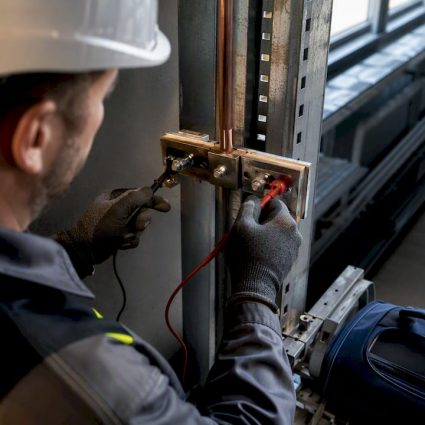
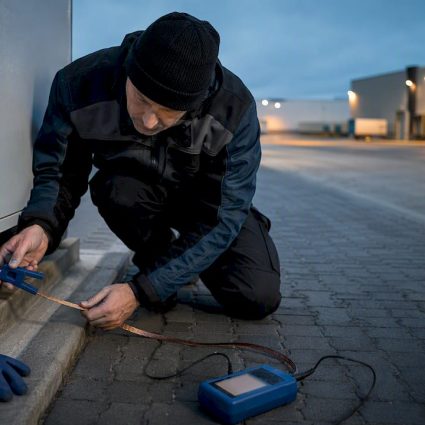
- Complete verification every 2 years. This adds electrical testing: continuity of conductors, equipotential bonding checks, and earth resistance measurements, with a written report for each test.
- Post-impact verification. If a strike is detected, verification must happen within 1 month. Any reserve raised needs remediation within 1 month of being logged.
Pro Tip:Assign one competent organization to run the ARF, the technical study, the installation oversight, and every subsequent verification. Field experience from ICPE inspections shows that splitting these roles across multiple providers is the single biggest cause of missing reports and undated carnet de bord entries when an insurer or inspector actually opens the file.
The fastest way to fail a check isn’t a broken conductor. It’s an undated carnet de bord entry, or one with no named verification owner attached to it.

How Do You Assemble an Inspection-Ready Dossier?
Build the dossier in the order an inspector will read it, not the order the paperwork arrived in.
Start with the ARF and technical study. Confirm the installation dates on-site actually match what the technical study specified, and flag any deviation now rather than during a claim review.
Collect every component’s conformity proof next. For each SPD, connector, and detector, get the manufacturer declaration, datasheet, or test certificate, and track the serial or batch number back to a named supplier. Traceability is what separates a defensible dossier from a stack of generic product brochures.
Chase the verification reports. You need the initial independent verification report and every subsequent periodic report, with any open reserve shown as closed and dated. An open reserve with no closing date is exactly what an insurer’s claims team will seize on.
Keep the carnet de bord alive, not archived. Every inspection, intervention, and recorded impact gets a dated entry. Indelec’s industrial lightning protection guide walks through this recordkeeping discipline in more detail for teams building the habit from scratch.
| Document | Owner | Insurer checks for |
|---|---|---|
| ARF | Competent risk assessor | Conformity to NF EN 62305-2, update after site changes |
| Technical study | Design engineer/installer | Matches ARF, dated, names responsible party |
| DOE | Installer, with manufacturer input | Component conformity proof for every part |
| Carnet de bord | Site owner/operator | Dated entries, no gaps, named verification owner |
| Verification reports | Independent competent body | On schedule, reserves closed and dated |
Why Most Compliance Gaps Are Procedural, Not Technical
The hardware side of lightning protection in France is rarely the weak link. Air terminals, conductors, and SPDs sold to current standards almost always perform as designed. What sinks a dossier during an insurer review is procedural drift: an ARF that never got updated after a warehouse extension, a carnet de bord with three months of blank entries, a verification report that lists the installer as both installer and independent verifier.

That gap exists because responsibility for compliance is split across too many actors on most sites. The risk assessor hands off to the installer, who hands off to a maintenance contractor, who may never see the original technical study. Each handoff is a place where a deadline gets missed or a document gets misfiled. The arrêté’s own structure assumes continuity between these roles, but it doesn’t enforce it. Nothing in the regulation stops a site from using four different providers for four related tasks.
Insurers have caught onto this pattern. When a claims team asks for the carnet de bord after a strike and finds gaps, they don’t treat the gap as a paperwork oversight. They treat it as a sign the protection system itself was never properly maintained, whether or not that’s true. The documentation is the evidence of diligence, and a thin file reads as a thin safety culture.
— INDELEC
Get an Insurer-Ready Lightning Protection Audit
A complete compliance chain includes the ARF, the technical study, installation, the DOE assembly with full manufacturer conformity proof, and coordination of independent verification on the statutory schedule. One provider running that whole sequence closes the handoff gaps that cause most inspection failures, from an undated carnet de bord to a missing six-month verification report.

If your site’s dossier has gaps, an audit is the fastest way to find them before an insurer or inspector does. Request a lightning protection system evaluation to get a clear picture of what your current documentation is missing and what it will take to close it.
Sources
Keep these on hand when preparing or defending a dossier:
- Norme NF C17-102 (AFNOR boutique)
- Protection foudre des ICPE : pourquoi la conformité se perd entre deux vérifications (INFORISQUE)
- Arrêté du 4 octobre 2010 modifié — verification obligations (Légifrance reference excerpt)
Each one answers a different question an insurer or inspector will ask, and none of them substitute for the other two.