IEC 62305 Summary: The Four Parts and the 2024 Edition
IEC 62305 is the international standard series for protection against lightning. It has four parts: general principles (Part 1), risk management (Part 2), physical damage to structures and life hazard (Part 3) and electrical and electronic systems within structures (Part 4). In France it is published as NF EN IEC 62305, and the third edition dates from October 2024. This summary tells you what each part does, what changed, and what it means if you own, design or maintain a site in France.
TL;DR
- IEC 62305 works as a chain: Part 1 sets the principles, Part 2 decides whether and how much protection you need, Part 3 protects the structure, Part 4 protects the electrical and electronic systems inside it.
- The French versions of Parts 1, 2 and 3 carry an October 2024 date at AFNOR and are listed as in force.
- The biggest technical shift in the third edition of Part 2 is a new way of counting dangerous events, based on ground strike-point density rather than flash density.
- For classified industrial sites (ICPE), the risk analysis (ARF) and the technical study (ET) are two separate deliverables. Mixing them up is a classic reason for a rejected file.
- Always check which edition your regulatory text or contract actually refers to before you design.
Table of Contents
- What IEC 62305 is and who needs it
- The four parts at a glance
- What changed in the third edition (2024)
- Applying it in France: ICPE sites and the ARF, ET, installation chain
- Common mistakes in lightning risk files
- A short worked example of the logic
- Our perspective: treat the standard as a design process, not a checklist
- Where Indelec fits in
- FAQ
- Sources
What IEC 62305 is and who needs it
The series is written by IEC technical committee 81 and adopted in Europe as EN IEC 62305, then by AFNOR as a French standard. It does not tell you to “install a lightning rod”. It gives a method: assess the risk, compare it with a tolerable level, and select protection measures until the risk is acceptable.
Three groups use it daily:
- Owners and facility managers, who need to justify (or refuse) protection spending against a quantified risk.
- Architects and contractors, who must integrate down conductors, earthing and bonding into the structure from the design stage.
- Engineering consultancies and inspectors, who produce risk analyses, studies and verification reports.
If you want the Indelec overview of how the standards fit together, see our lightning standards page.
The four parts at a glance
| Part | Title (French edition) | What it answers |
|---|---|---|
| 1 | Principes généraux | Vocabulary, lightning parameters, damage types, protection concept |
| 2 | Évaluation des risques | Is protection needed, and which measures bring risk below the tolerable level? |
| 3 | Dommages physiques sur les structures et risques humains | Air-termination, down conductors, earthing, separation distance, inspection |
| 4 | Systèmes électriques et électroniques dans les structures | Surge protection, shielding, bonding and zoning inside the building |
Part 1: general principles
Part 1 is the foundation. It defines the terms, describes the lightning threat (peak currents, charge, specific energy), lists the types of damage (injury, physical damage, failure of electrical and electronic systems) and the types of loss they can cause. It also introduces the lightning protection levels I to IV, where level I is the most demanding. Every other part refers back to it, so a consultant who skips Part 1 usually misreads Part 2.
Part 2: risk management
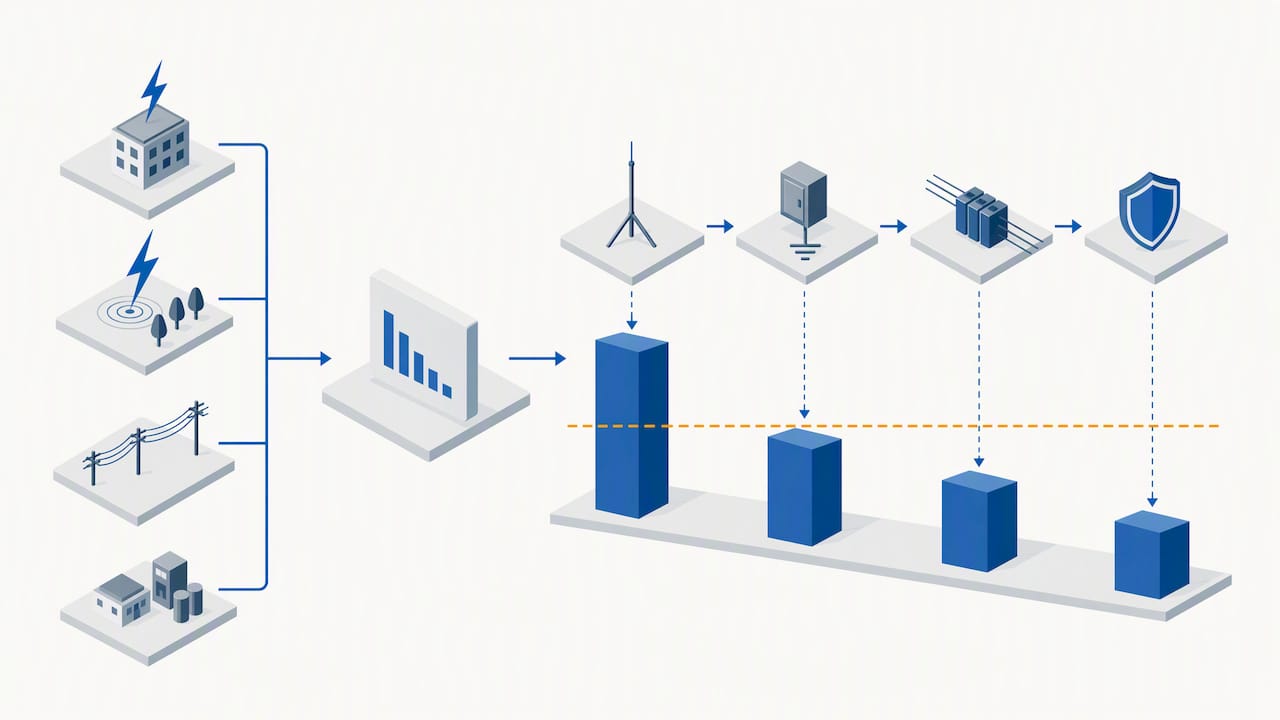
Part 2 is the part most people mean when they say “the lightning risk analysis”. It breaks the risk down into components (strikes to the structure, near the structure, to a connected line or near a line) and loss types, then calculates a risk value. The calculation is iterative: you add protection measures until the calculated risk is below the tolerable risk. The French authorities describe it exactly this way in their circular on the 15 January 2008 order, and stress that the analysis is not meant to dictate products.
Part 3: physical damage and life hazard
Part 3 is the one installers open most often. It covers the external lightning protection system (air-termination, down conductors, earth-termination), the internal system (equipotential bonding, separation distance) and maintenance and inspection. The third edition of Part 3 lists changes such as minimum thicknesses of metal sheets or pipes used as air-termination where hot-spot problems must be avoided, a clearer split between the general and simplified methods for separation distance, and revised rules on the continuity of steel reinforcement.
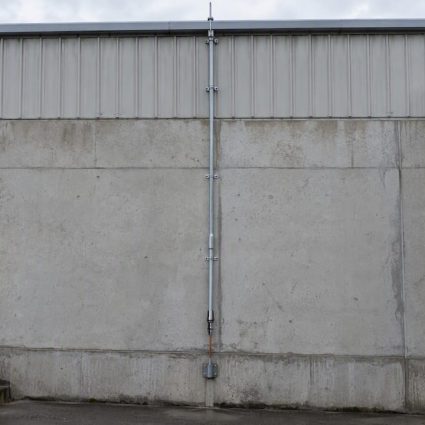
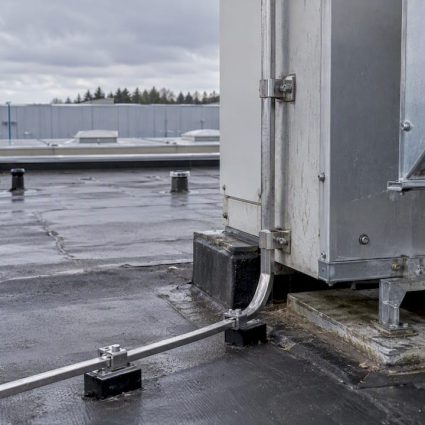
Typical building blocks you will specify under Part 3 include lightning rods, down conductors and earthing.
Part 4: electrical and electronic systems
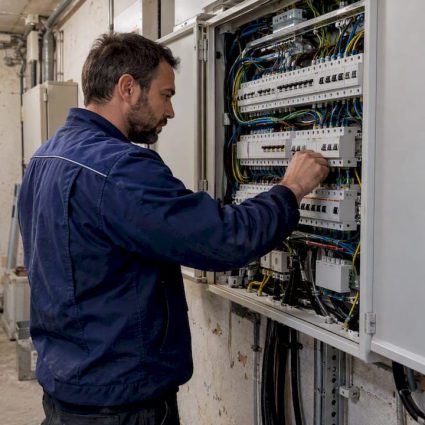
Part 4 deals with the equipment inside: power, data and signal lines, control systems, process instrumentation. Its tools are lightning protection zones, equipotential bonding, coordinated surge protective devices and, where relevant, shielding and routing. A structure can survive a strike intact and still lose its control room. That is why Part 4 matters for data centers, process plants and anything with sensitive electronics. Our range of surge protection devices addresses this layer.
What changed in the third edition (2024)
The third edition cancels and replaces the 2010 second edition, with technical revisions across the series. AFNOR lists Parts 1, 2 and 3 of the French edition with an October 2024 publication date, for example Part 1 at 83 pages.
For Part 2, the IEC webstore and its summary of changes point to three notable updates:
- A combined risk concept for loss of human life and fire.
- Ground strike-point density (NSG) replaces lightning flash density (NG) when calculating the number of dangerous events.
- Preventive temporary measures, including thunderstorm warning systems compliant with IEC 62793, can be counted to reduce risk components.
In practice, the NSG change means your input data differ from the 2012 method, and the outcome for a given building may differ too. Do not assume that a risk analysis done under the second edition gives the same protection level under the third.
Applying it in France: ICPE sites and the ARF, ET, installation chain
In France, the standard becomes mandatory through regulation. For classified installations (ICPE) covered by the order of 4 October 2010, INERIS describes lightning as a NaTech risk, a natural hazard acting on a technological installation. The compliance route has three steps:
- Lightning risk analysis (ARF) based on NF EN 62305-2.
- Technical study (ET) that defines the protection measures.
- Installation and verification of the prescribed equipment, ideally by a provider holding the QUALIFOUDRE qualification.
The INERIS circular is clear that the ARF and the ET are not the same task. The ARF establishes the need and the level of protection. The ET is a later engineering exercise that fixes the hardware and its placement: where the rods go, how many surge protectors, which earthing layout.
For a detailed walk-through, read our compliance guide for ICPE sites and, for hazardous areas, our article on IEC 62305 on French ATEX sites with isolated systems.
Which edition applies to your site?
This is where projects go wrong. INERIS has published a note on the evolution of the NF EN 62305 standards explaining that the version cited in a regulatory text is the one that is compulsory for the sites it covers, when a standard is revised. The previous revision, in 2012, raised the same question. So the practical rule is:
- Read the regulatory text that applies to your site, then check which edition it cites.
- Write the edition explicitly in your specification and in the ARF.
- If a site is designed to a newer edition than the one the regulation cites, say so in the file and agree it with the inspector and the owner before work starts.
Our article on what to put in a request for proposals for NF EN 62305 in France covers the contract wording.
Common mistakes in lightning risk files
Two INERIS documents are worth reading before you commission or review a study. The reading guide for an ARF flags the following pitfalls:
- Weak justification of the fire and explosion factor (rf). Calorific loads and danger factors, including ATEX zones even when temporary, must be documented with the tables of NF EN 62305-2. Generalized or unverified assumptions get rejected.
- Crediting existing protection without proof. Noting that a lightning rod exists is not enough. The technical study must demonstrate its effectiveness, for instance by verifying the steel thickness of a tank (5 mm or more is the example given for steel tanks) or the integrity of the structure.
- Treating ARF and ET as one document. The ARF gives the need and level, the ET gives the solution.
The iterative logic matters for budgeting too. Because the ARF calculates a real risk against a tolerable risk, it gives facility managers a quantified argument to put in front of regulators or insurers, instead of a subjective opinion.
A short worked example of the logic
Imagine a warehouse with a chemical storage area. The risk analyst enters the building dimensions, the local ground strike density, the lines entering the site, the fire risk and the presence of people. The first calculation shows a risk above the tolerable level. The analyst then tests measures one at a time: an external lightning protection system of a given level, surge protection on incoming lines, fire detection. After each addition the risk is recalculated. When it falls below the tolerable level, the ARF stops and states the required level of protection. The technical study then turns that conclusion into drawings, product choices, earthing values and a verification plan.
This is an illustration of the method, not a real project. Actual inputs and results depend on the site and the edition used.
Our perspective: treat the standard as a design process, not a checklist
We have worked on lightning protection since 1955, and the most expensive mistakes we see come from reading the standard backwards: choosing products first and then looking for an analysis that justifies them. IEC 62305 is built the other way round. The risk drives the protection level, the protection level drives the design, and the design drives the inspection plan.
Three habits make projects smoother:
- Bring the lightning specialist in at concept stage. Down conductors, reinforcement continuity and earthing are far cheaper to plan in the foundations than to retrofit.
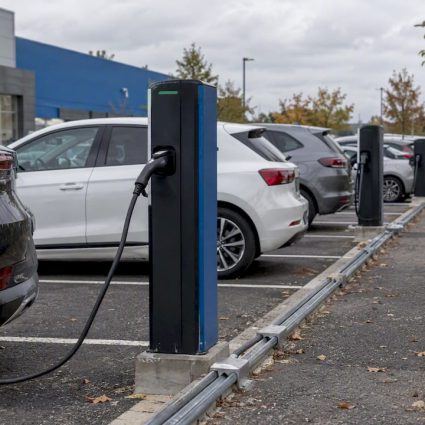
- Keep the ARF alive. A new tank, a rooftop extension, a changed storage regime or a new EV charging area can change the risk. Update the file when the site changes.
- Plan the whole life of the system. Part 3 includes inspection and maintenance for a reason. A system that was compliant at commissioning but never verified is a liability on paper and in reality.
It is also why we handle the full chain, from analysis and study to installation, verification and maintenance, and design our products inside that logic. Our R&D center keeps adapting solutions to changes in standards and climate conditions.
— INDELEC
Where Indelec fits in
If you need to turn this summary into a compliant system, we cover the whole sequence: the lightning risk analysis and technical study, installation, and verification and maintenance, together with the hardware: lightning rods, down conductors, earthing and surge protection. Industrial owners, contractors, architects and public infrastructure agencies can start with a description of the site and the regulatory framework it falls under. You can also browse our lightning protection services in English.
FAQ
Is IEC 62305 mandatory in France?
The standard itself is voluntary, but regulations make it binding for certain sites. For ICPE installations covered by the order of 4 October 2010, the risk analysis must follow NF EN 62305-2, and INERIS presents compliance as a legal matter for hazard studies. Check the text that applies to your site and the edition it cites.
What is the difference between IEC 62305 and NF EN IEC 62305?
IEC 62305 is the international publication. NF EN IEC 62305 is the same content adopted at European level and published by AFNOR as a French standard. The French edition of Parts 1 to 3 carries an October 2024 date.
What is the difference between the ARF and the technical study?
The ARF, based on Part 2, determines whether protection is needed and at what level. The technical study defines the actual measures: positions of air terminals, number of surge protectors, earthing design. They are separate deliverables, and regulators expect both.
What are the main changes in IEC 62305-2:2024?
The IEC highlights a combined risk concept for loss of life and fire, the use of ground strike-point density instead of flash density, and the option to credit temporary preventive measures such as thunderstorm warning systems. Expect different inputs and possibly different results than under the previous edition.
Do I need a QUALIFOUDRE provider?
For ICPE sites, INERIS describes the three-step process and recommends that the work ideally be done by a QUALIFOUDRE-certified provider. Confirm with your inspector which qualifications your file requires.
Sources
- AFNOR: NF EN IEC 62305-1 (October 2024)
- AFNOR: NF EN IEC 62305-2 (October 2024)
- AFNOR: NF EN IEC 62305-3 (October 2024)
- IEC webstore: IEC 62305-2:2024
- IEC 62305-3 Edition 3.0 2024-09 (sample)
- AIDA: circular of 24 April 2008 on the order of 15 January 2008
- INERIS: Foudre, un aléa potentiellement très dangereux
- INERIS: reading guide for a lightning risk analysis
- INERIS: note on the evolution of NF EN 62305 standards