Lightning risk assessment guide: protect your facility
TL;DR:
- Lightning risks include direct strikes, secondary effects, and induced surges, all threatening facility safety and operations.
- Regular, site-specific risk assessments and data updates are essential to effectively mitigate lightning hazards.
- Many facilities overlook ongoing assessment updates and rely on outdated protection, increasing incident risks.
Lightning can strike any facility without warning, and the consequences go far beyond a tripped breaker. A single strike can ignite fires, destroy sensitive control systems, halt production lines, and put personnel at serious risk. Despite this, lightning is an under-estimated danger for modern facilities, and most risk assessments treat it as an afterthought rather than a structured safety priority. This guide walks facility managers and safety officers through a practical, repeatable process for evaluating lightning exposure, identifying vulnerabilities, and selecting the right mitigation measures before an incident forces the issue.
Table of Contents
- Understanding lightning risk for facilities
- Preparation: Gathering data and facility specifics
- Step-by-step lightning risk assessment process
- Common mistakes and how to avoid them
- Why most risk assessments fall short: A fresh perspective
- Enhance your facility’s lightning protection
- Frequently asked questions
Key Takeaways
| Point | Details |
|---|---|
| Lightning risk is rising | Unpredictable strikes are increasingly impacting commercial and industrial facilities. |
| Systematic assessment is critical | A structured approach helps identify and reduce vulnerabilities for safer operations. |
| Avoid common mistakes | Regular reviews and up-to-date mitigation strategies prevent costly oversight. |
| Specialized protection matters | Advanced lightning rod technologies and expert planning ensure robust facility safety. |
Understanding lightning risk for facilities
Lightning risk is not a single, uniform threat. It arrives in three distinct forms, and each one demands a different response. A direct strike hits a structure or piece of equipment outright, often causing catastrophic physical damage. Secondary effects include fire, blast pressure, and step voltage that radiates outward from the strike point. Induced surges travel invisibly through power lines, data cables, and grounding systems, destroying electronics that may be hundreds of meters from the actual strike.
Several factors determine how exposed your facility actually is:
- Location and terrain: Hilltop sites, open plains, and coastal areas face higher strike frequency.
- Structural height: Taller structures attract more strikes statistically.
- Equipment sensitivity: Facilities running PLCs, SCADA systems, or precision instrumentation face amplified damage from even minor surges.
- Occupancy patterns: Facilities with continuous 24/7 operations have no safe window to absorb downtime.
- Proximity to hazardous materials: Petrochemical plants, fuel depots, and grain storage sites face fire and explosion risks that multiply the consequences of any strike.
The consequences of ignoring these factors are measurable. Equipment failure, unplanned shutdowns, insurance claims, regulatory scrutiny, and in the worst cases, fatalities. The common lightning hazards that affect facilities are well documented, yet many managers still treat lightning as a low-probability event.
| Risk category | Typical consequence | Recovery time |
|---|---|---|
| Direct strike to structure | Structural damage, fire | Days to weeks |
| Surge on power systems | Equipment failure, data loss | Hours to days |
| Induced surge on data lines | Control system disruption | Hours to days |
| Step voltage near strike | Personnel injury | Immediate and long-term |
The frequency and intensity of lightning impacts on infrastructure are rising, driven by shifting climate patterns. This is not a future concern. It is a present operational reality that belongs in every facility’s risk register. Reviewing facility lightning safety best practices is a reasonable starting point for any manager who has not yet formalized their approach.
“Most facilities assume their general insurance and basic grounding are sufficient. In practice, neither addresses the full spectrum of lightning-related risk.”
Preparation: Gathering data and facility specifics
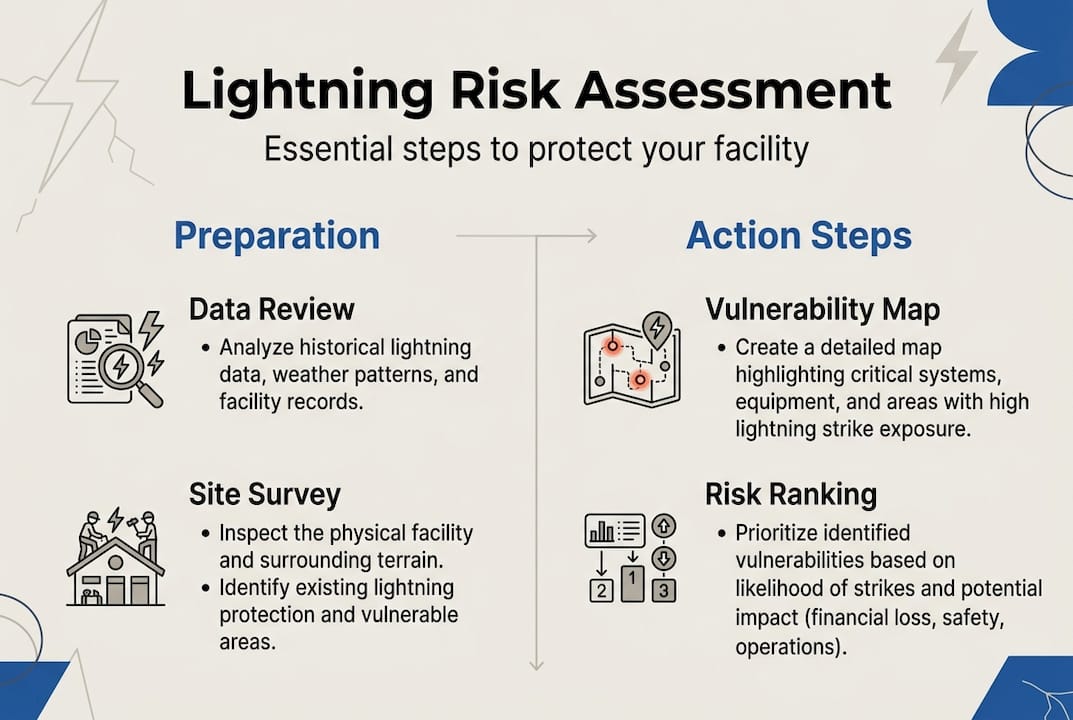
A risk assessment is only as accurate as the data behind it. Before you score anything or select any protection measure, you need a complete picture of your facility. Skipping this phase leads to generic recommendations that miss site-specific vulnerabilities.
Detailed facility data is the foundation of accurate lightning risk assessments. Here is what to collect:
- Facility location data: GPS coordinates, regional isokeraunic level (the average number of thunderstorm days per year), and local terrain maps.
- Structural layout: Floor plans, roof plans, building heights, and materials of construction.
- Asset inventory: All electrical and electronic equipment, control systems, communication infrastructure, and any hazardous material storage.
- Occupancy schedules: When are personnel present, and in which areas?
- Existing protection measures: Current lightning rods, surge protection devices, grounding systems, and their installation dates.
- Historical incident records: Any past lightning-related damage, near misses, or insurance claims.
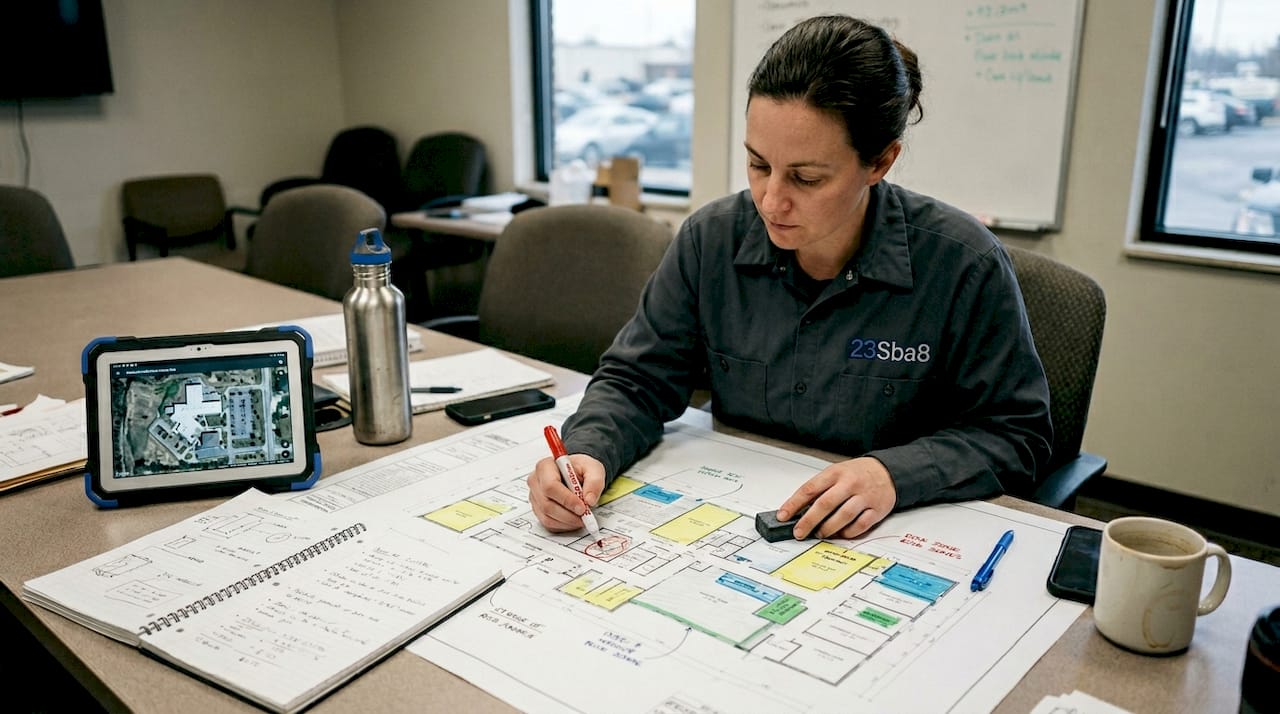
Once you have this data, organize it into a vulnerability map. Overlay your asset inventory on your site plan and mark areas of high exposure, such as rooftop equipment, outdoor substations, and communication towers. This visual tool makes it far easier to prioritize where protection is needed most.
| Method | Advantages | Limitations |
|---|---|---|
| Manual site survey | High detail, site-specific | Time-intensive, requires expertise |
| Automated monitoring systems | Real-time data, continuous | Higher upfront cost |
| GIS-based exposure mapping | Broad coverage, scalable | May miss micro-terrain factors |
| Vendor-supplied assessment tools | Fast, structured | May not reflect all local variables |
Following a structured infrastructure protection workflow ensures you do not miss critical data points during this phase.
Pro Tip: Involve your operations, IT, and maintenance teams in the data-gathering phase. Each department will flag assets and vulnerabilities that a single safety officer working alone would almost certainly overlook.
Step-by-step lightning risk assessment process
With your data in hand, you can now move through the assessment itself. This is not a one-time checkbox exercise. It is a repeatable, auditable process that produces a defensible risk score and a prioritized action plan.
- Hazard identification: List every credible lightning hazard relevant to your site, including direct strikes, surge pathways, and ground potential rise zones.
- Vulnerability analysis: For each hazard, assess which assets, systems, or personnel are exposed and how severely.
- Quantitative scoring: Apply a standardized scoring method based on national lightning standards such as IEC 62305. Assign numerical values to likelihood and consequence to produce a risk index.
- Risk prioritization: Rank hazards by their risk index. Focus first on scenarios that combine high likelihood with severe consequences.
- Mitigation action planning: For each high-priority risk, define a specific mitigation measure, assign an owner, set a deadline, and identify the verification method.
Following this lightning safety workflow keeps your team aligned and your documentation audit-ready. Each step should produce a written output that can be reviewed by an external auditor or regulator.
Industry standards require recurring risk assessments and systematic audits, not just a one-time installation check. Facilities that treat this as a living process, rather than a project with a finish line, consistently outperform those that do not.
Facilities that conduct systematic risk assessments see up to a 40% reduction in lightning-related incident rates compared to those relying on ad-hoc responses.
Pro Tip: Use the same scoring matrix every time you run an assessment. Consistency makes year-over-year comparisons meaningful and gives you hard data to justify capital expenditure on protection upgrades. Reviewing electrical lightning safety protocols alongside your scoring process will help you align with current best practices.
Common mistakes and how to avoid them
Even experienced safety officers make predictable errors when managing lightning risk. Knowing what these mistakes look like makes them far easier to avoid.
The most frequent errors include:
- Skipping regular reviews: A risk assessment completed three years ago does not reflect new equipment, building extensions, or changed site conditions.
- Ignoring site-specific factors: Generic assessments based on building type alone miss the terrain, occupancy, and equipment details that actually drive risk.
- Failing to update asset inventories: New machinery, upgraded control systems, and added communication infrastructure change your exposure profile significantly.
- Relying on outdated mitigation technologies: Older conventional lightning rods and surge protection devices may not meet current standards or protect modern sensitive electronics.
- Treating grounding as a one-time installation: Grounding systems degrade over time and require periodic testing and maintenance.
Failures to update risk assessments can leave facilities vulnerable in ways that are entirely preventable. The gap between your last assessment and your current site reality is where incidents happen.
“The most dangerous assumption in lightning risk management is that nothing has changed since the last audit.”
Preventing these errors requires a combination of scheduled audits, staff training, and a formal change-management process that flags when new assets or structural modifications trigger a reassessment. Managing lightning hazards effectively means treating the assessment as a continuous obligation, not a project milestone.
Investing in risk assessment and maintenance services from qualified specialists is one of the most cost-effective decisions a facility manager can make. The cost of a missed hazard far exceeds the cost of a thorough annual review.
Why most risk assessments fall short: A fresh perspective
After decades of working with industrial and commercial facilities across diverse geographies, one pattern stands out clearly. Most lightning risk assessments are competent on paper and dangerously incomplete in practice. They satisfy a regulatory checkbox without actually mapping the real exposure of a specific site.
The problem is not a lack of effort. It is a lack of specificity. A risk assessment built on regional averages and standard building categories will always miss the rooftop HVAC unit added last spring, the new fiber optic hub installed in the control room, or the drainage channel that creates a ground potential rise pathway no one thought to document.
The facilities that genuinely reduce their incident rates are the ones that treat risk assessment as an ongoing conversation between safety officers, operations teams, and protection specialists. They benchmark against similar facilities to find blind spots, drawing on adaptation lessons from sites that have already experienced and recovered from lightning events.
Pro Tip: After every thunderstorm season, walk the site with your maintenance team and ask one question: what changed this year? That conversation will surface more actionable intelligence than any desk-based review.
Enhance your facility’s lightning protection
You now have a clear framework for assessing and addressing lightning risk at your facility. Putting that framework into practice requires the right tools and the right expertise.

Indelec has been designing and installing lightning protection systems for industrial and commercial facilities since 1955. Our advanced lightning rods, including the Prevectron3, are engineered to exceed current lightning protection standards and are backed by rigorous field testing. Whether you need a full site risk assessment, a system design tailored to your facility’s specific exposure profile, or ongoing compliance support, our technical teams are equipped to help. Explore our protection system applications to see how facilities like yours have implemented robust, standards-compliant protection.
Frequently asked questions
How often should lightning risk assessments be performed for facilities?
Industry standards require recurring assessments, so most experts recommend annual reviews and a reassessment whenever major site changes, new assets, or structural modifications occur.
What data is crucial for an effective lightning risk assessment?
Facility location, structural maps, asset inventories, and historical incident data are essential. Detailed facility data is what separates a generic assessment from one that actually reflects your site’s real exposure.
Are specialized lightning rods necessary for every facility?
The need depends on risk level, asset sensitivity, and location. ESE lightning rods show higher efficiency in many industrial settings, making them the preferred choice where standard protection falls short.
What are the most common mistakes in lightning risk mitigation?
Skipping regular updates, neglecting new assets, and relying on outdated technologies are the most frequent errors. Failures to update assessments consistently appear as a root cause in post-incident reviews.