Lightning protection certification: A step-by-step guide

TL;DR:
- Certification gaps pose safety, liability, and insurance risks, especially involving structural current paths.
- Thorough inspection of reinforced concrete and steel structures is essential for genuine lightning protection certification.
- Proper preparation, documentation, and choice of certification method are critical for compliance success.
Certification gaps in lightning protection aren’t just paperwork problems. They’re liability exposures, insurance risks, and in the worst cases, genuine safety threats to your facility and everyone inside it. For facility managers and compliance officers, getting lightning protection certified means understanding not only which standards apply, but how installation quality, site design, and inspection depth all factor into approval. What often surprises even experienced managers is that reinforced concrete structures carry the majority of lightning current during a strike, not just the conductors you installed, which makes thorough inspection a non-negotiable part of any credible certification process.
Table of Contents
- Understanding lightning protection certification criteria
- Guided steps to preparing for lightning protection certification
- Comparing certification methods and documentation
- Case study: Certification challenges with reinforced concrete structures
- Why most lightning protection certifications miss the real structural risks
- Get expert help for lightning protection certification
- Frequently asked questions
Key Takeaways
| Point | Details |
|---|---|
| Know the standards | Understanding international and national lightning protection standards is essential for certification success. |
| Inspect structural paths | Inspections must check not only installed conductors but also current paths in structural elements like concrete. |
| Choose the right method | Comparison of certification methods helps select the solution with the right balance of cost, oversight, and compliance. |
| Prepare thorough documentation | Complete and accurate documentation streamlines certification and future compliance audits. |
| Seek expert support | Professional guidance makes certification smoother and ensures hidden facility risks are addressed. |
Understanding lightning protection certification criteria
Now that you know why certification matters, let’s look at the key criteria that guide the approval process.
The foundation of any lightning protection certification is alignment with recognized standards. Internationally, the IEC 62305 series sets out the framework covering risk assessment, protection system design, installation, and inspection. Nationally, countries adopt or adapt these into their own regulations. In the United States, NFPA 780 governs installation of lightning protection systems. In Europe, EN 62305 is the governing norm. Your job as a facility manager is knowing which standards apply to your jurisdiction and sector, and then documenting compliance against those specific requirements.
Core documentation requirements for certification include:
- Site plans showing facility dimensions, materials, and structural elements
- Material specifications for all lightning protection components including air terminals, down conductors, and grounding systems
- Risk assessment reports establishing the protection level needed
- Installation records with photos, test results, and material certifications
- Inspection checklists completed by qualified personnel
- Continuity and grounding resistance measurements
One area that compliance teams consistently underestimate involves structural elements. When you review lightning certification standards, you’ll see that current versions increasingly require documentation of all current paths, not just dedicated conductors. That includes reinforced concrete frames and steel structural elements that can inadvertently conduct lightning energy. Certification must verify current paths in reinforced structures, not just the installed conductors you intentionally placed.
Risk assessment drives the level of protection required. Based on IEC 62305-2, four Protection Levels (PL I through PL IV) determine system design. PL I offers the highest protection efficiency and is required for facilities with high failure consequences such as hospitals, chemical plants, or explosive material storage. PL IV offers a lower efficiency threshold and may apply to lower-risk commercial buildings. Your risk assessment must consider local lightning ground flash density, facility type, consequences of failure, and occupancy.
Pro Tip: When reviewing your facility’s structural drawings, specifically trace the reinforcing steel network. In many older buildings, this network forms an unintended but very effective conductor. If it’s not bonded and documented, your inspectors will flag it as a risk, and rightfully so.
Getting a thorough grip on these criteria before your certification inspection will save you from discovering gaps during the review that delay your approval.
Guided steps to preparing for lightning protection certification
Once you understand the criteria, the next step is preparing for the actual certification process.
Preparation isn’t a single action. It’s a structured process that moves from assessment through installation to documentation. Here’s how to approach it systematically:
Conduct an initial site risk assessment. Use your facility’s coordinates to determine local ground flash density (Ng), then combine this with your building’s dimensions, usage type, and consequence factors to calculate annual lightning frequency. A solid lightning risk assessment guide will walk you through the methodology and help you assign a Protection Level before you specify a single component.
Review your structural drawings and building design. For reinforced concrete and steel frame structures, identify all metallic elements that may carry lightning current. Reinforced concrete structures may inadvertently carry up to 80% of lightning current during a strike, making this step critical rather than optional. Engage your structural engineer to understand connectivity between rebar networks, column ties, and floor plates.
Design and specify your lightning protection system. Your design must specify air terminals (type, height, and placement), down conductor routing, equipotential bonding, surge protection devices (SPDs), and earth termination. All components must meet the material and dimensional requirements of your applicable standard. For guidance tailored to your facility type, the building lightning safety guide provides practical design frameworks.
Install according to the approved design. Installation must follow the specifications exactly. Changes in the field need to be documented and reviewed. Shortcuts in cable routing or grounding connections that seem minor during installation become audit findings during certification inspection.
Complete as-built documentation and testing. After installation, gather all records: as-built drawings showing actual routing, ground resistance test results, bonding connection records, and SPD installation logs. Continuity tests across the full system should confirm the electrical path from air terminal to earth is unbroken. The infrastructure lightning protection steps process covers testing protocols in more detail.
Schedule your certification inspection. Invite your certifying authority or qualified inspector to review documentation and physically verify installation. Be ready to walk them through your current path analysis including structural elements.
Pro Tip: For facilities built before 1990, request a detailed current path analysis from your inspector specifically for the structural frame. Older buildings often have undocumented rebar connectivity that affects how lightning energy distributes through the structure.
Preparation time varies widely by facility size and complexity. A mid-size commercial building might need four to six weeks. A large industrial complex with complex grounding requirements could require several months of coordinated effort across engineering, operations, and compliance teams.
Comparing certification methods and documentation
With preparations complete, it’s important to choose the method that fits your facility and compliance needs.
Not all certifications are equal. Your choice of certification method directly affects cost, credibility with regulators and insurers, and the depth of review applied to your system. Here’s how the three main approaches compare:
| Criterion | Third-party certification | Self-certification | Periodic audits |
|---|---|---|---|
| Documentation required | Full technical file, test records, as-built drawings | Internal records, self-completed checklists | Previous certification records plus updated inspection |
| Cost | Higher (external inspector fees) | Lower (internal labor only) | Moderate (targeted review costs) |
| Oversight level | High (independent review) | Low (internal only) | Medium (scheduled intervals) |
| Regulatory credibility | Highest | Limited to certain jurisdictions | High when paired with original certification |
| Best suited for | High-risk or complex facilities | Low-risk, simple commercial buildings | Aging facilities, post-modification checks |
Third-party certification brings an independent qualified inspector who reviews your documentation and physically verifies your installation. For high-risk facilities including chemical plants, data centers, hospitals, and fuel storage sites, this is the expected approach. Insurers and regulators routinely require it.
Self-certification shifts full responsibility to the facility manager or their designated competent person. It’s a lower-cost route, but verification of lightning current paths is critical even for self-certification, not just component compliance. Self-certification is typically only appropriate for low-risk facilities where the consequence of failure is limited.
Periodic audits are an ongoing practice rather than a one-time event. For aging facilities, facilities that have undergone structural changes, or those in high-flash-density regions, scheduling audits every three to five years keeps your certification current and catches degradation issues early.
Best practices for recordkeeping across all methods include:
- Maintain a single physical or digital file per facility with all certification records
- Log every inspection, test result, repair, and component change with dates and responsible personnel
- Store calibration records for testing instruments alongside test results
- Review your electrical protection compliance guide annually to confirm your documentation aligns with updated standards
Choosing the right method upfront avoids costly recertification when your initial approach doesn’t satisfy a regulator or insurer. The review your lightning protection standards page to confirm which method your jurisdiction mandates for your facility class.
Case study: Certification challenges with reinforced concrete structures
To make all this practical, let’s look at a facility that faced and overcame certification hurdles.
Consider a large industrial manufacturing site with a reinforced concrete structural frame, spanning 45,000 square meters across multiple production buildings. The facility had an existing lightning protection system installed roughly 15 years prior, with air terminals on roof edges, copper down conductors on the exterior, and a ring earth electrode. On paper, the system appeared complete and compliant.
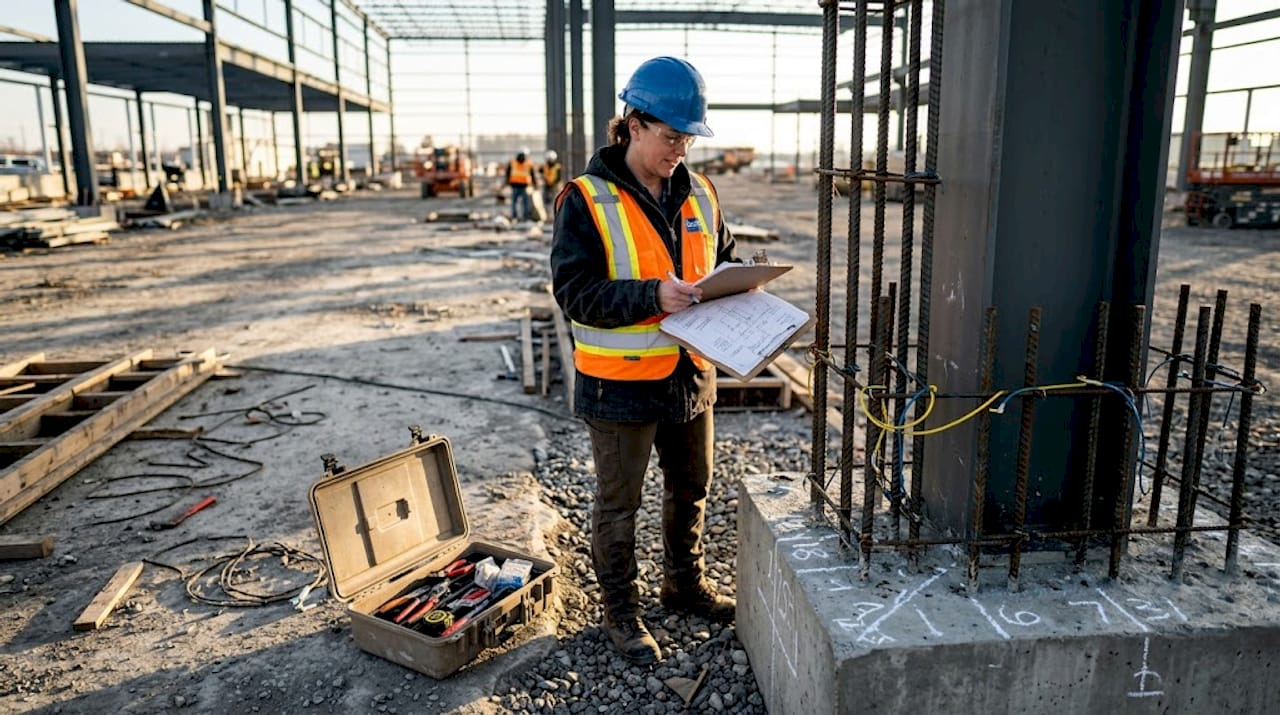
When the facility management team engaged a qualified inspector for certification renewal, the inspection uncovered significant issues.
| Inspection finding | Location | Impact on certification |
|---|---|---|
| Unbonded rebar columns in Building C | Structural frame, east wing | Current path bypassing earth system |
| Corroded bonding clamps on 3 down conductors | Exterior facade connections | Increased impedance, partial disconnection |
| No SPD documentation for control room panels | Electrical room, Building A | Missing component certification |
| Ground resistance exceeding 10 ohms | North electrode | Inadequate earth termination |
“Concrete structures often carry most of the lightning current; detailed inspection is crucial.”
Research finding, Metis243988
The most significant finding was the unintentional current path through the building’s reinforcing steel network. In Building C, the rebar network was electrically continuous between footings and roof level but was not bonded to the lightning protection system. During a strike, this would have created uncontrolled current distribution through the structure, bypassing the intended grounding path and potentially damaging embedded utilities and control wiring.
The corrective program involved several targeted actions. Bonding connections were added from the rebar network to the external down conductors at foundation level using purpose-made rebar bonding clamps. Corroded external connections were replaced. An SPD installation program was completed across all control panels. The north electrode was supplemented with additional radial electrodes to bring ground resistance below 5 ohms.
After corrections, the lightning protection system application for this facility was approved with a full documentation package that now explicitly maps current paths through both installed conductors and structural elements.
The lesson here is direct. If this facility had self-certified by reviewing component installation only, none of the structural bonding gaps would have been caught. The complete guide to building protection reinforces that current path inspection is inseparable from certification quality.
Why most lightning protection certifications miss the real structural risks
Here’s the uncomfortable reality experienced compliance officers learn over time: many facilities hold valid certification paperwork but still carry meaningful structural risk. The reason is that most certification checklists focus on what was installed, not on what the structure itself is doing with lightning current.
The building skeleton often carries 80% of lightning current versus intended conductors, yet inspection reports frequently stop at conductor routing and grounding resistance. That’s measuring half the problem.
The managers who get this right don’t treat certification as a documentation exercise. They treat it as a structural current audit. They request inspector credentials that include structural analysis experience. They ask for current path modeling, not just component checklists. They review system application insights to understand how real-world strike distribution differs from design assumptions.
Pro Tip: Schedule a follow-up inspection 12 months after initial certification, specifically targeting bonding connections on structural elements. Thermal cycling and vibration from operations can loosen clamps that passed initial inspection.
The harder truth is that compliance officers who accept certification at face value are managing paperwork risk, not structural risk. Both matter, but only one of them protects your people and your operations when a strike actually occurs.
Get expert help for lightning protection certification
For facility managers looking to streamline certification or solve complex risks, here’s where to get expert help.
Navigating certification requirements across IEC standards, national regulations, and site-specific structural challenges is exactly what Indelec’s technical team has built expertise in since 1955. Whether you need support with risk assessment methodology, installation design, current path analysis for reinforced concrete structures, or full certification documentation, our specialists work directly with your facility team.

Explore lightning system applications to see how site-specific solutions are designed and documented for complex industrial and commercial facilities. For standards alignment and jurisdiction-specific requirements, our lightning standards expertise resource provides updated guidance your compliance team can act on. Reach out directly to connect with an Indelec technical advisor and get facility-specific certification support.
Frequently asked questions
What are the main standards for lightning protection certification?
Facility lightning protection certifications typically follow IEC 62305 internationally and NFPA 780 in the United States, with national adaptations governing installation quality, inspection requirements, and risk assessment methodology.
How often should lightning protection certification be renewed?
Facilities should renew certification after major structural changes, after significant storm damage, or on a scheduled cycle of every three to five years depending on site risk level and applicable regulatory requirements.
Why is inspection of reinforced concrete critical during certification?
Concrete frames carry most lightning current during a strike, often more than the installed conductor system, so detailed inspections must map and bond all structural current paths to ensure genuine protection rather than paper compliance.
Can self-certification be adequate for low-risk facilities?
Self-certification may be adequate for low-risk sites, but it still requires thorough current path documentation and should be paired with periodic third-party audits to catch structural bonding gaps that internal reviewers routinely miss.