What Is Early Streamer Emission Lightning Protection?
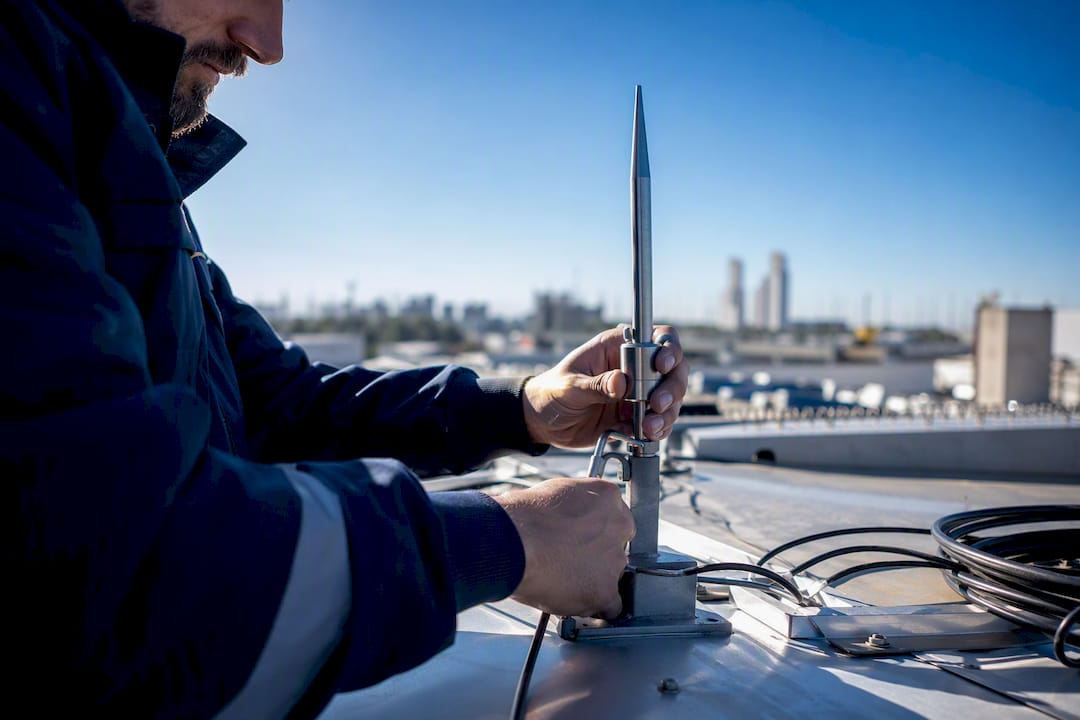
Early Streamer Emission (ESE) refers to an air terminal design intended to trigger the upward lightning streamer earlier than a plain metal rod would, using a built-in ionization or triggering mechanism at the tip. Here is the honest verdict for anyone specifying protection systems: ESE devices have a plausible physical basis, according to NIST’s technical review, but the independent evidence for their claimed performance gains remains contested and timing-dependent. That means ESE can be a reasonable choice for certain large or complex sites, but only if you verify the manufacturer’s trigger-time claims rather than accepting the marketed protection radius at face value.
A few facts anchor that verdict before we go any further:
- NIST’s literature survey found a plausible mechanism but flagged unresolved gaps in the supporting science.
- A 2019 comparative analysis found ESE systems often need fewer air terminals than meshed-cage designs on large roofs, which lowers installation complexity.
- ESE terminals show up most often on large flat roofs, industrial plants, and long-span structures where a conventional meshed cage would require extensive conductor runs, based on industry usage patterns.
Key Takeaways
Early Streamer Emission can shorten the streamer-initiation delay by a small, timing-dependent margin, but independent reviews say the resulting protection-radius gains still require site-specific verification, not brochure figures.
| Point | Details |
|---|---|
| ESE defined | An active air terminal designed to trigger an upward streamer earlier than a passive rod, through electronics, capacitive charge, or ionization. |
| Evidence is mixed | NIST found a plausible physical basis but stopped short of confirming manufacturer performance claims. |
| Radius depends on ΔT and height | A stated protection radius only holds at the tested mounting height; lower installation shrinks it proportionally. |
| Fewer terminals, more concentrated risk | ESE can cut terminal count on large roofs but shifts risk onto fewer active points needing monitoring. |
| Indelec’s approach | Indelec pairs ESE terminals like Prevectron3 with documented ΔT testing and IoT monitoring, and recommends a site assessment before specification. |
Table of Contents
- What Is Early Streamer Emission and How Does It Work?
- What Types of Early Streamer Emission Rods Exist?
- How Does ESE Differ From Franklin Rods and Meshed Cages?
- How Do Manufacturers Calculate ESE Protection Radius?
- What Does Independent Testing Say About ESE Effectiveness?
- What Are the Advantages and Limitations of ESE Devices?
- What Standards Govern Early Streamer Emission Systems?
- When Should You Consider ESE, and What Should You Ask Vendors?
- How Do Manufacturers Design and Validate ESE Terminals?
- Where Does Indelec Stand on ESE Claims?
- Get an ESE Site Assessment Before You Specify Anything
- Frequently Asked Questions
- Sources
What Is Early Streamer Emission and How Does It Work?
Lightning does not strike downward in one clean bolt. It develops in stages, and understanding those stages is the only way to evaluate what an ESE device actually claims to do.
A storm cloud builds up charge, and once the field is strong enough, a stepped leader starts propagating down from the cloud in short, jagged bursts. As that leader gets close to the ground, tall grounded objects respond with corona discharge, a faint buildup of ionized air around sharp points and edges. Under the right field conditions, that corona can organize into an upward streamer, a thin ionized channel reaching up to meet the descending leader. When the upward streamer and the downward leader connect, you get the return stroke, the bright, high-current flash most people picture when they think of a lightning strike.

A conventional Franklin rod is entirely passive. It relies on its height and sharp geometry to concentrate the electric field enough that corona forms and, ideally, organizes into a streamer at a useful moment. There is no active step involved. It sits there and waits for the field to do the work.
An ESE terminal tries to shortcut that waiting period. Depending on the design, it adds a triggering electronics package, a capacitive charge-harvesting circuit, or an ionizing element at the tip, all aimed at pushing the local field past the streamer-initiation threshold sooner than a plain rod would. Manufacturers describe this as an early emission time advantage, commonly abbreviated ΔT, measured in microseconds. The idea is that a terminal firing its streamer a fraction of a second earlier effectively behaves like a taller passive rod, which is the basis for the larger protection radius claims you see in ESE marketing.
The timing sensitivity here is the whole ballgame. A streamer that fires too early, before the leader is close enough to interact with it, does nothing useful. A streamer that fires at the right moment relative to leader approach can, in principle, intercept the strike from a wider area. But “right moment” depends on leader speed, charge distribution, and distance, none of which are constant from one storm to the next.
Laboratory tests documented in the IET’s early streamer emission investigations found that pulsed energization can produce a measurable, but often small, timing advantage in leader inception under controlled conditions. Crucially, the effect appeared strongly dependent on when the energization pulse fired relative to the simulated leader’s approach.
Picture a simple diagram: a downward leader stepping toward a rooftop, a conventional terminal’s corona slowly building underneath it, and beside it an ESE terminal firing its trigger pulse the instant local field conditions cross a threshold. The visual difference is a matter of microseconds and a few extra centimeters of streamer growth, not a dramatic redesign of how lightning behaves. That small, timing-dependent gap is exactly what the rest of the independent research tries to quantify.
What Types of Early Streamer Emission Rods Exist?
Early streamer emission rods are not a single design. Manufacturers use several distinct triggering mechanisms, and knowing which one you are buying changes your maintenance obligations and regulatory exposure.
- Ionizing or radioactive tips: older designs used a small radioactive source to sustain a low-level ionization field around the tip. Most jurisdictions now restrict or ban these because of radiation-handling and disposal rules.
- Electrically triggered devices: these use a battery or auxiliary power source to generate a high-voltage trigger pulse when field sensors detect approaching storm conditions.
- Geometry-based or capacitive-harvesting designs: these use passive components, often a capacitor charged directly by the ambient electric field, to release a trigger pulse without a battery. The ECS International technical whitepaper describes this approach in detail, including how manufacturers translate the resulting field gain into a claimed protection radius.
- Experimental laser-triggering approaches: research programs have tested using laser-induced ionization channels to guide a strike, but this remains largely confined to research settings rather than commercial rooftop deployment.
Pro Tip:If a proposed terminal uses a radioactive source, confirm current local regulatory status before specifying it. Several countries have phased these out entirely, and a device that is legal to keep in service may still be illegal to newly install.
Battery-based active devices need a maintenance schedule you would never apply to a passive rod. Skip the battery check for two or three years and you may have a terminal that looks fine but no longer triggers on schedule.
How Does ESE Differ From Franklin Rods and Meshed Cages?
The functional split is straightforward: an ESE terminal is an active, single-point device claiming a larger coverage radius, while a Franklin rod or a meshed-cage system relies on passive attraction and decades of field validation with no moving parts and no trigger electronics to fail.

That difference cascades into real design consequences. A large flat roof protected with a meshed cage typically needs a dense grid of horizontal conductors and multiple down-conductors. The same roof specified with ESE terminals may need far fewer air terminals, according to the 2019 comparative analysis, because each terminal’s claimed radius is larger. Fewer terminals generally means fewer roof penetrations, less conductor routing, and a simpler bill of materials.
The operational trade-off runs the other way. A meshed cage is a distributed system: no single component failure takes down protection for the whole structure. An ESE installation concentrates protection responsibility onto fewer active points, which raises the stakes on monitoring, maintenance, and grounding quality at each terminal. Lose one ESE terminal’s trigger function and you may have lost coverage over a meaningful chunk of the roof, not just a small gap.
Practically:
- Choose distributed meshed-cage protection when redundancy matters more than installation simplicity, or when local codes require it outright.
- Consider ESE where roof geometry, structural penetrations, or conductor routing make a dense mesh impractical or expensive.
- Either approach still needs a properly engineered grounding system. ESE does not reduce that requirement.
How Do Manufacturers Calculate ESE Protection Radius?
Protection radius claims are where ESE marketing and independent physics most often diverge; this detail warrants scrutiny before signing a contract.
Manufacturer formulas typically start from the terminal’s mounting height and add an adjustment tied to the measured ΔT, the early emission time advantage discussed earlier. A larger ΔT is said to extend the radius further, following the logic in standards like NF C 17-102. The catch: that formula is built on a specific ΔT value measured under specific lab conditions, and it assumes the terminal is installed at or above a defined optimum height.
Move the terminal below that optimum height and the protection radius does not stay constant. It shrinks roughly in proportion to the height reduction, a detail that gets lost when a vendor quotes a single headline radius figure without qualifying it. There is no universal radius that applies regardless of mounting conditions, no matter how confidently a spec sheet presents one.
For installation teams, this changes the design conversation. Instead of counting terminals against a fixed radius number, you need per-site calculations that plug in the actual mounting height and the vendor’s documented ΔT test method. Fewer terminals sound like a cost win until you realize the whole layout depends on placement precision, conductor routing back to a properly bonded ground system, and structural coordination for exactly where each terminal sits.
Pro Tip:Never accept a manufacturer’s stated protection radius as portable across projects. Ask for the ΔT test report and the assumed mounting height, then have your engineer recalculate the radius for your actual roof height and layout.
What Does Independent Testing Say About ESE Effectiveness?
The evidence is real, but it is thinner and more conditional than most sales literature suggests. That is the fair summary after working through the major independent reviews.
NIST’s technical evaluation is the most-cited independent source in this space. It concluded that ESE devices have a plausible physical basis and can, under certain conditions, increase the probability of initiating an upward streamer. But NIST stopped well short of endorsing manufacturer performance claims, stating the scientific basis for improved real-world protection remained far from certain and recommending further laboratory and field validation. NIST’s own public overview reiterates that efficacy remains an open question, citing mixed results and inconsistent test methods across published studies.
“The efficacy of early streamer emission remains open to question,” NIST notes in its public summary, pointing to method variability across the published record as a core reason definitive claims are hard to support.
Controlled lab work adds nuance rather than resolution. The IET investigations measured a small but real timing advantage for triggered devices under simulated leader approach, while earlier 1998 comparative rod tests found similarly modest advantages that depended heavily on gap length and applied voltage stress. Smaller peer-reviewed studies have reported comparable results within narrow parameter windows, with repeatability flagged as a concern.
The gap between lab and field matters here. Laboratory rigs simulate a leader with a controlled voltage ramp; they cannot replicate the variability of real leader speed, branching, and charge distribution during a natural storm. A small, repeatable advantage in a lab does not automatically scale to a reliable protection-radius gain over years of exposure to actual lightning. IEEE’s global-views review makes this point directly, calling for standardized field monitoring protocols to settle the disagreement.
Field acceptance studies echo the same conclusion: newer ESE prototypes show device-dependent performance, and researchers recommend site-specific acceptance testing rather than relying on generic lab figures.
What Are the Advantages and Limitations of ESE Devices?
Weigh these against your specific site rather than treating either list as universal.
Advantages:
- Fewer air terminals needed on large, flat roofs to meet a target lightning protection level, per the 2019 comparative analysis.
- Simpler layouts and potentially lower installation cost for structures where a dense meshed cage would mean extensive conductor runs.
- Well suited to high LPL requirements on sprawling industrial footprints where cage installation is structurally difficult.
Limitations and risks:
- The evidence base is genuinely contested. Independent bodies stop short of endorsing manufacturer radius claims.
- Performance is timing-sensitive. A small ΔT advantage in a lab does not guarantee a proportional real-world gain.
- Active devices concentrate risk on fewer points. Losing one terminal’s trigger function can mean losing coverage over a real portion of the structure.
- Radioactive-source devices carry regulatory and disposal obligations that vary by jurisdiction.
- Battery-based designs require ongoing maintenance checks that passive rods never need.
- Insurance and warranty conversations should explicitly address who monitors terminal function and how failures get detected before a claim, not after one.
What Standards Govern Early Streamer Emission Systems?
Standards compliance is not optional paperwork here. It is the mechanism that separates a defensible ESE installation from a liability.
ESE terminal design and protection-radius calculation typically reference NF C 17-102, the French standard most widely applied to ESE-specific testing and radius formulas. Conventional passive systems, by contrast, generally follow IEC 62305, the international standard covering risk assessment, terminal placement, and grounding for both active and passive approaches. Neither standard automatically validates a specific manufacturer’s ΔT claim; that validation happens through the vendor’s own type-approval and test documentation.
Before signing a contract, request:
- Independent test reports showing how ΔT was measured, and under what conditions.
- Current type-approval or certification documents for the specific terminal model, not a product family.
- The manufacturer’s documented installation and maintenance procedures.
- Written confirmation of which standard’s radius formula the design calculations follow.
When Should You Consider ESE, and What Should You Ask Vendors?
ESE terminals show up most often on large flat industrial roofs, telecom and utility infrastructure, and long-span structures such as cable car stations, where a dense meshed cage would mean substantial structural penetration. Indelec’s Prevectron terminals installed on cable car infrastructure illustrate the kind of specialized-structure deployment where ESE’s fewer-terminal footprint is a genuine practical advantage.
Before committing to a design, check these site factors:
- Roof height, footprint, and required LPL for the structure.
- Access conditions for ongoing maintenance and inspection.
- Grounding quality and whether it meets both ESE and conventional standard requirements.
- Your organization’s tolerance for single-point-of-failure risk versus a distributed mesh.
Then put these questions to any vendor directly:
- What ΔT value are you claiming, and how was it measured, lab simulation or documented field data?
- Can you provide the type-approval certificate for this exact terminal model?
- What is the recommended maintenance schedule, and what does a failure look like before it becomes visible?
- Do you offer any monitoring option to confirm the terminal is still functioning as designed?
How Do Manufacturers Design and Validate ESE Terminals?
Design work on modern ESE terminals generally centers on three things: tip geometry that concentrates field strength efficiently, triggering electronics tuned to fire at a useful moment relative to leader approach, and increasingly, connected monitoring that reports terminal status remotely. Indelec’s Prevectron3 Connect reflects this direction, pairing the ESE terminal with IoT-based monitoring so a facility team can confirm the device is still operating rather than assuming it is.

Responsible R&D work in this space means model validation against documented test methods, structured field-monitoring programs over multiple storm seasons, and site-specific acceptance testing rather than a one-size-fits-all radius claim. This is the same discipline independent reviewers keep asking the industry to formalize.
Pro Tip:Write an acceptance-test clause into any ESE procurement contract that specifies a monitoring period, the parameters to be recorded during that period, and a defined process for what happens if the terminal underperforms its stated ΔT.
Where Does Indelec Stand on ESE Claims?
Engineers evaluating ESE should treat manufacturer radius claims as a starting hypothesis, not a settled fact. Independent reviews from NIST and IEEE make clear that the physics is plausible but the performance margins are thin and highly conditional on timing and installation height. The pragmatic path forward is not rejecting ESE outright, nor accepting it uncritically. It is specifying it where the installation advantages genuinely fit your structure, then building acceptance testing, ΔT verification, and ongoing monitoring into the contract before the first terminal goes on the roof.
Get an ESE Site Assessment Before You Specify Anything
Deciding between an active ESE terminal and a distributed meshed cage is not a catalog decision. It is a site-specific engineering call that depends on your roof height, structural constraints, and how much single-point risk your operations team can accept. Indelec’s Prevectron3 terminal pairs OptiMax triggering technology with a documented test methodology, so your engineering team gets ΔT figures and mounting-height guidance instead of a bare radius claim.

If you are weighing ESE against a conventional system for an upcoming project, the first useful step is a proper risk assessment and installation review rather than a spec sheet comparison. Request a site evaluation, and you get a protection design sized to your actual building, not a generic radius pulled from a manufacturer brochure.
Frequently Asked Questions
What is early streamer emission in simple technical terms?
Early streamer emission describes an air terminal designed to initiate its upward lightning streamer sooner than a passive rod would, using a trigger mechanism at the tip rather than relying purely on field-driven corona buildup.
Is early streamer emission technology proven to work better than conventional rods?
Not definitively. NIST’s review found a plausible physical basis but said the evidence for improved real-world performance is far from conclusive, and lab-measured timing advantages are small and condition-dependent.
What are the main advantages of early streamer emission rods?
Fewer air terminals needed on large roofs, simpler conductor layouts, and often lower installation cost for sites where a dense meshed cage would be structurally impractical, according to a 2019 comparative analysis.
How does early streamer emission differ from a Franklin rod?
A Franklin rod is passive and relies purely on height and geometry. An ESE terminal adds an active trigger, electronic, capacitive, or ionizing, aimed at advancing streamer formation by a measurable time margin.
What should I ask a vendor before buying an ESE device?
Request the ΔT test method and value, the type-approval certificate for the exact model, the maintenance schedule, and whether monitoring is available to confirm the device is functioning.
Sources
- Early streamer emission lightning projection systems – literature survey and technical evaluation
- Early Streamer Emission Vs Conventional Lightning Protection Systems
- Lightning Protection based on Early Streamer Emission Technology
- Early Streamer Emission Lightning Protection Systems: Global Views Revisited | IEEE Conference Publication | IEEE Xplore