Enterprise EV Charger Maintenance in France: Match MA1, MA2, or MA3
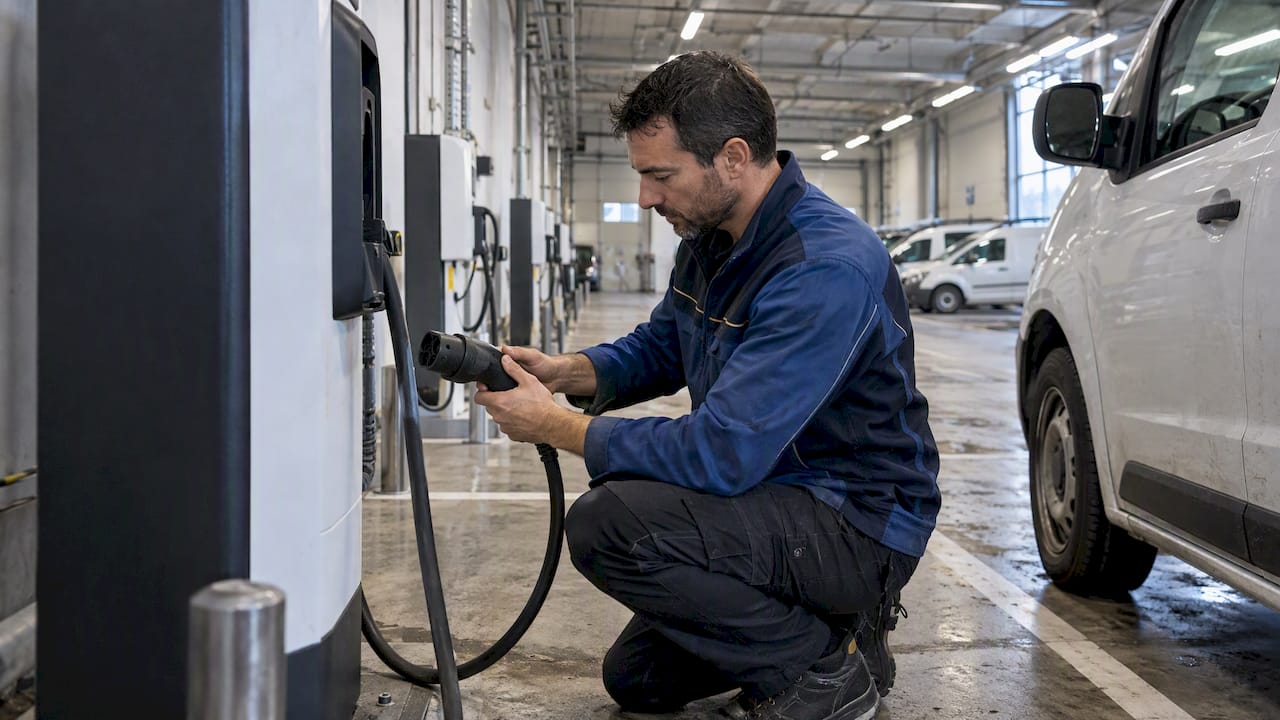
Maintenance of enterprise EV charging stations is required under French IRVE rules and must be carried out by qualified professionals. Facility managers need contracts built on preventive visits, remote supervision, and clear service commitments, with technicians holding the right MA1, MA2, or MA3 qualification depending on the station type.
TL;DR:
- Match a technician’s MA1, MA2, or MA3 qualification to station type: standard AC takes MA1, connected AC MA2, and DC fast charging MA3.
- Require a written intervention deadline, with 24 hours for standard business sites and 4 hours for public critical sites, plus remote diagnosis before dispatch.
- Choose premium coverage with 24/7 monitoring and faster response only where public facing or fleet critical downtime costs justify its higher price.
- Keep the technician’s qualification proof and standardized visit reports on file, since audits, warranty coverage, and Advenir funding may depend on documented compliant maintenance.
Table of Contents
- Why charging station maintenance matters for your business
- Preventive, corrective and predictive maintenance explained
- What the law requires for IRVE maintenance in France
- How to choose the right maintenance contract
- What enterprise charger maintenance costs
- Remote supervision and software keep stations running
- A practical checklist for preventive maintenance visits
- How Indelec supports compliant charging station maintenance
- Reliability and compliance deserve the same priority
- Request a compliant maintenance plan for your sites
- FAQ
- Sources
Why charging station maintenance matters for your business
Skipping maintenance on enterprise charging stations creates safety exposure, not just inconvenience. Faulty connections or degraded insulation on a charging circuit carry fire and shock risks that fall squarely under electrical safety obligations in the Labour Code, and a station left unchecked can fail exactly when a fleet vehicle or an employee needs it most. Downtime on a single station often costs more in lost productivity and frustrated drivers than a year of scheduled upkeep would have cost.
Maintenance also protects money already spent. Grant programs tied to Advenir funding often require proof of ongoing compliance, and manufacturer warranties on charging hardware typically assume regular servicing by qualified technicians.
- Unmaintained stations raise electrical and fire risk under Labour Code safety rules.
- Scheduled upkeep keeps fleet and employee charging available when needed.
- Documented maintenance supports Advenir eligibility and keeps warranties valid.
- A short outage usually costs more in lost charging time than a preventive visit.
Preventive, corrective and predictive maintenance explained
Enterprise charging contracts generally bundle three distinct approaches, and knowing which tasks belong where helps you read a proposal correctly.
- Preventive maintenance covers scheduled inspections, cleaning, connector tightening, and performance tests, typically the MA1-level, NIV1 tasks a qualified technician runs on a fixed calendar.
- Corrective, or curative, maintenance handles on-site repairs after a fault: swapping a failed contactor, replacing a damaged cable, or managing a warranty claim with the manufacturer.
- Predictive maintenance relies on software, remote diagnostics, firmware updates, and telemetry to flag a developing issue before it causes downtime, shifting some interventions from reactive to planned.
Sector guidance from CarPlug notes that maintenance is moving toward a hybrid model, where remote supervision reduces how often a technician needs to visit the site at all. The mix you need depends on how critical each station is: a single back-office charger can run on preventive visits alone, while a public-facing or fleet-critical station usually justifies predictive monitoring layered on top.
What the law requires for IRVE maintenance in France
French law sets a clear qualification bar for anyone servicing charging infrastructure. Décret n°2017-26, updated by Décret n°2021-546, requires that maintenance work on IRVE be performed by professionals holding the right qualification, and that work must also meet article R.4544-9 of the Labour Code governing electrical risk. Three qualification levels apply depending on station type: MA1 for standard AC stations, MA2 for connected AC stations, and MA3 for DC fast-charging stations.

These maintenance indices (MA) are distinct from the P1/P2/P3 indices that cover installation work rather than upkeep, so a contractor qualified to install a station is not automatically certified to maintain it. Qualifelec is the recognized body documenting MA1, MA2, and MA3 training paths and maintains a directory you can use to verify a provider’s actual qualification before signing anything.
A facility manager who hires an unqualified technician risks voiding the manufacturer warranty and falling out of compliance, according to Qualifelec’s qualification framework, since non-compliant maintenance can invalidate both insurance coverage and subsidy eligibility.
- Confirm the technician’s MA1, MA2, or MA3 certificate matches your station type.
- Ask for the Qualifelec listing or certificate number before signing.
- Check that the contract references R.4544-9 and the relevant decrees explicitly.
- Keep a copy of qualification proof in your compliance file for audits.
Before signing a new contract, reviewing recent qualification changes helps confirm your provider meets the current rules.
How to choose the right maintenance contract
Most providers offer at least two tiers: an essential plan covering scheduled preventive visits and basic diagnostics, and a premium or expert plan adding 24/7 remote monitoring, faster intervention windows, and bundled parts coverage. The right tier depends on how much a given station’s downtime actually costs you.
Before signing, insist on specific service-level details rather than vague promises.
- A defined intervention time, commonly 24 hours for standard business sites and 4 hours for public-critical ones.
- Remote diagnosis included before any on-site dispatch is billed separately.
- A clear spare-parts policy stating what’s covered and what’s billed extra.
- An escalation path naming who to call when a fix fails on the first visit.
- Standardized intervention reports you can produce for an audit or a subsidy review.
Pro Tip:Ask for a sample intervention report before signing, since the fields it tracks tell you more about contract quality than the sales pitch does.
What enterprise charger maintenance costs
Budgeting for maintenance means accounting for several distinct cost lines: scheduled preventive visits, a remote monitoring subscription, parts and labor for repairs, emergency call-out fees, and any software licensing for the supervision platform itself.
Industry pricing commentary notes that contracts are commonly tiered between a basic annual preventive plan and a premium package bundling 24/7 monitoring with shorter intervention deadlines, and that the premium tier carries a meaningful cost uplift justified mainly for public-critical sites.
- Treat maintenance as an OPEX line in your total cost of ownership, not as an afterthought to the CAPEX purchase.
- Match the SLA tier to how much downtime actually costs at that site.
- Factor in software subscription fees for any supervision or telemetry platform.
- Keep documentation ready, since Advenir-linked funding can require proof of ongoing compliant maintenance.
A detailed look at budgeting for charging infrastructure can help you model costs across a multi-site fleet before you commit to a contract tier.
Remote supervision and software keep stations running
Modern enterprise charging relies heavily on supervision software that sits between the hardware and your maintenance contract. These platforms push alerts when a station flags an error, collect usage telemetry you can analyze for patterns, and deliver firmware updates over the air without a technician on site.
Remote diagnostics let a provider resolve some software-level faults before they ever become a dispatched visit, which is the core of the predictive approach described earlier. Supervision also connects into broader site systems: energy management, load balancing across multiple stations, and sometimes building-wide electrical monitoring, so a charging fault doesn’t sit isolated from the rest of your facility’s power picture.
- Alerts flag a fault the moment it happens, not at the next scheduled visit.
- Telemetry data supports both predictive maintenance and usage reporting.
- Firmware updates delivered remotely cut the number of on-site visits needed.
- Load-balancing integration ties charging into your wider energy management setup.
Usage and diagnostic data collected by these platforms should be handled under the same data protection discipline as any other operational system on your network.
A practical checklist for preventive maintenance visits
A well-run preventive visit follows a consistent sequence, and knowing the steps helps you judge whether a contractor is doing the job properly.
- Pre-visit safety isolation: the technician de-energizes the circuit and confirms lockout before opening any panel.
- Visual inspection: checking connectors, cables, housing, and signage for visible wear or damage.
- Earthing and torque checks: verifying grounding continuity and tightening connections to specification.
- Cleaning and functional test: clearing debris from vents and running an actual charge cycle to confirm performance.
- Diagnostics: reading stored error codes, extracting logs, and confirming firmware is current.
- Reporting: filing a standardized intervention report and flagging any part likely to need replacement at the next visit.
AVERE’s MA1 training materials describe exactly this sequence, including use of a functional test bench to simulate loads and faults, parametrization through a web server or USB connection, and standardized self-check forms for traceability. That paper trail matters as much as the repair itself when you need to prove compliance later.
How Indelec supports compliant charging station maintenance
Our mobility division works alongside our established lightning protection and electrical safety services, giving us a structured approach to IRVE audits and maintenance for professional fleets. We build qualification checks and standardized reporting into every maintenance proposal, so facility managers get traceable documentation suited to compliance reviews and funding audits. Our mobility services cover audits, installation, and ongoing maintenance for enterprise charging infrastructure.
Reliability and compliance deserve the same priority
Too many facility teams treat charger maintenance as a line item to trim rather than a safety and uptime commitment. The smarter approach bakes maintenance into procurement from day one: verify qualifications before signing, demand traceable reporting with every visit, and budget maintenance as part of total cost of ownership rather than an afterthought once stations are already installed.
— INDELEC
Request a compliant maintenance plan for your sites
We apply rigorous standards to EV charging maintenance, including using qualified technicians, producing structured intervention reports, and providing compliance documentation with every visit.

Our services page covers mobility solutions alongside our broader electrical protection offering, so you can request an audit or a maintenance proposal built around your site’s actual risk and usage profile. Every proposal includes the qualification proof and reporting templates you need for audits or Advenir reviews.
For additional practical reference, the Holland Electric Duurzaam maintenance guide offers a useful operational checklist you can compare against your own contractor’s visit routine.
FAQ
What are the obligations for businesses on charging stations in 2026?
Businesses operating EV charging stations must have maintenance performed by technicians holding the correct MA1, MA2, or MA3 qualification under Décret n°2017-26 and its updates. Work must also comply with the relevant article of the Labour Code governing electrical risk.
What does maintenance on a charging station typically cost?
Costs vary by contract tier, with a basic plan covering scheduled preventive visits and a premium plan adding 24/7 monitoring and faster intervention windows, according to sector pricing commentary. The premium tier costs more but is usually justified only for public-critical sites where downtime is expensive.
What regulations apply to charging stations in French businesses?
Charging stations fall under Décret n°2017-26, as updated by Décret n°2021-546, which sets qualification requirements for installation and maintenance work. Qualifelec documents the specific MA1, MA2, and MA3 maintenance qualifications technicians must hold.
What qualification does a charging station maintenance technician need?
A technician needs an MA1, MA2, or MA3 qualification depending on the station type, MA1 for standard AC stations, MA2 for connected AC stations, and MA3 for DC fast chargers, as defined through Qualifelec’s training framework. Salary figures for this role are not publicly listed in official qualification or regulatory sources.
Sources
- Décret n° 2017-26 (plus updates) — Légifrance
- IRVE — Qualifelec Pros
- AVERE / Advenir white paper — IRVE deployment and operations (2026)
- CarPlug — What maintenance for a charging station?