French Lightning Installation Certification: The DOE Is Only the Start
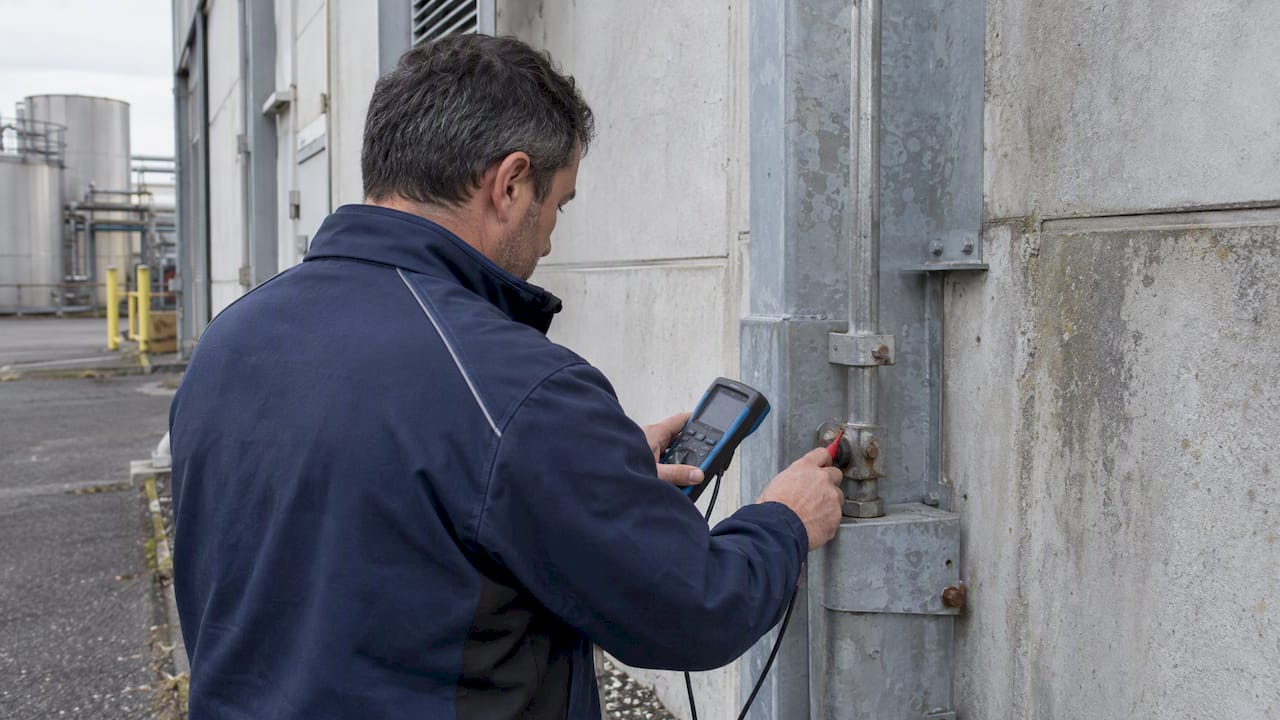
To stay compliant, require a Qualifoudre-certified organization, confirm that the assigned personnel hold the right individual level, and demand a documented lightning risk analysis (ARF) and technical study (ET) before any work starts. A compliant installation also ends with a dossier d’exécution (DOE), a carnet de bord, and the initial and periodic verification reports that French regulation requires.
TL;DR:
- Check that the contractor’s Qualifoudre scope matches the work, and name the certified technician in the contract rather than relying on company credentials alone.
- At covered existing classified sites, complete installation within two years of the technical study; new operations must install protection before starting activity.
- An independent verifier must inspect the system within six months; thereafter, schedule annual visual checks, full verifications every two years, and log detected lightning strikes.
- Require the technical study and completion file to cite exact standard clauses supporting protection levels, component choices, and any installation changes.
- Expect separate quotes for engineering, installation, and ongoing verification because site risk, layout, existing infrastructure, and independent inspection needs shape the total cost.
Table of Contents
- How to Choose an Installer: Verify Qualifoudre Status, Personnel, and Contract Items
- Which Certifications and Standards Actually Matter
- French Legal Obligations and Timelines You Cannot Skip
- What the Installation Must Deliver: DOE, Carnet de Bord, and Verification Reports
- Who Can Perform and Sign Off: Personnel Levels and On-Site Checks
- Indelec’s Practitioner Perspective on Compliance
- Step by Step: How a Paratonnerre Installation Gets Certified
- Cost Components and Typical Pricing for Certification and Installation
- Common Technical Installation Methods and Best Practices Beyond the Standards
- Troubleshooting Common Issues During Certification and Installation
- Why We See Compliance as Ongoing Risk Management
- How We Support ARF, ET, Installation, Verification, and Maintenance
- FAQ
- Sources
How to Choose an Installer: Verify Qualifoudre Status, Personnel, and Contract Items
Before signing anything, check the installer’s Qualifoudre scope against what your site actually needs. The Qualifoudre certification covers organizations and individual personnel separately, and an organization’s certificate alone does not guarantee that the technician on your roof holds the right level.
- Confirm the company’s Qualifoudre scope covers installation, ARF/ET, or verification, depending on what your project needs.
- Ask for the individual certification level of each assigned technician, along with their electrical habilitation and a short CV.
- Request proof of insurance, a summary of past audits, and references from comparable sites.
- Ask to see a sample DOE and a maintenance plan from a previous project before you sign.
Your contract should spell out deadlines for the ARF and ET, a firm delivery date for the DOE, a named independent verifier, and a maintenance schedule tied to the verification cadence.
Pro Tip:Name the certified technician in the contract itself, not just the company, to avoid a last-minute substitution with unqualified staff.
Which Certifications and Standards Actually Matter
Three references come up constantly in French lightning protection, and each plays a distinct role. Qualifoudre is a professional certification scheme, while NF EN 62305 and NF C 17-102 are the technical standards that define how the system is designed and installed.
- Qualifoudre certifies both the company and its personnel, with the organization’s certification depending on at least one staff member holding level N2 or higher.
- NF EN 62305 covers lightning risk assessment and overall protection design, forming the technical basis for the ARF and ET.
- NF C 17-102 details installation specifics for early streamer emission air terminals (PDA) and their testability.
- NF C 15-100 applies to the building’s general electrical installation and intersects with lightning protection at grounding and bonding points.
Your ET and DOE should cite the exact clauses used for dimensioning, protection level, and component selection. If a document references a standard only by name without clause numbers, ask the installer to be more specific. You can review how these standards map onto real installations on our lightning standards page.
French Legal Obligations and Timelines You Cannot Skip
Certain sites carry a legal obligation to protect against lightning, not just a technical recommendation. The Arrêté du 15 janvier 2008 sets the framework for classified installations (ICPE), and some ERP and IGH facilities fall under related requirements.
- An ARF is required first, to determine whether your site needs protection and at what level.
- When the ARF shows protection is necessary, an ET follows, detailing the technical solution.
- For existing ICPE sites, installation must be completed within two years of the ET; new operations must have protection in place before starting activity.
- Initial verification of the installed system is required within six months of completion.
- Periodic verification follows on a fixed cadence: a visual check each year and a complete verification every two years.
Verification must be carried out independently from the installer, and the operator keeps the resulting reports as part of its own recordkeeping duties. Our article on closing compliance gaps walks through how these six month and two year deadlines interact in practice.
What the Installation Must Deliver: DOE, Carnet de Bord, and Verification Reports
A finished installation is not just hardware on a roof. It comes with a paper trail that proves the work matches the ET and that the system stays functional over time.
- The DOE includes location plans, a count of conductors of descent, the type of surge protective devices installed (T1 or T2), the PDA test method used, and a justification tying each component back to the ET.
- The carnet de bord records entries made at installation and after every lightning event detected, which inspectors expect to review in full.
- Verification reports come in three forms: initial, complete, and visual, each issued by the verifier within its own deadline and kept by the operator.
- Maintenance obligations should be folded into existing facility processes rather than tracked as a separate, easily forgotten task.
Our breakdown of deliverables facility managers must keep covers how to organize these documents so they are ready whenever an inspector or insurer asks for them.
Who Can Perform and Sign Off: Personnel Levels and On-Site Checks
Qualifoudre personnel certification runs from N1 to N4, and each level authorizes a different scope of work, as set out in the Qualifoudre referential. Verification duties generally require at least level N2, while higher levels cover more complex design, training, or audit functions.
- Ask to see individual Qualifoudre certificates and electrical habilitation for every technician on-site, not just the company’s certificate.
- Match the names on those certificates to the people actually doing the work.
- Before accepting the job, confirm the DOE is available, the PDA is testable, labelling on conductors of descent is visible, and surge protection devices are clearly marked.
Indelec’s Practitioner Perspective on Compliance
We treat the ARF as the foundation of every project, because a rigorous risk analysis under NF EN 62305-2 determines the protection level that shapes the ET and, later, the DOE. Skipping or rushing this step is the most common reason an installation looks complete on-site but fails on paper.
The compliance gaps we see most often involve missing DOE items, incomplete carnet de bord entries, and personnel whose certified level does not match the task assigned. We build documentation and a maintenance handover into the project from day one, so the file is ready for an inspector before the installation is even finished.
Pro Tip:Keep the ARF, ET, and DOE in one file from the start of the project, cross-referenced by component, so an inspector can trace any part of the installation back to its justification in minutes.
Step by Step: How a Paratonnerre Installation Gets Certified
The process starts with the ARF, which evaluates the probability and consequences of a lightning strike on your site and determines whether protection is legally required. If the ARF concludes protection is needed, the ET follows, specifying the protection level, the type and placement of air terminals, the number and routing of conductors of descent, grounding design, and the surge protection devices required at relevant entry points.
During and after installation, the installer documents every component, test, and measurement that will feed into the DOE.
After installation, an independent verifier, distinct from the installer, carries out the initial verification within six months, checking that the installed system matches the ET and that all connections, bonding points, and PDA testability meet the applicable standards. This verification produces a report that becomes part of the permanent facility record alongside the DOE.
From that point, the system enters its periodic verification cycle: an annual visual check and a complete verification every two years, both recorded in the carnet de bord. Certification, in practice, is less a single event than the ongoing maintenance of this documentation trail, which is why operators who treat the ARF, ET, DOE, and verification reports as one continuous file tend to pass inspections with far fewer queries than those who collect the paperwork after the fact.

Cost Components and Typical Pricing for Certification and Installation
Pricing for a compliant paratonnerre project is built from several distinct components rather than one flat figure, and none of our services carry a published list price since each quote depends on the site. The ARF and ET represent the engineering phase: site visits, risk calculations, and the technical report that defines the protection level and the materials needed.
Installation costs depend on the number and height of air terminals, the length of conductors of descent, the complexity of the grounding network, and whether surge protection devices need to be added at multiple points in the electrical installation. Sites with multiple buildings, tall structures, or ICPE status generally require more extensive protection and therefore a larger installation scope.
Verification and maintenance are typically priced separately from installation, since the independent verifier must be distinct from the installer. Periodic verification costs recur on the annual and two year cycle set by regulation, and maintenance contracts often bundle these visits with carnet de bord updates so the record stays current between inspections.
Because every site’s risk profile, building layout, and existing infrastructure differ, we quote each project individually after reviewing the ARF and ET rather than applying a generic rate. Facility managers planning a budget should expect the engineering phase, the installation phase, and the ongoing verification and maintenance phase to be priced as three separate items in any serious proposal.
Common Technical Installation Methods and Best Practices Beyond the Standards
Beyond what the standards mandate, a few practical choices separate an installation that merely passes verification from one that holds up over years of use. Earth electrodes should be sized and positioned based on soil resistivity measured on-site, not assumed from a generic table, since resistivity varies significantly across French regions.

Copper conductors of descent should follow the shortest practical route to grounding while respecting the required distances of separation from metallic building elements and electrical cabling, a detail that local technical guidance on installation steps calls out specifically. Mechanical protection of exposed conductors, proper fixation to the structure, and clear labelling at each junction make future verification faster and reduce the chance of damage during other building maintenance work.
Air terminal installation should always preserve testability, since both NF C 17-102 and routine verification depend on being able to test the PDA’s function without dismantling it, as explained in this guide for technicians on overspanningsbeveiliging. Equipotential bonding between the lightning protection system and other grounded systems in the building, including the general electrical installation under NF C 15-100, prevents dangerous potential differences during a strike.
Photographic documentation of each installed component, tied directly to the ET’s justification for that component, has become standard practice among experienced installers. This single habit reduces back-and-forth with inspectors and insurers far more than any single piece of hardware, because it lets a verifier confirm compliance from the file before even reaching the roof.
Troubleshooting Common Issues During Certification and Installation
The most frequent problem we encounter is a DOE that is missing items the ET specifically required, usually because the installation changed slightly from the original plan without the paperwork catching up. Every deviation from the ET, however minor, needs a written justification in the DOE rather than a silent change on-site.
A second common issue is a carnet de bord with gaps, particularly missing entries after a lightning event was detected but not logged. Inspectors treat these gaps as a sign the operator is not actively managing the system, even when the hardware itself is sound.
Personnel level mismatches cause delays when a verification visit arrives and the technician on record does not hold the certification the task requires. This is avoidable by confirming individual Qualifoudre levels in the contract before work begins, rather than discovering the gap during an audit.
Finally, PDA testability problems, where an air terminal was mounted in a way that makes the required functional test difficult or impossible, often surface only during the first periodic verification. Catching this during the initial verification within six months of installation, rather than two years later, keeps the fix simple and the system’s compliance record intact.
Why We See Compliance as Ongoing Risk Management
We treat certification as an ongoing process, keeping continuous records that support the operator well beyond installation day. Certified personnel, a complete DOE, and an up-to-date carnet de bord give facility managers a defensible position if an incident, an insurance claim, or an inspection ever puts the installation under scrutiny.
— INDELEC
How We Support ARF, ET, Installation, Verification, and Maintenance
We provide services covering the full project cycle: risk analysis, technical study, installation, and ongoing verification and maintenance, ensuring consistent documentation from start to finish.

Before requesting a quote, it helps to gather your building plans, any previous ARF or ET your site may already have, and a short note on operational constraints such as access restrictions or planned renovations. That lets us scope the engineering phase accurately instead of guessing at protection levels.
- Protection contre la foudre covers ARF, ET, installation, and verification and maintenance under one service.
- Paratonnerres and related grounding, conductor, and surge protection product lines support the installation phase once the ET is approved.
- Our broader services overview also covers electric mobility solutions and work at height for sites that need it.
If your facility already has a Qualifoudre installer but needs an independent verification or a maintenance contract that keeps the carnet de bord current, we can pick up from wherever your documentation currently stands.
FAQ
What rules govern paratonnerre installation in France?
Lightning protection in France is governed primarily by the Arrêté du 15 janvier 2008, which requires certain classified installations to carry out a lightning risk analysis and, where needed, a technical study before installation. Technical design and installation details follow the NF EN 62305 series and NF C 17-102 standards.
Who is qualified to install a paratonnerre?
Installation should be carried out by a company holding the relevant Qualifoudre certification with personnel certified at the appropriate individual level. The organization’s certification depends on having at least one staff member at level N2 or higher, so checking individual certificates matters as much as checking the company’s status.
What steps must be followed to install a paratonnerre legally?
A compliant project starts with an ARF to determine whether protection is required, followed by an ET that specifies the technical solution, then installation by certified personnel. The project concludes with a DOE, a carnet de bord, and independent verification completed within six months of installation.
What does the NF C 17-102 standard cover?
NF C 17-102 covers early streamer emission air terminals, including their design, testability, and installation requirements. It works alongside the NF EN 62305 series, which addresses the broader risk assessment and protection design that feed into the ET.
Sources
Save these references alongside your facility’s own DOE and carnet de bord, since inspectors and verifiers will expect your documentation to align with them.
- FAQ QUALIFOUDRE version 30_novembre_2023.pdf
- Arrêté du 15 janvier 2008 relatif à la protection contre la foudre de certaines installations classées – Légifrance
- NF C 17-102 – Protection against lightning: early streamer emission lightning protection systems – AFNOR