Infrastructure Lightning Risk: Advanced Protection Strategies for 2026
TL;DR:
- Lightning protection in industrial sites remains a complex and evolving challenge due to outdated systems and increasing risks. Regulatory standards now demand thorough, site-specific risk assessments, documented compliance, and the use of proven technologies like NFPA 780 or IEC 62305. Unverified solutions such as dissipation arrays and ESE devices lack the scientific validation required for regulatory acceptance, emphasizing the importance of evidence-based decision-making for safety and liability.
Lightning protection in industrial infrastructure is not a solved problem. Many facilities operating today rely on systems selected years ago based on marketing claims rather than verified performance data, leaving them exposed to both physical risk and serious compliance failures as 2026 standards tighten. With lightning-related industrial incidents driving unplanned downtime, equipment losses, and regulatory scrutiny at record levels, the gap between what site managers believe they have installed and what regulators will actually accept has never been more costly. This guide cuts through the noise, delivering a clear framework for evaluating technologies, meeting updated requirements, and making decisions that hold up under audit.
Table of Contents
- Rising lightning risk: What’s changing for infrastructure in 2026
- Understanding modern lightning protection standards
- Evaluating protection technologies: Proven vs. unverified options
- Implementing an effective lightning risk management plan
- What most infrastructure safety guides overlook
- Reliable solutions for lightning safety and compliance
- Frequently asked questions
Key Takeaways
| Point | Details |
|---|---|
| 2026 compliance means proof | Regulators and insurers require systems backed by recognized standards and real-world data. |
| Unproven tech is high risk | Alternatives without strong evidence often fail to meet safety or audit requirements. |
| Regular review is essential | Periodic risk assessments and documentation ensure continued compliance and protection. |
| Documentation is audit armor | Maintain up-to-date records to avoid penalties and support claims in the event of incidents. |
Rising lightning risk: What’s changing for infrastructure in 2026
Lightning is not a rare event for critical infrastructure. Globally, the frequency and financial cost of lightning-related damage to industrial sites have been climbing steadily, driven by climate shifts and the growing density of sensitive electronics embedded in modern plant systems. Insurance loss data consistently places lightning among the top causes of industrial electrical damage, with repair and downtime costs often running well into the millions on a single major incident.
Regulatory expectations have moved in step with this reality. Frameworks like COMAH (Control of Major Accident Hazards) and guidance from the UK’s Health and Safety Executive (HSE) now make clear that lightning protection is not optional for high-risk sites. COMAH sites require formal LPS in their safety cases, explosive atmospheres demand systems specifically designed to prevent ignition, and data centers are expected to have redundant earthing and surge protective devices (SPDs) built in. HSE guidance note OG-00044 goes further, noting that a properly designed LPS can actually reduce the need for a complex separate risk assessment because the system itself addresses the primary hazard pathway.
What changed most entering 2026 is the accountability layer. Regulators now expect:
- Documented, site-specific risk assessments tied to a recognized standard
- Installation certificates from qualified engineers
- Scheduled inspection records that reflect the current system state
- Evidence that any non-standard technology choice has been formally evaluated and approved
The common pitfall is assuming that a system installed a decade ago still satisfies current requirements. Generic solutions applied across diverse site types without re-evaluation are now a red flag for auditors. The compliance expectations for 2026 explicitly require that protection levels match site-specific risk classifications, not just industry averages.
Having established the urgent reasons for revisiting lightning protection, let’s clarify what the latest standards require.
Understanding modern lightning protection standards
Two frameworks dominate globally recognized lightning protection practice: NFPA 780 (the U.S. standard published by the National Fire Protection Association) and the IEC 62305 series (the international standard widely adopted across Europe, Asia, and beyond). Both share a common foundation: they are built on decades of field data, peer-reviewed research, and iterative refinement by technical committees. That history matters enormously when auditors and insurers evaluate a system.

| Standard | Jurisdiction | Key focus areas | Regulatory acceptance |
|---|---|---|---|
| NFPA 780 | United States | Air terminals, bonding, grounding | High; insurer-preferred |
| IEC 62305 | International | Risk assessment, LPZ, SPDs | High; regulatory standard in EU |
| BS EN 62305 | United Kingdom | Equivalent to IEC 62305 | Mandatory for COMAH sites |
Against this backdrop, two alternative technologies have attracted significant marketing attention without earning equivalent scientific credibility.
Dissipation Array Systems (DAS) claim to prevent lightning strikes by dissipating the charge in the atmosphere around the protected structure. The premise sounds attractive. The evidence is another matter entirely. Dissipation arrays lack peer-reviewed scientific support for their core claim that visible corona discharge from the array prevents strikes. NFPA 780, by contrast, is backed by a century of documented field performance and is the product of continuous technical review.
Early Streamer Emission (ESE) devices claim to provide a larger protection radius than conventional air terminals by emitting an upward streamer earlier, theoretically intercepting a downward leader at a greater distance. ESE devices are the subject of active standards debate. Some national standards recognize them under specific conditions; others do not. Most major insurers and regulators still favor proven lightning standards with long-term field validation over systems whose claimed advantages depend on mechanisms that remain scientifically contested.
“The presence of visible corona is not evidence of efficacy. What matters is whether the system reliably intercepts lightning under tested, reproducible conditions over extended periods. Field claims without peer-reviewed data simply do not meet the bar that regulators and insurers require in 2026.”
The practical takeaway for safety engineers is direct: the standard you select determines your coverage in regulatory proceedings and liability disputes. If your system uses a technology not accepted by your applicable standard, your documentation is incomplete regardless of how impressive the installation looks. Understanding the real-world examples of electrical protection standards that have held up in enforcement actions is essential before committing to any system.
With a firm grasp of core standards, it’s essential to examine which strategies work best in various real-world industrial settings.
Evaluating protection technologies: Proven vs. unverified options
When infrastructure project managers sit down to compare technologies for a site upgrade, the conversation often starts with cost and coverage radius. Those are the wrong starting points. The first question should be: which technologies does the applicable standard, my insurer, and my regulator accept without qualification?
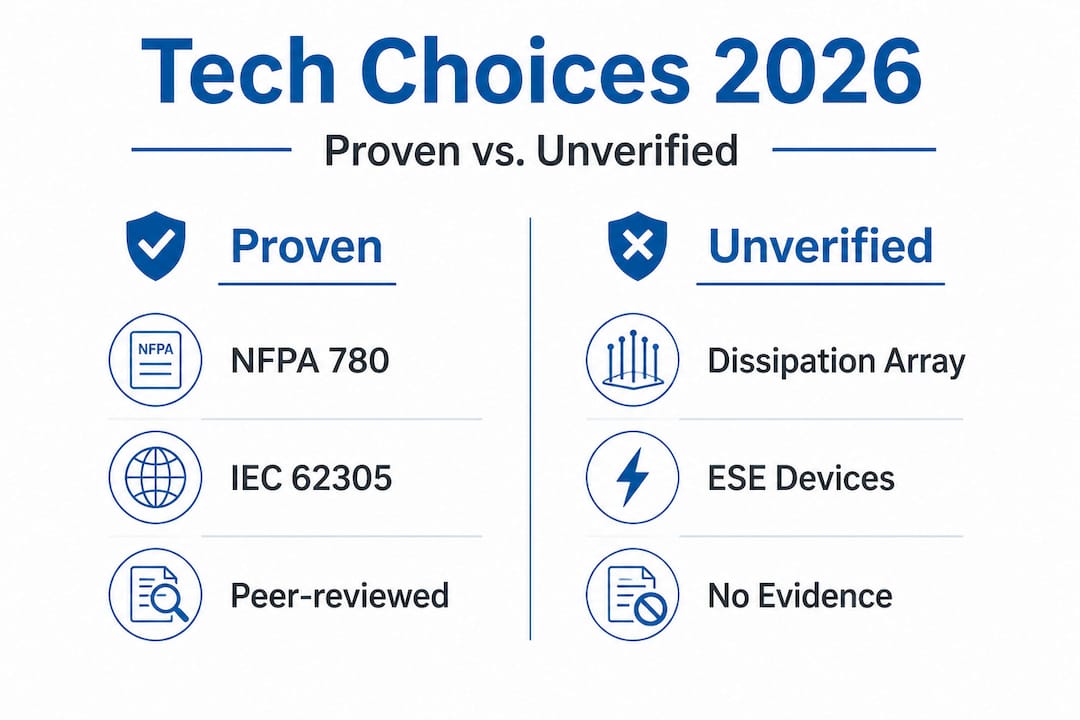
Here is a direct comparison to guide that conversation:
| Technology | Standard basis | Peer-reviewed evidence | Insurer/regulator acceptance | Risk for 2026 compliance |
|---|---|---|---|---|
| Conventional LPS (NFPA/IEC) | NFPA 780, IEC 62305 | Strong, century of data | High, broadly accepted | Low |
| ESE devices | Some national standards | Limited, contested | Variable, often conditional | Medium to high |
| DAS | No major standard | Absent for core claims | Low, generally not accepted | High |
The gap between conventional LPS and its alternatives is not subtle. Traditional NFPA/IEC approaches are preferred by regulators over unverified alternatives because the evidence base is clear, repeatable, and independently verified. DAS and ESE vendors often present site testimonials and proprietary test data. That is not the same as peer-reviewed, reproducible research reviewed by independent bodies.
Pro Tip: Before accepting any alternative technology proposal, request five or more years of continuous, third-party-verified strike interception or prevention data for a site with comparable characteristics to yours. If the vendor cannot provide this, the risk is yours to carry.
For project managers executing a site upgrade in 2026, here is a practical decision framework:
- Identify the governing standard for your site type, jurisdiction, and risk class.
- Map your site against the LPS application categories defined by that standard to determine required protection level.
- Evaluate technology options strictly within the set of systems accepted by your standard and confirmed by your insurer in writing.
- Reject proposals from any vendor that cannot separate marketing claims from independently verified performance data.
- Document every step of this process because the evaluation record itself is part of what auditors review.
Systems like the Prevectron3 represent the kind of approach that satisfies both regulatory requirements and the push for more eco-friendly LPS development, showing that innovation and compliance can move together. That balance is increasingly what leading infrastructure operators expect. The specific challenges of critical infrastructure lightning protection make it clear that proven performance, not marketable promises, must drive every selection.
Once you know the strengths and weaknesses of each approach, the next step is to translate standards and technology choices into actionable, compliant lightning risk management.
Implementing an effective lightning risk management plan
Risk management for lightning protection is a process, not a purchase. Even the best-specified system fails to protect you if the documentation and maintenance discipline are not maintained alongside it. Here is how to build a plan that survives both a lightning event and a regulatory audit.
Step-by-step implementation:
- Conduct a formal risk assessment. Use the IEC 62305-2 risk assessment methodology or the NFPA 780 equivalent. Quantify annual tolerable risk against calculated risk for your site. This calculation drives your protection level choice and is the foundation of your compliance file.
- Define site-specific requirements. A petrochemical plant in an explosive zone has fundamentally different requirements than a data center or a water treatment facility. Facilities in special categories such as COMAH sites or those with Zone 0/1 explosive atmospheres need LPS designed specifically to prevent ignition sources, not just to redirect current. Data centers need redundant earthing paths and coordinated SPDs at every zone boundary.
- Select compliant technology and a qualified installer. Installer competency is as important as product selection. Your system certificate is only as strong as the professional standing behind it.
- Commission and certify the system. Obtain third-party commissioning verification. The certificate of installation must reference the applicable standard and the protection level achieved.
- Establish an inspection schedule. Most standards require annual visual inspections and full electrical continuity checks at intervals defined by risk level (typically every two to four years). Inspection records must be retained and available on demand.
- Prepare your audit trail. Assemble all documents into a single compliance file: risk assessment, design drawings, installation certificates, inspection reports, and any system modification records.
Pro Tip: Treat your lightning risk management file the same way you treat your pressure vessel inspection records. Regulators in 2026 are applying the same level of scrutiny to electrical safety documentation that they have long applied to mechanical hazards. A well-maintained file is your first line of defense in any incident investigation.
Special cases deserve particular attention. Explosive zone facilities cannot tolerate any spark-generating failure mode in their LPS. Bonding and equipotential connection requirements are stricter, and any SPD installed in these zones must be rated for the hazardous area classification. For utilities and transmission infrastructure, zone of protection calculations must account for tall structures, multiple strike attachment points, and induced voltage effects on adjacent control cables. The complete guide to lightning protection for facilities provides detailed treatment of these scenarios for safety engineers managing varied site portfolios.
Now that you’re equipped with the how-to, it’s worth taking a critical look at the pitfalls and real decision-making dilemmas faced by experienced industry professionals.
What most infrastructure safety guides overlook
After nearly seven decades working with industrial clients across every major sector, we have watched the same pattern repeat. A vendor presents an alternative technology with compelling visuals, proprietary case studies, and a promise of lower installation cost. The procurement team, understandably drawn to the economics, approves the system. Three years later, a strike event or a regulatory inspection reveals that the system is not accepted by the facility’s insurer, does not appear in the applicable standard, and has no independent performance record. The cost of remediation, including downtime, re-installation, and potential enforcement action, dwarfs the original savings.
The persistence of DAS and ESE marketing in the industrial sector is not a mystery. Both technologies look plausible on a whiteboard. Charge dissipation and early streamer capture are mechanisms that sound scientifically reasonable until you ask where the peer-reviewed strike interception data is. The answer, consistently, is that it does not exist in the form that regulators, insurers, and independent standards bodies require.
Organizations that have cycled through alternative systems before returning to conventional LPS share a common insight: the credibility of your protection system is not just a safety issue. It is an operational and reputational issue. An unprotected incident at a facility with a non-standard system in place creates liability exposure that conventional LPS documentation would have avoided entirely. The expertise required to navigate both the technical and regulatory dimensions of that risk is not optional at the level of infrastructure investment most of these facilities represent.
For forward-thinking safety managers, the most durable protection strategy combines evidence-backed technology, rigorous documentation, and a commitment to reviewing the system whenever standards or site conditions change. That review discipline is what keeps a 2026-compliant system compliant in 2028 and beyond.
Reliable solutions for lightning safety and compliance
Choosing the right lightning protection system is one of the most consequential infrastructure decisions a safety engineer makes. Getting it right in 2026 means starting with certified, data-backed technology that meets your applicable standard without qualification.

Indelec’s product and service portfolio is built for exactly this environment. The Prevectron3 lightning rod delivers certified performance grounded in extensive field data, designed to satisfy the documentation requirements that auditors and insurers expect. For teams evaluating the efficiency of ESE lightning rods backed by survey data, our technical team can walk you through the evidence and help you determine whether ESE is appropriate for your site’s standard and risk class. Across all lightning protection applications, from petrochemical to data infrastructure to utilities, our engineers bring site-specific expertise and full compliance documentation support. Contact us to schedule a site audit or compliance consultation before your next regulatory review.
Frequently asked questions
What are the key requirements for lightning protection compliance in 2026?
Compliance in 2026 requires adherence to recognized standards like NFPA 780 or IEC 62305, with COMAH sites mandating formal LPS documentation in their safety cases, alongside verifiable inspection records and site-specific risk assessments. Documentation quality is now weighted as heavily as system design quality in regulatory reviews.
Can dissipation arrays or alternative technologies replace conventional lightning rods?
No. Dissipation arrays lack peer-reviewed long-term evidence supporting their core protective claims and are generally not accepted by regulators or insurers as stand-alone replacements for NFPA 780 or IEC 62305 compliant systems.
What documentation is needed for a regulatory lightning risk audit?
You need a validated site-specific risk assessment, installation certificates referencing the applicable standard, scheduled inspection records, and evidence that the system as installed meets current COMAH or HSE requirements for your site classification.
Is there a single best lightning protection system for all infrastructure types?
No single system fits every site. The optimal choice depends on site risk class, applicable jurisdiction standard, and special hazard categories. Traditional NFPA/IEC-based systems are the most broadly accepted starting point because their evidence base satisfies the widest range of regulatory and insurer requirements.
Recommended
- Climate Adaptation Strategies for Robust Electrical Protection
- Climate-adaptive lightning protection: key methods explained
- Optimize your lightning protection planning workflow: 5 key steps
- Innovation in lightning protection enhances safety 2026
- Why ATEX Lighting Matters in Hazardous Industrial Environments