Magnetic Induction from Lightning: What Students Must Know
TL;DR:
- Lightning’s rapidly changing currents produce magnetic fields that induce damaging voltages in electrical systems without direct contact. These induction effects can cause widespread infrastructure failures hundreds of meters from a strike, especially in setups with large conductor loops and inadequate grounding.
- Protection relies on minimizing loop areas, deploying surge protectors, and designing grounding systems that account for soil properties to prevent electromagnetic coupling from causing costly damage.
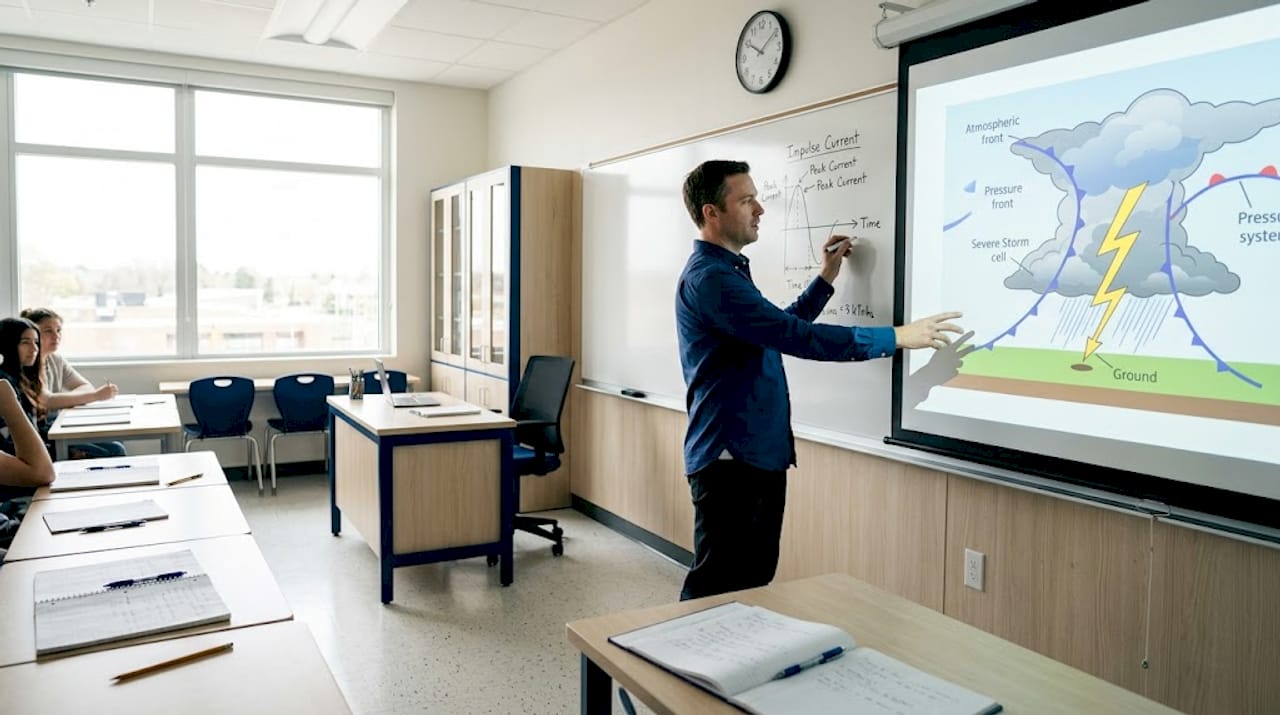
Most people picture lightning danger as a bolt making direct contact with a structure or person. That picture is incomplete. What is magnetic induction from lightning, and why does it matter as much as the strike itself? When lightning discharges, it drives tens of thousands of amperes through the atmosphere in roughly one millisecond. That violently changing current produces a transient magnetic field powerful enough to induce damaging voltages in electrical systems located hundreds of meters away, with no direct contact required. For students and educators working through electromagnetic theory, this phenomenon connects textbook physics directly to real infrastructure failures, clinical emergencies, and protection engineering.
Table of Contents
- Key takeaways
- What is magnetic induction from lightning: the physics explained
- Effects of lightning on induction: infrastructure at risk
- Modeling and measuring lightning magnetic fields
- Protective measures against magnetic induction
- My perspective on a persistently underestimated topic
- How Indelec helps you go beyond the theory
- FAQ
Key takeaways
| Point | Details |
|---|---|
| Lightning creates transient magnetic fields | Rapidly changing current during a strike produces a magnetic pulse lasting roughly 1 ms that radiates outward. |
| Induction damages systems without direct strikes | Induced overvoltages can destroy transformer windings, trip power lines, and ignite fires through electromagnetic coupling alone. |
| Soil conductivity shapes induced voltages | Ground parameters like conductivity and permittivity directly affect how large induced voltages become on nearby conductors. |
| Loop geometry is a critical design factor | Large conductor loops in installations like solar PV systems act as antennas, amplifying induction effects. |
| Protection requires grounding and surge design | Proper earthing, surge protective devices, and loop minimization are the primary defenses against magnetic induction damage. |
What is magnetic induction from lightning: the physics explained
Lightning is, at its core, a massive current pulse. A typical return stroke moves between 20,000 and 300,000 amperes through a channel only a few centimeters wide. That current does not flow steadily. It rises from zero to its peak in microseconds, then decays. This rapid change is exactly what generates a magnetic field.
James Clerk Maxwell’s equations describe the relationship precisely. A time-varying electric current produces a time-varying magnetic field, and a time-varying magnetic field induces an electromotive force in any closed conductor within its range. Lightning satisfies the first condition with extreme intensity. The result is a transient magnetic pulse with a duration of approximately 1 millisecond that propagates outward from the lightning channel in all directions.
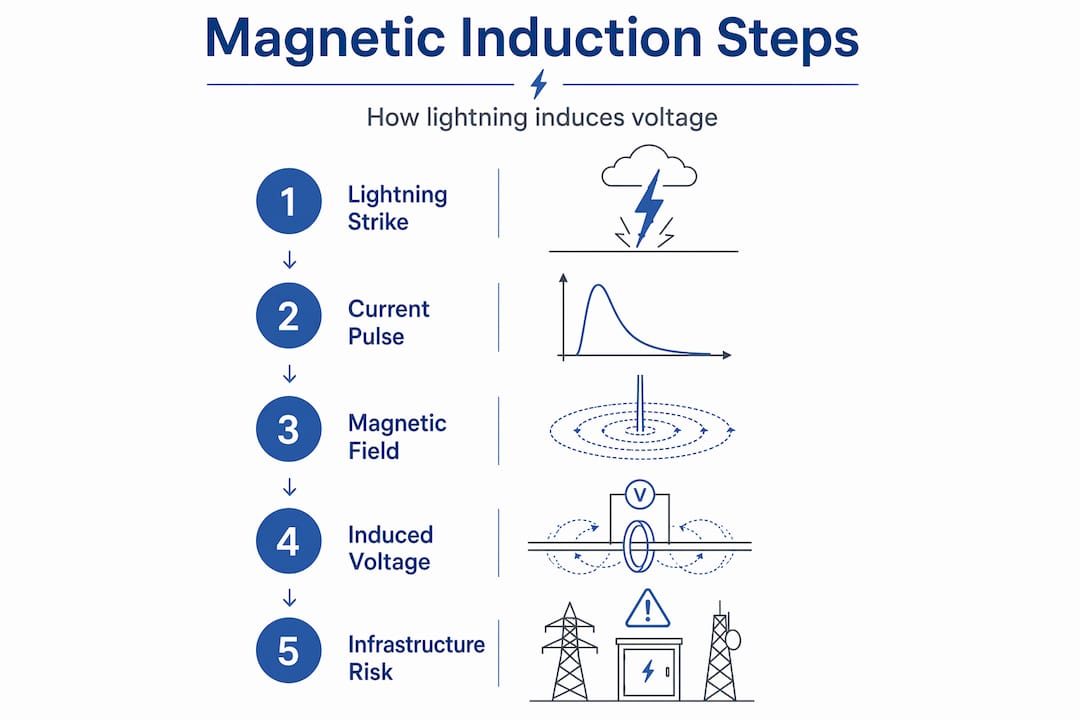
Think of the lightning channel as a very long, very energetic wire. Any current-carrying straight conductor produces a magnetic field that wraps around it in concentric circles, called an azimuthal field. The faster the current changes, the stronger this field is at any given moment. Lightning’s current rise time is measured in microseconds, which places the frequency content of the electromagnetic pulse well into the ELF (extremely low frequency) and VLF (very low frequency) ranges, typically studied between 3 Hz and 3 kHz for global resonance effects.
The Maxwell-Faraday law ties the electric and magnetic sides of the phenomenon together: a changing magnetic flux through any closed loop induces a voltage around that loop. That is the engine of magnetic induction phenomena in practice. When a power line forms a loop relative to a ground return path, and a lightning strike changes the magnetic flux threading that loop, a voltage appears across the line. No physical contact needed.
- The current rise time during a lightning return stroke typically spans 1 to 10 microseconds
- Peak magnetic field strengths near a strike can reach tens of milliteslas at close range
- The generated electromagnetic pulse covers frequencies from a few hertz up into the megahertz range
- Lightning electromagnetic waves propagate far enough to interact with Earth’s radiation belts, triggering high-energy electron showers in space
Pro Tip:When teaching Faraday’s law, use a lightning strike as your concrete example instead of a rotating coil. It makes the “changing flux” concept visceral and memorable, and it immediately connects theory to real engineering problems.
Effects of lightning on induction: infrastructure at risk
Understanding how lightning creates magnetic fields is one thing. Understanding what those fields do to electrical infrastructure is where the stakes become concrete. The induction effects of thunderstorms on power systems represent one of the most costly and underappreciated categories of weather-related infrastructure damage globally.
Here is how the failure sequence typically unfolds on a transmission line:
- A lightning return stroke occurs near (but not on) a transmission line.
- The rapidly changing magnetic field induces a voltage wave on the line through electromagnetic coupling.
- This lightning-induced voltage (LIV) travels along the line in both directions from the coupling point.
- The voltage wave reaches a transformer, substation, or connected equipment.
- If the peak voltage exceeds the insulation’s withstand rating, breakdown occurs. The result can be a punctured winding, an arc flash, or an outright fire.
Transformer windings are particularly vulnerable. At the high frequencies embedded in a lightning pulse, winding inductance dominates the transient response and magnetic flux penetration into the core reduces sharply. The voltage distributes unevenly across windings, concentrating stress at the first few turns. Measured simulations show voltages spiking to megavolt levels within 1 ms at the winding entry point, well exceeding typical insulation ratings for medium-voltage equipment.
The role of the ground cannot be overstated. Soil is not a perfect conductor. Its conductivity and permittivity vary by geology, moisture content, and frequency. These parameters directly control how induced voltages couple from the lightning channel into buried or overhead conductors. Wet clay soils conduct far better than dry sand, which changes both the magnitude and the waveshape of the induced transient. Frequency-dependent soil models are now considered mandatory in accurate lightning-induced voltage calculations.

| Failure mode | Trigger mechanism | Typical result |
|---|---|---|
| Transformer insulation breakdown | Uneven overvoltage at entry windings | Winding puncture, outage, fire |
| Power line flashover | Induced voltage exceeds line insulation rating | Arc, trip, supply interruption |
| Electronic equipment damage | High-frequency induced currents in signal cables | Component failure, data loss |
| Soil ionization along fault lines | Lightning following geological conductive paths | Localized magnetic anomalies, equipment error |
Lightning’s reach extends well beyond the immediate strike zone. Induced currents without direct contact can cause insulation breakdown, fire risk, and power outages through electromagnetic coupling at distances of several hundred meters in typical terrain.
Modeling and measuring lightning magnetic fields
Engineers cannot design adequate protection without accurate models of the fields they are protecting against. This section covers the main approaches used by researchers and protection specialists.
Dipole models and numerical simulation
The simplest analytical approach treats the lightning channel as a series of short current-carrying dipoles and sums their contributions. More advanced approaches use transmission line models of the return stroke, defining how current propagates upward along the channel after the initial ground connection. These models feed into numerical simulation tools that compute the full electromagnetic field at any point in space and time.
A second category uses frequency-domain analysis. Because the lightning pulse contains a broad spectrum of frequencies, the electromagnetic response of soil and conductors is computed at each frequency separately and then combined using Fourier methods. The Cooray-Rubinstein formula is the most widely cited approach for correcting field-to-line coupling calculations when the ground is imperfect, accounting for the dispersive nature of real soil.
Pro Tip:When comparing simulation approaches for a classroom exercise, prioritize models that incorporate frequency-dependent soil conductivity. A simulation assuming perfectly conducting ground can underestimate induced voltages by a factor of two or more in dry or sandy terrain.
Schumann resonances and ELF monitoring
At the global scale, the cavity between Earth’s surface and the ionosphere acts as a resonant waveguide for lightning electromagnetic energy. The fundamental resonance frequency is about 7.83 Hz, known as the first Schumann resonance. Monitoring these resonances gives researchers a continuous picture of global lightning activity and the electromagnetic environment it creates. This is one of the most elegant examples of magnetic induction phenomena operating at planetary scale.
Lightning-induced remanent magnetism
A particularly striking detection method uses the permanent magnetization that lightning leaves behind. When a lightning channel passes through rock or soil, the intense magnetic pulse can permanently re-align magnetic mineral grains. The result is lightning-induced remanent magnetism (LIRM), a detectable magnetic anomaly that survives long after the storm. Geophysicists use these anomalies to reconstruct historical lightning paths, estimate peak currents, and even study geological conductive features like ore bodies or fault zones that preferentially guide lightning current. For protection engineers, LIRM surveys on a site can reveal where lightning has repeatedly struck in the past, which directly informs grounding and rod placement decisions.
Protective measures against magnetic induction
Knowing the physics and the failure modes leads directly to the question of prevention. The magnetic induction effects on electrical infrastructure can trigger cascade failures across entire grids without any direct strike evidence. Protection, therefore, must account for the full electromagnetic environment, not just strike interception.
- Minimize induction loops. Any closed conductor loop exposed to a changing magnetic field will develop an induced voltage proportional to the loop area. In solar PV installations, cable routing must eliminate large loops that would otherwise act as antennas during nearby lightning activity. The same principle applies to control wiring in substations.
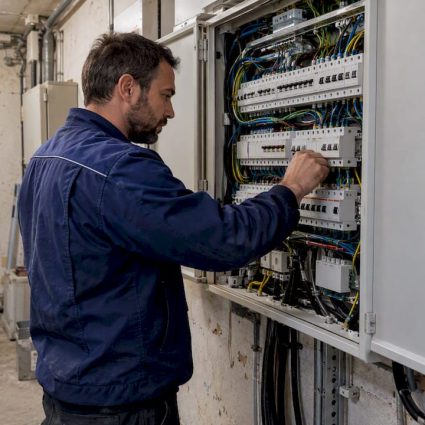
- Deploy surge protective devices (SPDs) at the right locations. SPDs must be installed at equipment entry points, at service entrances, and at intermediate points on long cable runs. A single SPD at the panel is rarely sufficient when the induction coupling occurs at a remote point on the cable.
- Engineer the grounding system carefully. Effective earthing reduces the ground potential rise at a protected site and provides a low-impedance return path for surge currents. Soil resistivity measurements drive grounding electrode design. Deep earth electrodes are particularly valuable in high-resistivity soil, where shallow ring electrodes cannot achieve acceptable impedance.
- Apply lightning protection standards rigorously. IEC 62305 and equivalent national standards define both the interception geometry and the electromagnetic compatibility (EMC) zone approach. The EMC zone methodology specifically addresses magnetic induction by defining spatial volumes where field strengths are attenuated to safe levels.
- Protect transformer windings with coordinated arresters. Given that overvoltages spike within 1 ms and concentrate at entry windings, metal oxide varistors (MOVs) placed at transformer terminals provide the fastest clamping response. Coordination with the transformer’s own impulse withstand rating is mandatory.
Pro Tip:For educational labs, modeling a simple rectangular wire loop near a simulated lightning current source demonstrates induction directly. Increase the loop area by a factor of four and induced voltage doubles. Students instantly grasp why cable routing is a design variable, not an afterthought.
The indirect electromagnetic effects of lightning also carry clinical weight. Lightning’s magnetic field can trigger cardiac arrhythmias and secondary trauma even in individuals who were not directly struck, which is a critical point for safety educators and emergency responders to convey.
My perspective on a persistently underestimated topic
I’ve spent decades working on lightning protection problems, and the one pattern I keep seeing is that magnetic induction gets treated as a footnote in both engineering curricula and safety training. Everyone teaches the visible strike. Almost no one teaches what the field does to systems half a kilometer away.
The physics is not the hard part. Faraday’s law is introduced in most sophomore electromagnetics courses. What’s missing is the connection from the equation to the failure report. In my experience, lightning remains an underestimated danger precisely because its indirect effects are invisible. A transformer that fails three days after a storm because induced stress weakened its insulation does not generate the same immediate alarm as a visible strike. The causation gets missed.
What I find encouraging is the direction of current research. Frequency-dependent soil models and advanced coupled transmission line simulations are giving engineers far more accurate predictions of induced voltages than were possible even ten years ago. The gap between theoretical models and measured field data is closing. That means protection designs based on these models are more reliable, not just more mathematically interesting.
My advice to educators specifically: teach magnetic induction from lightning as a design constraint, not just a physics curiosity. Show students a real failure mode, a transformer winding that failed at its entry turns because a nearby strike sent a megavolt transient through the supply cable. Then show them how SPD placement and loop geometry changes the outcome. That sequence, from physics to failure to fix, is what makes this topic stick.
— Indelec
How Indelec helps you go beyond the theory

Understanding magnetic induction from lightning is the first step. Designing systems that survive it is the work. Indelec has been engineering lightning protection solutions since 1955, combining patented technology with field-proven methods to protect infrastructure from both direct strikes and the induction effects that travel far beyond the strike point.
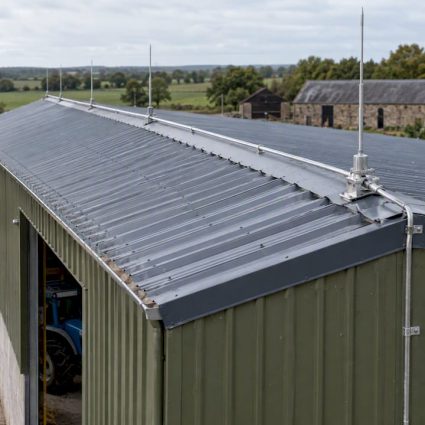
The Prevectron 3 air terminal uses OptiMax technology to intercept strikes before they generate the destructive current pulses that drive magnetic induction damage. For grounding, Indelec’s deep earth grounding drilling services address the soil conductivity challenge directly, placing electrodes where they achieve effective impedance regardless of surface geology. Indelec also offers technical training programs and expert consultations to help engineers and educators apply these principles to real system designs. Explore the full range of lightning protection applications to find solutions matched to your site’s specific electromagnetic environment.
FAQ
What is magnetic induction from lightning?
Magnetic induction from lightning is the process by which the rapidly changing current in a lightning channel generates a transient magnetic field that induces voltages in nearby conductors, without any direct physical contact between the strike and the affected equipment.
How far away can lightning magnetic induction cause damage?
Induction effects can cause damaging overvoltages in conductors hundreds of meters from a strike, with the exact distance depending on the peak current, the geometry of the exposed conductors, and local soil conductivity parameters.
Why are transformer windings especially vulnerable?
At the high frequencies in a lightning pulse, winding inductance concentrates voltage at the entry turns of a transformer, where insulation faces peak stress within the first millisecond of the transient, exceeding rated withstand levels in unprotected equipment.
How does soil conductivity affect lightning-induced voltages?
Soil conductivity and permittivity control how strongly lightning electromagnetic fields couple into nearby conductors. Frequency-dependent soil parameters change both the peak magnitude and the waveshape of induced voltages, making accurate soil modeling a requirement for reliable protection design.
What is the best way to reduce magnetic induction risk in an installation?
The most effective strategy combines loop area minimization in cable routing, coordinated surge protective devices at equipment terminals, and a properly engineered grounding system that accounts for local soil resistivity.