Electrical safety for industries: protect your facility
TL;DR:
- Electrical hazards like arc flash, shock, and lightning pose significant risks in industrial workplaces.
- Implementing standards like NFPA 70E and NFPA 780 involves hazard assessments, proper labeling, and engineering controls.
- Continuous risk management, tailored grounding, and regular inspections are essential for effective electrical and lightning safety.
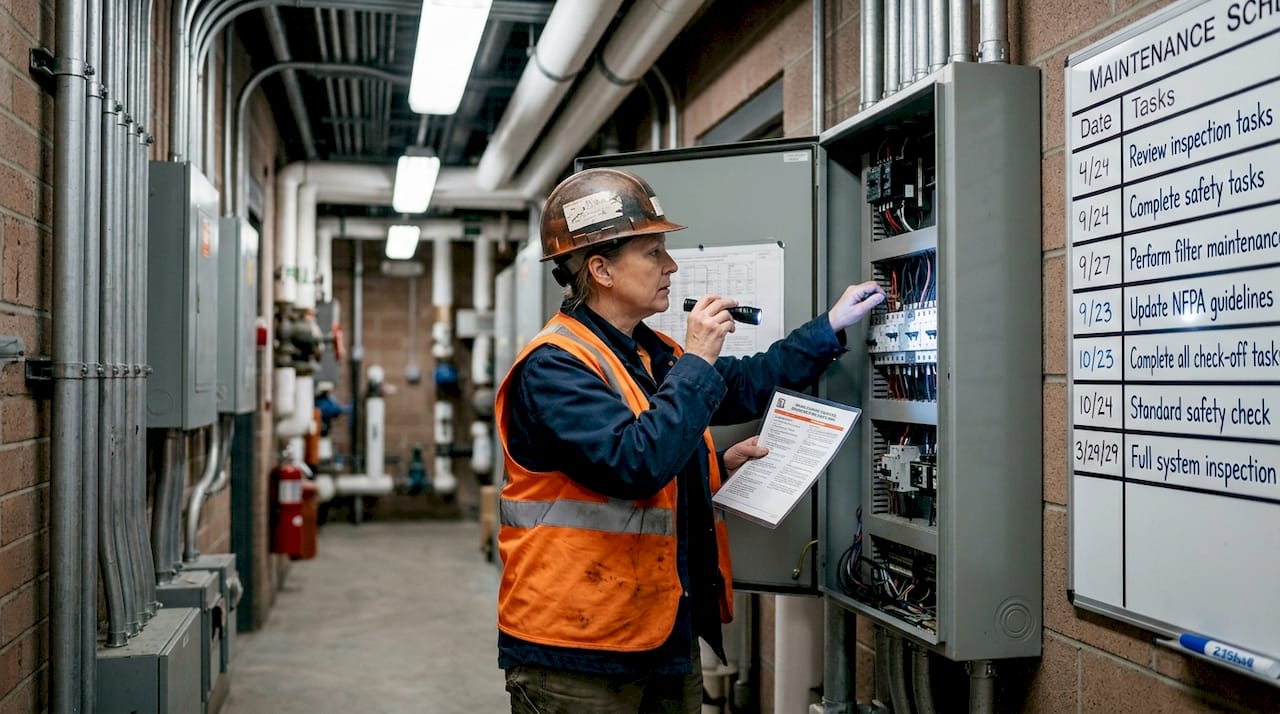
Electrical incidents remain among the deadliest threats in industrial workplaces, yet the gap between written safety programs and daily practice is wider than most compliance officers realize. Over 2,070 workers died from electrical contact between 2011 and 2024, with manufacturing among the most affected sectors. The challenge is not just knowing the rules. It is building systems that hold up under real operating conditions, shift changes, and aging infrastructure. This article walks you through the core hazard types, the standards that govern them including NFPA 70E and NFPA 780, and the practical strategies that actually reduce risk in industrial facilities.
Table of Contents
- Understanding industrial electrical hazards
- Core standards: NFPA 70E and electrical safety essentials
- Lightning risk in industrial contexts
- Advanced strategies: Risk assessment, digital tools, and post-modification audits
- A hard look at what actually works in industrial electrical safety
- How Indelec can strengthen your facility’s safety and compliance
- Frequently asked questions
Key Takeaways
| Point | Details |
|---|---|
| Follow proven standards | NFPA 70E and 780 provide clear methods for managing workplace electrical and lightning safety. |
| Evaluate risks regularly | Risk assessments and arc flash studies should be performed every five years or after system changes. |
| Integrate digital tracking | Facility managers improve compliance and reduce incidents by digitizing LOTO and safety processes. |
| Prioritize engineering controls | Engineering solutions and unified audits create more safety impact than PPE or checklist-only approaches. |
| Tailor lightning protection | Customized, code-compliant lightning protection is essential for industrial sites facing climate risk. |
Understanding industrial electrical hazards
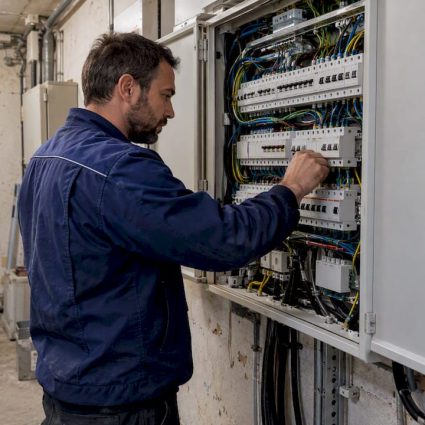
Industrial environments concentrate electrical risk in ways that office or commercial buildings simply do not. High-voltage distribution systems, rotating machinery, outdoor switchgear, and process control rooms all create overlapping hazard zones. Understanding the specific types of hazards you face is the first step toward managing them.
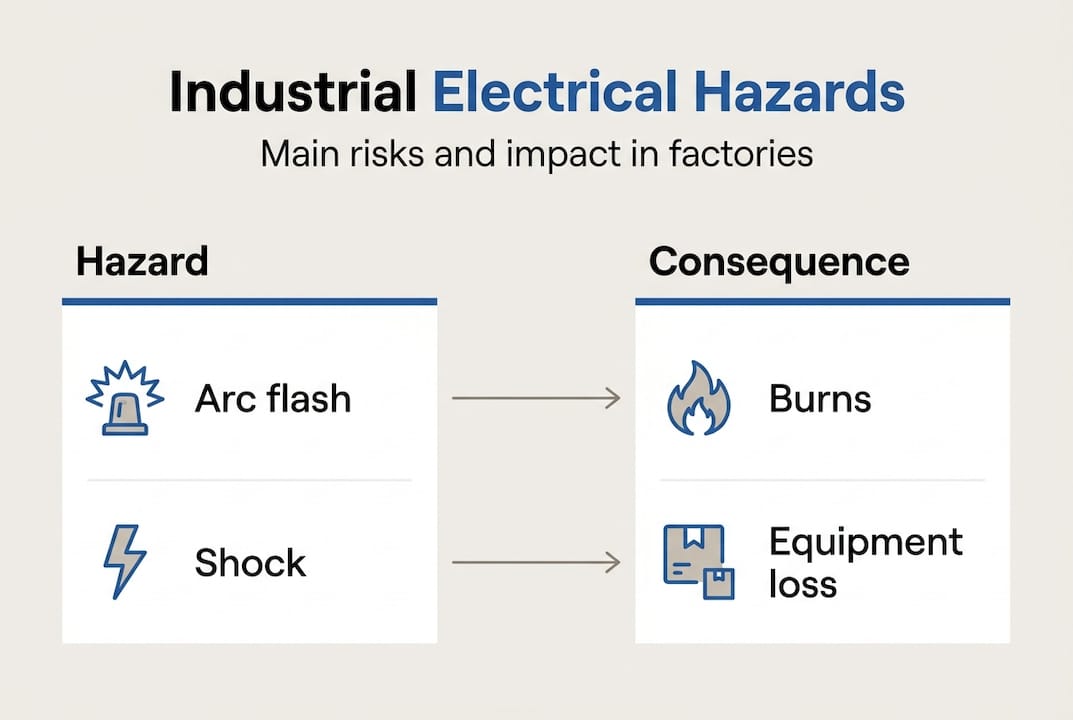
The four main hazard categories are arc flash, electric shock, equipment failure, and lightning. Arc flash releases explosive thermal energy that can reach temperatures of 35,000°F, vaporizing copper conductors and causing severe burns at distances of several feet. Electric shock, even at lower voltages, can cause cardiac arrest. Equipment failure from insulation breakdown or corrosion can trigger both of the above. Lightning, though intermittent, can destroy control systems, ignite flammable storage, and injure workers in outdoor yards or near tall structures.
| Hazard type | Common industrial source | Potential consequence |
|---|---|---|
| Arc flash | Switchgear, panel work | Burns, fatalities, equipment loss |
| Electric shock | Exposed conductors, LOTO failures | Cardiac arrest, falls |
| Equipment failure | Aging insulation, corrosion | Fire, unplanned downtime |
| Lightning strike | Outdoor equipment, tall structures | Structural damage, ignition, data loss |
The regulatory picture reinforces the urgency. Electrical violations rose 29% from 2022 to 2023 in manufacturing, and lockout/tagout (LOTO) remains the top-cited OSHA violation in the sector. That trend reflects a systemic problem, not isolated incidents.
Certain conditions amplify every hazard. Confined spaces and equipment above 15kV create scenarios where standard calculations and PPE tables may not apply, demanding engineering judgment beyond the baseline standard.
The impacts of a single serious incident extend far beyond the immediate injury:
- Worker fatalities and permanent disability
- Unplanned production downtime lasting days or weeks
- OSHA citations and civil penalties reaching six figures
- Increased insurance premiums and reputational damage
- Mandatory third-party audits and corrective action plans
“LOTO violations consistently top OSHA’s most-cited list in manufacturing. Every year this remains true is a year the industry has failed to close a known gap.”
If you want a clearer picture of how to protect your facility effectively against both electrical and lightning hazards, understanding the hazard landscape is where that work begins.
Core standards: NFPA 70E and electrical safety essentials
With the main hazards defined, it is critical to ground your approach in trusted industry standards. NFPA 70E is the primary framework governing electrical safety in the workplace. It defines arc flash risk assessment, LOTO procedures, PPE selection, and the requirements for establishing electrically safe work conditions. Knowing the standard is not enough. You need to operationalize it.
Here is a practical sequence for implementing NFPA 70E in your facility:
- Conduct a hazard identification survey across all electrical systems, noting voltage levels, equipment age, and access frequency.
- Perform an arc flash risk assessment for all panels and switchgear, calculating incident energy levels and flash protection boundaries.
- Label all equipment with arc flash hazard data, including incident energy in cal/cm², working distance, and required PPE category.
- Select and issue PPE based on the four-category system, matching protection level to calculated hazard.
- Train all qualified workers annually on LOTO procedures, PPE use, and emergency response.
- Audit the program at least once per year, updating assessments after any system modification.
PPE category selection is one of the most misunderstood parts of the standard. The table below summarizes what each category requires:
| PPE category | Minimum arc rating (cal/cm²) | Typical voltage range | Key protection required |
|---|---|---|---|
| 1 | 4 | 120V–240V | Arc-rated shirt, pants, face shield |
| 2 | 8 | 208V–600V | Arc-rated suit, balaclava, hard hat |
| 3 | 25 | 600V–15kV | Arc flash suit, arc-rated gloves |
| 4 | 40 | Up to 15kV | Full arc flash suit, multilayer system |
Pro Tip: Engineering controls, such as remote racking, remote switching, and arc flash detection relays, should always be your first line of defense. PPE is the last layer, not the primary one. Facilities that invest in engineering controls consistently see lower incident rates than those that rely on PPE compliance alone.
One important gap: NFPA 70E’s standard arc flash tables and calculations are designed for systems up to 15kV. Above that threshold, you need specialized engineering analysis. For a detailed compliance and lightning safety guide that addresses both standard and edge-case scenarios, it is worth reviewing how these requirements interact with your specific infrastructure. You can also align OSHA and NFPA 70E requirements to build a more unified compliance program.
Lightning risk in industrial contexts
With the foundation of core electrical safety in place, let’s tackle the equally critical but often underestimated threat of lightning. Industrial sites are structurally and operationally more vulnerable to lightning than most facility managers account for in their safety programs.
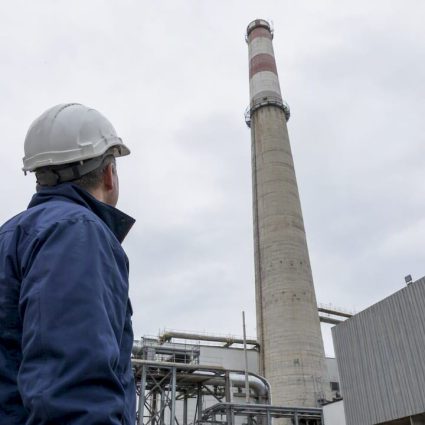
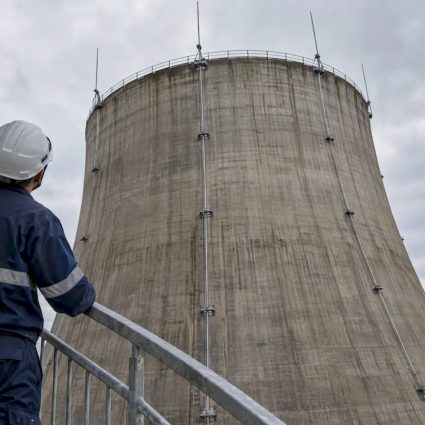
Tall structures, outdoor storage yards, tank farms with flammable materials, and exposed control rooms all create elevated risk profiles. A direct strike is only one concern. Side flash, ground potential rise, and conducted surges through power and data lines can damage equipment and injure workers even when lightning strikes hundreds of feet away.
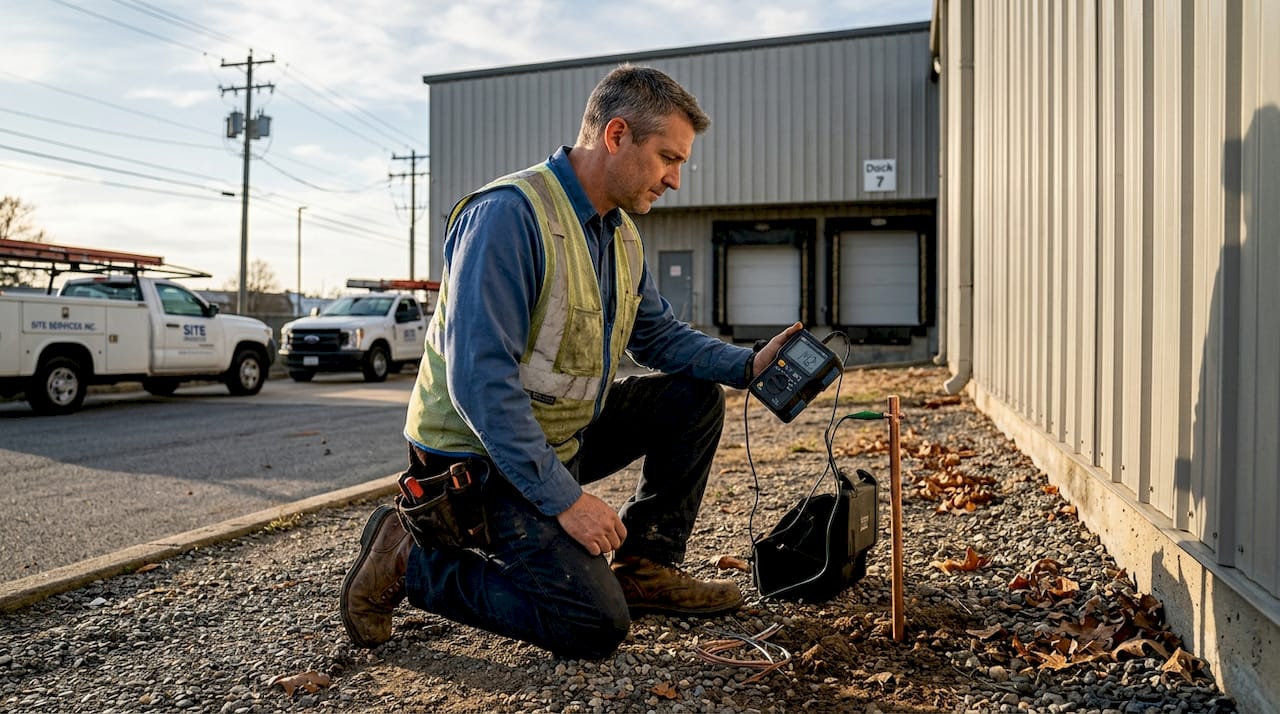
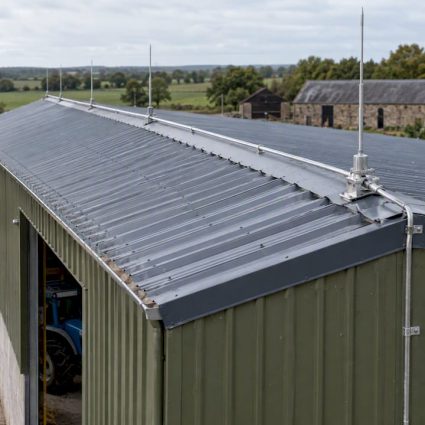
NFPA 780 specifies the requirements for a compliant lightning protection system (LPS): air terminals positioned to intercept strikes, downconductors to carry current safely to ground, grounding electrodes with resistance at or below 10 ohms, and equipotential bonding to prevent dangerous voltage differences between conductive structures. Self-protecting metallic structures must be continuous and at least 4.8mm thick to qualify.
During any LPS inspection, check for the following:
- Air terminal placement and condition, especially after severe weather
- Downconductor continuity and secure attachment to the structure
- Ground resistance measurement, verified with a dedicated earth tester
- Equipotential bonding connections at all metallic entry points
- Surge protection devices on power and data lines entering protected zones
Grounding performance is heavily influenced by soil resistivity (the measure of how strongly soil resists electrical current flow). High-resistivity soils require longer or more complex electrode systems to achieve the required resistance. The table below illustrates this relationship:
| Soil type | Typical resistivity (Ω·m) | Minimum electrode depth needed |
|---|---|---|
| Wet clay | 20–100 | Standard depth (2–3m) |
| Sandy loam | 100–300 | Extended depth (4–6m) |
| Dry sand | 300–1,000 | Deep earth or chemical treatment |
| Rock or gravel | 1,000+ | Specialized deep-earth drilling |
In high-resistivity soils, a standard driven rod may deliver ground resistance well above 10 ohms, leaving your system non-compliant and your facility exposed. This is a detail that matters enormously on sites with sandy or rocky substrates. Review the full NFPA 780 requirements and explore current lightning protection standards to understand what applies to your site. If you have specific lightning risk questions about your facility type, those are worth addressing before the next storm season.
Advanced strategies: Risk assessment, digital tools, and post-modification audits
Beyond standards, continuous improvement and technology make safety programs robust and sustainable over time. Facilities that treat electrical safety as a living system rather than a periodic compliance exercise consistently outperform those that rely on static checklists.
Here is a practical framework for ongoing risk management:
- Map your electrical and lightning risk zones using current facility drawings and recent inspection data. Flag areas with aging equipment, recent modifications, or high lightning exposure.
- Implement digital LOTO and PPE tracking to log every procedure, equipment change, and training event. Paper logs create accountability gaps that digital systems close.
- Schedule arc flash studies on a five-year cycle or immediately after any significant system change, including transformer replacements, new feeders, or load additions.
- Integrate lightning risk into your standard safety review rather than treating it as a separate program. Climate data shows that lightning frequency is shifting in many regions, making historical assumptions unreliable.
- Assign ownership for each risk zone to a named individual, ensuring follow-through on corrective actions.
Knowing when to trigger an unscheduled arc flash study is just as important as the five-year cycle. Update your incident energy analysis after:
- Adding or removing generation sources
- Changing transformer size or impedance
- Modifying protective relay settings
- Expanding or reconfiguring distribution panels
- Significant load growth that changes fault current levels
Pro Tip: Combine your arc flash, LOTO, and lightning protection audits into a single annual safety review. Running them separately creates scheduling gaps and misses the interaction effects between hazard types, especially in facilities where lightning-induced surges can trigger arc flash events downstream.
Facilities in high-lightning-frequency zones or with frequent system changes should consider integrating digital safety tracking into their maintenance management systems. For a thorough overview of LPS design considerations, the lightning protection for buildings guide covers both standard and complex scenarios. You can also review lightning protection system application options relevant to industrial configurations.
A hard look at what actually works in industrial electrical safety
After years of working with industrial facilities on lightning and electrical protection, one pattern stands out: the sites with the best safety records are not the ones with the thickest compliance binders. They are the ones that treat every near-miss as a data point and act on it fast.
Conventional wisdom says annual training is enough. It is not. Training without root-cause analysis of near-misses is just paperwork. Real improvement comes from asking why a LOTO procedure was skipped, not just retraining the worker who skipped it.
Engineering controls and digitized audit logs consistently outperform checklists in reducing incidents. When a remote racking system eliminates the need to open energized switchgear, no amount of PPE non-compliance can cause an arc flash injury at that point. That is a permanent fix, not a behavioral one.
Lightning protection is where we see the biggest gap between facilities. Most sites check the box with a basic LPS installation and never revisit it. But soil conditions change, structures are modified, and climate patterns shift. A grounding system that met the 10-ohm threshold five years ago may not meet it today. Facilities that use local climate data and schedule regular ground resistance testing separate themselves from those that are simply waiting for the next incident.
True culture change matters more than new hardware. The best safe lightning solutions are only as effective as the people who maintain and inspect them.
How Indelec can strengthen your facility’s safety and compliance
Ready to apply these insights? Indelec has been designing and installing lightning protection systems for industrial facilities since 1955, with deep expertise in NFPA 780 compliance, grounding system design, and site-specific risk assessment.

Whether you need a new lightning protection system application for a complex industrial site, specialized deep earth grounding solutions for high-resistivity soil conditions, or guidance on current lightning standards expertise to keep your compliance program current, Indelec brings the technical depth and field experience to get it right. Our audit and certification services give facility managers documented evidence of compliance, not just a verbal assurance. Contact our team to discuss your site’s specific challenges.
Frequently asked questions
What are the most common electrical safety violations in industries?
The top violations are LOTO and electrical hazards in manufacturing, which together drove a 29% increase in OSHA citations from 2022 to 2023. Addressing these two areas first delivers the greatest compliance improvement.
How often should arc flash and electrical risk assessments be updated?
Industry best practice requires updates every five years or after significant changes to your electrical system. Post-modification arc studies are mandatory when fault current levels or protective device settings change.
What features must a compliant lightning protection system include for industrial sites?
An industrial LPS must include air terminals, downconductors, grounding with resistance under 10 ohms, and equipotential bonding. These NFPA 780 LPS requirements apply to all new and substantially modified installations.
How do lightning risks differ from typical electrical hazards in industrial environments?
Lightning can damage structures, ignite flammable materials, and disrupt equipment through conducted surges even without a direct strike. These lightning risk factors demand specialized grounding and bonding strategies that go beyond standard electrical safety programs.
Are there exceptions for high-voltage or unique installation scenarios?
Arc flash above 15kV and nonstandard sites such as confined spaces require alternate assessment methods and engineering judgment outside the standard NFPA 70E tables.