Why lightning conductors matter: compliance, safety, risk reduction
TL;DR:
- Lightning strikes cause hidden damage through surges affecting equipment and operations.
- Proper lightning protection includes air terminals, conductors, grounding, and surge protection devices.
- Compliance standards and regular maintenance are essential for effective protection and insurance coverage.
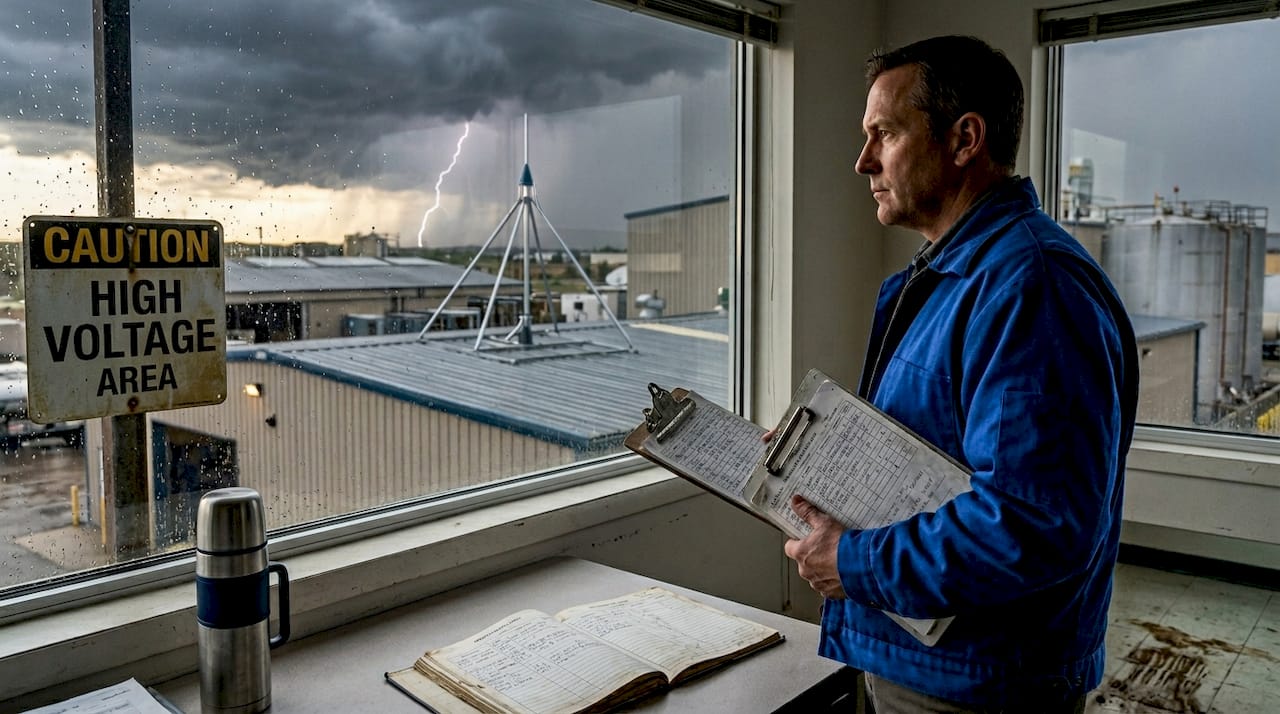
Most facility managers assume lightning is a problem for exposed hilltop towers or rural substations, not their urban warehouse or manufacturing campus. That assumption is costly. Lightning strikes the continental United States roughly 20 million times per year, and the damage is not limited to direct hits. Indirect surges travel through power lines, data cables, and grounding networks, silently destroying equipment and triggering shutdowns across entire facilities. For safety officers and facility managers, the gap between “we’ve never had a strike” and “we are fully protected and compliant” is wider than most realize, and the consequences of that gap are measured in downtime, liability, and uninsured losses.
Table of Contents
- The hidden risks of lightning in industrial and commercial facilities
- Lightning conductors: how they work and what they prevent
- Legal and compliance drivers: mandatory standards and insurance requirements
- Installation and maintenance: what makes lightning protection truly reliable
- Special considerations for sensitive and high-risk environments
- What most facility managers get wrong about lightning protection
- Your next steps: expert lightning protection for your facility
- Frequently asked questions
Key Takeaways
| Point | Details |
|---|---|
| Lightning is a real business risk | Modern industrial and commercial sites face frequent, severe lightning threats—both direct and via surges. |
| Standards and compliance matter | NFPA 780, UL 96A, and IEC 62305 set required benchmarks for safe and insurable protection systems. |
| Installation quality is critical | Professional installation and ongoing inspections stop weak points from undermining safety. |
| Sensitive sites require extra care | Hazardous, data-driven, or mission-critical facilities need advanced attention and tailored solutions. |
| Strategic protection pays off | Investing in robust systems is a strategic benefit—not just a legal box to check. |
The hidden risks of lightning in industrial and commercial facilities
To understand why lightning conductors are essential, let’s get clear on the actual risks your site faces.
Lightning is not a rare event. It is a statistically predictable hazard that your facility lightning safety program must account for on the same level as fire suppression or fall protection. What makes it tricky is that the most damaging effects are often invisible until it is too late.
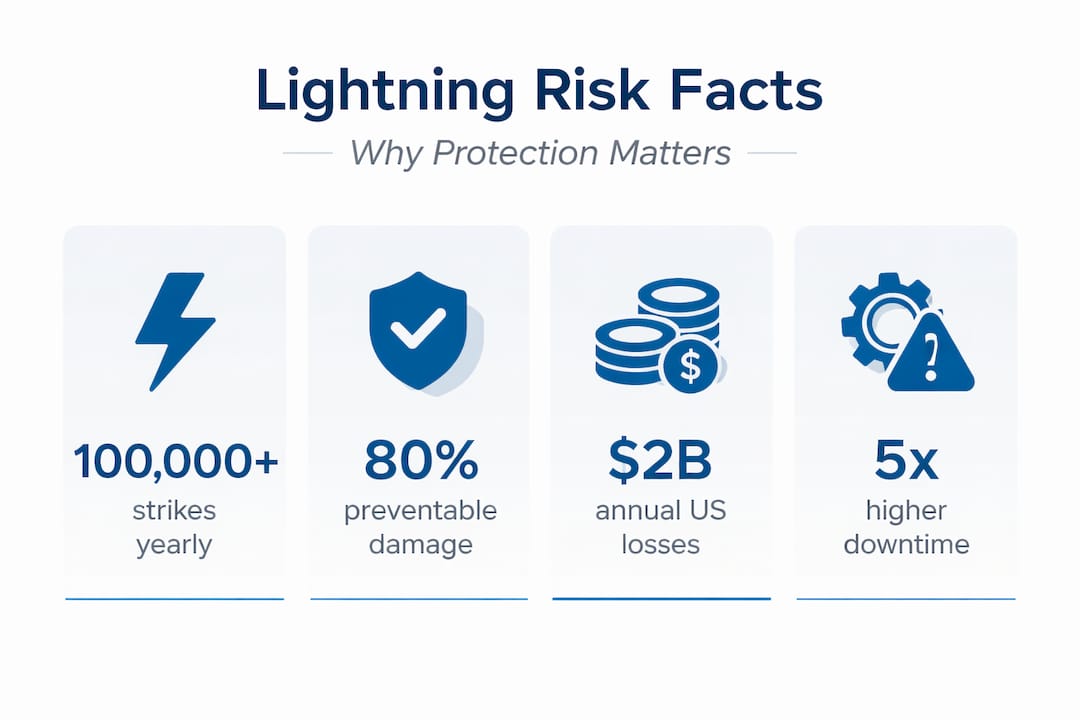
Direct strikes are the obvious threat. They ignite fires, rupture structural elements, and destroy rooftop equipment. But the majority of lightning-related losses come from indirect effects: voltage surges traveling through power distribution networks, telecommunications lines, and grounding conductors. A single strike landing 300 meters from your facility can induce a transient overvoltage strong enough to destroy a programmable logic controller (PLC) or corrupt a SCADA server.
Consider what that means in practice:
- A manufacturing line that loses its PLC mid-run requires a full restart, calibration check, and potentially a product quality audit.
- A data center that absorbs a surge event through an unprotected fiber entry point can lose weeks of logged operational data.
- A chemical processing plant where a surge trips safety interlocks may face a mandatory regulatory inspection before operations resume.
“Edge cases where lightning protection needs special attention in industrial settings include industrial lightning risk to hazardous or regulated operations and sites where surge pathways exist across power and data networks, including PLC and SCADA environments.”
The cascading operational risk is real. A single unprotected entry point, whether a power feed, an Ethernet run, or an antenna cable, can become the pathway for a surge that takes down systems far removed from the original strike point. Facilities with interconnected networks across multiple buildings face exponentially higher exposure because each connection is a potential surge pathway.
Lightning conductors: how they work and what they prevent
Knowing the risks, it is critical to grasp how lightning conductors address these threats and what makes a system effective.
A lightning conductor system does not repel or attract lightning in a simple sense. It provides a controlled, low-impedance path for lightning current to travel safely from the point of strike to the earth, bypassing the building structure, occupants, and sensitive equipment. A complete system includes four integrated components:
- Air terminals (lightning rods): Positioned at the highest points of a structure to intercept the downward leader of a lightning strike.
- Down conductors: Heavy-gauge cables that carry the massive current pulse from the air terminal to the ground termination system, routed to minimize side-flash risk.
- Earth termination network: Ground rods, rings, or grids that safely dissipate the energy into the soil. Soil resistivity directly affects performance, which is why site-specific grounding design matters.
- Surge protective devices (SPDs): Installed at every power and data entry point to clamp transient overvoltages before they reach sensitive equipment.
Facility managers and safety officers rely on recognized standards for lightning conductors to justify both design methodology and installation requirements. In the US, NFPA 780 and UL 96A govern lightning protection system design and installation. Internationally, the IEC 62305 series provides the framework for risk assessment, lightning protection level (LPL) selection, and system verification. These standards are not optional suggestions; they are the technical baseline that insurers, regulators, and building code authorities use to evaluate your protection.
The real losses a properly designed system prevents go beyond fire and structural damage. Think about infrastructure lightning protection in terms of avoided costs: equipment replacement, emergency contractor fees, regulatory fines, production downtime, and the reputational damage that follows a preventable incident. A well-engineered system also keeps your SPDs from absorbing repeated surge events that degrade their performance over time, because the primary system is intercepting and diverting the bulk of the energy before it reaches those devices.
Pro Tip: Do not treat SPDs as a standalone solution. They are the last line of defense in a coordinated protection strategy, not a substitute for a properly designed air terminal and grounding system. Skipping the primary system and relying only on SPDs is like removing your building’s sprinkler system and trusting only the fire extinguishers.
Legal and compliance drivers: mandatory standards and insurance requirements
Understanding the direct threat is not enough. Compliance and insurance realities up the stakes and make robust protection non-negotiable.
For most industrial and commercial facilities, lightning protection is not a discretionary upgrade. It is a compliance obligation. Facilities in regulated industries, including petrochemical, pharmaceutical, defense, and data infrastructure sectors, face mandatory requirements tied directly to lightning protection standards and the real-world examples of how those standards are enforced.
Here is a side-by-side look at the two dominant frameworks:
| Feature | NFPA 780 / UL 96A (US) | IEC 62305 (International) |
|---|---|---|
| Risk assessment method | Site-specific, prescriptive | Quantified risk calculation |
| LPL classification | Not explicitly tiered by LPL | LPL I through IV |
| SPD coordination | Required at service entrances | Required, coordinated by zone |
| Inspection requirement | Annual recommended | Periodic, documented |
| Applicability | US domestic projects | Global, including EU and Asia |
The UFGS 26 41 00 standard for US federal facilities explicitly requires that facility managers use these recognized standards to justify design methodology, LPL selection, and installation requirements. That language matters: “justify” means documentation and audit trails, not just hardware on the roof.
Insurance is the other major driver. Insurers increasingly require proof of compliant lightning protection as a condition of coverage for industrial and commercial properties. Facilities with certified, maintained systems often qualify for reduced premiums, sometimes significantly. More critically, a facility that experiences a lightning-related loss without a compliant system in place may find its claim partially or fully denied. The insurer’s argument is straightforward: you knew the standard, you had the means to comply, and you chose not to.
The consequences of non-compliance are concrete:
- Failed inspections that delay occupancy permits or trigger mandatory shutdowns.
- Regulatory fines in industries where lightning protection is tied to process safety management (PSM) regulations.
- Denied insurance claims that leave the facility owner absorbing the full cost of equipment damage, fire remediation, and business interruption.
- Personal liability exposure for the safety officer or facility manager who signed off on an inadequate system.
Installation and maintenance: what makes lightning protection truly reliable
Effective protection does not stop at buying the right hardware or ticking a code box. True safety depends on how the system is put together and maintained.
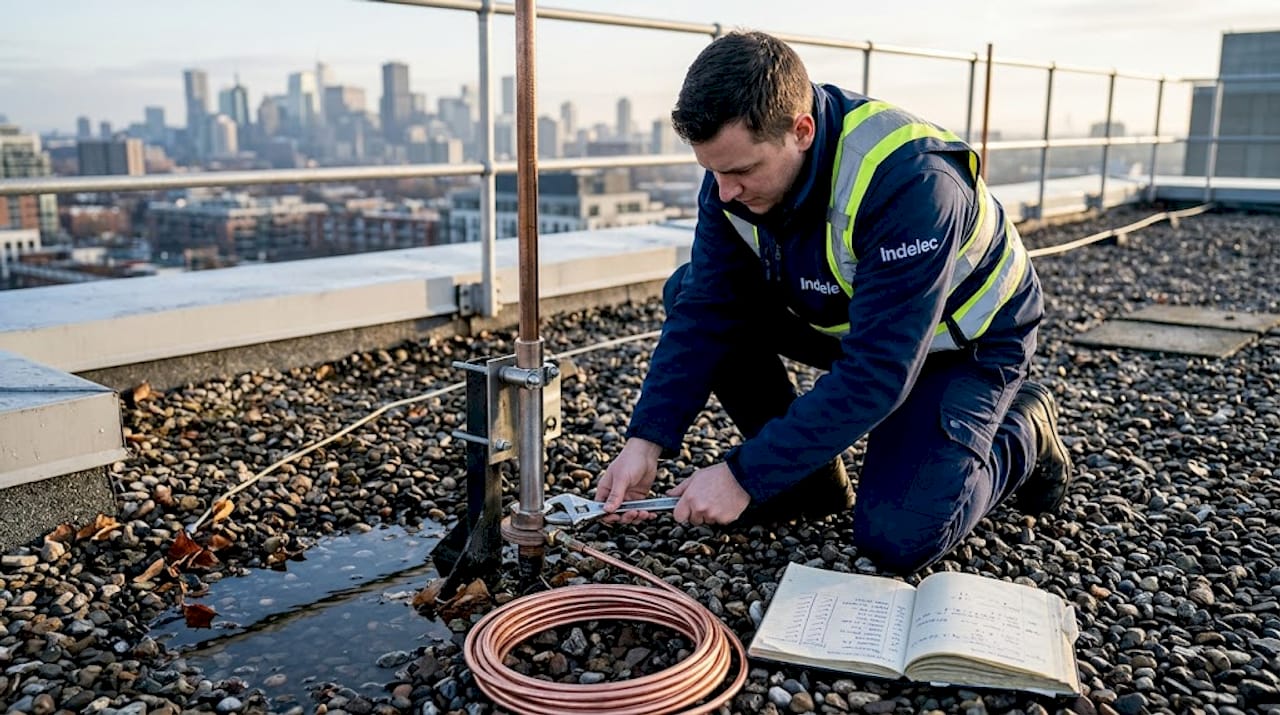
The most common failure mode in lightning protection is not a design flaw. It is an installation error. Correct installation mechanics and ongoing verification matter because even a correctly designed system can fail if bonding, grounding, and surge coordination are incomplete or if installation quality is poor. This is a critical distinction that too many facility managers overlook when they accept the lowest bid on a protection project.
| Common installation failure | Why it matters | Consequence |
|---|---|---|
| High ground resistance | Energy cannot dissipate safely | Side-flash, equipment damage |
| Missed equipotential bonds | Voltage differences between systems | Arc flash, equipment destruction |
| Incorrect SPD selection | Wrong clamping voltage or energy rating | SPD fails, surge reaches equipment |
| Poorly routed down conductors | Excessive bends increase impedance | System bypassed during strike |
| No inspection documentation | Cannot verify compliance | Insurance and regulatory exposure |
The industrial lightning protection guide for contractors and facility teams consistently highlights the same weak points: grounding electrode systems that were never tested after installation, equipotential bonding that was skipped on secondary structures, and SPDs that were installed but never coordinated with the primary system’s expected current levels.
Key maintenance responsibilities every facility manager should track:
- Annual visual inspection of all air terminals, down conductors, and connection points for corrosion, mechanical damage, or disconnection.
- Ground resistance testing every one to two years, or after significant soil disturbance near grounding electrodes.
- SPD status checks after every significant storm event, since SPDs have a finite energy absorption capacity and degrade with use.
- Documentation updates whenever the facility adds structures, equipment, or utility connections that alter the protection zone or surge pathways.
Pro Tip: Build lightning protection inspection into your existing preventive maintenance schedule rather than treating it as a separate annual event. Facilities that integrate it into routine electrical maintenance catch degradation earlier and maintain better documentation for compliance audits. Review installation and maintenance best practices to structure your program correctly from the start.
Special considerations for sensitive and high-risk environments
Beyond mainstream installations, some environments need even more rigorous approaches.
Certain facility types face compounded risk that standard installations may not fully address. If your site falls into any of the following categories, you need to evaluate whether your current protection strategy is genuinely adequate or just minimally compliant.
- Hazardous material storage and processing: Petrochemical, explosive, and flammable material facilities face regulatory requirements that go beyond NFPA 780. A lightning-initiated fire in a chemical storage area is not just an insurance event; it is a potential process safety incident with regulatory, criminal, and community consequences.
- PLC and SCADA-dependent operations: Sites where industrial lightning risk is amplified by extensive control networks need surge protection coordinated across every network entry point, not just the main power service. A surge entering through a field instrument cable can travel directly into a control panel.
- Data centers and mission-critical facilities: These sites typically require LPL I or LPL II protection under IEC 62305, the highest levels of protection, along with shielded cable management and zone-based SPD coordination.
- Off-grid and battery storage systems:Off-grid power systems and battery storage installations are particularly vulnerable because they lack the passive surge absorption that utility grid impedance provides. Every energy pathway in and out of the storage system is a potential surge entry point.
- Tall structures and rooftop equipment: Communication towers, HVAC systems, and rooftop solar arrays all increase strike probability and require purpose-designed protection for high-risk sites that accounts for the specific geometry and equipment sensitivity.
For these environments, early streamer emission (ESE) air terminals and advanced testing protocols may be appropriate. ESE technology extends the protection radius compared to conventional Franklin rods, which can reduce the number of air terminals needed on complex rooftop layouts without compromising coverage.
What most facility managers get wrong about lightning protection
At this point, it is clear why robust lightning protection matters. But let us address the subtle traps that smart managers still fall into.
The most common mistake is treating lightning protection as a one-time compliance event rather than a living system. A manager installs a system, gets the inspection certificate, files it away, and considers the matter closed. Five years later, the facility has added a new server room, extended a production building, and replaced the main electrical switchgear. None of those changes triggered a lightning protection review. The original system no longer covers the full facility, and the new switchgear’s SPD coordination was never updated.
Minimum code compliance is a floor, not a ceiling. The standards tell you the minimum acceptable level of protection for a generic risk classification. They do not account for the specific operational consequences of a strike at your facility. A thorough lightning risk assessment goes beyond the standard checklist to quantify what a strike event would actually cost you in downtime, data loss, regulatory exposure, and recovery time. That number almost always justifies investing above the minimum.
The false economy of cutting corners is particularly dangerous in lightning protection because the failure mode is invisible until it is catastrophic. A poorly bonded down conductor looks identical to a correctly bonded one. A degraded SPD shows no external signs of failure until a surge arrives and passes straight through it. The cost of doing it right the first time is a fraction of the cost of a single major event.
Facility leaders who treat lightning protection as a strategic element of business continuity, rather than a compliance checkbox, consistently deliver better outcomes. They schedule reviews when the facility changes. They maintain documentation that satisfies both insurers and regulators. They invest in professional design and testing rather than the lowest-cost installation. That approach is not just safer. It is smarter business.
Your next steps: expert lightning protection for your facility
Ready to move from compliance and checklists to true resilience? Here is how to take action.
Indelec has been designing and installing lightning protection systems since 1955, and the work we do for industrial and commercial facilities goes well beyond placing rods on a rooftop. Whether your site needs a Prevectron3 air terminal for wide-area coverage, a full system application service for complex multi-building campuses, or deep earth grounding for sites with challenging soil resistivity, our engineering team brings the technical depth and field experience to get it right.

Our approach starts with a site-specific risk assessment, not a catalog selection. We evaluate your facility’s lightning exposure, identify every surge pathway, and design a coordinated system that meets or exceeds the applicable standard for your industry and jurisdiction. For facilities that need compliance documentation, audit support, or system upgrades after a change in operations, our team provides the full service cycle from design through certification.
Frequently asked questions
What standards must lightning conductors in the US comply with?
US facilities must follow NFPA 780 and UL 96A, which set strict criteria for design, installation, and verification of lightning protection systems. These standards define everything from air terminal placement to grounding electrode requirements and SPD coordination.
Do insurance companies require lightning conductors?
Most insurers require compliant lightning protection and may offer lower premiums when proper systems are installed and maintained. Facilities without a compliant system risk having lightning-related claims partially or fully denied.
What are the top installation mistakes with lightning conductors?
Poor grounding, missed electrical bonds, and undersized or incorrect surge protective devices top the list of common failures. Bonding, grounding, and surge coordination failures are the most frequent causes of system underperformance after a strike.
Are lightning conductors needed for facilities with battery storage or off-grid systems?
Yes, any site with sensitive electrical infrastructure is at risk, particularly off-grid systems and those with battery storage, which are vulnerable to surges. These systems lack the natural surge buffering of a utility grid connection, making dedicated industrial lightning risk mitigation even more critical.