Surge arresters: Protect your facility and cut downtime
TL;DR:
- Surge arresters protect equipment by diverting harmful voltage spikes to ground instantly.
- Internal surges from motors and switching are often underestimated and pose significant risks.
- Regular monitoring and maintenance are essential to ensure surge protection systems remain effective.
A single lightning event or uncontrolled electrical surge can halt an entire production line for days. Lightning damage averages $500,000 per incident in industrial facilities, and that figure doesn’t include the cascading losses from missed deliveries, regulatory scrutiny, and emergency procurement. Yet many facility managers treat surge protection as an afterthought, investing heavily in fire suppression and physical security while leaving electrical infrastructure exposed. Surge arresters are the critical layer that stands between a brief voltage spike and catastrophic equipment failure. This article breaks down how they work, what failure really costs, and how to build a defensible, cost-effective protection strategy.
Table of Contents
- Understanding surge arresters: What they are and how they work
- The real risks: What happens when surge protection fails
- How surge arresters save money: ROI and long-term benefits
- Common failure modes and maintenance best practices
- Our perspective: What most facility managers overlook in surge protection
- Take the next step: Expert solutions for surge and lightning protection
- Frequently asked questions
Key Takeaways
| Point | Details |
|---|---|
| Major cost reduction | Investing in surge arresters dramatically lowers the risk of expensive downtime and equipment loss. |
| Comprehensive risk coverage | Surge arresters protect against both external lightning and internal electrical surges. |
| Strong return on investment | Facilities typically recover installation costs within 3–7 years from avoided losses. |
| Ongoing maintenance matters | Regular inspections and monitoring prevent hidden arrester failures that leave facilities exposed. |
Understanding surge arresters: What they are and how they work
Surge arresters are protective devices connected between electrical conductors and ground. Their job is straightforward: when voltage on a line exceeds a safe threshold, the arrester activates, diverts the excess energy to ground, and returns to standby mode once the spike passes. That cycle can happen in microseconds, faster than any mechanical breaker or fuse can respond.
At the core of most modern surge arresters are metal oxide varistors (MOVs). An MOV is a semiconductor element with a highly nonlinear resistance characteristic. Under normal voltage, it presents very high resistance and passes virtually no current. When voltage spikes beyond the clamping level, resistance drops sharply and the device conducts, channeling harmful energy away from sensitive equipment. Some higher-rated arresters for transmission and substation use stack multiple MOV discs in series to handle greater energy capacity.
It’s worth being precise about how surge arresters differ from related devices, because confusion here leads to under-protected facilities:
- Lightning rods (air terminals): Intercept direct lightning strikes and conduct the discharge current safely to ground via down conductors. They do not limit voltage on electrical distribution lines.
- Grounding systems: Provide the low-impedance earth path that both lightning rods and surge arresters rely on. Without solid grounding, neither works effectively.
- Surge arresters: Address the electrical transient, the fast voltage spike traveling through your wiring, whether that spike originated from a direct strike, a nearby strike inducing current on cables, or entirely internal sources.
That last point deserves emphasis. Surge events include not just lightning, but also internal facility sources such as motors starting or stopping, welding equipment, variable-frequency drives, and capacitor bank switching. An industrial plant running heavy machinery can generate dozens of significant internal transients every single day. These internal surges may never trip a breaker, but they stress insulation and degrade semiconductor components steadily over time.
Common scenarios that send damaging surges through your facility:
- A nearby lightning strike inducing voltage on overhead cables feeding your switchgear
- A large motor starting under load, creating a back-EMF spike on the distribution bus
- Utility grid switching operations during peak demand or fault clearing
- Welding stations sharing a distribution panel with precision instrumentation
- Uninterruptible power supply (UPS) switchovers during grid anomalies
As you can see, surge protection for industrial facilities is never just about thunderstorms. It’s about the full spectrum of transient events that threaten equipment reliability.
Pro Tip: Even small surges that never cause immediate failure can degrade insulation and semiconductor junctions over months. If you’re seeing unexplained instrument failures or premature motor bearing wear, chronic low-level surges may be the root cause. Log your power quality before you replace equipment.
The real risks: What happens when surge protection fails
Understanding what surge arresters do is one thing. Seeing the damage that follows when protection is absent or inadequate is what drives real investment decisions.
Surges arrive from three main sources: external events (lightning, utility faults), internal facility operations (motor switching, welding), and grid-side disturbances (power factor correction switching, transformer energization). Each source has a different frequency, energy level, and point of entry, which is why a single arrester at the service entrance is rarely enough for a complex industrial facility.
The consequences of uncontrolled surges fall into several categories:
- Direct equipment failure: A sufficiently energetic spike can puncture insulation, destroy MOV components in drives and PLCs, or flash over transformer windings. Replacement cost for a medium-voltage transformer alone can run $200,000 or more.
- Operational downtime: Equipment failure stops production. In process industries like chemical manufacturing or food processing, an unplanned shutdown also means waste, cleanup, and potentially lost batch product.
- Safety incidents: Surge-induced arcing can ignite flammable materials or create shock hazards for personnel during the event.
- Data and control system loss: Modern facilities rely heavily on networked sensors, SCADA systems, and industrial ethernet. A surge that reaches these networks can wipe configurations, corrupt data historians, or disable safety interlocks.
- Cumulative degradation: Repeated smaller surges that never cause immediate failure still shorten equipment life. A motor drive rated for ten years of service may fail in five if it absorbs hundreds of moderate transients annually.
“Protection is not a cost, it’s an investment. Every dollar spent on surge arresters reduces the probability of a multi-hundred-thousand-dollar loss event.” This isn’t a theoretical argument. It’s arithmetic.
The numbers are stark. Surges contribute to $150 billion in US business losses annually. That figure spans all sectors, but industrial and commercial facilities bear a disproportionate share because of their high equipment density and process sensitivity.
| Surge consequence | Typical cost range | Recovery time |
|---|---|---|
| PLC or drive replacement | $5,000 to $50,000 | 1 to 4 weeks |
| Medium-voltage transformer | $100,000 to $250,000 | 4 to 12 weeks |
| Full production line restart | $50,000 to $500,000+ | 1 to 8 weeks |
| Data system rebuild | $20,000 to $150,000 | 1 to 6 weeks |
| Single major incident (average) | $500,000 | Varies |
Exploring industrial lightning hazards in detail often reveals that the facilities most at risk are those with older wiring, mixed-voltage distribution, or recent expansions that added new surge sources without upgrading protection. And the regulatory dimension adds another layer: in many industries, a surge-induced safety system failure can trigger audits, fines, or mandatory production halts. Revisiting your electrical safety practices alongside your hardware protection is the complete picture.

How surge arresters save money: ROI and long-term benefits
Understanding the risks makes the financial case for surge protection straightforward. The question isn’t whether to invest, it’s how to frame the investment correctly so stakeholders approve it quickly.
Here is a structured way to build the ROI argument:
- Quantify your exposure. Identify all high-value equipment on your distribution system, estimate replacement and downtime costs for each, and calculate an expected annual loss based on your facility’s surge frequency and local lightning density (expressed as ground flash density, or GFD, available from meteorological data).
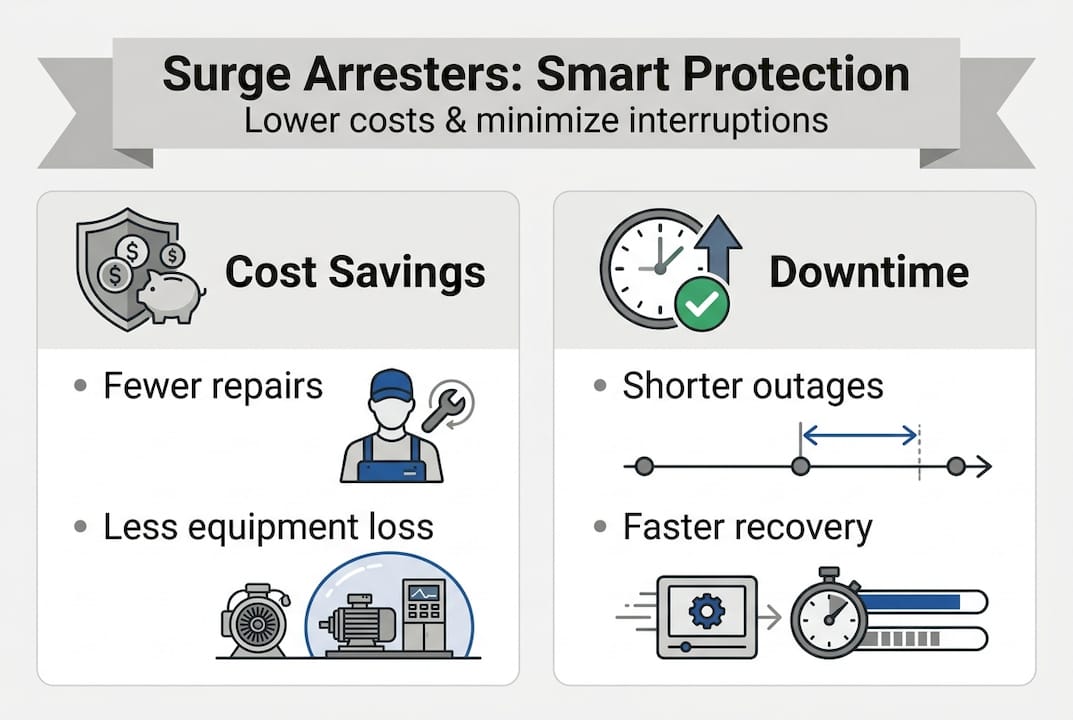
- Cost the protection system. A full surge protection installation for a mid-size industrial facility, covering service entrance, distribution panels, and sensitive equipment panels, typically falls in the range of $77,000 to $375,000.
- Calculate payback period. With a major incident averaging $500,000 and a reasonable annual incident probability of 10 to 20 percent for high-GFD regions, the expected annual loss is $50,000 to $100,000. At that rate, a $200,000 protection investment pays back in two to four years, well within most capital justification thresholds.
- Include indirect savings. This is where most ROI models leave money on the table. Surge protection reduces insurance premiums (many commercial insurers offer discounts of 10 to 20 percent for documented protection systems), extends equipment service life, and demonstrates regulatory due diligence that can accelerate permit approvals for facility expansions.
A complete facility surge protection guide will walk you through the site-specific variables, but the comparison below illustrates the core tradeoff:
| Scenario | 5-year equipment costs | 5-year downtime losses | Total 5-year exposure |
|---|---|---|---|
| No surge protection | $350,000 to $750,000 | $200,000 to $600,000 | $550,000 to $1.35M |
| Full surge protection installed | $77,000 to $375,000 (install) + $15,000 maintenance | $20,000 to $80,000 | $112,000 to $470,000 |
The protected scenario cuts total five-year exposure by 50 to 65 percent in realistic modeling. For capital budget discussions, that’s a compelling number even before factoring in insurance and compliance benefits.
Pro Tip: When presenting this analysis to finance or executive stakeholders, frame surge protection as a capital asset with a defined depreciation schedule, not as a maintenance expense. This classification changes how it appears on the balance sheet and often makes approval faster.
Common failure modes and maintenance best practices
Financial sense is only realized if surge arresters work when called upon. The bad news is that surge arresters do fail, often silently. The good news is that most failure modes are predictable and detectable with the right maintenance program.
Arrester failures include moisture ingress, thermal runaway, and MOV degradation from repetitive small transients. Understanding each mode helps you catch problems before they leave equipment exposed.
Moisture ingress is the most insidious failure mechanism, particularly in outdoor installations or facilities near the coast. Water penetrating the housing creates conductive paths (called tracking) across the insulator surface or internally through the MOV stack. This progressively increases leakage current and can eventually cause explosive failure during a surge event. Hydrophobic housing materials and sealed end fittings are essential in high-humidity or coastal environments.
Thermal runaway occurs when an arrester operates continuously near its maximum continuous operating voltage (MCOV). Temporary overvoltages (TOVs) from utility faults or ferroresonance can push MOV temperature beyond safe limits. Once thermal runaway begins, the process is self-reinforcing and ends in arrester destruction. Proper MCOV rating selection during design prevents this.
Mechanical damage from physical vibration, improper mounting, or impact can crack MOV discs internally without visible external signs. The arrester may pass a visual inspection but fail to clamp adequately under the next surge.
Progressive leakage current increase is the clearest early warning sign. A healthy arrester passes less than 0.5 mA of leakage current under normal operating voltage. A reading above 1 mA signals significant degradation and warrants replacement before the next severe event.
A practical maintenance checklist for surge arrester systems:
- Annual visual inspection: Check for casing cracks, discoloration, tracking marks, and corroded ground connections
- Annual leakage current measurement: Use a clamp-type leakage current meter at rated voltage; document trends over time
- Post-event inspection: After any known surge event, inspect all arresters in the affected zones, not just those that may have operated
- Five-year comprehensive review: Evaluate whether arrester ratings still match the current system configuration, particularly if loads or distribution voltage have changed
- Environmental reassessment: If the facility has added processes that increase internal surge generation, such as additional VFDs or welding stations, the protection scheme may need expansion
For electrical infrastructure safety, ungrounded systems deserve special attention. In an ungrounded or high-impedance grounded distribution system, a single line-to-ground fault raises the voltage on the other two phases to full line-to-line voltage. Arresters not specifically rated for this condition can enter thermal runaway during a fault, compounding the original problem. Always specify arrester ratings with your grounding system configuration in mind.
Pro Tip: Install continuous leakage current monitors on critical switchgear and medium-voltage arresters. Threshold alarms sent to your SCADA or BMS system mean you catch degradation in real time rather than during the next scheduled inspection, which could be months away.
Our perspective: What most facility managers overlook in surge protection
After working across hundreds of industrial and commercial protection projects, one pattern stands out clearly: most facilities overestimate the protection delivered by their service entrance arrester and underestimate the threat from within.
Internal surges from motors, drives, and switching operations can be just as destructive as lightning-induced transients, and they occur far more frequently. A facility that installs a single arrester at the utility connection point and calls the job done has addressed perhaps 30 percent of its real surge exposure. The remaining 70 percent travels through internal distribution without interception.
Routine visual checks also give a false sense of security. An arrester can look perfect externally while its MOV stack has degraded to the point where it provides only partial clamping. The only reliable measure is instrumentation, specifically leakage current trending over time. Facilities that invest in continuous monitoring consistently report fewer unexpected failures and lower total maintenance costs.
The most resilient facilities treat surge protection as a living system. They revisit arrester ratings after every significant equipment addition, they tie protection verification into commissioning checklists for new installations, and they track facility lightning safety alongside production KPIs. That mindset shift, from “installed and done” to “monitored and maintained,” is what separates facilities that weather surge seasons without incident from those that absorb preventable losses year after year.
Take the next step: Expert solutions for surge and lightning protection
Protecting your facility from surges requires more than selecting a product from a catalog. It demands a system engineered around your specific distribution architecture, load profile, environmental conditions, and regulatory requirements.

Indelec’s team brings over six decades of field experience to exactly this challenge. From advanced lightning rods like the Prevectron3 air terminal to end-to-end lightning protection services covering design, installation, testing, and certification, every solution is built to your site’s actual risk profile. Explore the full range of lightning protection system applications and connect with a protection specialist to start building a system that gives your facility real, measurable defense against the full spectrum of surge threats.
Frequently asked questions
What makes surge arresters different from lightning rods?
Surge arresters protect electrical systems from voltage spikes traveling through wiring, while lightning rods intercept direct lightning strikes and route them safely to ground. Both are needed for complete protection, as surge events include internal sources like motors and welders that lightning rods cannot address.
How often should surge arresters be inspected or replaced?
Annual visual inspections and leakage current measurements are the minimum standard, with replacement required when leakage current exceeds 1 mA or visible damage is present. Post-event inspections after major surges are mandatory, regardless of the regular inspection schedule.
Are surge arresters a worthwhile investment for all facilities?
Yes. Protection investments of $77,000 to $375,000 typically deliver ROI in three to seven years for industrial and commercial facilities, even before accounting for insurance savings and extended equipment life.
What are common causes of surge arrester failure?
Moisture ingress leading to surface tracking, thermal runaway from temporary overvoltages, mechanical cracking of MOV discs, and progressive leakage current increase from repeated small transients are the primary failure mechanisms, with coastal and high-pollution environments accelerating most of them.
How do I justify surge arrester investment to stakeholders?
Present the average incident cost of $500,000 alongside the three-to-seven-year ROI timeline and factor in insurance discounts and regulatory compliance benefits to build a capital investment case that addresses both risk management and operational efficiency objectives.