5 industrial lightning hazards and ways to reduce risk
TL;DR:
- Lightning poses recurrent and costly threats to industrial facilities, especially in high-risk regions.
- Proper risk assessments, tailored protection systems, and ongoing maintenance are essential for safety and operational continuity.
- Electromagnetic pulses and surges often cause more damage and loss than direct lightning strikes.
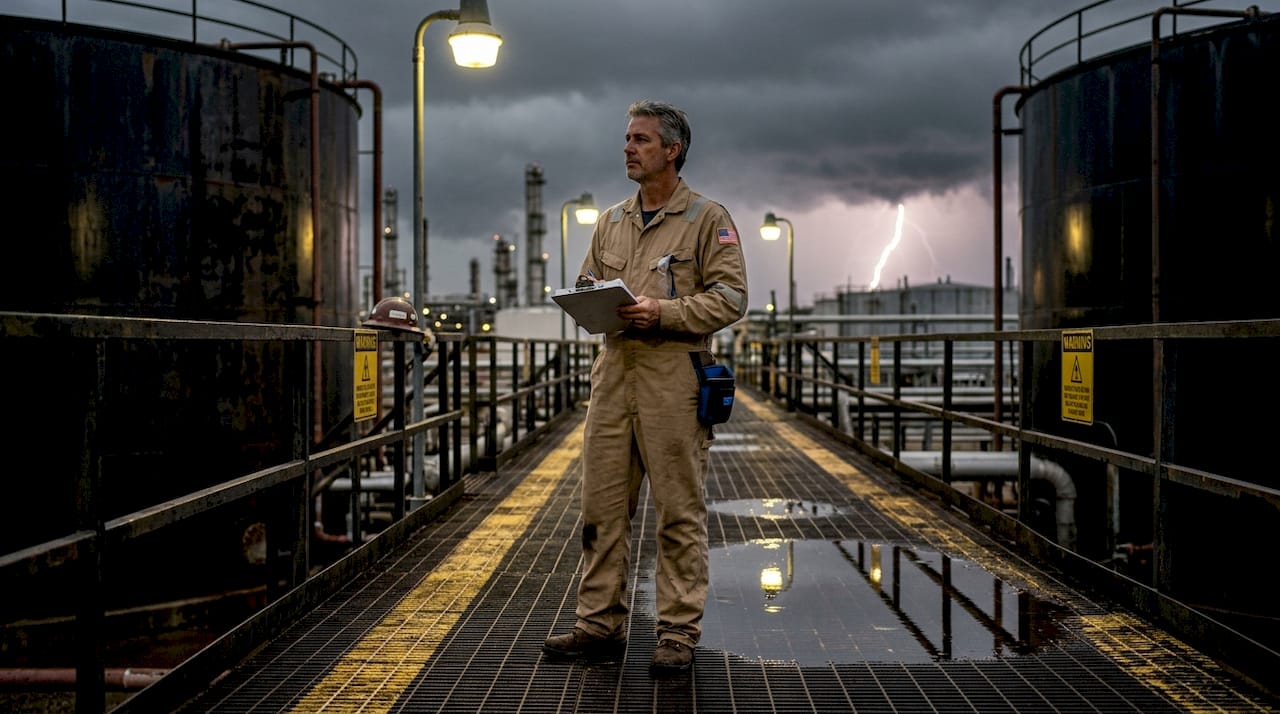
Lightning strikes are not a remote possibility for industrial facilities. They are a recurring, costly threat. A tank fire at Citgo’s Lake Charles refinery on July 11, 2025, followed a nearly identical event at Calcasieu Refining just two years earlier, both triggered by a single bolt hitting flammable vapor above storage tanks. These incidents are not outliers. They reflect a pattern that facility managers in high-risk regions see repeatedly. This article breaks down the five most critical lightning hazards facing industrial sites, explains why each one matters, and outlines proven strategies to reduce your exposure.
Table of Contents
- Top industrial lightning hazards you should know
- Case study: Tank farms and refinery lightning fires
- Critical vulnerabilities: Industrial piping and exposed equipment
- Invisible dangers: Surges, secondary effects, and electrical failures
- Regional and environmental factors: Why location matters
- Why lightning risks are underestimated and how to rethink protection
- Safeguard your facility with advanced lightning protection
- Frequently asked questions
Key Takeaways
| Point | Details |
|---|---|
| Fire and explosion risk | Lightning can ignite flammable vapors in tanks and pipework, causing devastating fires. |
| Surge and secondary damage | Indirect strikes and surges can cripple controls and electronics, resulting in costly downtime. |
| Geography matters | Facilities in high-strike zones like the Gulf Coast must use enhanced protection tailored to local risks. |
| Follow safety standards | Compliance with NFPA 780 and IEC 62305 significantly reduces lightning risk in industrial settings. |
Top industrial lightning hazards you should know
Lightning delivers more than a visible flash. At an industrial facility, a single strike can trigger a cascade of hazards that spread far beyond the impact point. Understanding each type is the first step toward facility lightning safety and meaningful risk reduction.
Here are the five primary hazards every industrial facility manager needs to recognize:
- Direct strikes: The most visible hazard. A bolt contacts a structure, tank, pipe, or piece of equipment directly. This can ignite flammable materials, rupture containment, and destroy hardware instantly.
- Side-flashes: When lightning hits a tall structure, the current can arc sideways to a nearby object, including personnel or equipment that is not the primary target.
- Electromagnetic pulses (EMP): A strike generates a powerful electromagnetic field that can fry sensitive electronics within hundreds of meters, even without direct contact.
- Ground surges: Current from a strike spreads through the soil and enters equipment through grounding conductors or buried cables, damaging motors, sensors, and control systems.
- Fire and explosion risks: In facilities handling flammable vapors, gases, or dust, any of the above hazards can trigger ignition with catastrophic results.
Industrial sites amplify every one of these hazards. Tall stacks, long pipe runs, exposed tanks, and dense electrical networks all create more pathways for lightning current to travel. Secondary effects like EMP and surges often cost more than the direct strike itself, which is why a thorough risk assessment aligned with IEC 62305 or NFPA 780 is not optional. It is the foundation of any serious protection strategy.
Case study: Tank farms and refinery lightning fires
Tank farms sit at the intersection of two dangerous realities: high lightning exposure and stored flammable material. The consequences when these two factors meet are severe.
“Lightning strikes on industrial tank farms can ignite flammable vapors, causing tank fires as seen at Calcasieu Refining and Citgo’s Lake Charles refinery in consecutive years.”
Both Louisiana incidents share a common thread. The Gulf Coast region has one of the highest lightning strike densities in the United States, and refineries in this area operate with large volumes of volatile hydrocarbons stored in floating roof tanks. These tanks are particularly vulnerable because the seal between the floating roof and the tank shell can spark when lightning current passes through it, creating exactly the ignition source needed to set off accumulated vapor.
The operational and financial consequences extend well beyond the fire itself:
- Production shutdowns lasting days or weeks while damaged tanks are inspected and repaired
- Regulatory investigations that can delay restart and trigger compliance penalties
- Environmental incidents from burning or spilled hydrocarbons requiring remediation
- Insurance claims that drive up premiums across the facility
- Worker safety risks during firefighting and cleanup operations
A proper lightning risk assessment for a tank farm considers the tank diameter, roof type, contents, regional flash density, and the proximity of other structures. Floating roof tanks require specialized shunting systems and bonding to prevent sparking at the seal. These are not generic solutions. They must be engineered for each site.
Critical vulnerabilities: Industrial piping and exposed equipment
Long runs of exposed piping are one of the most underappreciated lightning hazards in industrial settings. A pipe that stretches hundreds of meters across an open facility acts as an antenna, collecting induced current from nearby strikes and channeling it directly into connected equipment.
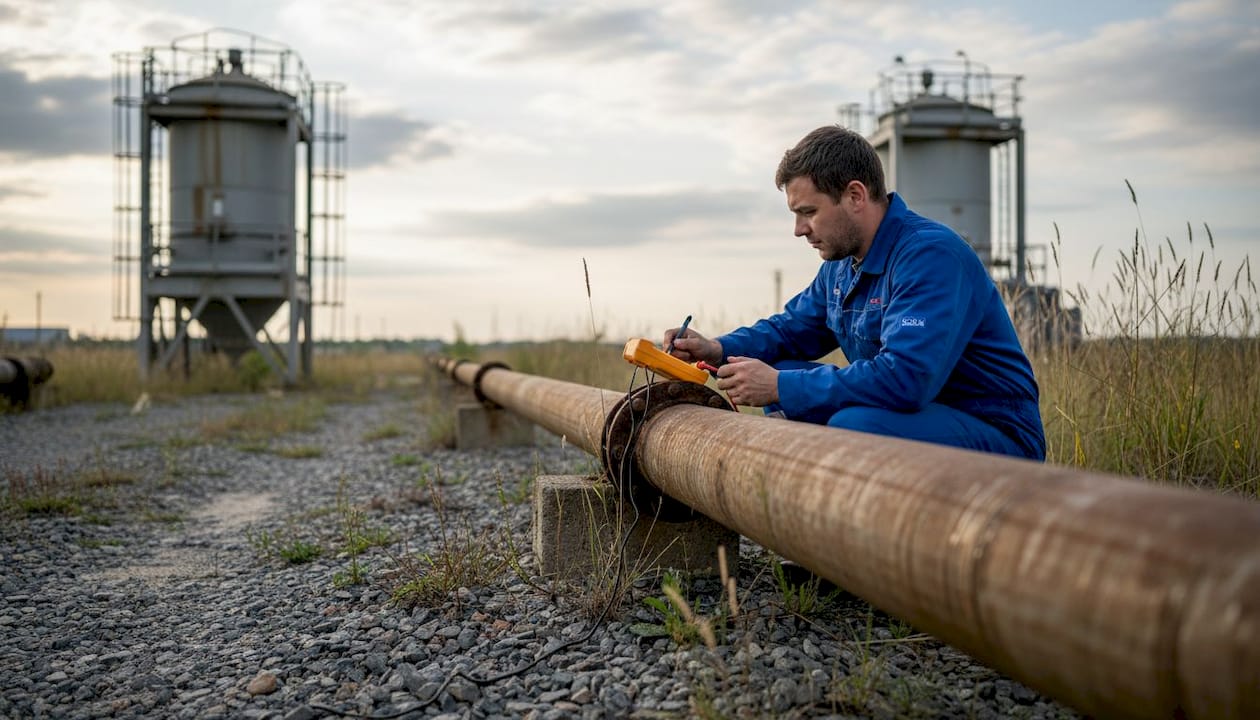
NFPA 780 specifies protection thresholds for industrial piping: pipes with a wall thickness of 4.8mm or greater are considered self-protecting against direct strikes. Pipes below that threshold require air terminals placed every 50 feet, or overhead ground wires with a 30-meter protection radius. Ground resistance must not exceed 10 ohms.
| Pipe wall thickness | Protection required | Air terminal spacing | Ground resistance |
|---|---|---|---|
| 4.8mm or more | Self-protecting | Not required | 10 ohms max |
| Less than 4.8mm | Active protection needed | Every 50 ft (15m) | 10 ohms max |
| Any thickness, hazardous area | Full bonding and grounding | Per site assessment | As low as possible |
Soil resistivity plays a major role in how well grounding systems perform. In sandy or rocky soils, standard ground rods may not achieve the required resistance, which means the entire protection system underperforms. Customized grounding solutions, including deep earth drilling or chemical grounding enhancement, are often necessary to meet lightning protection standards in challenging soil conditions.
Pro Tip: Always measure soil resistivity before designing your grounding system. A ground rod that meets resistance specs in clay soil may fail completely in dry sand. This single step prevents one of the most common and costly protection failures we see in the field. For more on this, review electrical lightning safety requirements for your infrastructure type.
Invisible dangers: Surges, secondary effects, and electrical failures
The most expensive lightning damage at industrial facilities often leaves no visible mark. Surges and electromagnetic effects travel silently through power lines, data cables, and instrument loops, destroying control systems and halting production without a single scorch mark on the building.
Here is what makes indirect effects so dangerous:
- A strike 300 meters away can induce enough voltage on an unshielded cable to destroy a PLC input card
- Surge events can repeat multiple times within a single storm, compounding damage
- Control room equipment, variable frequency drives, and network switches are especially susceptible
- Damage is often intermittent at first, making it hard to diagnose until full failure occurs
| Hazard type | Visible damage | Financial impact | Detection difficulty |
|---|---|---|---|
| Direct strike | High | High (immediate) | Easy |
| Ground surge | Low to moderate | Moderate to high | Moderate |
| EMP/induced surge | None to low | Very high (downtime) | Difficult |
| Side-flash | Moderate | Moderate | Easy |
Secondary effects like EMP and surges often exceed the cost of direct fire damage when you factor in lost production, emergency repairs, and replacement of specialized equipment with long lead times. A facility that loses its distributed control system for two weeks does not just pay for new hardware. It pays for every day of idle production.
Layered surge protection, as required by NEC and IEC standards, means installing protection at the service entrance, at distribution panels, and at the point of use for sensitive equipment. Reviewing your industrial electrical safety setup and following a structured lightning protection workflow ensures no layer is missed.
Regional and environmental factors: Why location matters
Not all facilities carry the same lightning risk. Location is one of the strongest predictors of strike frequency, and it should directly shape the intensity of your protection investment.
Flash density by region matters more than most managers realize. Louisiana records 18.9 cloud-to-ground flashes per square mile annually, and Florida tops the Gulf Coast at 20.8 flashes per square mile. A facility in either state faces a fundamentally different risk profile than one in the Pacific Northwest, and protection systems must reflect that difference.
Flash density snapshot: Florida averages 20.8 flashes per square mile per year. Louisiana averages 18.9. For a 50-acre tank farm, that translates to a statistically near-certain strike event within any given five-year period.
Tall structures add another layer of risk. Refinery stacks, flare towers, and elevated process units do not just face higher strike probability. They also generate upward leaders, which are electrical discharges that rise from the structure to meet a descending lightning bolt. This behavior increases effective strike frequency well beyond what regional flash density alone would predict.
Soil conditions further complicate protection in Gulf Coast states. Coastal sandy soils and waterlogged ground near bayous can have highly variable resistivity, making standard grounding designs unreliable. Facilities in these areas often require high-risk site protection strategies that include deep grounding, multiple electrode arrays, and regular resistance testing to confirm performance after seasonal soil changes.
Pro Tip: Schedule ground resistance testing twice a year, once in the dry season and once after heavy rain. Soil resistivity shifts significantly with moisture content, and a system that passes in February may fail its specs by August in a Gulf Coast climate.
Why lightning risks are underestimated and how to rethink protection
After working with industrial facilities across high-risk regions, we have seen the same pattern repeat. A facility invests in fire suppression, maintains solid insurance coverage, and considers itself prepared. Then a surge event takes out the SCADA system, and the real cost of underpreparedness becomes clear.
The problem is framing. Most facility owners think of lightning protection as a fire prevention measure. It is not. It is an operational continuity measure. The fires are dramatic, but the best protection applications address the full spectrum of hazards, including the invisible ones that quietly erode equipment life and system reliability.
Two errors come up repeatedly. First, outdated grounding systems that were installed decades ago and never retested. Soil shifts, connections corrode, and what once met spec no longer does. Second, treating lightning protection as a one-time installation rather than an ongoing program. IEC 62305 and NFPA 780 both require periodic inspection and testing for a reason. A lightning protection system that is not maintained is not a protection system. It is a false sense of security. The facilities that manage lightning risk well treat it the same way they treat pressure safety or fire detection: as a living program with scheduled reviews, documented testing, and clear accountability.
Safeguard your facility with advanced lightning protection
The hazards covered in this article are manageable, but only with solutions that are engineered for your specific site, region, and risk profile. Generic off-the-shelf approaches leave gaps that become expensive failures during the next storm season.

Indelec has been designing and installing lightning protection systems for industrial facilities since 1955. From eco-friendly protection solutions that meet modern sustainability standards to deep earth grounding for challenging soil conditions, our team brings the technical depth your facility needs. We work to IEC 62305 and NFPA 780 standards, and every system we design starts with a thorough site assessment. If your facility operates in a high-flash-density region or handles flammable materials, now is the right time to review your protection posture. Learn more about lightning protection or contact us to schedule a consultation.
Frequently asked questions
What are the most common causes of lightning damage in industrial sites?
Direct strikes, ground surges, and fires from ignited flammable vapors cause most lightning damage at industrial facilities. Tank fires at Calcasieu Refining and Citgo illustrate how a single strike can trigger all three effects simultaneously.
Are some regions more at risk for lightning hazards than others?
Yes. Gulf Coast states like Florida and Louisiana face some of the highest flash densities in the US, with Louisiana averaging 18.9 cloud-to-ground flashes per square mile annually, demanding more aggressive protection investment.
What standards should facilities follow for lightning protection?
Industrial sites should follow IEC 62305 and NFPA 780, which cover everything from air terminal placement to grounding. NFPA 780 specifies piping protection based on wall thickness and required ground resistance thresholds.
Are electrical surges from lightning as dangerous as direct strikes?
Often more so. Surges and EMP effects can destroy control systems and halt production across an entire facility, with repair and downtime costs that routinely exceed direct fire damage.
How can facility owners reduce lightning risk?
Start with a site-specific risk assessment, then install a compliant protection system with grounding matched to your soil conditions. NFPA 780 and IEC 62305 provide the framework, but implementation must be tailored to your facility’s geography, structure height, and materials handled.