Protection of Roof Equipment: A Facility Manager’s Guide
TL;DR:
- Protecting rooftop equipment involves a multi-layered system that includes fall, lightning, structural, and weather protection. Facility managers must understand how these layers interact to avoid failures, violations, and damage. Regular inspections after storms and comprehensive system design are essential for safety and durability.
Protection of roof equipment is defined as a multi-layered system that safeguards rooftop devices, structures, and maintenance personnel from hazards including falls, lightning strikes, wind uplift, and environmental degradation. The industry term for this discipline is rooftop equipment protection, and it spans fall protection systems, lightning protection per NFPA 780, structural supports, and weather-resistant enclosures. Facility managers who treat these elements as separate tasks rather than a unified system consistently face higher failure rates, regulatory violations, and costly equipment damage. Getting this right requires understanding what each protection layer does and how they interact.
What is protection of roof equipment, and what does it cover?
Roof equipment protection is a comprehensive system designed to address multiple overlapping requirements simultaneously. It covers fall protection for maintenance personnel, fire and electrical access clearances, structural durability against wind and snow loads, and lightning protection for electrical systems. No single product or measure covers all of these. A facility manager who installs a screen around an HVAC unit but ignores grounding has addressed aesthetics, not safety.
The four core protection dimensions are:
- Fall protection and access systems: Guardrails, warning lines, personal fall arrest systems, and designated access routes that keep workers safe during routine and emergency maintenance.
- Fire and electrical clearances: Mandated clear zones around electrical panels, conduit runs, and mechanical equipment that allow safe emergency access and reduce fire spread risk.
- Structural and environmental durability: Supports, fasteners, and enclosures rated to resist wind uplift, snow accumulation, UV degradation, and thermal cycling across the equipment’s service life.
- Lightning protection systems: Air terminals, conductors, grounding electrodes, and surge protective devices that safely channel lightning current away from equipment and building electrical systems.
Pro Tip:Map each piece of rooftop equipment against all four protection dimensions before specifying any product. A gap in one dimension can nullify the protection provided by the others.
The importance of roof equipment safety becomes clear when you consider that a single storm event can simultaneously test all four systems. Wind loads stress supports and screen attachments. Lightning threatens electrical systems. Rain infiltrates poorly sealed penetrations. And any emergency response sends workers onto the roof under hazardous conditions.
How do lightning protection systems safeguard rooftop equipment?
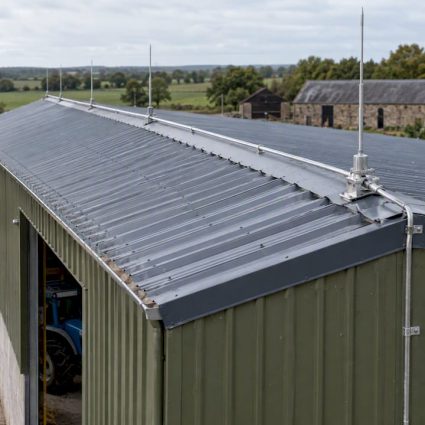
A Lightning Protection System (LPS) is defined by NFPA 780 as an integrated network of air terminals, conductors, and grounding systems that safely disperses lightning current and protects rooftop equipment from direct strikes and induced voltage surges. The system does not prevent lightning from striking. It controls where the strike terminates and provides a low-resistance path to ground, preventing the current from traveling through equipment, wiring, or structural steel.
A compliant LPS includes four core components:
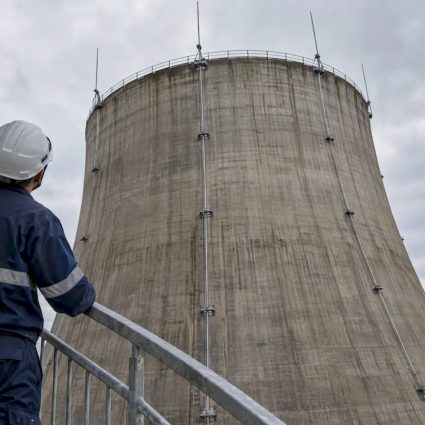
- Air terminals (lightning rods): Positioned at roof edges, ridges, and high points to intercept strikes before they reach unprotected equipment. Indelec’s Prevectron3, for example, uses patented OptiMax technology to extend the protection radius beyond conventional rod designs.
- Down conductors: Heavy-gauge cables that carry lightning current from air terminals to the grounding system. NFPA 780 requires multiple conductor paths to reduce the risk of a single point of failure.
- Grounding electrodes: Buried rods or plates that dissipate current safely into the earth. Soil resistivity determines the depth and configuration required.
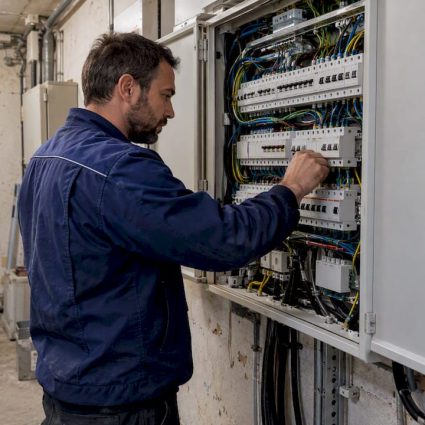
- Surge protective devices (SPDs): Installed at electrical panels and equipment connections to clamp voltage spikes caused by nearby strikes. SPDs protect internal electronics that the air terminal system cannot fully shield.
Lightning protection involves controlled pathways for current flow with verifiable system design, not just isolated components. A single air terminal without proper bonding and grounding creates a false sense of security. The entire network must be designed and tested as a system.
Routine inspection is non-negotiable for LPS integrity. Connections corrode, conductors shift, and grounding resistance increases over time. NFPA 780 recommends inspection after any known lightning event and at regular intervals aligned with local storm frequency. Facility managers should document each inspection and track resistance measurements to catch degradation before it becomes a failure.
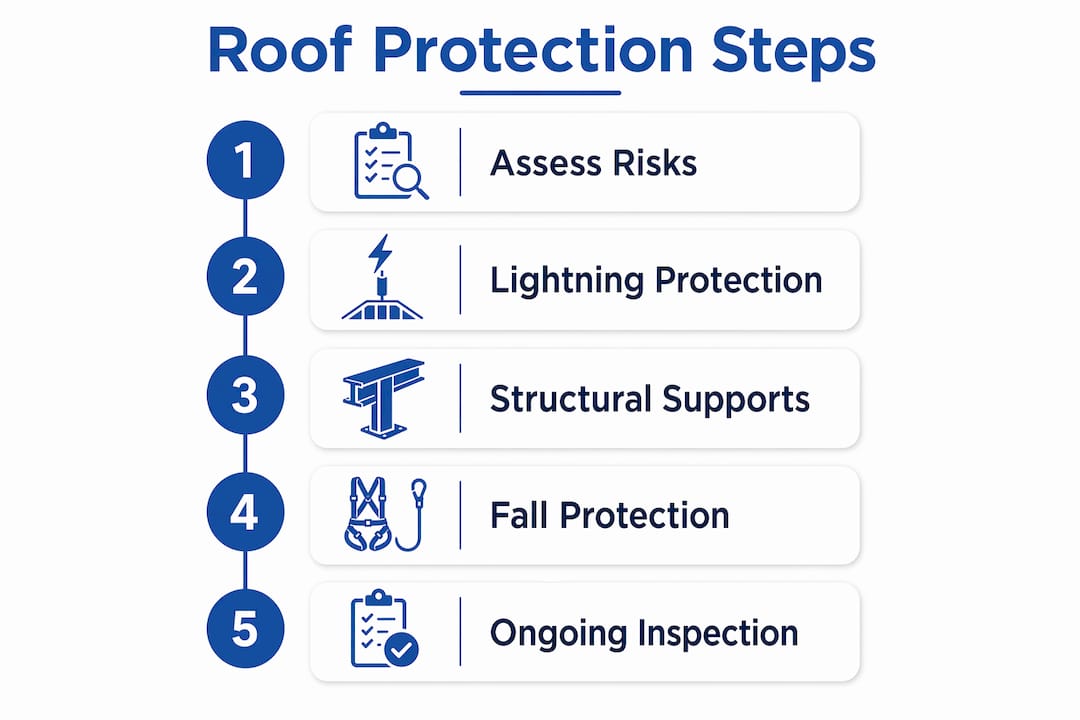
Pro Tip:After any severe storm, check conductor connections at roof penetrations and ground-level terminations. These joints experience the highest mechanical stress during a strike and are the most common failure points.
What structural measures protect rooftop equipment from wind and weather?
Structural protection for rooftop equipment centers on two systems: equipment supports and screens or enclosures. Both must be engineered, not selected from a catalog based on appearance alone.
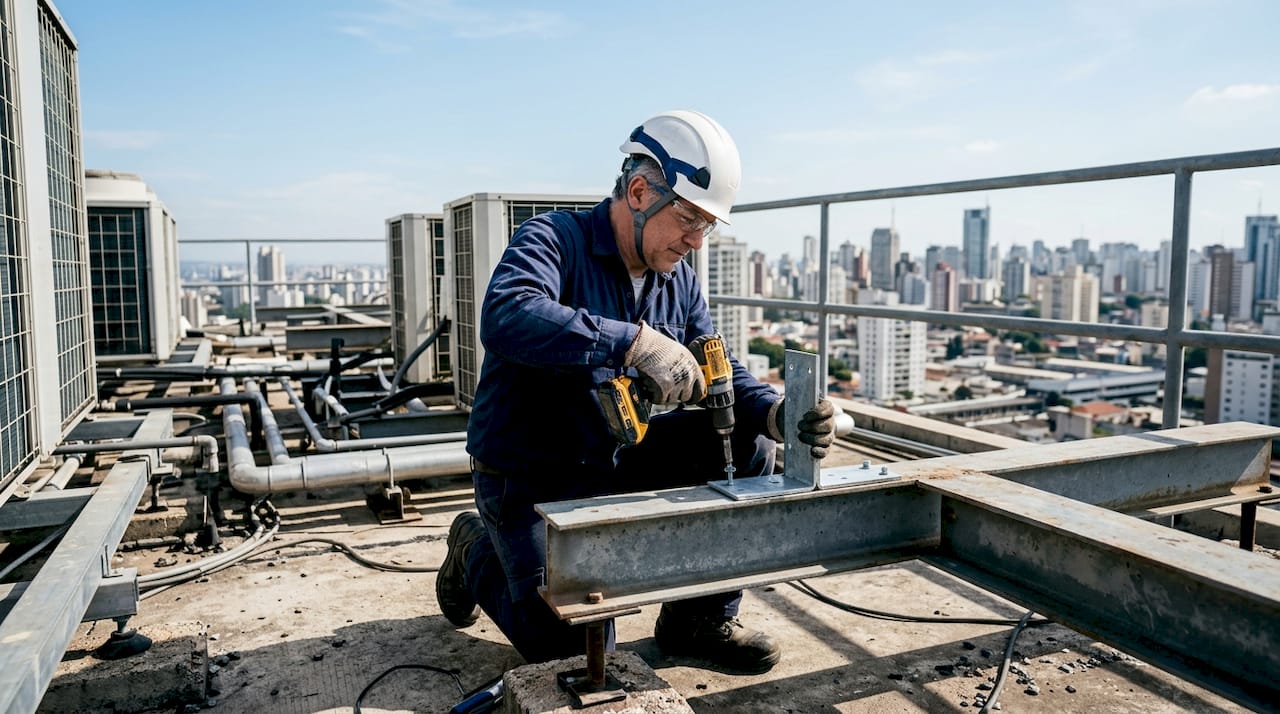
Equipment supports distribute weight, resist wind uplift, and prevent roof membrane damage. Selection depends on roof type and the combined live, dead, and wind loads the equipment generates. The three main support types serve different conditions:
| Support type | Primary use case | Key consideration |
|---|---|---|
| Ballast-based | Low-slope roofs with no penetration allowed | Weight must be calculated against wind uplift, not just gravity |
| Penetration-based | High-wind zones or heavy equipment | Requires flashing and waterproofing at every penetration point |
| Through-roof | Structural attachment to building frame | Highest wind resistance; requires structural engineer sign-off |
Wind corner loads can be 2–3 times higher than loads in the field zone of a roof. That difference is not a safety margin. It is a design requirement. Equipment placed near roof corners and edges needs zone-appropriate fastening and reinforcement, or attachment failure becomes predictable during any significant storm.
Screens and enclosures present a different challenge. Their primary functions are noise attenuation, aesthetic screening, and access control. But unengineered screens can create new risks by loosening and detaching under wind loading. A screen that becomes a projectile during a storm is worse than no screen at all. Design requirements include wind load calculations per the International Building Code (IBC), vibration-resistant fasteners, and materials that do not degrade under UV exposure.
Maintenance and inspection for structural systems must go beyond visual checks from the roof interior. Post-storm inspections must verify that attachment points remain secure, that membrane contact points show no abrasion, and that screen panels have not shifted. Experienced facility managers schedule these checks seasonally and within 48 hours after any severe weather event.
What are OSHA requirements for fall protection on rooftops?
OSHA requires fall protection for any worker on a roof 6 feet or more above a lower level. That threshold applies to routine maintenance, inspections, and emergency repairs. The permitted methods vary by roof slope, and choosing the wrong method for the roof type is a citation-level violation.
For low-slope roofs (slopes of 4:12 or less), OSHA permits the following systems:
- Guardrail systems: Permanent or temporary rails at roof edges, minimum 42 inches high with mid-rail and toe board.
- Safety net systems: Installed below the work area to catch falling workers and tools.
- Personal fall arrest systems (PFAS): Harness, lanyard, and anchor point rated to arrest a fall before the worker contacts a lower level.
- Warning line systems combined with safety monitors: Warning lines set back at least 6 feet from the roof edge, with a designated safety monitor watching workers in the controlled access zone.
For steep-slope roofs (slopes greater than 4:12), OSHA eliminates the warning line option. Workers must use guardrails, safety nets, or personal fall arrest systems. No exceptions apply.
Skylight protection is a separate but equally critical requirement. Skylights must be covered with rated covers or guarded with rails, because falls through skylights account for a disproportionate share of rooftop fatalities. Facility managers often overlook skylights when planning fall protection for equipment maintenance routes.
Practical compliance means mapping every maintenance route on the roof and identifying every fall hazard along that path, not just at the equipment location itself. A worker who safely reaches an HVAC unit but passes an unguarded skylight on the way is still exposed to a fatal hazard.
Key Takeaways
Effective protection of roof equipment requires integrating fall protection, lightning protection, structural supports, and weather-resistant enclosures as a single engineered system rather than independent add-ons.
| Point | Details |
|---|---|
| Systems approach is required | Treating fall protection, LPS, and structural supports as separate tasks creates dangerous gaps. |
| NFPA 780 defines LPS components | Air terminals, conductors, grounding electrodes, and SPDs must all be present and bonded. |
| Wind corner loads demand zone design | Loads at roof corners run 2–3 times higher than field zones; fastening must match the zone. |
| OSHA triggers at 6 feet | Any rooftop work 6 feet or more above a lower level requires a compliant fall protection system. |
| Inspection timing is critical | Post-storm checks within 48 hours catch attachment failures and hidden damage before they escalate. |
Indelec’s perspective on integrated roof protection
The most common mistake facility managers make is treating roof equipment protection as a checklist rather than a system. A screen gets installed because the building owner wants the HVAC units hidden. A lightning rod gets added because the insurer requires it. Fall protection gets addressed when OSHA shows up. Each item gets checked off independently, and the result is a roof that looks protected but fails under real conditions.
What we have seen across decades of lightning protection work is that the electrical and structural dimensions of roof protection are deeply connected. A poorly grounded LPS can actually increase the risk of side-flash damage to nearby equipment. A screen installed without wind load calculations can tear free and damage conductor cables. These interactions only become visible when you look at the roof as a whole system.
The facilities that perform best over time are the ones where safety, structural, and electrical teams review rooftop equipment together before installation and after every significant weather event. Inspection frequency matters as much as inspection quality. Seasonal checks catch UV degradation and thermal fatigue. Post-storm checks catch the acute failures that internal roof inspections miss entirely. Protocols should evolve as equipment is added, building use changes, or local climate patterns shift.
— Indelec
Indelec’s rooftop lightning protection solutions
Facility managers who need a verified lightning protection solution for rooftop equipment can rely on Indelec’s expertise, built since 1955 across industrial, commercial, and infrastructure projects worldwide.

Indelec’s Prevectron3 lightning rod uses patented OptiMax technology to deliver an extended protection radius that conventional rods cannot match, and it is designed to comply with NFPA 780 and UL standards. The full system includes grounding design, surge protective devices, and technical training for facility teams who need to maintain compliance between inspections. Indelec also offers lightning protection services covering installation, certification, and ongoing maintenance to keep rooftop systems performing through every storm season.
FAQ
What is protection of roof equipment?
Protection of roof equipment is a multi-layered system covering fall protection, lightning protection, structural supports, and weather-resistant enclosures. It safeguards both rooftop devices and the personnel who maintain them.
What does NFPA 780 require for rooftop lightning protection?
NFPA 780 requires an integrated Lightning Protection System with air terminals, down conductors, grounding electrodes, and surge protective devices. All components must be bonded together and inspected regularly to maintain system integrity.
At what height does OSHA require fall protection on a roof?
OSHA requires fall protection for any worker on a roof 6 feet or more above a lower level. Permitted systems vary by roof slope, with steep-slope roofs requiring guardrails, safety nets, or personal fall arrest systems.
Why do roof corners need special attention for wind protection?
Wind corner loads run 2–3 times higher than loads in the field zone of a roof. Equipment supports and screen attachments at corners must be designed and fastened for these amplified pressures to prevent uplift failure during storms.
How often should rooftop equipment protection systems be inspected?
Inspections should occur seasonally and within 48 hours after any severe storm. Post-storm checks must verify attachment integrity, conductor connections, and screen panel positions, not just the roof membrane surface.