Staff Training’s Role in Lightning Safety: A Field Guide

TL;DR:
- Staff training in lightning safety prepares workers to recognize hazards and respond appropriately during storms. Documented by OSHA, regular training, drills, and multiple competent persons enhance safety and emergency response effectiveness.
Staff training in lightning safety is defined as the structured process of equipping workers with the knowledge, authority, and skills to recognize lightning hazards, respond correctly, and protect lives during electrical storms. For safety officers and facility managers in industrial environments, this training is not optional. The OSHA General Duty Clause requires employers to document lightning safety practices, including formal staff training. Lightning strikes approximately 40 million times annually in the U.S., and 90% of victims survive when treated promptly. That survival rate depends entirely on whether the people nearby know what to do.
What are the essential components of lightning safety training programs?
Effective lightning safety training covers six core areas. Each one addresses a specific failure point that causes injuries or deaths in industrial settings.
Storm recognition and lightning science. Staff must understand how thunderstorms develop, how fast conditions can change, and why flat or elevated worksites increase exposure. Knowing that lightning can strike miles ahead of visible rain changes how workers read the sky.
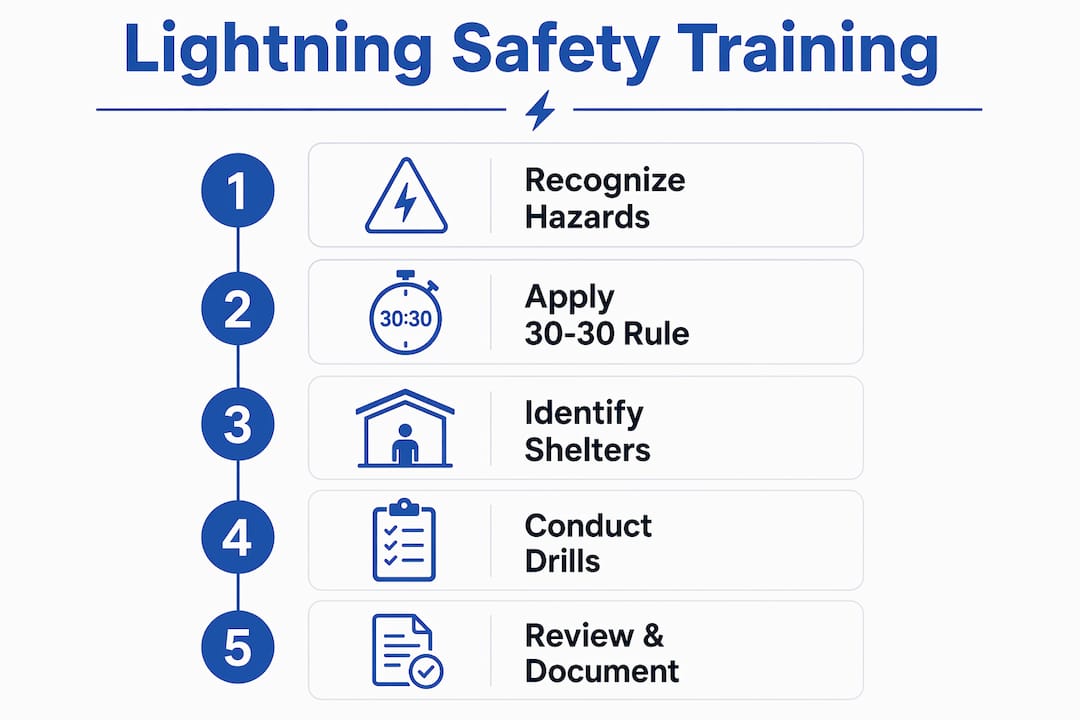
The 30-30 rule. Workers should count the seconds between a lightning flash and the thunder that follows. If that count reaches 30 or fewer, the storm is within 6 miles and work must stop. Training on the 30-30 rule gives staff a simple, reliable decision trigger that does not require weather apps or supervisor approval.
Safe shelter identification. Not all structures offer equal protection. Fully enclosed metal vehicles and substantial buildings with plumbing or wiring are safe. Open sheds, picnic shelters, and tall isolated trees are not. Training must walk staff through the specific shelters available at each worksite.
Work suspension and evacuation authority. Staff need to know exactly who can call a work stoppage and under what conditions. Ambiguity here costs lives. Training must spell out that any trained worker has the authority to initiate evacuation without waiting for management.
Buddy systems and accountability. A buddy system ensures no worker is left in the field during a storm. Accountability protocols confirm that every person is accounted for before the all-clear is given.
First aid for lightning strike victims. This includes CPR technique, recognizing lightning-specific injury patterns such as cardiac arrest and neurological effects, and understanding that lightning victims do not retain electrical charge and are safe to touch immediately.
Pro Tip:Run a site-specific shelter drill before storm season begins each year. Walk the crew from their actual work positions to each designated shelter and time the route. A drill that takes 8 minutes reveals a problem that a classroom session never would.
How does cross-training competent persons improve lightning safety compliance?
Single points of failure kill people. When only one person on a crew holds lightning safety authority, an absence, a distraction, or a communication breakdown can delay evacuation by critical minutes. Training at least two competent persons per crew eliminates that risk.
A competent person in this context is someone who can identify lightning hazards, monitor weather conditions, and make the call to halt work. That authority must be documented and backed by management. Empowering on-site staff to act without waiting for approval is the single most effective way to reduce delayed sheltering decisions.
Cross-training across multiple crew members delivers four concrete benefits:
- Coverage during absences. If the primary safety lead is off-site, sick, or occupied elsewhere, a second trained person steps in without delay.
- Faster decisions. Multiple trained observers mean someone is always watching the sky, checking weather tools, and tracking the 30-30 count.
- Reduced authority confusion. When every crew member knows who can call a stop, there is no hesitation about whether to act.
- Stronger compliance culture. When lightning safety knowledge is distributed across a team rather than concentrated in one person, the whole crew takes it more seriously.
Weather monitoring is part of the competent person’s role. Training should cover the use of weather apps, onsite lightning detection tools, and the interpretation of National Weather Service alerts. Staff who understand what a “severe thunderstorm watch” versus a “warning” means will act earlier and more decisively.
Pro Tip:Rotate the weather-monitoring responsibility among trained crew members during each shift. Rotation builds familiarity with the tools and prevents the task from becoming invisible background noise.
What role does documentation play in sustaining lightning safety readiness?
Documentation is not paperwork for its own sake. It is the evidence that your training program exists, functions, and meets OSHA requirements. Training records must be retained for at least three years and refreshed annually before storm season begins. Without records, a well-run program is legally invisible.
A complete documentation system for lightning safety training includes:
- Sign-in sheets for every training session, including the date, trainer name, and topics covered
- Written lightning safety plans specific to each worksite, updated when site conditions change
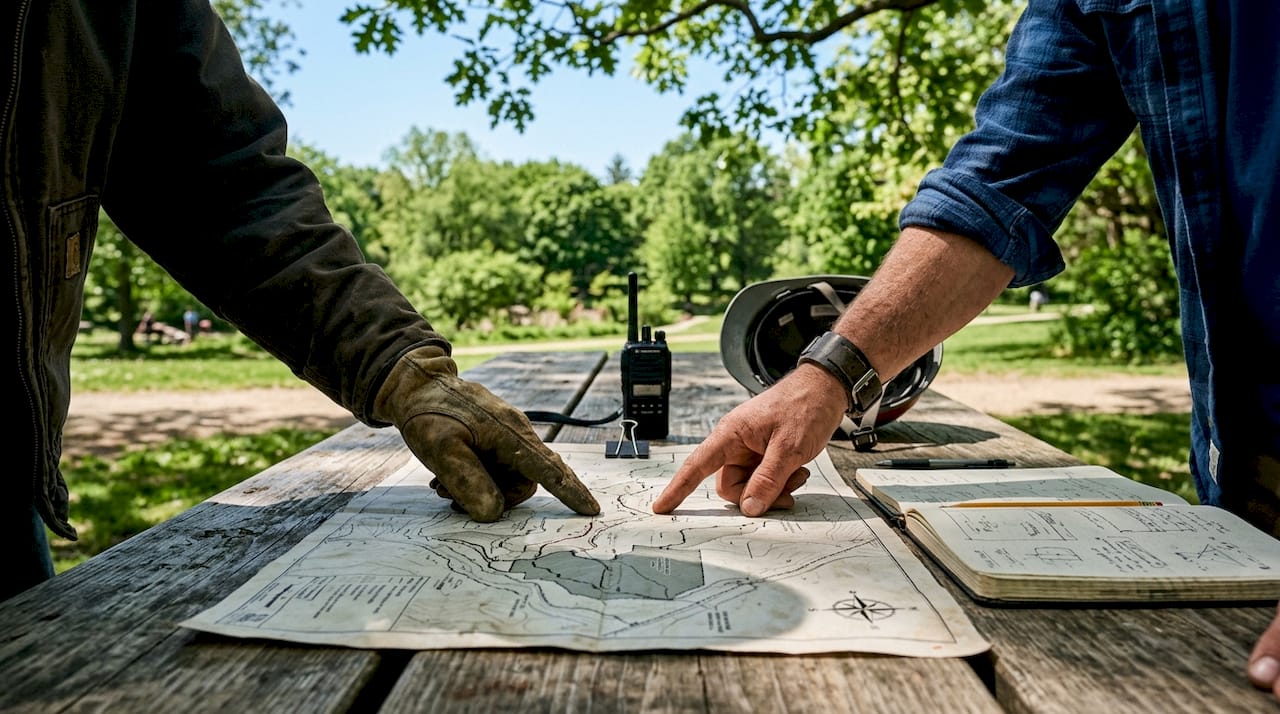
- Shelter location maps posted at the worksite and included in onboarding packets
- Drill records showing the date, participants, and outcome of each evacuation exercise
- Toolbox talk logs documenting weekly or seasonal briefings on weather monitoring, near-miss reviews, and protocol updates
| Documentation Item | Minimum Retention | Review Frequency |
|---|---|---|
| Training sign-in sheets | 3 years | Annual |
| Site-specific lightning safety plan | 3 years | Annual or after site changes |
| Shelter location maps | Current version on file | When site layout changes |
| Drill records | 3 years | Seasonal |
| Toolbox talk logs | 3 years | Weekly during storm season |
Toolbox talks and lightning drills during active storm seasons do more than reinforce protocols. They also generate the audit trail that protects your organization during OSHA inspections. A weekly briefing that covers a recent near miss, a weather app check, and a quick shelter route review takes 10 minutes and creates a defensible compliance record. For guidance on building that record systematically, Indelec’s resource on documenting protection systems provides a practical framework safety officers can adapt directly.
How can training programs address misconceptions and improve emergency response?
The most dangerous moment after a lightning strike is the pause. Bystanders freeze because they believe the victim is still electrified and dangerous to touch. That belief is false, and it kills people. Lightning victims carry no residual charge and require immediate CPR or first aid. Training that addresses this myth directly and repeatedly is the difference between a survivor and a fatality.
Common misconceptions that training must correct include:
- “Don’t touch the victim.” Lightning does not leave a charge in the body. Immediate contact is safe and necessary.
- “They’ll recover on their own.” Lightning strike victims frequently suffer cardiac arrest. Without CPR, survival rates drop sharply.
- “The storm has to be directly overhead.” Lightning can strike from storms more than 10 miles away, a phenomenon called a “bolt from the blue.”
- “Rubber-soled shoes protect you.” They do not. No footwear provides meaningful protection against a direct or ground-current strike.
“Lightning emergencies are rare but carry high morbidity and mortality, making training a critical risk mitigation investment for employers. When staff understand the real injury patterns, including cardiac arrest, neurological damage, and blast trauma, they respond faster and more effectively. Education directly reduces morbidity and mortality in lightning strike cases.”
Building staff confidence to act quickly requires more than a one-time classroom session. Scenario-based practice, where workers role-play finding a struck colleague and initiating CPR, produces faster and more reliable responses than lecture alone. Employee training programs that include hands-on practice consistently improve emergency response quality across industries. Lightning safety is no exception.
Key Takeaways
Staff training in lightning safety is the most direct way to reduce injuries, ensure OSHA compliance, and build a crew that acts correctly when seconds matter.
| Point | Details |
|---|---|
| Train multiple competent persons | At least two per crew prevents single points of failure during lightning emergencies. |
| Apply the 30-30 rule | Workers must know to shelter when the flash-to-thunder count reaches 30 seconds or fewer. |
| Document every session | Retain sign-in sheets, drill records, and safety plans for at least three years for OSHA compliance. |
| Correct the “no-touch” myth | Lightning victims carry no charge; immediate CPR is safe and often lifesaving. |
| Refresh training annually | Seasonal refreshers before storm season keep protocols current and staff prepared. |
Indelec’s perspective on building lightning safety training that actually works
The hardest part of lightning safety training is not the content. It is getting staff to take it seriously before an incident happens. At Indelec, we have seen this pattern repeatedly across industrial sites: the training exists on paper, the shelter locations are marked, and the plan looks complete. Then a storm rolls in fast, one person hesitates, and the system fails.
The fix is not more paperwork. It is leadership that treats lightning safety with the same urgency as fall protection or lockout/tagout. When a site manager personally participates in a drill, the crew notices. When authority to halt work is explicitly delegated in writing and reviewed at the start of each season, workers act without second-guessing themselves.
Integrating lightning safety into your broader emergency protocol development process also matters. Lightning should not live in a separate binder that nobody reads. It belongs in the same framework as fire evacuation, chemical spill response, and medical emergencies. That integration is what turns a compliance document into a living safety culture.
Hands-on drills are non-negotiable. A crew that has physically walked from their work position to the shelter, timed the route, and practiced the buddy check will respond faster and with less confusion than one that only read the plan. That muscle memory is what saves lives when the sky turns dark in 90 seconds.
— Indelec
How Indelec supports lightning safety in industrial facilities
Indelec has specialized in lightning protection since 1955, working with industrial facilities, infrastructure operators, and safety teams across the globe. The company’s lightning protection services cover risk assessment, system installation, and ongoing maintenance, giving safety officers a single point of accountability for both physical protection and compliance documentation.

For facilities building or updating their lightning safety programs, Indelec’s protection system applications are designed to meet current regulatory standards and integrate with site-specific safety plans. Indelec also supports teams in aligning their physical infrastructure with the training and documentation requirements that OSHA inspections demand. Contact Indelec to discuss a protection and preparedness assessment for your facility.
FAQ
What is the role of staff training in lightning safety?
Staff training in lightning safety equips workers to recognize storm hazards, apply the 30-30 rule, identify safe shelters, and administer first aid to strike victims. It is also the primary mechanism for meeting OSHA documentation and compliance requirements.
How often should lightning safety training be refreshed?
Lightning safety training records must be refreshed annually, with sessions ideally scheduled before storm season begins. Toolbox talks and drills during active storm periods reinforce the core protocols between formal sessions.
Can you touch a lightning strike victim?
Yes. Lightning victims do not retain electrical charge and are safe to touch immediately. Delaying CPR or first aid due to this misconception significantly reduces survival odds.
How many competent persons should a crew have for lightning safety?
At least two competent persons per crew should be trained and authorized to monitor weather and call a work stoppage. This prevents dangerous delays when the primary safety lead is unavailable.
What documentation does OSHA require for lightning safety training?
OSHA requires employers to retain training sign-in sheets, site-specific lightning safety plans, and drill records for at least three years. Records must be updated annually and made available during inspections.