Avoid Consuel Rejections: Surge Protection for French EV Chargers
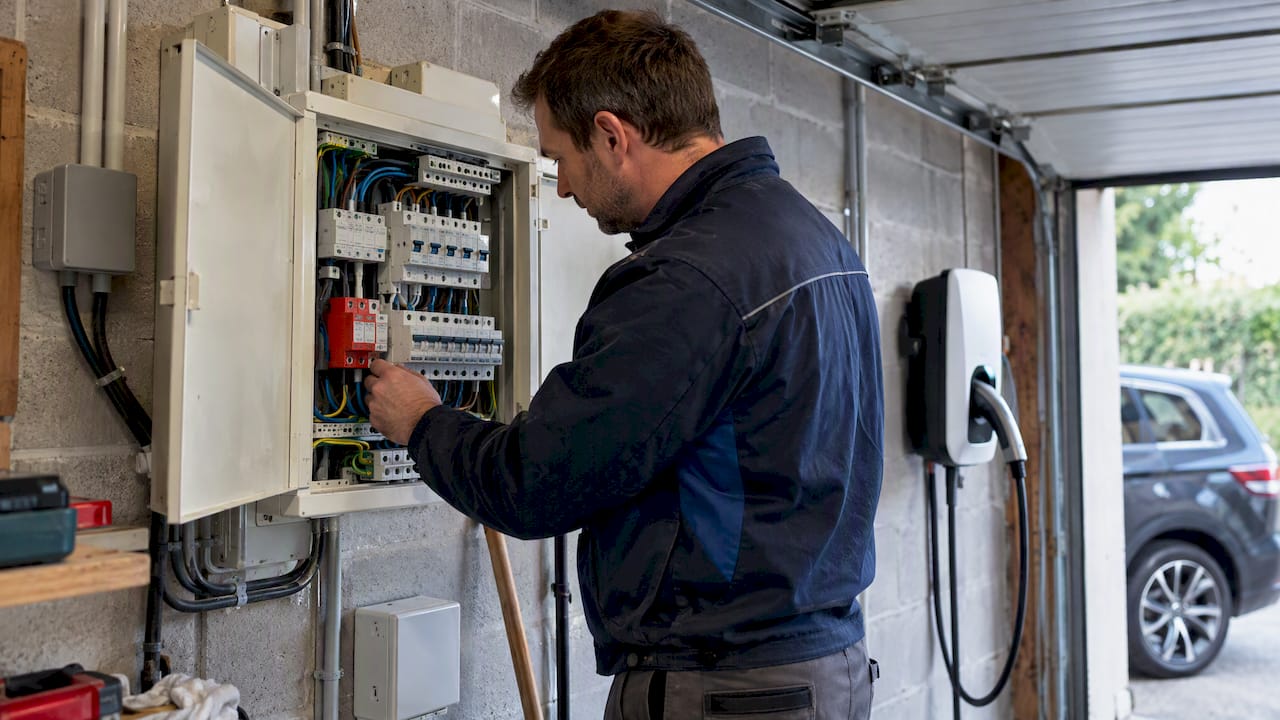
For most EV charging points, a Type 2 surge protective device at the distribution board or charger row is the right baseline; add a Type 1 (or combined Type 1+2) device when the building carries a lightning protection system or sits in a high direct strike risk zone. Whether the device is mandatory or simply smart risk management depends on NF C 15-100 criteria, so have a qualified installer document the choice in the technical file before the Consuel review.
TL;DR:
- A Type 2 surge protective device at the distribution board generally suffices for residential and commercial EV chargers unless the building has a lightning rod or is in a high strike risk zone.
- Install a Type 1 or combined Type 1+2 device if there is a lightning rod, overhead supply in a high-risk area, or multiple chargers sharing a single supply to prevent costly failures.
- Proper placement involves mounting devices close to the entry point and adding additional protection at charger rows when conductor runs are long, with grounding and wiring rules critical to performance.
- Surge arresters are classified as Type 1 for direct lightning, Type 2 for induced transient suppression, and Type 3 for sensitive electronics, with the appropriate type depending on the risk factors.
- Regular inspection and maintenance, including checking indicator signals and replacing worn units promptly, are essential for continued protection and compliance with standards.
Table of Contents
- Do you need a parafoudre for a charger? Obligation vs. recommendation
- Types of surge arresters and which one suits EV charging points
- Installation best practices: placement, wiring distances, grounding and coordination
- Regulations and inspection: NF C 15-100, IEC 61643-11 and Consuel practical notes
- Typical configurations and ballpark costs
- Expected lifespan and maintenance requirements of parafoudres at EV charging stations
- Compliance and certification standards specific to parafoudres for charging points beyond NF C 15-100
- Warranty and service considerations from manufacturers or installers
- INDELEC’s practical approach: risk analysis, tailored SPD selection, testing and maintenance
- How we can help with your charging station protection
- FAQ
- Sources
Do you need a parafoudre for a charger? Obligation vs. recommendation
Installing a surge protective device is not automatically required just because you add a charging point. Under NF C 15-100, the obligation depends on specific building characteristics rather than the charger itself.
A parafoudre becomes mandatory when one of these conditions applies:
- The building already has a paratonnerre (lightning rod) installed.
- The electrical supply arrives overhead in a zone with elevated keraunic activity.
- The building falls into a category the standard flags for mandatory surge protection, regardless of lightning rod presence.
Outside those triggers, a surge arrester is a recommendation rather than a legal requirement, but the practical risk picture often justifies installing one anyway. Frequent local thunderstorms, expensive charger electronics, or a multi-charger commercial site all raise the cost of an unprotected failure well above the price of the device. When a survey identifies any of the mandatory triggers, the installer’s job extends beyond fitting the hardware: the technical file needs to reflect the device, its rating, and its placement, since Consuel reviewers check that documentation against what is physically installed.
Types of surge arresters and which one suits EV charging points
Surge arresters are classified under IEC 61643-11, which sorts devices by the type of transient they are built to handle. Type 1 devices are designed to evacuate the direct lightning current (10/350 microsecond waveform) that enters a building through a lightning rod or an overhead line struck nearby. Type 2 devices handle the more common induced and switching transients (8/20 microsecond waveform) and are the standard general protection for distribution boards. Type 3 units offer fine, local protection for sensitive electronics and are typically paired with a Type 2 upstream rather than used alone. A combined Type 1+2 device does both jobs in a single housing, which simplifies installation where panel space is tight.
For most residential and commercial EV chargers, a Type 2 device at the board or charger row is sufficient. Switch to Type 1 or a combined Type 1+2 cascade when:
- The building has a paratonnerre and needs to evacuate direct lightning current at the service entry.
- The site sits in a zone with a documented high risk of direct strikes.
- The installation feeds multiple chargers from a shared distribution point that would suffer a costly, simultaneous failure.
Standards guidance recommends an Up threshold of 1,000 V or less to adequately protect charger electronics without accelerating component ageing, a figure drawn from IEC 61643-11 classification and common In and Up guidance for Type 1, 2, and 3 devices.
Installation best practices: placement, wiring distances, grounding and coordination
Where you mount the device matters as much as which type you choose. Placing protection only at the main distribution board leaves the conductor run to the charger exposed, and that length adds impedance that works against the SPD’s clamping performance.
- Mount the primary SPD as close to the point of entry as practical, then add a second device at the charger row or sub-board if the run is long.
- When a paratonnerre is present, build a cascade: Type 1 at the service entry to handle the 10/350 microsecond impulse, Type 2 at the sub-distribution or charger row for the 8/20 microsecond transients.
- Keep connecting conductors short and low-impedance, respecting routing rules that call for runs under 50 centimeters between the SPD and its protected circuit where feasible.
- Bond grounding and equipotential connections carefully; a study simulating lightning strikes on EV charging stations found that grounding configuration and cable shielding are often the deciding factor in whether induced overvoltages actually damage charger electronics.
- Match the enclosure’s IP rating to the mounting environment, since outdoor chargers face moisture and temperature swings that indoor boards do not.
Pro Tip:A grounding survey before SPD selection can let you specify a lower, less expensive rating because better bonding reduces the induced overvoltage the device actually has to absorb.
For handover, keep the SPD model number, its certificate, the installation diagram showing conductor lengths, and any decoupling device certification together in the technical file. Consuel reviewers look for exactly this paper trail, and our guide to IRVE surge rules walks through the NF C 15-100 implications in more depth.
Regulations and inspection: NF C 15-100, IEC 61643-11 and Consuel practical notes
Three reference points govern most compliance questions on an EV charging project. NF C 15-100 sets the conditions under which a surge protective device becomes mandatory, tied to lightning rod presence, overhead supply in high-risk zones, and specific building categories. IEC 61643-11 classifies the device itself by type and performance, which tells an inspector whether the hardware matches the risk the site presents. Consuel’s DRE148 guidance for IRVE installations sets out what the technical file needs to contain, and when a charger supports V2X functionality, conformity to EN 50549 becomes part of that documentation.
The most common inspection failures are administrative rather than technical:
- Missing or outdated SPD certificates that do not match the installed model.
- No decoupling device certificate when the charger is V2X capable, which Consuel checks against EN 50549.
- Conductor routing in the file that does not match what was actually installed on site.
Keeping the technical file synchronized with the physical installation, and updating it whenever hardware changes, avoids the bulk of these rejections.
Typical configurations and ballpark costs
A residential single-phase charger typically needs a Type 2 SPD mounted near the charger or at the home’s distribution board, with installation usually done alongside the charger setup. A commercial multi-point site changes the calculus: centralized protection at the main board works for a handful of chargers sharing a short run, but a row of chargers spread across a parking structure usually benefits from Type 2 protection at each row’s sub-board to keep conductor lengths short and limit the blast radius of a single failed device.
- Residential: a single Type 2 device, mounted close to the circuit it protects.
- Commercial, few chargers, short runs: centralized Type 2 protection at the main distribution board.
- Commercial, many chargers or long runs: Type 2 per row, with a Type 1+2 cascade at the entry point if a paratonnerre is present.
Sites with a lightning rod, a documented high strike risk, or high-value multi-charger installations justify the added cost of a Type 1+2 cascade over a single Type 2 device.
Expected lifespan and maintenance requirements of parafoudres at EV charging stations
Surge protective devices wear out by absorbing energy, not by calendar age alone. Each transient event degrades the internal varistor slightly, so a device in a region with frequent storms or one that has absorbed a near-direct strike ages faster than an identical unit in a quieter location. Most SPDs include a visual or signaling indicator that shows when the internal component has reached end of life, and that indicator should be part of any routine inspection rather than something checked only after a suspected failure.

A practical maintenance cadence includes a visual check of the status indicator at each scheduled electrical inspection, plus a closer look after any known severe storm event near the site. For commercial multi-charger sites where downtime carries a real cost, some operators add remote monitoring so a failed or degraded SPD triggers an alert rather than waiting to be discovered on the next scheduled visit. Replacing a spent SPD promptly matters because a charger left without working surge protection is exposed exactly when storm activity is highest, which is also when the risk was supposed to be managed. Keeping a simple log of inspection dates and any indicator changes also supports the technical file an inspector or insurer may ask to review later.
Compliance and certification standards specific to parafoudres for charging points beyond NF C 15-100
NF C 15-100 answers whether a device is mandatory, but it is not the only standard a charging point installation needs to satisfy. IEC 61643-11 governs how the SPD itself is tested and classified, and an installer should confirm the device carries documentation tying it to the correct Type 1, Type 2, or Type 3 classification for the role it plays in the installation.
Where a charging point supports vehicle-to-grid or vehicle-to-everything functionality, Consuel’s guidance requires the decoupling device to carry EN 50549 conformity, and that certificate needs to sit alongside the SPD documentation in the technical file. Consuel’s SC145 guidance on technical documentation reinforces that every installed charger model, its associated SPD, and any decoupling device need matching certificates on file, since a mismatch between what is documented and what is installed is a frequent cause of a failed review. For installers working across several standards at once, keeping a single reference sheet per site, listing the SPD model, its IEC classification, the NF C 15-100 trigger that applies, and any EN 50549 certificate, makes the Consuel handover considerably smoother than reconstructing that information after the fact.
Warranty and service considerations from manufacturers or installers
Warranty terms on surge protective devices vary by manufacturer and are usually tied to correct installation and documented maintenance, so keeping records of inspection dates and indicator status protects your ability to make a claim if a device fails prematurely. A warranty claim is also far easier to support when the technical file already contains the installation diagram, conductor routing, and original certificate, the same documentation Consuel expects to see.
Beyond the device warranty itself, the service relationship with your installer matters for how quickly a failed SPD gets replaced. A charger left unprotected during peak storm season carries real risk, so ask what response time an installer commits to for an emergency replacement, and whether that visit includes updating the technical file to reflect the new device. For commercial sites running several chargers, a maintenance contract that bundles periodic inspection with priority response tends to cost less over the life of the installation than paying for one-off emergency callouts. When comparing installers, ask specifically what their service agreement covers: inspection frequency, replacement turnaround, and whether the paperwork handoff for Consuel or insurance purposes is included or billed separately.

INDELEC’s practical approach: risk analysis, tailored SPD selection, testing and maintenance
We treat every charging point as a site-specific problem rather than a catalog lookup. Our risk analysis (ARF) and technical study (ET) services look at soil resistivity, existing grounding infrastructure, and whether the building’s equipotential bonding already meets the standard before we recommend a device type or rating.
That groundwork matters because the same Type 2 device performs differently on two sites with different grounding quality, a point the lightning strike simulation research backs up directly. Once a device is installed, we build testing and maintenance into a cadence that matches the site’s exposure, checking indicator status and documentation together so the technical file never falls out of sync with the hardware in the panel.
— INDELEC
How we can help with your charging station protection
We offer the full chain a charging point project needs: risk analysis (ARF) and technical study (ET) to size the protection correctly, installation of the SPD and any associated grounding work, and ongoing verification and maintenance to keep the device performing and the paperwork current.

A site survey from our team typically covers:
- Grounding and equipotential bonding assessment specific to the charging point location.
- SPD type and rating selection matched to your building’s lightning rod status and local risk profile.
- Documentation prepared for your technical file, including certificates Consuel will expect to see at handover.
If you are planning a new charging installation or retrofitting surge protection onto an existing one, our lightning protection and surge protection services page outlines how a project typically moves from survey to signed-off installation. For outdoor mounting and environmental planning considerations relevant to exposed charging equipment, the outdoor kiosk power supply planning checklist covers practical details worth reviewing alongside your SPD placement.
FAQ
Quand le parafoudre est-il obligatoire ?
A surge protective device becomes mandatory under NF C 15-100 when the building has a paratonnerre, when the electrical supply arrives overhead in a zone with high keraunic activity, or when the building falls into a category the standard flags directly. Outside those triggers, installing one is a recommended risk mitigation rather than a legal requirement.
Quels sont les 3 types de parafoudre ?
Under IEC 61643-11, surge arresters are classified as Type 1, built to evacuate direct lightning current; Type 2, designed for induced and switching transients and used as general protection at distribution boards; and Type 3, a fine local protection typically paired with an upstream Type 2 device rather than used alone.
C’est quoi le rôle d’un parafoudre ?
A surge protective device limits the overvoltage a transient event, whether from lightning or a switching event on the grid, sends through an electrical installation, protecting connected equipment like charger electronics from damage. It does not eliminate the transient entirely; it clamps the voltage to a level the downstream equipment can tolerate.
Est-il obligatoire d’avoir un parafoudre selon le Consuel ?
Consuel does not impose a universal SPD requirement independent of NF C 15-100: it verifies that the installation’s technical file matches what the standard requires for that specific building, including the SPD certificate and, for V2X-capable chargers, the EN 50549 decoupling certificate referenced in Consuel’s DRE148 guidance. When NF C 15-100 triggers the obligation, Consuel checks that the documented device matches the one installed.
Sources
- Legifrance — NF C 15-100 references
- IET — Analysis of transient overvoltages in EV charging stations due to direct lightning strikes
- Consuel — DRE148 (IRVE guidance)