LPS Separation Distance: How to Calculate and Respect It
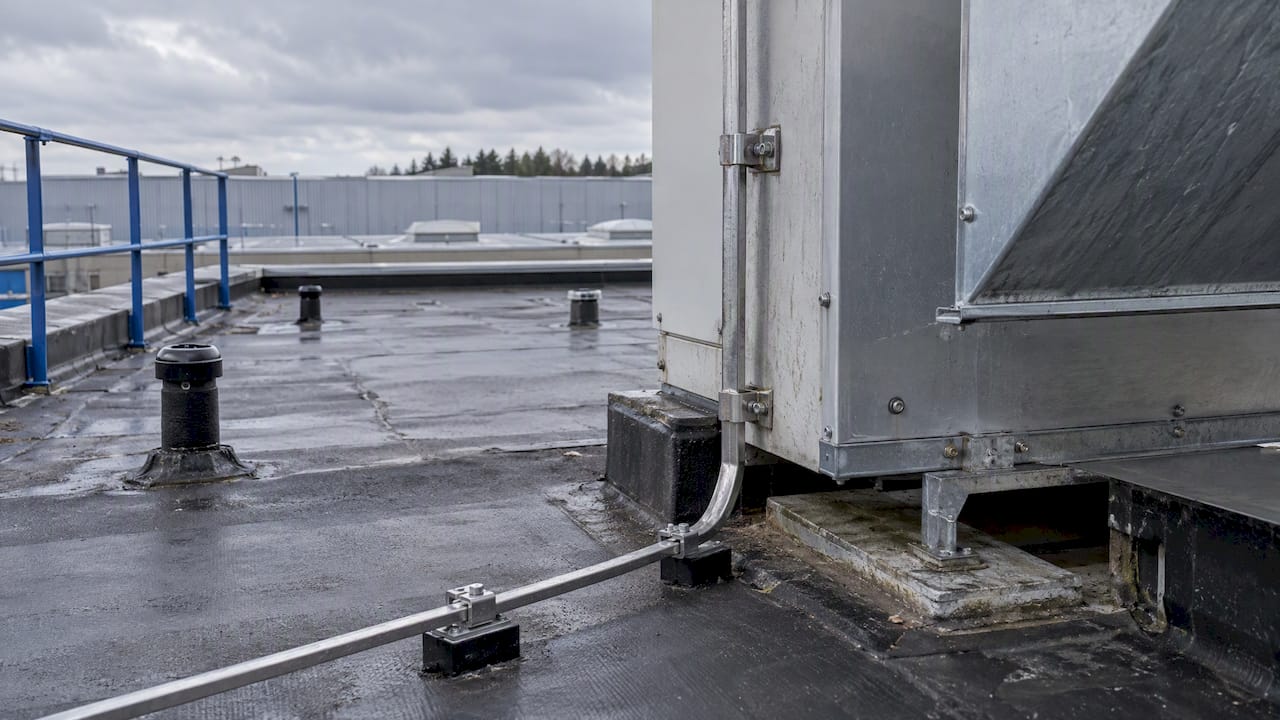
The separation distance (distance de séparation) is the minimum gap you must keep between a lightning protection system (LPS) and any metal part or internal circuit nearby, so that a lightning current cannot jump across as a spark. You calculate it from the protection level, the share of current carried by each down-conductor, the insulating material in the gap and the length of the path. If you cannot keep that gap, you either bond the two elements together or you accept and document the risk. On French industrial sites this is not optional paperwork: it belongs in the technical study.
TL;DR
- The separation distance is the air or material gap that prevents dangerous sparking between the external LPS and conductive parts of the structure.
- It is calculated from the protection level, current sharing, the material in the gap and the length of the conductor path, following NF EN 62305-3, whose latest edition dates from 2024.
- For ICPE sites under the French “Arrêté foudre”, it is a mandatory element of the technical study (ET) that follows the lightning risk analysis (ARF).
- When the distance cannot be met, the answer is equipotential bonding with suitable components, not simply adding more rods or conductors.
- Missing or ignored separation distances are a classic cause of failed audits and late retrofits of surge protection devices.
Table of Contents
- What the separation distance actually protects
- Where the requirement comes from
- How the calculation works
- Worked decision: what to do when the distance is not available
- Common mistakes seen at audit
- Rooftop equipment: solar panels as a typical case
- Who should do the assessment, and when
- Our perspective: treat distance as a design input
- How Indelec can help
- FAQ
- Sources
What the separation distance actually protects
A lightning current running down a conductor creates a voltage along it. Any metal object close to that conductor sits at a very different potential. If the gap is too small, the air breaks down and a spark crosses it. That spark can puncture a roof membrane, ignite a flammable atmosphere, damage cables or send a surge into the building’s electrical network.
INERIS describes the separation distance as a safety boundary, not a theoretical figure. Its experts also warn against the idea that more rods automatically means less risk: each added down-conductor has to be assessed for its effect on the separation distance. More down-conductors can reduce the current in each one, but they also multiply the places where a conductor runs close to something metallic.
The distance applies to more than structural steel. It concerns:
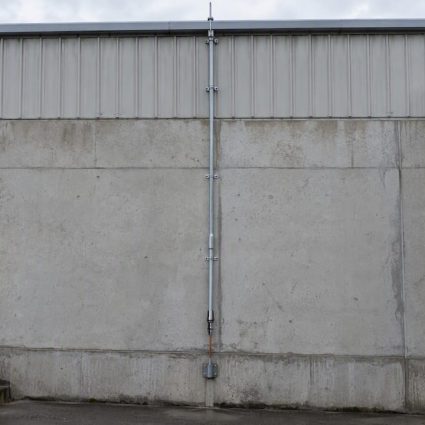
- metal roof equipment, handrails, cable trays, ducting and cladding;
- process pipework and storage tanks;
- internal circuits such as power, data and plumbing that run near down-conductors.
That last category is the one people forget. When the required gap was never established at design stage, the usual consequence is a costly retrofit of surge protection devices after the audit.
Where the requirement comes from
The standard: NF EN 62305-3
Part 3 of the 62305 series covers physical damage to structures and life hazard. The 2024 edition of IEC 62305-3 replaces the 2010 text and sets out the requirements for protecting a structure against physical damage by means of an LPS. The previous edition, IEC 62305-3:2010, is still the one many existing studies refer to, so check which edition your documents cite before comparing numbers.
The standard’s principle is simple: to prevent sparking, either keep a separation distance between the concerned components, or, when that distance cannot be kept and the components are not naturally connected, bond them. The Association Protection Foudre’s reading of the standard states the same logic.
The French regulation for classified installations
For ICPE sites, the framework is the arrêté of 4 October 2010 on the prevention of accidental risks, amended in 2011. Article 16 of the amended text applies to the listed classified installations where a lightning strike can trigger an event that harms people or the environment. The process runs in two steps:
- The lightning risk analysis (ARF) identifies the buildings and equipment where lightning could start a dangerous phenomenon.
- The technical study (ET) defines the protection measures, and the separation distance calculation is part of it.
INERIS indicates that this work must be done by a qualified entity, typically one holding Qualifoudre certification, and that the ARF and ET must be updated for any modification requiring a new authorization, or every five years for installations under the authorization regime. For a wider view of the compliance cycle, see our guide to lightning protection for ICPE sites.
How the calculation works
The general form used in the standard is:
s = ki × (kc / km) × l
| Symbol | Meaning | What drives it |
|---|---|---|
| s | Required separation distance, in meters | The result |
| ki | Coefficient for the LPS class | The protection level chosen in the ARF |
| kc | Current-sharing coefficient | Number of down-conductors, type of air-termination, earthing arrangement |
| km | Material coefficient | What fills the gap: air, concrete, brick or other material |
| l | Length, in meters | Path along the conductor from the point of interest to the nearest equipotential bonding point |
The exact coefficient values come from the tables of NF EN 62305-3, so take them from the edition cited in your study rather than from a rule of thumb. The 2024 edition also clarifies both the general and simplified methods.
An illustration with assumed values
The numbers below are chosen only to show the mechanics. They are not a design value for any real site.
Suppose a rooftop cable tray runs beside a down-conductor. You take ki = 0.04, a single down-conductor so kc = 1, air in the gap so km = 1, and a path length of 10 m from the tray’s position to the nearest bonding point.
s = 0.04 × (1 / 1) × 10 = 0.4 m
The tray must stay at least 0.4 m from the conductor, or be bonded to it. Now move the same point 20 m along the path: the distance doubles to 0.8 m. Length is the lever people underestimate, and it is why a long run down a tall building can generate large required distances at its upper levels.

Now split the current over four down-conductors with a favorable kc, and the required distance falls sharply. That is the legitimate benefit of additional conductors. It only holds if the earthing arrangement actually supports that current sharing, which is a design question, not an assumption.
Why the simplified method can cost you
The simplified approach uses conservative coefficients. It is quick, but it can overstate the required distance, in some cases significantly. A detailed calculation of current sharing can bring the figure down and avoid unnecessary bonding hardware. On a complex roof, the extra engineering time often pays for itself.
Worked decision: what to do when the distance is not available
On a real roof, the calculated distance often collides with the layout. Plant equipment, ducts and cable routes are already there. Work through the options in this order.
- Re-route the LPS. Move the down-conductor or the air-termination so the gap is respected. This is the cleanest fix and the cheapest if caught at design stage.
- Increase current sharing. Add down-conductors or improve the earthing so that kc falls, and recalculate. INERIS’s caution applies: each added conductor must be assessed, not just counted.
- Change the gap material. A higher km value in the gap can reduce the required distance, subject to what the standard allows for the material in question.
- Bond the elements. If the distance still cannot be met, direct equipotential bonding between the LPS and the metal object is the viable alternative. Where the object is not otherwise connected, isolating spark gaps are the typical component. Bonding brings part of the lightning current into the bonded object, so downstream consequences must be checked.
- Document an accepted risk. Where sparking would only damage a building membrane or similar element, the site owner can explicitly accept that damage. This is a decision for the owner, recorded in writing, never a default.
When external equipment is bonded to the LPS, or when the distance is not respected, the QUALIFOUDRE FAQ points out that surge protective devices for that outdoor equipment must be taken into account. In other words, the separation distance and the surge protection plan are one conversation. Our surge protection range is built for that coordination.
Common mistakes seen at audit
- Calculating once, then modifying the site. A new roof unit, a relocated tray or an added mast changes the geometry. The ARF and ET need updating, and so does the separation calculation.
- Treating the roof only. The calculation also covers internal circuits near down-conductors, including pipes and data cables.
- Forgetting the length term. Distances are computed at each point of concern, not once for the whole building.
- Adding rods without recalculating. More terminals or conductors change both current sharing and proximity to metalwork.
- Isolating one element and ignoring the rest. Protection works as a system. Isolating a single item without checking the surrounding conductive circuits can cancel its benefit.
- Mixing editions. An ET based on the 2010 edition and an audit referring to 2024 will not match line by line.
A research paper on lightning current waveshape and the flashover distance between an LPS and equipment on a roof shows the calculated gap itself depends on modelling choices, which is another reason to leave the study to a qualified engineer rather than a spreadsheet copied from a forum.
Rooftop equipment: solar panels as a typical case
Solar arrays are now the most frequent source of new metal and cabling on roofs, and they raise exactly the separation question: how far must the frame, the strings and the inverter cabling stay from air-terminals and down-conductors? Installers in neighboring Belgium publish a useful overview of when lightning protection for solar panels is really needed, which helps frame the discussion with the people who install the array. For an industrial roof in France, the decision still goes back to the site’s risk analysis and to a qualified study, and any array added after the original study counts as a modification that should trigger an update.
Who should do the assessment, and when
The separation distance is an engineering output, not a field estimate. For ICPE sites, use a Qualifoudre-certified entity, as the INERIS guidance describes. Ask for these before you accept the deliverable:
- The ARF, with the buildings and equipment at stake identified.
- The ET, showing the protection level, the calculated distances at the points of concern and the method used (simplified or detailed).
- A list of locations where distances are not achievable, with the bonding or surge protection solution chosen for each.
- The standard edition referenced.
Re-run the study after any substantial modification and on the regulatory cycle. Our notes on closing the six-month, annual and two-year gaps and on the deliverables facility managers must keep explain how to keep the file inspection-ready.
Our perspective: treat distance as a design input
We have been working on lightning protection since 1955, and the pattern repeats: separation distance is treated as a checkbox at the end, when the roof is already crowded. By then every option is a compromise.

The better sequence is to settle the protection level from the ARF, then place air-terminals and down-conductors with the distance in mind, and only then lay out the roof equipment. A calculation done early costs an engineer’s time. The same calculation done after commissioning costs bonding hardware, surge protection and sometimes a second site visit.
We also prefer to be candid about trade-offs. Equipotential bonding is a legitimate answer, and sometimes the only one, but it moves current into places you did not design for, so it needs the same rigor as the isolated solution. And no calculation replaces a walk through the site: the drawings rarely show every pipe and cable tray.
— INDELEC
How Indelec can help
If you manage an industrial, commercial or public site and need the separation distances calculated, checked or put right, our teams cover the whole chain: lightning risk analysis and technical study, supply, installation, then inspection and maintenance. You can see the scope on our lightning protection services page, and the matching hardware in our ranges of lightning rods, down-conductors and earthing. Send us your current ARF and ET and we will tell you where the distances stand.
FAQ
Is the separation distance mandatory?
For ICPE sites covered by the 2010 Arrêté foudre, the technical study that follows the risk analysis must address it, and INERIS describes it as a safety boundary against dangerous sparking. For other buildings, it is a requirement of the standard whenever an external LPS is installed, unless the owner chooses bonding or accepts the stated risk.
What if I cannot keep the calculated distance?
You can bond the LPS to the metal element directly, using components such as isolating spark gaps where the element is not otherwise connected. The bonding changes how current flows, so surge protection for the affected equipment must be reviewed. The alternative, in limited cases, is a written acceptance of the potential damage by the site owner.
Does adding more down-conductors always reduce the distance?
Often it lowers the current share and therefore the required gap, but not automatically. Each added conductor must be assessed for its own proximity to metal parts and for the earthing that supports the current sharing. INERIS specifically warns against assuming more rods mean less risk.
When must the calculation be redone?
Whenever the installation is substantially modified, and on the review cycle of the ARF and ET: after a modification requiring a new authorization or every five years for authorization-regime installations. Also redo it after any change to the roof layout or the LPS, and when a study cites an outdated edition of the standard.
Sources
- IEC 62305-3:2024, Protection against lightning, Part 3
- IEC 62305-3:2010, Protection against lightning, Part 3
- INERIS, FAQ QUALIFOUDRE, November 2023
- INERIS, Omega 3 report, lightning protection of ICPE
- Légifrance, Arrêté of 19 July 2011 amending the Arrêté of 4 October 2010, article 2
- Influence of lightning current waveshape on the separation distance (Elektronika ir Elektrotechnika, 2013)
- Association Protection Foudre, reading of NF EN 62305-3