2026 Recoding Means Check IRVE Qualification in France Before You Sign
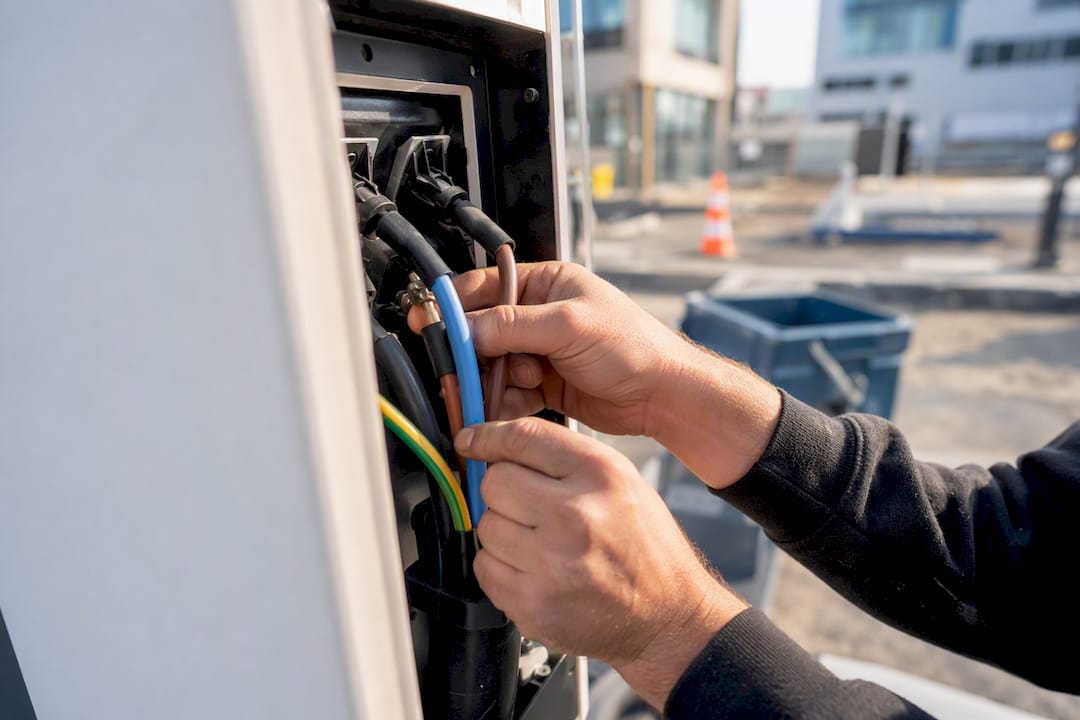
Yes: any professional who installs, commissions, or maintains a charging point rated above 3.7 kW must hold an IRVE qualification under Article D. 353-2 of the Energy Code. That covers nearly every common residential wallbox sold in France today. Before signing a quote, ask for the qualification number and check it against the Qualifelec directory.
TL;DR:
- Installers working on wallboxes over 3.7 kW must hold an IRVE qualification, verified by the Qualifelec directory, before signing any contract.
- IRVE qualifications are tiered into IRVE1, IRVE2, and IRVE3, with IRVE1 covering most residential and small commercial installations up to 36 kVA.
- Certification must be renewed annually with updated documentation; failure to do so can disqualify subsidy eligibility and invalidate compliance.
- Homeowners should verify qualification number, expiry date, and IRVE mention on the invoice to ensure legal and financial protections.
- Public and shared installations always require qualified contractors, while private, homeowner-only outlets below 3.7 kW generally do not.
Table of Contents
- Qualification IRVE Obligatoire: Which Installations Are Covered
- What IRVE1, IRVE2, and IRVE3 Actually Cover
- How Installers Obtain the IRVE Qualification
- How to Verify an Installer’s IRVE Status Before You Pay
- IRVE Status and Your Access to Subsidies
- Common Mistakes Installers and Clients Both Make
- Why the 2026 Recoding Changes What You Should Cite
- Indelec’s Approach to Compliant EV Charging Projects
- Sources
Qualification IRVE Obligatoire: Which Installations Are Covered
The 3.7 kW line in Article D. 353-2 is the whole ballgame. Cross it, and the installer must carry an IRVE qualification, no exceptions for “just a quick job.” Stay under it, in a private home with no public access, and the rule generally does not apply.
Where this plays out in practice:
- A single-phase 3.7 kW socket in a detached house, used only by the owner, typically falls outside the obligation.
- A 7 kW or 11 kW wallbox, the most common residential install in France, crosses the threshold and requires a qualified installer.
- Any charger in a shared condominium garage, workplace parking lot, retail site, or public street falls under the obligation regardless of power, because these are collective or public-facing installations.
- Fleet depots and highway fast-charging stations sit even further into the regulated zone, since they combine higher power with public or semi-public access.
If you manage a co-owned building or a commercial site, assume the rule applies. The exemption window is narrow and shrinking as more homes install 11 kW and 22 kW units.
What IRVE1, IRVE2, and IRVE3 Actually Cover
IRVE is not one qualification. It is a tiered system, and matching the right tier to the right job matters both for cost and for legal exposure.
- IRVE1 covers charging stations up to 36 kVA. This is the tier for nearly all residential wallboxes and standard commercial single or three-phase installs, including the common 7, 11, and 22 kW units.
- IRVE2 applies to communicating installations above 36 kVA, typically larger collective parking setups or commercial sites with load management systems and multiple connected points.
- IRVE3 is reserved for DC rapid-charging infrastructure, the kind found on highways and in fleet depots.
Note the unit switch: the threshold is measured in kVA, not kW. A 22 kW wallbox still lands comfortably in IRVE1 territory, according to AVERE France’s technical reference guide. If a contractor quotes IRVE2 for a standard home install, ask why.
How Installers Obtain the IRVE Qualification
Companies get qualified through accredited certification bodies, primarily Qualifelec, alongside AFNOR Certification and Qualit’EnR depending on the scope. The process is administrative and technical, and it takes real preparation.
- Assemble the company file: Kbis extract, professional liability insurance, technician CVs, and completed IRVE training certificates.
- Confirm electrical authorizations: individual technicians must hold valid B1V, B2V, BC, or BR habilitations, renewed on their own separate cycles.
- Submit reference installations: for IRVE2 or IRVE3, applicants need documented, completed projects with photos and test logs.
- Undergo review or audit: Qualifelec evaluates the file and may conduct an on-site audit of a recent installation, especially for higher indices.
- Receive the certificate: processing typically runs four to eight weeks depending on how complete the initial file is and whether an audit is required.
Pro Tip:Do not confuse individual training with company qualification. A technician can complete P1/P2/P3 training modules and still work for a company that has no valid IRVE certificate. Clients need to verify the company’s status, not just the technician’s course completion, according to guidance from habilitations-electrique.fr.
How to Verify an Installer’s IRVE Status Before You Pay
A verbal claim of being “IRVE certified” means nothing on its own. You need three pieces of information and one habit: check before you sign, not after.
- Ask for the exact qualification number, the issuing body, the index (IRVE1, 2, or 3), and the expiry date.
- Cross-check that number on the free Qualifelec public directory, which lists active qualifications without requiring registration.
- Confirm the AFNOR record if the installer references AFNOR Certification instead of or alongside Qualifelec.
- Require the IRVE mention printed directly on the invoice, since this is often the only proof accepted for subsidy claims.
The Qualifelec directory is the fastest way to settle the question, and it costs nothing to check. Watch for vague phrasing like “certified for EV charging” with no number attached, certificates that expired months ago, or a quote that pushes an IRVE2 install onto a standard residential wallbox job. Many qualification files actually fail on documentation gaps rather than technical shortfalls, a pattern Qualifelec’s own process page points to directly.
IRVE Status and Your Access to Subsidies
The qualification is not just a compliance checkbox. It is often the gatekeeper for money.
- The Advenir grant and several local subsidy schemes require the installation to be carried out by a company holding a current IRVE mention.
- The invoice needs to state that mention explicitly. Without it, tax administration guidance suggests homeowners risk losing eligibility for related tax treatments on the acquisition.
- Public procurement contracts for charging infrastructure routinely require bidders to hold a valid, current qualification as a condition of eligibility, not a preference.
Property managers overseeing shared parking installations should treat the invoice wording as part of the deliverable, not an afterthought filed away later.
Common Mistakes Installers and Clients Both Make
The technical side of IRVE compliance is usually fine. The paperwork side is where things fall apart.

Qualification certificates run for up to four years, but they require an annual dossier update in between, and this step gets missed constantly, according to AFNOR’s certification guidance. A lapsed update can invalidate a project’s subsidy eligibility even if the physical install was flawless. On the client side, the frequent mistake is accepting an IRVE2 quote for a job that only needs IRVE1, paying more for a tier the project never required. On the installer side, the frequent mistake is applying for IRVE2 or IRVE3 without a properly documented reference file, then failing the audit over missing photos or test logs rather than missing skill.

Pro Tip:If you are preparing for an audit at a higher index, build the reference file as you go, not after the fact. Dated photos, signed test logs, and a customer sign-off on each completed installation turn a stressful audit into a formality.
Why the 2026 Recoding Changes What You Should Cite
Plenty of installer websites still reference the old 2017 decree language, and that is not laziness. The rule genuinely moved. What used to sit in decree 2017-26 is now recoded into Article D. 353-2 of the Energy Code, and citing the old article number in a client contract or subsidy file is a paperwork risk homeowners rarely think about.
Here is where the conventional advice falls short: most guides treat IRVE verification as a one-time check at signing. It is not. The qualification carries a four-year clock with annual updates in between, and the individual technician’s electrical authorization runs on its own separate renewal schedule. A homeowner who verified everything correctly eighteen months ago could be sitting on an invalid file today without knowing it.
Prioritize this first: confirm the qualification number on the Qualifelec directory before any contract is signed. Then confirm again that the invoice carries the mention when the work is billed. That two-step habit closes most of the gap between what people assume is covered and what actually is.
— INDELEC
Indelec’s Approach to Compliant EV Charging Projects
Indelec audits EV charging projects for professional fleets and commercial sites, then delivers installations built to match the correct IRVE index rather than the most expensive one. Since 1955, Indelec has built its reputation on rigorous compliance work in electrical protection, backed by a dedicated R&D center and adherence to established lightning and electrical standards.

That same discipline applies to charging infrastructure: a proper audit before installation, correct index matching, and documentation that holds up if a subsidy file or public tender gets scrutinized later. For property managers weighing several quotes, Indelec’s mobility and EV charging services offer a single point of accountability instead of piecing together technicians and paperwork separately. Property managers evaluating power needs across different site configurations may also find this comparison of residential and commercial charging setups useful for context. Visit Indelec’s services overview to request a project audit or a quote on your charging infrastructure.