Lightning strike effects: Protect facilities and reduce risks
TL;DR:
- Lightning causes electrical, thermal, and mechanical damage surpassing simple scorch marks.
- Indirect lightning surges through utility lines and ground paths cause most electronic and operational damage.
- Proactive, regular maintenance and comprehensive protection systems are essential for true lightning resilience.
Lightning is not just a fire starter. A single strike can simultaneously destroy electrical infrastructure, rupture concrete walls, take down server systems, and trigger costly operational shutdowns across an entire facility, often with insurance losses between $1 and $2 billion in the US each year. For facility managers and safety officers, understanding the true scope of lightning’s effects is the foundation of any real protection strategy.
Table of Contents
- What actually happens during a lightning strike
- Direct lightning strike effects on facilities
- The often-overlooked impact: Indirect lightning strike effects
- How to mitigate lightning strike risks in your facility
- The hidden cost of underestimating lightning risk: Our perspective
- How Indelec can help safeguard your facility
- Frequently asked questions
Key Takeaways
| Point | Details |
|---|---|
| Lightning strikes are multifaceted threats | Besides fires, lightning can cause structural, electrical, and operational failures in facilities. |
| Indirect surges are the main loss factor | About 70 percent of lightning damage affects electronics via power surges rather than direct hits. |
| Facility mitigation is essential | Up-to-code grounding, surge protection, and regular safety audits are crucial for reducing risk. |
| The cost of neglect is high | Annual lightning damage is billions of dollars, mostly preventable through proactive protection. |
What actually happens during a lightning strike
Most people picture lightning damage as a scorch mark and a blown fuse. The reality is far more violent. When a lightning channel connects with a structure, it releases an enormous burst of energy in a fraction of a second. That energy doesn’t just flow through the building’s electrical system. It interacts with every material in its path, generating three distinct and simultaneous forces: electrical, thermal, and mechanical.
The electrical forces are staggering. A single lightning strike can carry currents exceeding 100,000 amperes and heat the surrounding air to 50,000°F, more than five times the surface temperature of the sun. That’s not a figure to treat casually. Your facility’s internal wiring is rated in tens of amperes. The difference between what your infrastructure handles daily and what a direct strike delivers is catastrophic by design.
Thermal effects are equally destructive. Metal conductors and steel reinforcement bars inside concrete can reach melting point almost instantly. This is why reinforced concrete structures are not as safe as they look. The moisture trapped inside masonry vaporizes explosively under that kind of heat, and the result is spalling, where chunks of masonry or concrete are blown outward with significant force. This is a hidden vulnerability many safety officers overlook when assessing older industrial buildings.
Mechanical forces come from the rapid expansion of superheated air. The acoustic shock wave, essentially a micro-explosion, can shatter windows, blow out wall sections, and damage rooftop equipment without leaving a visible burn mark. Understanding this force matters when you’re designing protection for buildings with sensitive rooftop infrastructure like HVAC units or communications arrays.
| Physical effect | Parameter | Typical range |
|---|---|---|
| Peak current | Amperes | 5,000 to 200,000+ A |
| Channel temperature | Degrees Fahrenheit | Up to 50,000°F |
| Pressure wave | PSI at strike point | Thousands of PSI |
| Strike duration | Milliseconds | 0.2 to 2 ms |
| Energy dissipated | Joules | Up to 5 billion J |
Pro Tip: When auditing your facility’s vulnerability, always assess electrical infrastructure safety across all three damage categories. Most risk assessments only cover fire, missing thermal and mechanical consequences entirely.
Direct lightning strike effects on facilities
With the physical forces understood, it becomes much easier to predict where facility damage will appear and why it occurs where it does.
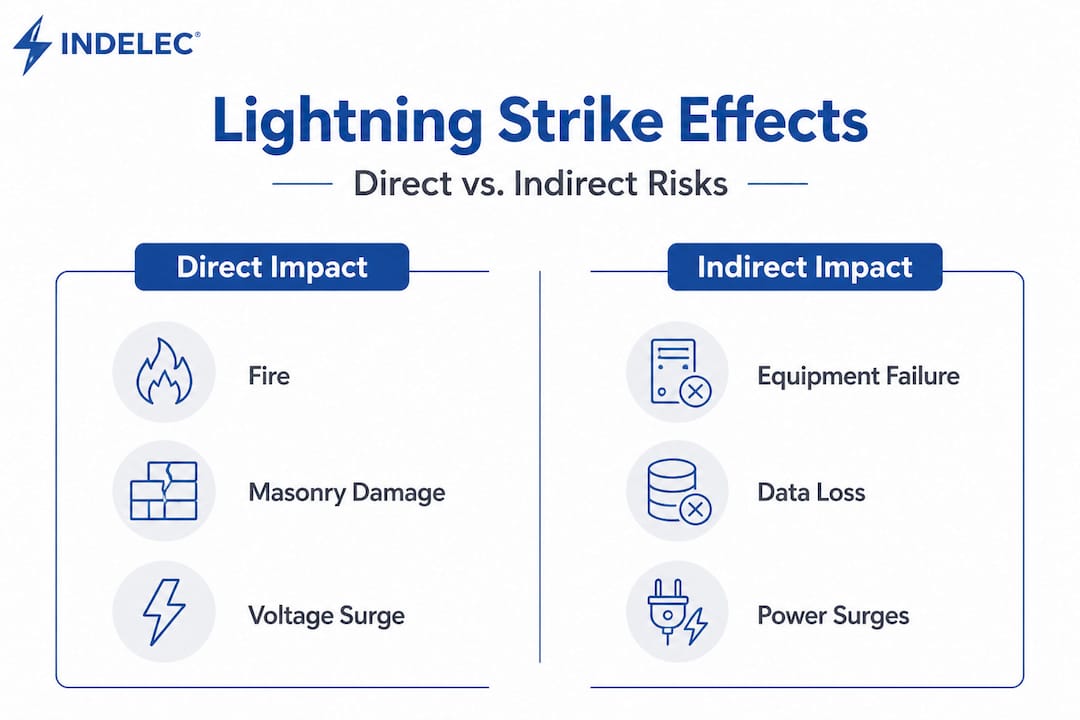
The primary direct effects on a building include ignition fires from combustible materials, spalling and explosive rupture of masonry due to vaporized moisture, side flashes that cause internal arcing between metallic elements and nearby wiring, and voltage surges that instantly destroy electrical systems. Each of these creates a distinct set of problems that require different mitigation responses.
Key takeaway: Direct strike damage rarely stops at the entry point. Fires, side flashes, and surge currents all propagate through the facility, turning a localized event into a widespread operational emergency.
Fires tend to ignite at the roof level first, particularly at junctions of combustible materials like timber framing, insulation, or roofing membrane. Industrial facilities with chemical storage or flammable vapor zones face a compounding risk that goes well beyond structural loss.
Spalling and masonry damage are common in older brick-and-mortar commercial buildings and industrial block structures. Moisture in the masonry wall vaporizes almost instantly under the heat of a direct strike, creating explosive internal pressure. The result can look deceptively minor from the outside while causing serious structural compromise internally.
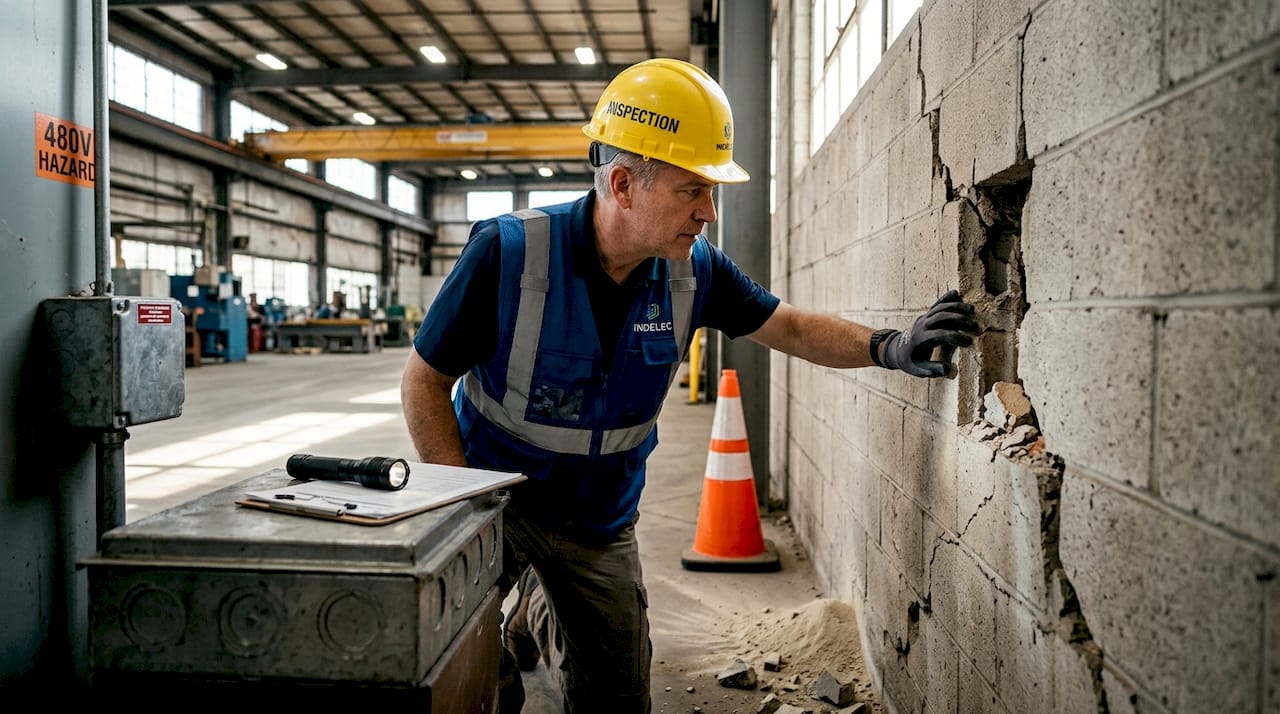
Side flashes represent a specific risk to personnel and internal systems. When lightning current travels through a structural column and “jumps” to a nearby metal conduit, pipe, or equipment frame, it can arc through the air gap between them. This arcing damages equipment and creates secondary ignition points anywhere along that path.
Voltage surges travel through the facility’s electrical backbone. Every connected device is exposed. Control panels, motors, PLCs (programmable logic controllers), and distribution boards can all sustain irreversible damage in a single event.
| Construction type | Primary risk | Secondary risk |
|---|---|---|
| Masonry/brick | Spalling, wall rupture | Moisture-driven explosive damage |
| Steel frame | Surge conduction, arcing | Structural connection melting |
| Wood frame | Fire ignition | Structural collapse post-fire |
| Reinforced concrete | Rebar heating, spalling | Explosive delamination |
To understand the full scope of building lightning safety methods and how construction type influences protection design, your protection strategy needs to address each of these categories specifically.
Key consequences of direct strike events:
- Roof-level fires spreading to insulation and structural timber
- Explosive spalling in masonry walls near strike contact points
- Side flashes causing secondary ignition and equipment arcing
- Blown distribution boards and destroyed electrical panels
- Melted wiring and cable insulation throughout the structure
- Irreversible damage to rooftop mechanical and communications equipment
When reviewing reducing industrial lightning risks at your sites, the structural construction type must be the starting point, not an afterthought. The installation approach for a steel-framed warehouse differs significantly from a reinforced concrete processing plant. A surge protection installation guide can help you align protection design with facility-specific vulnerabilities.
The often-overlooked impact: Indirect lightning strike effects
Here’s where most facility protection strategies fall short. A strike doesn’t have to hit your building directly to cause serious damage. Indirect lightning is actually responsible for the majority of costly facility losses, and it works through pathways that are rarely visible or obvious.
Indirect strikes cause surges via utility lines or the ground, and roughly 70% of all electronics damage from lightning comes from these surges, not from direct hits. Think about what that means operationally. Your facility could be miles from a strike and still suffer total failure of your data servers, building management systems, security platforms, or communications infrastructure.
The damage chain is consistent. A strike hits a utility line or the earth near your facility. That energy travels through the grid, through your incoming supply cable, or through the ground path itself. It enters at the weakest point of your protection system, usually a gap in surge protection, and propagates through every connected circuit. By the time the current dissipates, it may have destroyed equipment at multiple points simultaneously.
Systems most frequently damaged by indirect surge events:
- IT and data server infrastructure — high sensitivity to voltage spikes, complete data loss risk
- Building management systems and SCADA — operational continuity depends on these platforms
- Security and access control systems — cameras, card readers, alarm panels all fail simultaneously
- Communications equipment — telephone, fiber, and radio infrastructure share the same entry vulnerability
- HVAC controllers and variable speed drives — expensive to replace and rarely covered without adequate surge protection
- Emergency lighting and fire detection systems — failure of these in a post-strike scenario compounds the emergency significantly
- Industrial PLCs and motor control centers — downtime costs in manufacturing environments can reach thousands of dollars per hour
The 70% surge damage figure has enormous implications for how facilities budget for lightning protection. Most organizations spend heavily on visible protection, lightning rods and air terminals, while underinvesting in the surge protection for facilities that would actually prevent the majority of their losses. A direct strike to your roof may cost you a repair. An unprotected surge event can cost you weeks of downtime and the replacement of thousands of dollars in electronic assets.
Pro Tip: The most commonly missed surge protection points in commercial and industrial facilities are the interfaces between outdoor field wiring and indoor control panels. Sensors, actuators, and communication cables that run outside the building envelope are constant entry points for surge energy. Review your complete surge protection guide to identify and close these gaps before the next storm season.
How to mitigate lightning strike risks in your facility
Understanding the risks is vital, but application makes all the difference. Every facility manager needs a structured mitigation strategy that addresses all three forms of lightning damage: direct strike, thermal/mechanical, and indirect surge.
The four pillars of effective lightning protection for industrial and commercial facilities are: earthing and bonding systems, surge protective devices, fire defenses, and regular inspection and maintenance. Each plays a distinct and non-replaceable role in an integrated protection system.
Core mitigation priorities for your facility:
- Earthing and bonding: A well-designed grounding system dissipates lightning current safely into the earth, preventing it from traveling through the facility’s structure or electrical systems. Bonding ensures that all metallic elements share the same potential, eliminating side flash risk.
- Surge protective devices (SPDs): Install SPDs at every level of the electrical distribution system, from the main incoming supply to individual equipment panels. This is the primary defense against indirect strike damage.
- Air terminals and down conductors: Properly positioned lightning rods and down conductors intercept and route direct strike current away from the structure safely. The placement standard matters enormously here.
- Fire suppression systems: Facilities with direct strike risk should verify that suppression systems are positioned to cover probable ignition points, particularly roof spaces, plant rooms, and chemical storage areas.
- Communication line protection: Install surge protection on every incoming telecommunications and data line. These are common indirect entry paths.
- Regular inspection cycles: Protection systems degrade. Grounding connections corrode, SPDs reach end-of-life without obvious external signs, and cable paths can become compromised during renovations.
Most facilities that experience serious lightning losses were technically compliant at some point. The gap between meeting the primary effects of fires and surges on paper and being genuinely protected lies in maintenance and real-world application. Code-minimum protection sets a floor, not a ceiling.
Explore the facility lightning safety workflows that industrial and commercial operators use to ensure protection systems remain effective year-round, and compare them against your current practices. When upgrading, consider professional lightning protection systems designed specifically for your facility class.
Pro Tip: Older facilities built before current IEC 62305 or NFPA 780 standards came into force are particularly vulnerable. Auditing these sites against current standards, not the standards that existed when they were built, often reveals critical gaps in earthing resistance, SPD coverage, and bonding continuity.
The hidden cost of underestimating lightning risk: Our perspective
After more than 60 years of working across industrial, commercial, and infrastructure sectors globally, one pattern emerges repeatedly: lightning is treated as an insurance problem, not an operational threat. That distinction costs facilities far more than the price of proper protection.
Annual US insurance claims between $1 and $2 billion represent only the direct financial losses that are reported and paid. They don’t capture operational downtime, customer disruption, regulatory penalties for safety failures, data loss, or the long-term reliability degradation that comes from partially damaged electrical systems that are never fully repaired.
The regulatory compliance mindset is another problem. Many facility managers invest in lightning protection systems to satisfy audit requirements and then stop. The protection system gets installed, the certificate gets filed, and the job is considered done. But compliance is a point-in-time assessment. It says nothing about what happens to a grounding electrode in corrosive soil over five years, or whether the SPD installed in 2018 still has functional varistors today.
There’s a real gap between passing a lightning risk assessment and having a facility that is genuinely protected under real-world conditions. Understanding lightning current distribution patterns and how they interact with your specific building geometry is a level of analysis that compliance paperwork almost never demands, but that makes the actual difference in a severe storm event.
The facilities that sustain the worst losses are rarely unprotected on paper. They’re the ones that invested in protection, assumed the work was done, and skipped the inspection and maintenance cycle. Proactive strategies, annual system audits, SPD replacement programs, and updated risk assessments as facilities change, consistently outperform reactive ones in both cost and operational continuity. The investment in preventing industrial lightning hazards is almost always lower than the cost of recovering from them.
How Indelec can help safeguard your facility
When your facility’s resilience depends on reliable lightning protection, generic solutions aren’t enough.

Indelec has designed and delivered custom lightning protection solutions for industrial, commercial, and infrastructure facilities since 1955, combining advanced air termination systems, surge protective devices, earthing design, and certified installation support into integrated programs tailored to your specific risk profile. Our technical team brings deep expertise in current lightning safety standards including IEC 62305 and NFPA 780, helping you close the gap between regulatory compliance and real operational protection. If you’re ready to move from reactive insurance coverage to proactive risk reduction, explore facility lightning protection options and request an assessment tailored to your facility’s vulnerabilities and operational priorities.
Frequently asked questions
What is the most common type of damage caused by a lightning strike to a facility?
Most lightning-related facility losses come from electrical surge damage to electronics and control systems, not from fires, with surges accounting for approximately 70% of all electronics damage attributed to lightning events.
How much do lightning strikes cost businesses in the US each year?
Lightning strikes generate between $1 and $2 billion in annual insurance claims for US businesses alone, with global losses exceeding $5 billion and approximately 15,000 structure fires attributed to lightning in 2019.
Can lightning strikes affect facilities even if there is no direct hit?
Yes, indirect lightning surges travel through utility supply lines, telecommunications cables, and ground paths to enter your facility and destroy electronics, control systems, and operational infrastructure without any direct contact with the building.
What key measures should facility managers take to protect buildings from lightning?
Every facility should install properly designed earthing and bonding systems, multi-level surge protective devices, and fire defenses, while scheduling regular system inspections annually to catch degradation before the next storm event exposes the gap.
Recommended
- Lightning risk assessment guide: protect your facility
- Building lightning safety: protect your facility effectively
- Lightning protection for buildings: complete guide to safer facilities
- Lightning current distribution: keep your facility safe
- Waarom Stroomonderbreker Essentieel Is Voor Veiligheid – Holland Electric Duurzaam