Why Industrial Sites Need Protection: A Manager’s Guide
TL;DR:
- Most facility managers only consider protection after an incident occurs, which is financially and operationally risky. Robust layered strategies, including lightning protection, cybersecurity, and regular maintenance, are essential to mitigate complex physical and digital threats. Continuous management and organizational alignment are crucial for ensuring real site safety beyond mere compliance.
Most facility managers think about protection after something goes wrong. A lightning strike takes out a control system. A cyberattack halts production for three days. A compliance audit reveals documented gaps that cost more to fix than they would have to prevent. Understanding why industrial sites need protection before an incident occurs is not cautious thinking. It is the only thinking that makes financial and operational sense. This guide breaks down the real risks, the governing standards, and the layered strategies that separate well-run facilities from vulnerable ones.
Table of Contents
- Key takeaways
- Why industrial sites need protection from multiple threat vectors
- Regulations and standards shaping site protection
- Layered protection strategies for industrial sites
- Practical guidelines for facility managers
- Real-world results from integrated protection
- My perspective on what actually separates safe facilities from vulnerable ones
- How Indelec protects industrial facilities from the ground up
- FAQ
Key takeaways
| Point | Details |
|---|---|
| Lightning is a real operational threat | A direct strike can destroy control systems, trigger fires, and cause days of costly downtime. |
| Compliance is more complex than it looks | EPA’s site-specific approach means facilities compliant on paper may still face increased enforcement. |
| Defense-in-depth is non-negotiable | No single protective measure is enough; mutually reinforcing layers provide the only reliable safeguard. |
| Cyber and physical risks are converging | Physical breaches can compromise networked production systems, making unified governance critical. |
| Maintenance prevents barrier decay | Installed safety systems degrade without regular inspection and validation, undermining all other protections. |
Why industrial sites need protection from multiple threat vectors
The phrase “site protection” tends to conjure fences and security guards. The reality is far more complex, and the threats are far more expensive. Industrial sites face a convergence of physical, environmental, and digital risks that can hit simultaneously and reinforce each other in ways that catch underprepared managers off guard.
Environmental hazards that cause real damage
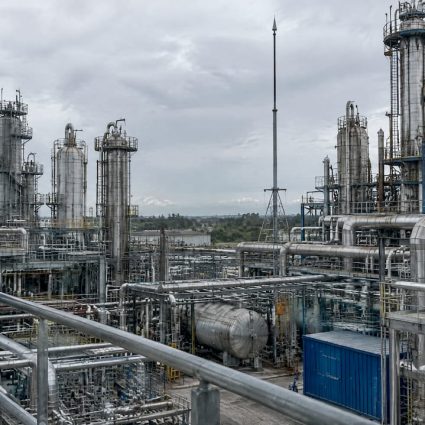
Lightning is one of the most underestimated threats to industrial infrastructure. A direct strike on unprotected equipment can destroy programmable logic controllers, ignite stored chemicals, and take production offline for days or weeks. Refineries, chemical plants, and power generation facilities are especially exposed due to their height, open footprint, and the presence of conductive materials and flammable substances. Extreme weather events are growing more frequent, which means the statistical probability of a strike at any given facility is increasing year over year.
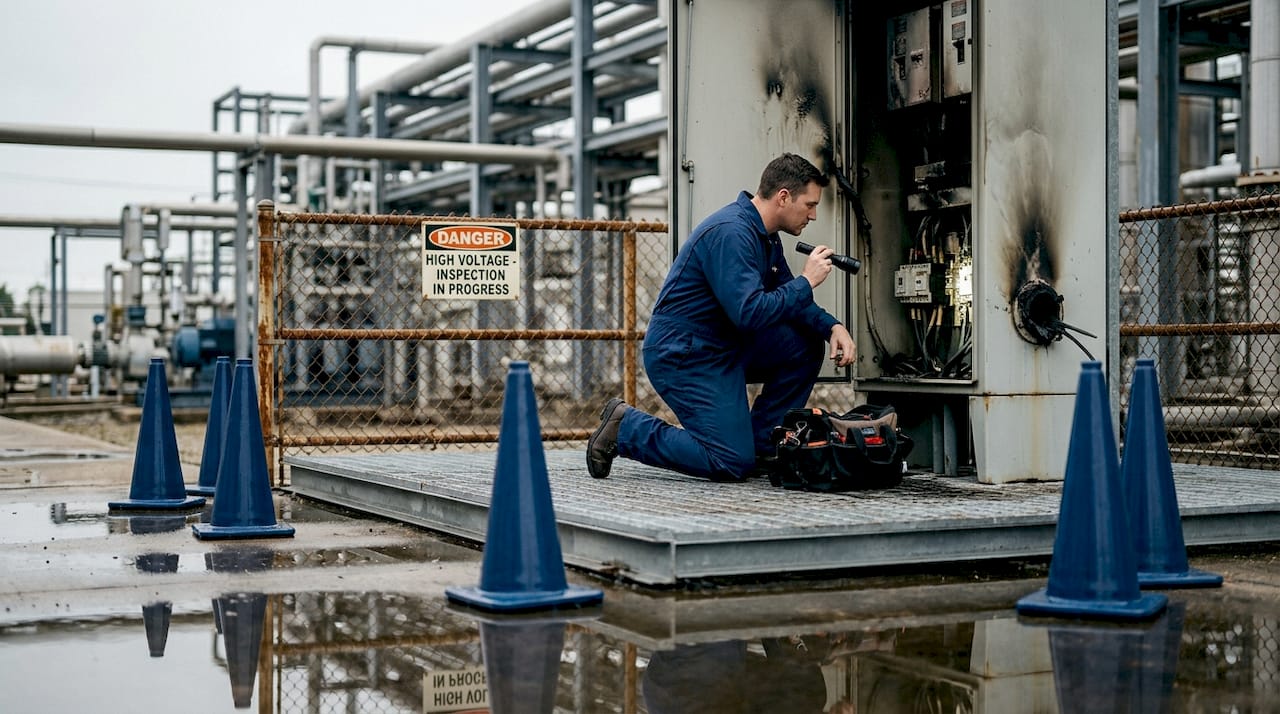
Physical threats extend beyond weather. Theft of copper wiring, vandalism of perimeter systems, and sabotage of critical equipment are persistent concerns for facilities in remote or semi-urban locations. A single compromised access point can cascade into production delays and safety incidents.
The cyber dimension of industrial site safety
Manufacturing accounted for 27.7% of cyber incidents recorded in 2025, placing it among the most targeted sectors globally. The reason is straightforward: industrial control systems were designed decades ago for reliability, not network security. Connecting them to modern IT infrastructure without proper segmentation creates vulnerabilities that skilled attackers can exploit.
What makes this especially dangerous is that physical and digital threats rarely stay separate. Physical breaches can compromise networked production via badge readers, camera systems, and remote support credentials. An attacker who gains physical access to a server room or network switch can cause damage far beyond what a purely remote attack could achieve.
The risks that industrial facilities face on any given day include:
- Lightning strikes and surge damage to control systems and communication infrastructure
- Theft, vandalism, and unauthorized physical access to equipment and sensitive areas
- Ransomware and malware targeting operational technology networks
- Insider threats enabled by poor access management across IT and OT systems
- Regulatory violations triggered by environmental incidents or undocumented failures
- Industrial accidents from electrical faults causing costly downtime and reputational damage
Regulations and standards shaping site protection
Understanding the importance of industrial site security requires knowing what the law actually demands. Regulatory frameworks have grown more specific and more demanding, and “we were compliant last year” is no longer a safe assumption.
OSHA requirements and the cost of gaps
OSHA mandates regular risk assessments and documented controls across industrial environments. Failure to comply with OSHA safety requirements leads to production delays, regulatory fines, and lasting harm to business reputation. But the real cost is often not the fine itself. It is the operational disruption, the legal exposure, and the workforce confidence damage that follows a serious incident.
Documenting your controls is not a bureaucratic exercise. It is the only way to demonstrate due diligence when something goes wrong and regulators come asking questions.
EPA’s evolving site-specific compliance approach
EPA’s site-specific compliance approach factors in community exposure, pollution history, and proximity to sensitive receptors. This means that a facility that meets general federal standards may still face increased enforcement based on local environmental conditions. For industrial sites in areas with high environmental sensitivity or communities with existing pollution concerns, this is a serious consideration that changes how you need to design and document your protection measures.
The takeaway for facility managers is that compliance is no longer a static target. It requires ongoing monitoring and adjustment as your site’s context changes.
International standards for lightning protection
The IEC 62305 standard and its national equivalents define how lightning protection systems must be designed, installed, and maintained. These standards cover everything from risk assessment methodology to the specific components required for different protection levels. Reviewing your applicable lightning protection standards is a prerequisite before any installation or upgrade project, not an afterthought.
| Regulatory framework | Primary focus | Key requirement |
|---|---|---|
| OSHA 29 CFR 1910 | Workplace electrical safety | Documented risk assessments and regular control reviews |
| EPA site-specific compliance | Environmental impact | Site-contextualized enforcement based on local factors |
| IEC 62305 | Lightning protection | Structured risk analysis and certified system design |
| NFPA 780 | Lightning protection systems (US) | Installation standards for air terminals and grounding |
Pro Tip:Run a gap analysis against both OSHA requirements and your applicable lightning protection standard simultaneously. The overlap is significant, and addressing both in one assessment saves time and avoids duplicating documentation work.
Layered protection strategies for industrial sites
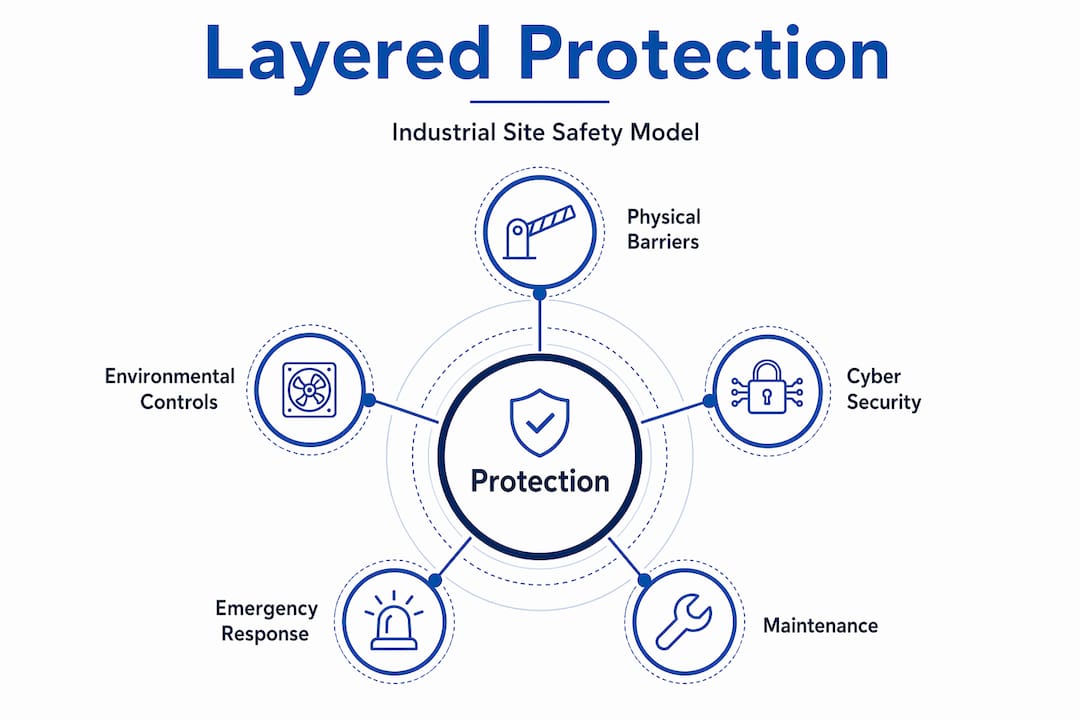
The defense-in-depth principle holds that no single protective layer can guarantee prevention of a determined threat. This is not a theoretical concept. It is the design philosophy behind every well-protected industrial facility in the world.
How lightning protection fits the layered model
A properly designed lightning protection system illustrates the layered approach well. An air terminal intercepts the strike. Down conductors carry the current safely to ground. A grounding system dissipates the energy. Surge protection devices guard sensitive electronics from secondary effects. Remove any one of these layers and the system fails at that point. The five most common industrial lightning hazards all trace back to gaps in one or more of these layers, which is why system integrity matters more than any single component.
Integrating cyber and physical controls
Physical and cybersecurity must be unified to manage insider threats, drone reconnaissance, and operational technology vulnerabilities effectively. Roughly 85 to 90 percent of organizations still operate IT and OT in separate silos, which creates the exact gaps that both human attackers and cascading failures exploit.
A practical layered strategy for how to safeguard industrial facilities includes the following steps:
- Conduct a unified risk assessment covering physical, environmental, and cyber threat vectors before designing any controls
- Install certified lightning protection systems with verified grounding as the environmental protection baseline
- Deploy perimeter security with monitored access control that feeds data into your IT governance framework
- Segment operational technology networks and restrict remote access using multi-factor authentication
- Install real-time monitoring and automated emergency controls including shut-offs and alarms for critical process areas
- Schedule regular independent audits of all protective systems to detect degradation before it becomes failure
Active safety barriers such as automated emergency shut-offs and real-time alarms prevent risk escalation beyond facility control. Modern protective barriers focus on risk management by design, not passive monitoring. This distinction matters. Passive systems tell you something went wrong. Active systems prevent the escalation that turns an incident into a disaster.
Pro Tip:When integrating OT and IT security protocols, start with read-only monitoring of OT systems before attempting any active management. Unintended commands on industrial control networks can cause physical damage and safety incidents, so visibility should come before control.
Practical guidelines for facility managers
Knowing the threats and the standards is necessary but not sufficient. The benefits of securing industrial sites only materialize through deliberate, sustained implementation. Here is where many facilities fall short.
Barrier decay is one of the most insidious risks in industrial site safety. Critical safety controls degrade when they are bypassed in day-to-day operations, when maintenance is deferred, or when the original design intent is forgotten during turnover of personnel. Treating your safety systems the way you treat heavy machinery, with scheduled inspection, validation, and documentation, is the only way to prevent this.
Practical measures that directly support the importance of industrial site security include:
- Assign ownership of each protective system to a named individual with authority and budget to maintain it
- Review your risk assessment annually or whenever a significant change occurs at the facility
- Coordinate your physical security team and IT governance team in quarterly joint reviews
- Run emergency drills that test realistic scenarios. Drills often expose hidden failures like incompatible radio frequencies and blocked emergency access routes that routine exercises never surface
- Engage with regulators proactively rather than reactively. Facilities that communicate openly with inspectors consistently receive more favorable outcomes
- Use the factory electrical safety checklist as a structured starting point for quarterly self-audits
Pro Tip:The most valuable emergency drill is one your team does not know is coming. Announced drills test planning. Unannounced drills test culture. The gap between the two reveals exactly where your real vulnerabilities are.
Real-world results from integrated protection
The evidence for why protecting industrial areas pays off is not abstract. Facilities that have implemented certified lightning protection systems report measurable reductions in equipment failures, insurance claims, and unplanned downtime. A petroleum storage facility that upgrades from a passive rod to an early-streamer-emission air terminal and completes its grounding system can reduce the probability of a damaging strike by an order of magnitude.
| Protection approach | Typical outcome | Key limitation |
|---|---|---|
| No formal system | High exposure to strike damage, regulatory gaps | No baseline for insurance or compliance |
| Basic passive rod only | Partial strike interception | No surge protection, grounding often incomplete |
| Certified full system | Measurable strike reduction, insurer confidence | Requires qualified installation and periodic inspection |
| Integrated system with monitoring | Operational continuity, real-time incident data | Higher upfront investment, needs IT/OT coordination |
Facilities that integrate access control data into their IT governance framework have documented reductions in insider incidents and faster response times when anomalies are detected. The facilities that consistently perform best in audits and safety records share one trait: they treat protection as an operational function, not an insurance formality.
My perspective on what actually separates safe facilities from vulnerable ones
In my experience working with industrial facilities across multiple continents, the gap between well-protected sites and vulnerable ones is rarely about budget. It is almost always about mindset. Facilities that check the compliance box and move on are the ones that face the most expensive incidents.
What I have found is that the best-run facilities treat every safety control as a living system that requires attention. They do not install a grounding system and assume it will work in ten years without inspection. They do not segment their OT network once and consider the job done. They build what I would call a barrier management culture, where every person on the floor understands that the protections around them need care to remain effective.
The other pattern I have seen repeatedly is the cost of siloed operations. I have walked through facilities where the IT security team had no idea what SCADA systems were running, and the operations team had no idea those systems were internet-connected. That kind of blind spot does not get resolved by purchasing better technology. It gets resolved by deliberate organizational alignment.
My strong view is that minimum compliance is a ceiling, not a floor. Facilities that use OSHA requirements and IEC standards as a starting point for continuous improvement consistently outperform those that treat them as finish lines. The environmental hazards are real, the regulatory environment is tightening, and the cyber threat to industrial operations is not going away. Building a culture that takes integrated protection seriously is the most durable investment you can make.
— Indelec
How Indelec protects industrial facilities from the ground up
Protecting an industrial site from environmental hazards requires more than intent. It requires the right technology, properly installed and maintained.

Indelec has been engineering lightning protection solutions since 1955, and the Prevectron3 air terminal with patented OptiMax technology represents the current standard in early-streamer-emission protection for high-value industrial infrastructure. For facilities where grounding is a challenge due to soil conditions, Indelec’s deep earth grounding drilling service provides the low-resistance grounding that makes the entire protection system function as designed. Indelec also offers technical consulting, compliance support, and certified installation services tailored to your facility’s specific risk profile. Contact Indelec to discuss a protection assessment for your site.
FAQ
Why do industrial sites face higher lightning risk than other facilities?
Industrial sites typically feature tall structures, open footprints, conductive materials, and flammable substances that make them significantly more attractive lightning targets than commercial buildings. Their geographic isolation and critical infrastructure density also mean a single strike can cause disproportionate damage.
What does defense-in-depth mean for industrial site protection?
Defense-in-depth means using multiple independent protective layers so that if one fails, others remain in place. For industrial sites, this includes lightning protection, physical access control, cybersecurity controls, and active emergency barriers operating as a coordinated system rather than separate checkboxes.
How often should industrial safety systems be inspected?
At minimum, certified lightning protection systems should be inspected annually, with full testing after any significant weather event or modification to the facility. OSHA-related safety controls require documented review on a schedule determined by your risk assessment, typically annually or after any process change.
What is barrier decay and why does it matter?
Barrier decay occurs when installed safety controls degrade over time through bypassing, deferred maintenance, or personnel turnover that loses the original design intent. It is one of the leading causes of unexpected incidents at facilities that appear compliant on paper.
How are cyber and physical security risks connected at industrial sites?
A physical breach, such as unauthorized access to a server room or control panel, can give an attacker direct access to operational technology networks, bypassing digital perimeter defenses entirely. This is why physical security is now considered an integral part of IT governance at networked industrial facilities.