Lightning protection for buildings: complete guide to safer facilities
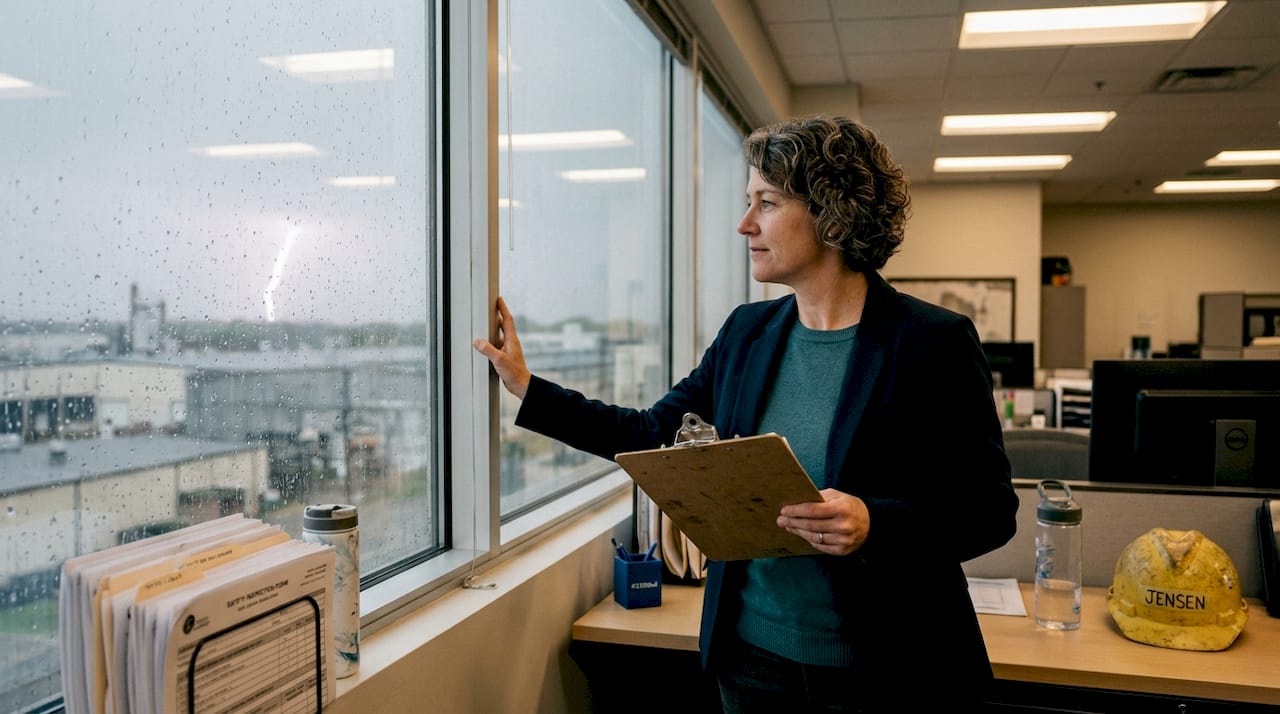
Lightning strikes are not a rare event for commercial and industrial facilities. In 2025, the US recorded 88 million lightning flashes, with 43% reaching the ground. Yet most facility managers still rely on basic grounding or assume their building’s steel frame provides adequate protection. It does not. A single direct strike can ignite structural fires, destroy control systems, and trigger weeks of costly downtime. This guide walks you through the real risks, the core components of a modern lightning protection system (LPS), the standards you need to know, and the practical steps to keep your facility safe and compliant.
Table of Contents
- Understanding the real risks of lightning for commercial buildings
- Key components of an effective lightning protection system
- Comparing lightning protection standards and methodologies
- Installation best practices and pitfalls to avoid
- Emerging trends and advanced lightning protection solutions
- Our take: What most building owners get wrong about lightning protection
- Solutions for your facility’s lightning protection needs
- Frequently asked questions
Key Takeaways
| Point | Details |
|---|---|
| Lightning risk is real | Many US regions have a high frequency of damaging lightning strikes that impact facility safety and operations. |
| Integrated systems work best | Effective protection combines external LPS, internal surge protection, and proper bonding for full coverage. |
| Know your standards | NFPA 780 and IEC 62305 set the bar—risk assessment and adherence prevent costly mistakes and insurance issues. |
| Avoid shortcuts | Pitfalls like poor grounding, missed bonding, or undersized SPDs can jeopardize the whole system. |
| Upgrade for resilience | Emerging technologies like ESE rods and monitoring networks offer advanced protection for high-value sites. |
Understanding the real risks of lightning for commercial buildings
Lightning is far more common than most building owners realize, and the consequences of a direct hit go well beyond a blown fuse. Ground flash density varies dramatically across the US, but in Florida it reaches up to 14 flashes per km² per year, meaning exposed infrastructure in high-activity regions faces repeated risk every single season.
The damage profile is wide. A single strike can cause structural fires, destroy sensitive electronics, corrupt data systems, and knock out HVAC or process control equipment. Business interruption costs often exceed the direct repair bill by a factor of three or more. For facilities running continuous operations, even a four-hour outage can translate into six-figure losses.
“Regulatory standards expect risk-based solutions, not generic hardware. A surge protector at the panel is not a lightning protection system.”
Common misconceptions still drive poor decisions. Many owners believe that a building’s steel frame acts as a natural conductor, or that a single ground rod at the utility entrance is sufficient. Neither is true. Without a properly bonded, low-resistance grounding network and coordinated surge protection devices (SPDs), induced voltages from nearby strikes travel freely through electrical and data lines.
The consequences extend beyond physical damage. Insurers increasingly require documented facility lightning safety assessments before issuing coverage on high-value assets. Facilities without compliant LPS documentation face claim denials and rising premiums. Safety liability is also a real concern: OSHA and local fire codes hold building owners accountable for protecting occupants from foreseeable hazards.
Key damage categories from lightning events:
- Structural fires from direct arc heating
- Equipment failure from conducted or induced surges
- Data and control system loss
- Extended business interruption
- Insurance coverage gaps
Having seen the scope of the problem, next let’s break down what a complete lightning protection system involves.
Key components of an effective lightning protection system
A modern LPS is not a single device. It is an integrated system with external and internal layers working together. External systems intercept strikes via air terminals, down conductors, and grounding, while internal SPDs, bonding, and shielding handle surges and electromagnetic effects.
External LPS components:
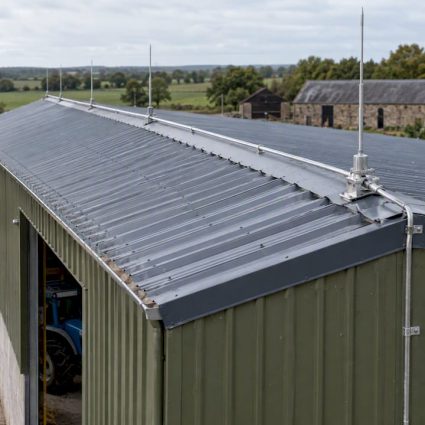
- Air terminals (Franklin rods, ESE rods, or mesh conductors): Intercept the strike at the highest point and provide a controlled path.
- Down conductors: Carry the lightning current from the air terminal to the grounding system. Routing matters; sharp bends increase impedance and arc risk.
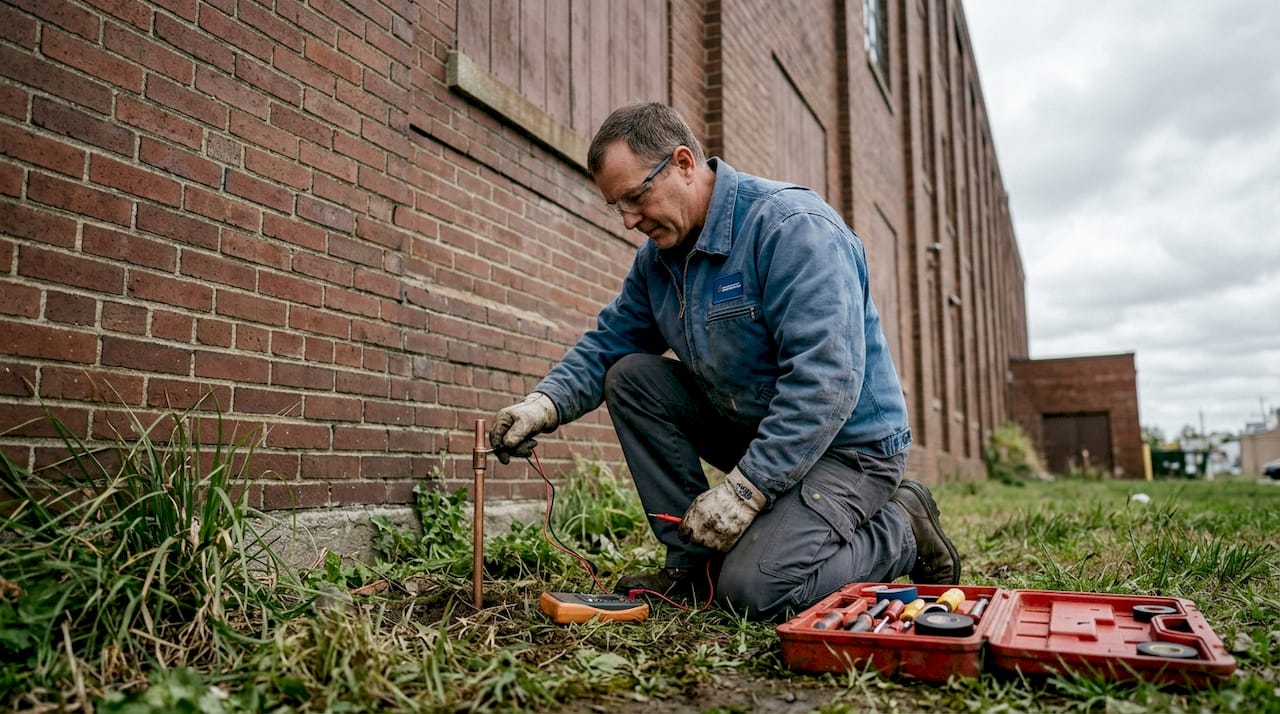
- Grounding/earthing system: Dissipates the current safely into the earth. Target resistance is 10 ohms or less for reliable performance.
Internal LPS components:
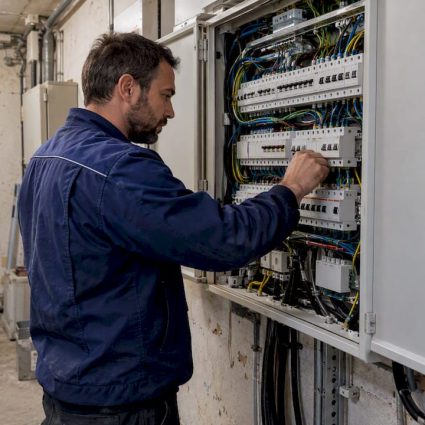
- Type 1, 2, and 3 SPDs: Installed at the service entrance, distribution panels, and sensitive equipment respectively. Multi-stage protection is essential.
- Equipotential bonding: Connects all metallic structures, pipes, cable trays, and equipment frames to a common reference. This eliminates dangerous voltage differences during a strike.
- Shielding: Cable routing in metallic conduit or shielded trays reduces electromagnetic transient coupling.
For facilities with explosive or flammable atmospheres (EX zones), explosion hazard protection standards require insulated or spatially separated down conductors to prevent arc ignition. This is a non-negotiable design requirement in petrochemical, pharmaceutical, and grain handling facilities.
You can review system application examples for industrial contexts, or explore design examples for high-sensitivity sites to see how these components come together in practice.
Pro Tip: Never treat SPD selection as an afterthought. Undersized or mismatched SPDs fail silently, leaving your equipment exposed while giving you false confidence that internal protection is in place.
Now that you’ve seen the components, understanding LPS standards and how they’re applied is crucial.
Comparing lightning protection standards and methodologies
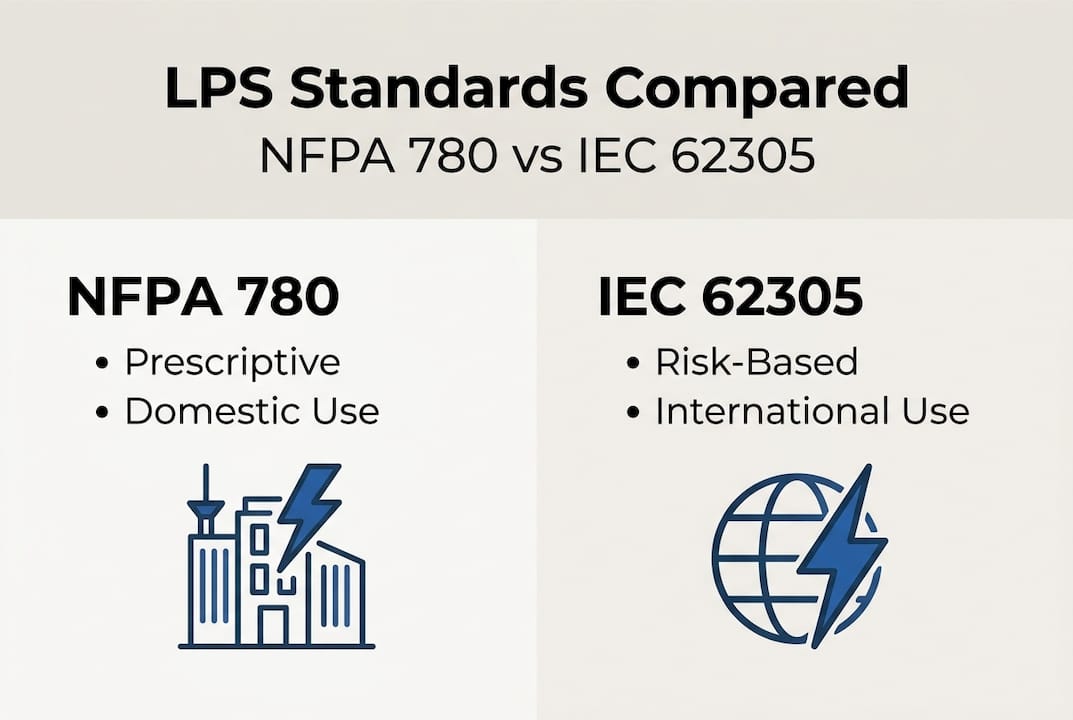
Two frameworks dominate the global LPS landscape, and knowing which one applies to your facility is not optional.
| Feature | NFPA 780 (US) | IEC 62305 (International) |
|---|---|---|
| Approach | Prescriptive | Risk-based |
| Risk assessment | Optional | Mandatory |
| Protection levels | Not tiered | LPL I (highest) to IV (lowest) |
| Inspection body | LPI | National authorities |
| Design flexibility | Lower | Higher |
NFPA 780 is prescriptive, detailing specific hardware and installation requirements. IEC 62305 is risk-based and assigns a Lightning Protection Level (LPL I through IV) based on a formal risk assessment. Both require professional design and documentation.
Three primary design methodologies are used under both standards:
- Rolling sphere method: Simulates a sphere of defined radius rolling over the structure to identify unprotected zones. Radius varies by LPL (20 m for LPL I, 60 m for LPL IV).
- Mesh/grid method: Creates a Faraday cage effect over flat or complex roof surfaces. Mesh size tightens with higher protection levels.
- Protective angle method: Defines a cone of protection beneath an air terminal. Simple but limited to straightforward geometries.
For IEEE standards critique and comparative analysis, independent research highlights where prescriptive approaches can fall short for complex or high-risk facilities. Our lightning standards guide covers both frameworks in detail, and a sport arena case shows how methodology selection affects real project outcomes.
Pro Tip: For international projects or facilities with cross-border insurance policies, always confirm with your insurer and local authority which standard governs. Assuming NFPA 780 compliance satisfies an IEC 62305 requirement is a costly mistake.
With the standards clear, let’s address common installation mistakes and practical success factors.
Installation best practices and pitfalls to avoid
Even a well-designed LPS fails if installation quality is poor. Poor grounding, missed connections, or failing to protect for surge and electromagnetic effects are the most common real-world failures. Here is a sequential approach that works.
Step-by-step installation process:
- Conduct a formal site risk assessment (per NFPA 780 or IEC 62305).
- Engage a qualified LPS designer. Do not delegate this to a general electrical contractor.
- Install external LPS components with verified grounding resistance below 10 ohms.
- Install multi-stage SPDs at all entry points and sensitive equipment locations.
- Complete equipotential bonding across all metallic systems.
- Document the full installation with test records for audit and insurance purposes.
Common pitfalls that cause failures:
- Grounding resistance above 10 ohms due to poor soil contact or corroded connections
- Missing bonding points on secondary metallic systems (gas pipes, cable trays, HVAC ducting)
- Single-stage SPD protection at the service entrance only
- No post-installation continuity testing
“Arresters, proper earthing, and environmental shielding dramatically reduce outages and damage when correctly specified and installed.”
Climate is also a factor. Regions with increasing storm frequency require more frequent inspection cycles. The contractor guide for industrial sites and the safety workflow resource both provide field-tested checklists for ongoing compliance.
Pro Tip: Schedule LPS inspections after every major storm season, not just annually. Corrosion, physical damage to down conductors, and grounding degradation are invisible until they fail under load.
Finally, let’s look at how emerging technologies and new approaches are shaping the future of lightning protection.
Emerging trends and advanced lightning protection solutions
The LPS industry has moved well beyond passive Franklin rods. Several technologies now offer measurably better outcomes for facilities with high exposure or high consequence of failure.
Key innovations reshaping LPS design:
- Early Streamer Emission (ESE) rods: These active air terminals trigger an upward leader earlier than conventional rods, extending the protected radius. ESE lightning rod efficiency data shows consistent performance advantages in independent testing.
- Charge Transfer Systems (CTS): By dissipating the ground charge that enables lightning attachment, CTS can reduce lightning strikes by up to 80% compared to conventional collectors. Wind farms and explosive storage facilities are primary beneficiaries.
- Online LPS monitoring: Sensors embedded in the grounding system and down conductors provide real-time continuity data, flagging degradation before failure occurs.
- Lightning detection network integration: Linking your facility’s LPS to regional lightning detection feeds enables predictive alerts, allowing operators to shut down sensitive processes before a storm arrives.
- Eco-friendly grounding compounds: For sites with strict environmental standards, green lightning solutions replace traditional chemical ground enhancement materials with biodegradable alternatives.
Data centers, wind farms, and facilities storing flammable or explosive materials benefit most from these advanced approaches. The combination of active collection, continuous monitoring, and smart SPDs creates a layered defense that passive systems simply cannot match.
Pro Tip: If your facility has expanded or been modified since the original LPS was installed, treat it as a new risk assessment trigger. New rooftop equipment, added structures, or changed occupancy can all invalidate your existing protection zone calculations.
Now that you’re equipped with the latest approaches, here’s a blunt perspective on what really drives successful lightning protection.
Our take: What most building owners get wrong about lightning protection
After decades of designing and installing LPS across industrial and commercial sectors, the pattern is clear. Most facilities that suffer serious lightning damage had some form of protection in place. The problem was not the absence of hardware. It was the absence of a system.
Building owners check the box: air terminal installed, ground rod in place, surge protector at the panel. Then they move on. What they miss is that lightning protection is a living system. Connections corrode. Grounding resistance drifts upward as soil conditions change. New equipment gets added without bonding. SPDs degrade silently after absorbing a surge.
Facilities with integrated LPS and ongoing monitoring see far lower losses from both direct and indirect events. The difference is not the quality of the initial installation. It is the commitment to treating LPS as infrastructure that requires the same maintenance discipline as any other critical system.
The blunt truth: shortcuts and ignored standards lead to insurance denials and avoidable disasters. Engage qualified experts early, document every system update, and review your proven lightning safety protocols at least annually. Lightning does not care about your maintenance backlog.
Solutions for your facility’s lightning protection needs
If this guide has raised questions about your current LPS, that is exactly the right response. Indelec has been designing and delivering lightning protection solutions for industrial and commercial facilities since 1955, combining risk assessment expertise, advanced product engineering, and full compliance support.

Whether you need to understand why lightning protection is essential for your specific risk profile, explore deep earth grounding for challenging soil conditions, or review the full range of system application services available for your sector, our team is ready to help. A professional evaluation is the fastest way to identify gaps, confirm compliance, and protect the assets and people in your care.
Frequently asked questions
What are the main standards for lightning protection systems in the US and internationally?
The US follows NFPA 780 and IEC 62305 as the two primary frameworks. NFPA 780 is prescriptive and used domestically, while IEC 62305 is risk-based with defined Lightning Protection Levels and is required on most international projects.
Is lightning protection mandatory for all commercial buildings?
Not universally, but risk assessments determine necessity and many insurers require documented LPS on facilities in high-exposure areas or those housing critical equipment. Skipping protection in a high-risk zone is a liability decision, not just a compliance one.
How often should a lightning protection system be inspected?
Regular inspections per NFPA guidelines call for at least annual checks, plus an inspection after any major storm event or structural modification to the building.
What’s the target grounding resistance for safe lightning protection?
Ideal LPS grounding resistance should be 10 ohms or less. Higher resistance means the system cannot safely dissipate strike energy, increasing the risk of side flashing and equipment damage.
Does an LPS prevent all lightning damage?
No system eliminates all risk, but integrated LPS with internal protection devices, including multi-stage SPDs and full equipotential bonding, dramatically reduces the probability of injury, fire, and equipment loss from both direct and indirect lightning events.