What is lightning interception? A facility manager’s guide

TL;DR:
- Lightning interception is a proactive engineering strategy that guides lightning safely to ground using purpose-built devices like air terminals. Proper placement, standards compliance, and integrated surge protection are essential for preventing damage to critical industrial systems and structures. Regular inspection and maintenance ensure the system’s effectiveness, reducing risk and enhancing facility safety over time.
Most facility managers inherit lightning protection systems they didn’t design and can’t fully explain to auditors. The bigger problem is that lightning interception is widely misunderstood, even by people who should know better. The most persistent myth is that a lightning rod “attracts” strikes, turning your building into a target. It doesn’t. What is lightning interception, really? It’s a controlled engineering strategy that gives lightning a preferred, safe path to ground before it can tear through your roof membrane, fry your control systems, or ignite a fire. Understanding this distinction is what separates reactive repairs from proactive protection.
Table of Contents
- Understanding lightning interception and its role in protection
- Technical standards shaping interception system design
- Comparing lightning interception methods and interception network components
- Nuances and challenges in industrial lightning interception systems
- Applying lightning interception knowledge to facility management
- Why conventional thinking about lightning interception can fall short
- Explore professional lightning interception solutions for your facility
- Frequently asked questions
Key Takeaways
| Point | Details |
|---|---|
| Lightning interception defined | Lightning interception uses devices like air terminals to safely capture and direct strikes away from buildings. |
| Regulatory standards matter | NFPA 780 and IEC 62305-3 provide essential design and inspection rules for effective interception systems. |
| Proper inspection is critical | Annual visual checks and periodic resistance testing maintain system reliability over time. |
| Misconceptions corrected | Lightning protection systems do not attract lightning but provide a safe controlled path for strikes. |
| Special site considerations | Explosive atmospheres and poor soils require specialized grounding and spacing approaches. |
Understanding lightning interception and its role in protection
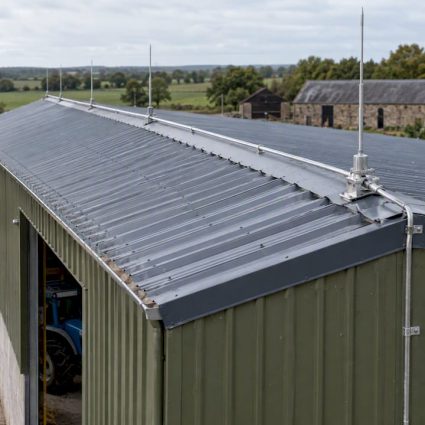
Lightning interception uses purpose-built devices called air terminals to capture strikes at designated points before they reach vulnerable building surfaces. Think of it this way: lightning is going to land somewhere. Interception engineering simply determines where that somewhere is, and makes sure it’s a point designed to handle the energy.
Air terminals, commonly called lightning rods, must be physically higher than the surfaces they protect and built to withstand the thermal and mechanical stress of a direct strike. Placement matters enormously. NFPA 780 (2026 edition) defines air terminals as interception points requiring proper placement and construction to safely channel lightning currents, with spacing no greater than every 50 feet on flat roofs. Go beyond that, and you create unprotected zones where a strike can bypass the terminal entirely and hit the roof deck or penetrate the building envelope.
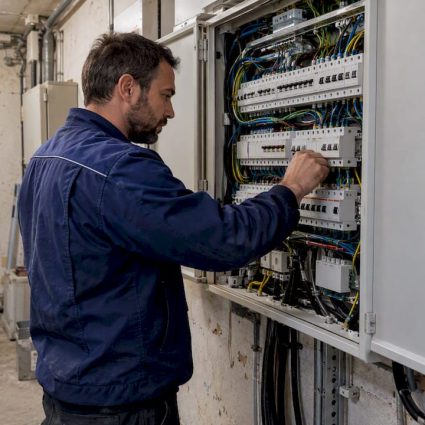
For industrial facilities, the consequences of a missed interception point aren’t just structural. A direct strike to an unprotected section of roof can induce voltage spikes that travel through conduit and destroy programmable logic controllers, sensors, and HVAC controls. Integrating a facility lightning safety workflow from the design phase prevents these failures rather than responding to them.
Key functions of air terminals in an industrial interception system:
- Capture the strike at a controlled, designed point above the protected surface
- Initiate the conduction path that moves energy from the air terminal to down conductors
- Prevent flashover to adjacent unprotected surfaces or structural steel
- Protect electronics by keeping high-current paths away from electrical rooms and control panels
- Provide a verifiable interception perimeter that can be inspected and tested on a schedule
Technical standards shaping interception system design
Two standards govern how industrial lightning interception systems are designed, spaced, and maintained. Knowing which one applies to your facility, and how they differ, directly affects whether your insurance claim holds up after a strike event.
NFPA 780 is the dominant standard in North America. It governs air terminal height requirements (minimum 10 inches for buildings under 30 feet, minimum 24 inches for taller structures), spacing between terminals, conductor sizing, and the use of the rolling sphere method to define protection zones. The rolling sphere model imagines a 150-foot radius sphere rolling over your building. Any point the sphere touches before contacting an air terminal is a potential strike point.
IEC 62305-3 is the governing standard internationally, and it’s more granular about inspection requirements. IEC 62305-3 requires annual visual inspections and spaced down conductors based on perimeter for effective interception over 25 years. The standard assigns four Lightning Protection Levels (LPL I through IV), with LPL I representing the most stringent requirements for the most critical or hazardous facilities.
| Standard | Region | Inspection frequency | Rolling sphere radius | Min down conductors |
|---|---|---|---|---|
| NFPA 780 | North America | Every 1 to 3 years | 150 ft (46 m) | Perimeter-based |
| IEC 62305-3 LPL I | International | Annual visual + testing | 20 m | 25 m spacing |
| IEC 62305-3 LPL II | International | Annual visual | 30 m | 10 m spacing |
| IEC 62305-3 LPL III/IV | International | Annual visual | 45 to 60 m | 15 to 20 m spacing |
Both standards are reviewed at the lightning standards level, and applying the right one to your specific facility type is a non-negotiable first step. A chemical plant and a distribution warehouse don’t carry the same risk profile, even if they sit on the same industrial park. Consult your building lightning safety documentation to confirm which protection level your facility currently meets.
Key standard compliance points to track:
- Rolling sphere compliance for all rooftop protrusions
- Bonding of HVAC units, vents, and antennas to the interception network
- Down conductor spacing per perimeter measurements
- Earth termination resistance values below thresholds
- Documentation of last inspection date and findings
Comparing lightning interception methods and interception network components
Not every interception system uses the same approach. The method you choose depends on building geometry, contents, occupancy type, and your target protection level. BS EN IEC 62305-3 defines three air termination methods and outlines down conductor and earth system roles for safe lightning dissipation.
| Method | Best suited for | Coverage mechanism | Limitations |
|---|---|---|---|
| Air terminals (Franklin rods) | Flat and pitched roofs | Point interception, spaced grid | Gaps between rods if poorly spaced |
| Meshed conductors | Flat industrial roofs with dense equipment | Grid coverage across entire roof surface | More material, complex bonding |
| Catenary wires | Open structures, tanks, substations | Suspended wire over protected area | Requires structural anchor points |
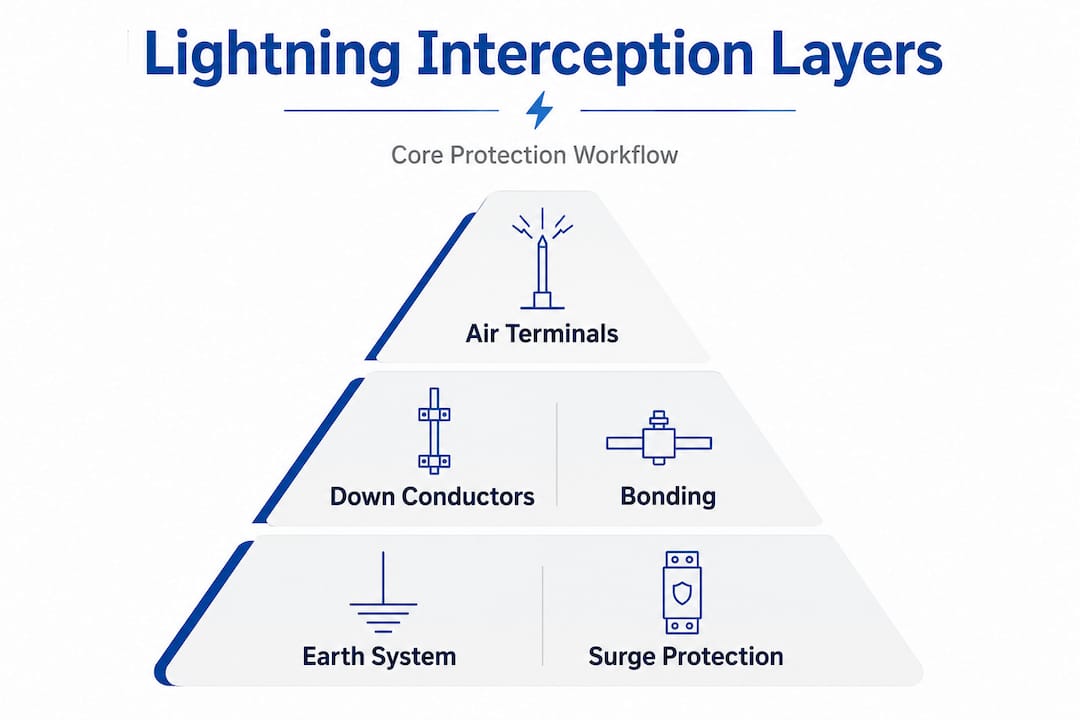
Each method connects to the same downstream components. Here’s how the full interception network functions, from top to bottom:
- Air termination system captures the strike at the highest designated points
- Down conductors route current from the roof to grade level, with minimum numbers determined by building perimeter
- Equipotential bonding network connects all metallic structures, pipes, and equipment to prevent side flashes between components at different potentials
- Earth termination system disperses current safely into the soil through Type A (individual rods or plates) or Type B (ring electrodes) configurations
- Surge protection devices (SPDs) intercept conducted transients traveling along power and data cables into the building
Pro Tip: When you commission a new interception system or inspect an existing one, physically verify that every piece of rooftop equipment, including exhaust fans, cooling towers, satellite dishes, and pipe risers, has a visible, code-compliant bond to the air termination network. Missing bonds are the single most common cause of internal side flash damage in industrial facilities.
The lightning protection system application determines how all these components are specified and sized together. Treating them as independent purchases rather than an integrated system is one of the costliest mistakes in industrial facility management. Review electrical protection standards examples to understand how specific industries configure these networks.
Nuances and challenges in industrial lightning interception systems
This is where lightning interception explained at the basic level stops being sufficient. Industrial facilities carry complications that standard commercial buildings don’t. Getting these details wrong can void warranties, fail audits, or worse, contribute to a catastrophic incident.
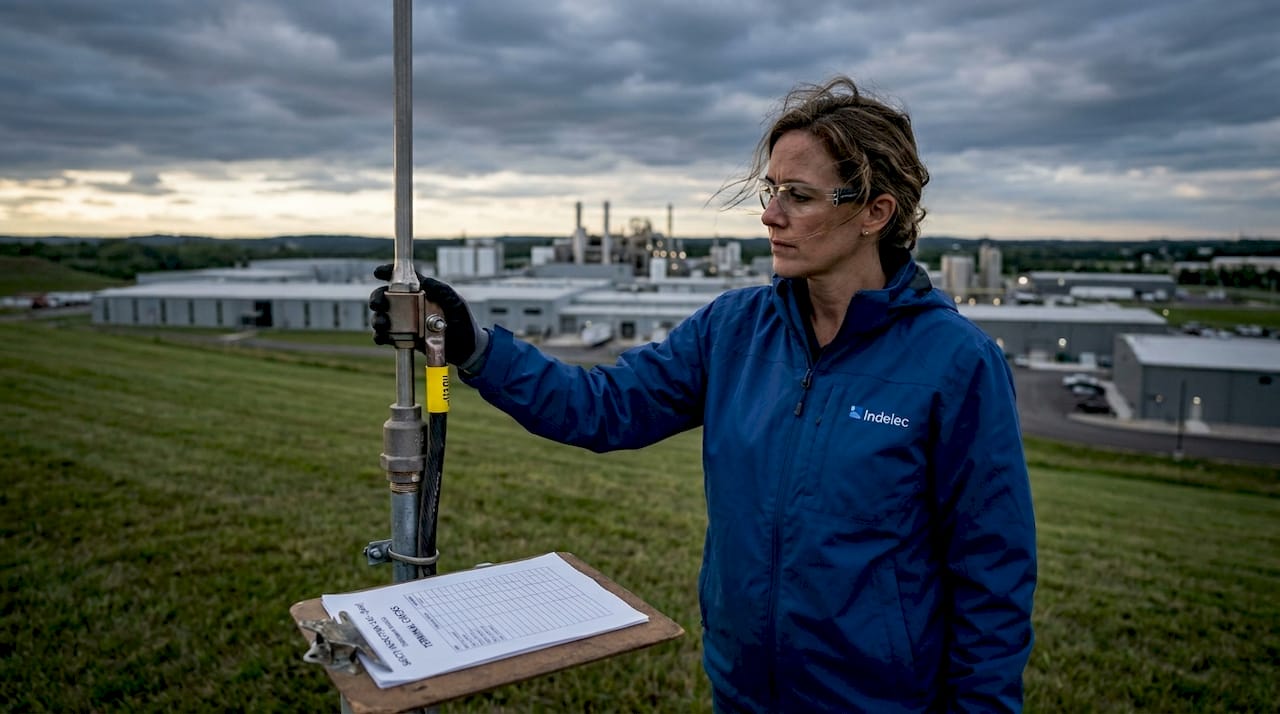
Surge protection integration is the most underestimated element. Air terminals stop direct strikes. They do nothing for induced surges traveling along power lines, data cables, and instrumentation loops during a nearby strike. Properly coordinated surge protection devices at the service entrance, distribution panels, and equipment level reduce induced failure rates by around 90%. Designing SPDs into the system from the start costs a fraction of what post-strike equipment replacement costs.
Bonding HVAC and vent penetrations is where many existing systems silently fail. Every metallic protrusion through a roof creates a potential parallel path for lightning current. If that path isn’t bonded into the interception system with a properly sized conductor, the uncontrolled current can jump to structural steel, conduit, or piping inside the building. That jump is a side flash, and it’s a fire and explosion risk.
Difficult soil conditions are a real challenge for earth termination systems. Clay-heavy or dry sandy soils can push ground resistance above acceptable thresholds, reducing the system’s ability to safely disperse current. IEC 62305-3 mandates separation distances in explosive environments and recommends chemical backfill to reduce grounding resistance in poor soil. Chemical backfill compounds can improve grounding resistance by up to 70% in resistive soils, a significant margin when your LPL I target is under 10 ohms.
Explosive and flammable material environments require LPL I protection by default. This means tighter rolling sphere radii, closer down conductor spacing, mandatory separation distances between down conductors and metallic structures, and specialized bonding protocols. If your facility stores, processes, or produces flammable materials, your standard commercial lightning protection specification is not sufficient.
Additional industrial-specific considerations:
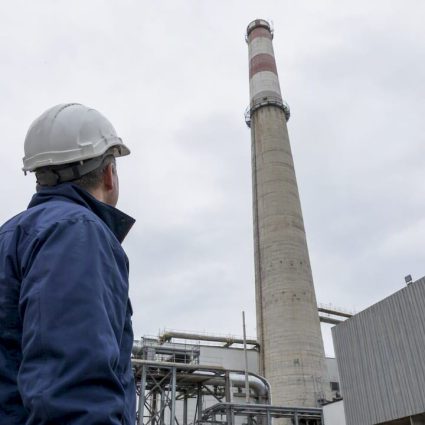
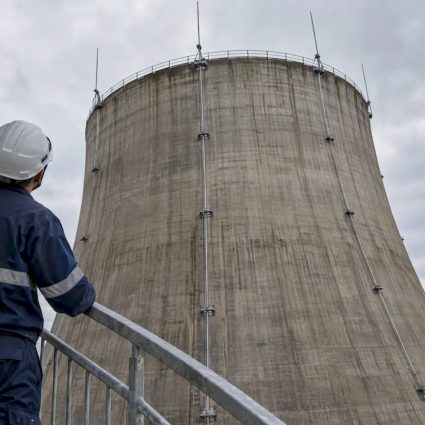
- Tall vertical equipment such as stacks, silos, and flare towers requires side-flash protection along the structure height, not just at the top
- Overhead conveyor systems connecting buildings can act as unintended lightning current pathways between structures
- Electrical infrastructure serving process equipment needs zone-by-zone surge protection coordination
Pro Tip: Conduct a soil resistivity test before designing the earth termination system, not after installation. Discovering that your site has 1,000 ohm-meter soil after the ground electrodes are buried means expensive remediation. The test takes a few hours and saves significant rework.
Applying lightning interception knowledge to facility management
Understanding lightning interception technology matters only if it changes how you manage your facility. Here is how to translate the engineering into a practical program.
Establish a documented inspection schedule:
- Conduct annual visual inspections of all air terminals, down conductors, and bonding connections, checking for corrosion, physical damage, and loose connections
- Perform resistance testing of the earth termination system every one to three years per IEC 62305-3 inspection recommendations
- Document all findings, corrective actions, and test results in a system log tied to your facility’s maintenance records
- Schedule post-strike inspections after any confirmed direct strike event, regardless of visible damage
Design and placement priorities:
- Apply the rolling sphere method before installing any new rooftop equipment to verify it falls within an existing interception zone
- Never install a new HVAC unit, antenna mast, or exhaust stack without verifying bonding requirements with your lightning protection designer
- Follow perimeter-based down conductor spacing rules whenever the building footprint changes due to expansion or renovation
Common mistakes to eliminate:
- Treating surge protection as optional rather than as a required element of the interception system
- Using undersized bonding conductors on rooftop equipment because they were “easier to route”
- Neglecting to re-certify the system after building modifications that change roof geometry or add new metallic protrusions
- Assuming a system installed 15 years ago still meets current protection levels without testing
The industrial lightning protection guide and the facility lightning safety workflow provide structured frameworks for turning these principles into repeatable programs.
Why conventional thinking about lightning interception can fall short
Here is the uncomfortable truth most lightning protection vendors won’t tell you: a technically compliant system can still fail your facility if it was designed in isolation. We’ve seen it repeatedly. Air terminals properly spaced per NFPA 780. Down conductors correctly sized. Earth resistance within limits. And then a strike event causes $400,000 in control system damage because nobody coordinated the surge protection design with the interception network.
The myth that lightning protection “attracts” strikes keeps some facility managers from installing systems at all, which is the worst possible outcome. The Lightning Protection Institute is clear that proper interception prevents 99% of fires caused by direct strikes. The system doesn’t pull lightning from clear skies. It simply ensures that when lightning strikes, which it will, it follows a path your engineers designed rather than one of nature’s choosing.
What actually causes system underperformance in industrial facilities is almost always one of three things. Missing bonds on rooftop equipment that were added after the original system installation. Surge protection that was never specified because it fell between the electrical and lightning protection scopes. Or ground resistance that drifted above acceptable limits over years of soil changes without anyone checking.
The fix isn’t a bigger lightning rod. It’s a proactive protection approach that treats the interception network, the bonding system, and the surge protection layer as one integrated defense. And it’s a maintenance culture that doesn’t wait for a strike event to discover what the last inspection missed. Visit our building lightning safety resource to see how a facility-wide approach changes outcomes.
Explore professional lightning interception solutions for your facility
Understanding lightning interception is the first step. Implementing it correctly across a complex industrial facility is a different challenge entirely, one that requires engineering depth, standards knowledge, and field experience.

Indelec has designed and certified lightning protection systems for industrial clients globally since 1955, with solutions built to NFPA 780 and IEC 62305-3 requirements. From initial lightning protection system design to grounding, surge coordination, maintenance programs, and system certification, every element is integrated from the start. Our standards-aligned engineering ensures your facility meets current protection levels and stays compliant through facility changes. Explore our advanced lightning protection systems and connect with our technical team to assess what your facility actually needs.
Frequently asked questions
What does lightning interception mean in lightning protection?
Lightning interception refers to using designated air terminals or other devices to safely capture lightning strikes before they hit vulnerable parts of a structure, then directing the electrical current safely to ground. NFPA 780 defines air terminals as interception points that safely channel lightning currents to ground.
How often should lightning interception systems be inspected?
Facility lightning interception systems require annual visual inspections and resistance testing every one to three years to ensure continued effectiveness and safety over their design life. IEC 62305-3 recommends this schedule for industrial lightning protection systems specifically.
Do lightning rods attract lightning strikes?
Lightning rods do not attract lightning but provide a preferred, safe interception point that controls where lightning strikes to protect structures and reduce the risk of side flashes. The Lightning Protection Institute confirms that systems provide controlled paths, not attraction, reducing lightning-caused fires by up to 99%.
What special considerations do explosive industrial areas require for lightning protection?
Explosive atmospheres require higher protection levels with proper separation distances and grounding techniques like chemical backfill to prevent sparks and ensure safe lightning dissipation. IEC 62305-3 mandates LPL I and separation distances greater than 0.5 meters for explosive atmospheres, with chemical backfill improving grounding effectiveness in resistive soils.