How technical consulting drives effective lightning mitigation
TL;DR:
- Effective lightning protection requires a comprehensive engineering strategy tailored to each facility.
- Technical consultants evaluate site-specific risks, design integrated systems, and ensure regulatory compliance.
- Ongoing testing and system updates are essential to maintain protection and reduce costly damage.
Most facility managers assume their lightning protection is adequate until a strike proves otherwise. A single event can destroy programmable logic controllers, corrupt months of operational data, trigger fire suppression systems, and halt production for days. The financial and reputational damage adds up fast. What separates facilities that survive these events from those that don’t is rarely the presence of a lightning rod. It’s the quality of the engineering strategy behind the entire protection system, and that strategy only comes from rigorous technical consulting.
Table of Contents
- Understanding lightning mitigation: What’s at stake for your facility
- The core role of technical consulting in lightning mitigation
- Step-by-step: How technical consulting delivers effective lightning mitigation
- Ensuring compliance and exceeding standards through consulting
- Practical tips for selecting and working with technical lightning consultants
- What most facility managers get wrong about lightning mitigation
- Take the next step: Expert lightning mitigation for your facility
- Frequently asked questions
Key Takeaways
| Point | Details |
|---|---|
| Custom solutions work best | Tailored lightning mitigation, designed by technical consultants, far outperforms generic systems for facility safety. |
| Regulation requires expertise | Meeting and exceeding standards is best achieved with consulting that interprets and applies complex regulations correctly. |
| Involve consultants early | Early engagement avoids costly retrofits, ensures smooth installation, and maximizes ROI. |
| Ongoing reviews are critical | Regularly reviewing systems with expert input keeps your facility prepared as standards and risks change. |
Understanding lightning mitigation: What’s at stake for your facility
Lightning mitigation is not just about intercepting a strike. It’s about managing what happens to your facility the moment current enters the ground, surges through conductors, and couples into sensitive equipment. The physics are unforgiving, and the consequences are broader than most managers anticipate.
Lightning damage costs industrial and commercial facilities billions of dollars globally each year, spanning equipment replacement, business interruption, emergency repairs, and insurance claims. For a mid-sized manufacturing plant, a single direct strike can trigger losses exceeding $500,000 when you factor in downtime, lost product, and regulatory scrutiny.
The consequences extend well beyond obvious equipment loss:
- Equipment destruction: Motors, control panels, and sensors take direct damage from overvoltage events.
- Data corruption and loss: Servers and industrial control systems lose configuration data, requiring expensive recovery efforts.
- Business interruption: Production lines, logistics platforms, and data centers can go offline for days or weeks.
- Safety hazards: Ground potential rise from nearby strikes can injure personnel and damage structural elements.
- Regulatory exposure: An inadequate protection system revealed after an incident can trigger compliance investigations and fines.
Standard approaches, like installing a single air terminal and a basic grounding electrode, address only the most obvious exposure. They don’t account for structural geometry, the location of critical electronics, soil resistivity, or the presence of flammable materials. A lightning risk assessment looks at all of these variables in a structured, site-specific way. Without that foundation, even well-meaning protection investments leave serious gaps.
With the scale of risk in mind, it’s clear why a custom approach is essential. This is where technical consulting becomes invaluable.
The core role of technical consulting in lightning mitigation
Technical consultants do something that product vendors and general installers rarely do: they evaluate your entire facility as a system. They bring risk modeling tools, regulatory knowledge, and field experience together to build a protection strategy that reflects your actual exposure, not an average one.
Here is what that process looks like in practice:
- Site risk profiling: Consultants gather structural data, review site geography, analyze local lightning frequency maps, and evaluate the proximity of sensitive assets to exterior elements.
- Regulatory gap analysis: They assess your current installation against applicable IEC, NFPA, and local standards, identifying compliance shortfalls before an incident or audit forces the issue.
- System architecture design: They specify the full protection stack, including external lightning protection, bonding and grounding, surge protection devices (SPDs) at multiple levels, and shielding for data and power lines.
- Coordination with operations: Consultants work alongside your engineering, IT, and facilities teams to ensure the protection design doesn’t conflict with existing infrastructure or planned upgrades.
- Documentation for compliance: They produce the reports, drawings, and certification support your team needs for insurance, audits, and regulatory bodies.
The output of risk assessment and installation work done by qualified consultants is a protection system that performs under real-world conditions, not just on paper. Generic vendors optimizing for speed or price typically can’t deliver this depth of analysis.
Pro Tip: When reviewing a consultant’s proposal, check whether they explicitly address surge protection coordination across low-voltage power and data systems. This is the most commonly overlooked layer, and it’s where post-strike damage typically concentrates in modern facilities.
The breadth of lightning mitigation services available today means facility managers have real choices. The right consultant helps you navigate those choices based on your actual risk profile, not the latest product catalog.
Step-by-step: How technical consulting delivers effective lightning mitigation
Knowing that consultants are valuable is one thing. Seeing their process in detail is what allows you to evaluate proposals, manage the engagement effectively, and hold consultants accountable for outcomes.
Phase 1: Risk evaluation
Consultants start with quantitative risk assessment using methods defined by IEC 62305, the international standard governing lightning protection. This assigns a risk number to your facility based on structure type, occupancy, content value, and geographic lightning density. The result tells you whether protection is mandatory, recommended, or sufficient as-is.
Phase 2: System design
Using the risk output, consultants specify an integrated protection system. This isn’t just a lightning rod placement map. It includes the full grounding network layout, the bonding scheme for metallic structures, the SPD selection for each distribution board, and any required shielding for control rooms or server areas.

Phase 3: Regulatory review
Before any installation begins, consultants reconcile the design against applicable standards. They also assess facility safety and compliance requirements specific to your sector, whether that’s petrochemical, healthcare, logistics, or data infrastructure.
Phase 4: Installation oversight
Experienced consultants don’t just hand over drawings and disappear. They coordinate with installation crews, review workmanship at key milestones, and perform continuity and resistance testing to verify the system is built as designed.
Phase 5: Post-installation support
The system needs periodic inspection and testing, especially after nearby strikes, structural modifications, or equipment upgrades. Consultants establish maintenance schedules, define test criteria, and provide update recommendations when standards change.
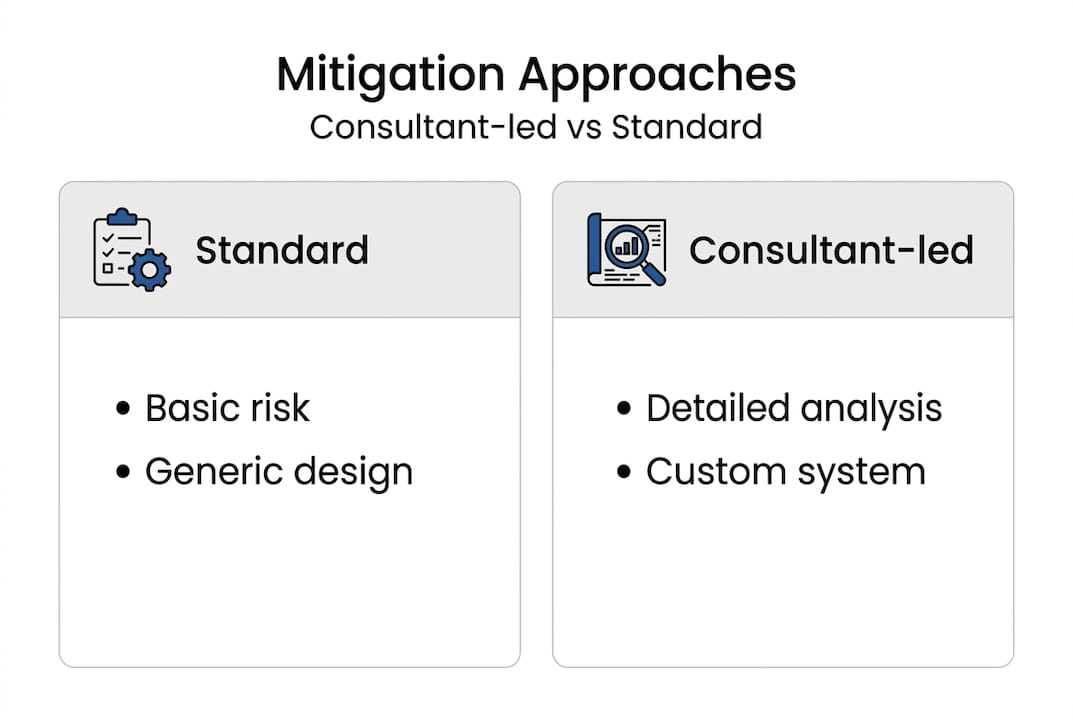
The table below illustrates where custom consulting outperforms off-the-shelf approaches:
| Criterion | Off-the-shelf solution | Consultant-led approach |
|---|---|---|
| Risk analysis depth | Generic, product-driven | Site-specific, data-driven |
| Regulatory alignment | Basic or assumed | Verified against current standards |
| Surge protection coordination | Often incomplete | Multi-level, fully coordinated |
| Documentation quality | Minimal | Audit-ready, comprehensive |
| Long-term adaptability | Fixed at installation | Reviewed and updated periodically |
| Total cost of ownership | Lower upfront, higher risk | Optimized for lifecycle value |
Pro Tip: Engage a consultant before finalizing your facility layout or electrical design. Retrofitting protection into a completed structure routinely costs three to five times more than integrating it during design. The same principle applies to energy storage best practices where upfront engineering avoids compounding problems downstream.
Seeing the full process reveals another key benefit: regulatory alignment, which is critical for audit success and long-term safety.
Ensuring compliance and exceeding standards through consulting
Regulatory compliance for lightning protection is not optional in most industrial and commercial sectors. Standards like IEC 62305, NFPA 780, and sector-specific codes (such as those governing fuel storage, explosives handling, and healthcare facilities) establish minimum requirements that carry legal and insurance weight.
A common mistake is treating compliance as a checkbox. You install what the standard specifies, document it, and move on. But standards represent minimum thresholds, established through consensus and often lagging actual risk conditions. Consultants help you understand what the lightning standards require, and where exceeding those requirements makes financial and operational sense.
Key areas where exceeding standards delivers measurable returns:
- Enhanced SPD coordination: Standards often specify minimum SPD performance ratings. Consultants evaluate your specific equipment sensitivity and specify devices that protect beyond the required threshold.
- Redundant grounding paths: Facilities with mission-critical operations benefit from secondary grounding networks that maintain protection continuity even if a primary element is damaged.
- Automated monitoring: Real-time strike counters and fault detection systems provide operational intelligence that standard installations don’t require but many large facilities now consider essential.
- Shielded cable routing: Particularly in control-heavy industrial environments, routing signal cables through metallic conduits or shielded trays adds a layer of protection that compliance documents rarely mandate explicitly.
“Facilities that exceed lightning protection minimums typically see measurable reductions in unplanned downtime and often qualify for lower insurance premiums. The upfront investment in exceeding the standard pays back faster than most capital expenditure categories in a facility’s risk management budget.”
The following table compares standard-only versus advanced practice outcomes across key performance areas:
| Performance area | Standard compliance | Advanced (consultant-led) |
|---|---|---|
| SPD protection level | Meets IEC minimum | Matched to equipment sensitivity |
| Grounding redundancy | Single network | Primary and secondary paths |
| Post-strike recovery time | Days to weeks | Hours to days |
| Insurance premium impact | Neutral to moderate savings | Significant savings potential |
| Regulatory audit outcome | Pass | Pass with documented excellence |
The lightning safety compliance guide outlines how facilities should document and demonstrate their protection posture. Consultants translate that documentation framework into actual systems that perform under scrutiny.
Practical tips for selecting and working with technical lightning consultants
Finding the right consultant matters as much as deciding to hire one. The market includes experienced specialists and generalists who add lightning protection to a broader electrical engineering service menu. Knowing how to distinguish between them protects your investment.
Key selection criteria:
- Sector-specific experience: A consultant with a track record in petrochemical facilities brings knowledge of explosion-proof bonding requirements that a generalist simply won’t have. Ask for references in your sector specifically.
- Credentials and affiliations: Look for engineers certified in IEC 62305 application, membership in relevant bodies (such as the Lightning Protection Institute), and demonstrated familiarity with your applicable national standards.
- ROI and compliance track record: Ask for documented examples of facilities where their work prevented costly incidents or resolved compliance gaps identified in audits.
- Proposal quality: A strong proposal specifies deliverables at each phase, defines testing criteria, and outlines what ongoing support looks like. Vague proposals with broad scope statements are a warning sign.
- Reporting and documentation: Consultants should produce structured reports that your insurance carrier, regulatory body, and facilities team can all use independently.
Pro Tip: Ask prospective consultants for case studies showing how their designs performed after an actual lightning event at a client site. Post-incident performance data is the most honest test of a protection system’s real-world quality.
Working effectively with a consultant once engaged requires your involvement too. Provide accurate site drawings, share your equipment inventory, and communicate upcoming changes to structure or operations. Consultants can only protect what they know about.
Maximize long-term value by including consultants in your periodic inspection cycles, not just at installation. Facilities evolve. New equipment arrives, structures are modified, and grounding conditions change as soils shift or construction disturbs electrode networks. A consultant who understands your facility’s history is far more effective than one called in cold after a problem appears.
What most facility managers get wrong about lightning mitigation
After decades of working with industrial and commercial facilities, one pattern stands out: the biggest gaps in lightning protection don’t come from budget constraints. They come from misplaced confidence in outdated assumptions.
The most persistent misconception is that a visible lightning rod means the facility is protected. That rod intercepts current, but where that current goes next, through your grounding network, into the soil, across bonded metal structures, depends entirely on the quality of everything else in the system. A well-maintained rod connected to a poorly designed grounding network can actually increase side-flash risk inside the facility.
A second common error is over-reliance on original construction blueprints. Facilities change constantly. Control rooms get upgraded. New production lines introduce sensitive electronics. Mezzanines, extensions, and equipment pads alter the structure’s geometry and grounding configuration. Protection designs that weren’t updated to reflect these changes leave real gaps, and those gaps tend to cluster around exactly the assets you’d least want to lose.
Skipping periodic testing is the third major error. Lightning protection systems don’t fail dramatically. Grounding resistance increases gradually as corrosion affects connections. SPD modules wear down after absorbing partial strikes and eventually lose effectiveness without triggering any obvious alarm. The maintenance considerations involved in keeping a protection system performing as designed require structured inspection and testing, not just visual checks.
Consultants see the full system. They aren’t focused on selling a product or completing an installation efficiently. They evaluate structure, electronics, operational processes, and regulatory context as an integrated picture. That systems-level view is what reveals the vulnerabilities that checklist-driven approaches miss consistently.
True protection is dynamic, not static. Standards evolve, facilities change, and climate patterns continue to shift lightning strike frequency across regions. Facilities that treat lightning protection as a one-time project rather than an ongoing program pay more over time, in reactive repairs, lost productivity, and compliance remediation.
Take the next step: Expert lightning mitigation for your facility
Your facility’s exposure to lightning risk is unique. The combination of your structure, your critical systems, your geographic location, and your regulatory environment creates a risk profile that no generic catalog solution can address adequately.
Indelec brings nearly seven decades of specialized experience to exactly this challenge. From initial system application expertise that maps your protection architecture to the full scope of technical consulting services, the team works alongside your facility managers and engineers to deliver protection that performs under real-world conditions. For facility managers who recognize that essential lightning solutions are a non-negotiable part of operational safety, the next step is a conversation with specialists who have seen, designed, and built protection systems across every major industrial sector.
Frequently asked questions
What does a technical lightning consultant do differently than a standard installer?
A technical lightning consultant analyzes facility-specific risks, designs customized mitigation plans, and ensures compliance with all applicable regulations, unlike general installers who typically offer standardized product-based solutions without the underlying risk engineering.
When should a facility manager engage technical consulting for lightning mitigation?
The ideal time is during new construction or major system upgrades, but consultants deliver significant value at any stage, particularly when previous incidents, audit findings, or facility changes have revealed potential gaps in existing protection.
How do consultants ensure compliance with lightning safety standards?
Consultants apply current national and international standards such as IEC 62305 and NFPA 780, interpret their relevance to your specific facility type and risk class, and produce the documentation required by regulatory bodies and insurers.
What is the cost-benefit of hiring a technical consultant for lightning mitigation?
Consultants help facilities avoid direct damage costs, extended downtime, equipment replacement, and regulatory penalties, and their fees are typically recovered many times over through incident prevention and optimized system design that avoids unnecessary over-engineering or under-protection.