How lightning testing works: facility safety and compliance
TL;DR:
- Lightning testing verifies the effectiveness of protection systems through structured, real-world, and laboratory assessments. Regular testing, documentation, and ongoing maintenance are essential for compliance and safety. Treating lightning protection as a strategic operation helps prevent equipment damage, safety hazards, and regulatory issues.
Most facility managers assume that installing surge protectors and grounding rods is enough to manage lightning risk. It is not. Lightning testing is the process that actually confirms whether your protection systems work, and without it, you are operating on assumption rather than evidence. Across industrial and commercial sectors, facilities that skip formal testing routinely fail audits, face insurance disputes, and suffer preventable equipment damage. This guide walks you through what lightning testing involves, the methodologies used, how testing is performed step by step, and the compliance pitfalls that catch even experienced safety engineers off guard.
Table of Contents
- What is lightning testing and why does it matter?
- Types of lightning tests and core methodologies
- Step-by-step process: How lightning testing is performed
- Common pitfalls and best practices for facility compliance
- Rethinking lightning testing: What most compliance strategies overlook
- Explore expert solutions for lightning risk management
- Frequently asked questions
Key Takeaways
| Point | Details |
|---|---|
| Lightning testing is essential | Routine lightning testing is critical for facility safety and legal compliance. |
| Multiple test methods | Facilities should apply the right testing method for their infrastructure and risk profile. |
| Ongoing compliance required | Regular tests and documentation are mandatory to maintain certification and insurance. |
| Expert assessment adds value | Third-party evaluations provide reassurance and meet professional and regulatory standards. |
| Proactive risk management wins | Adopting a data-driven, strategic approach helps future-proof your facility against lightning threats. |
What is lightning testing and why does it matter?
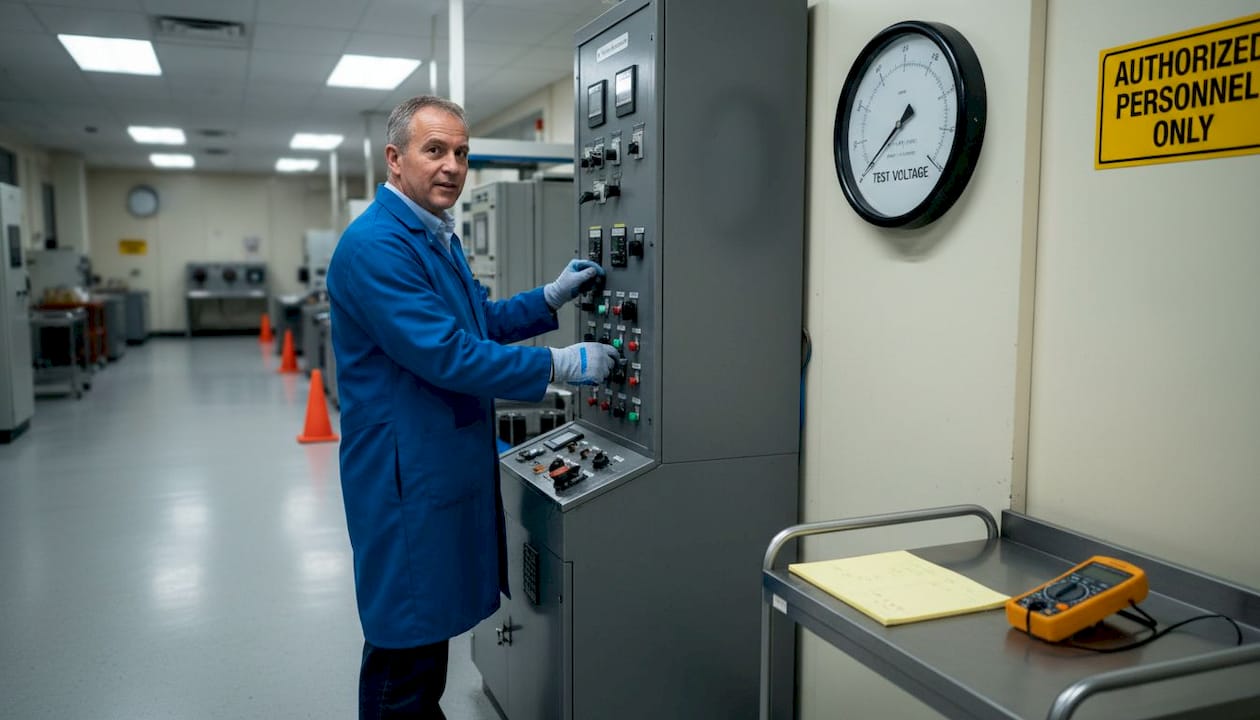
Lightning testing refers to a structured set of simulated or real-world verification procedures designed to confirm that a facility’s lightning protection system performs as intended. It is not a single test. It is a layered process covering grounding integrity, surge protection response, conductor continuity, and system-wide resilience. The goal is to produce evidence, not assumptions.
For facility managers and safety engineers, the stakes are concrete. A system that looks correct on paper may have corroded connections, undersized conductors, or improperly bonded components that only testing can expose. These are not theoretical concerns. They are the kinds of failures that lead to equipment destruction, fire, and worker injury during actual storm events.
The regulatory dimension is equally important. Lightning testing is a regulatory requirement in many countries and industries, including petrochemical, data center, healthcare, and heavy manufacturing sectors. Skipping or deferring testing does not just create safety gaps. It creates legal exposure.
Here is what formal lightning testing typically covers:
- Grounding system resistance measured against national and international thresholds
- Conductor continuity across the entire protection network
- Surge protective device (SPD) functionality at each protection level
- Bonding integrity between structural and electrical systems
- Documentation compliance with applicable standards such as IEC 62305 or NFPA 780
The primary stakeholders in this process are facility managers responsible for operational continuity, safety engineers who interpret test results, and regulatory inspectors who validate compliance. Each group depends on accurate, documented test outcomes to make informed decisions.
“A lightning protection system that has never been tested is a system whose performance is unknown. Unknown performance is not protection.”
Pro Tip: Request a copy of the previous test report before commissioning any new lightning protection work. Gaps in historical documentation are often the first sign of a compliance problem.
For facilities with complex infrastructure, reviewing the full range of system applications available for different site configurations helps set realistic expectations before testing begins.
Types of lightning tests and core methodologies
Understanding which test applies to your facility requires knowing what each method measures and where its limitations lie. Tests range from high-voltage lab simulations to on-site system verification, and choosing the wrong approach wastes budget while leaving real risks undetected.
Here are the four primary testing methodologies used in professional lightning risk management:
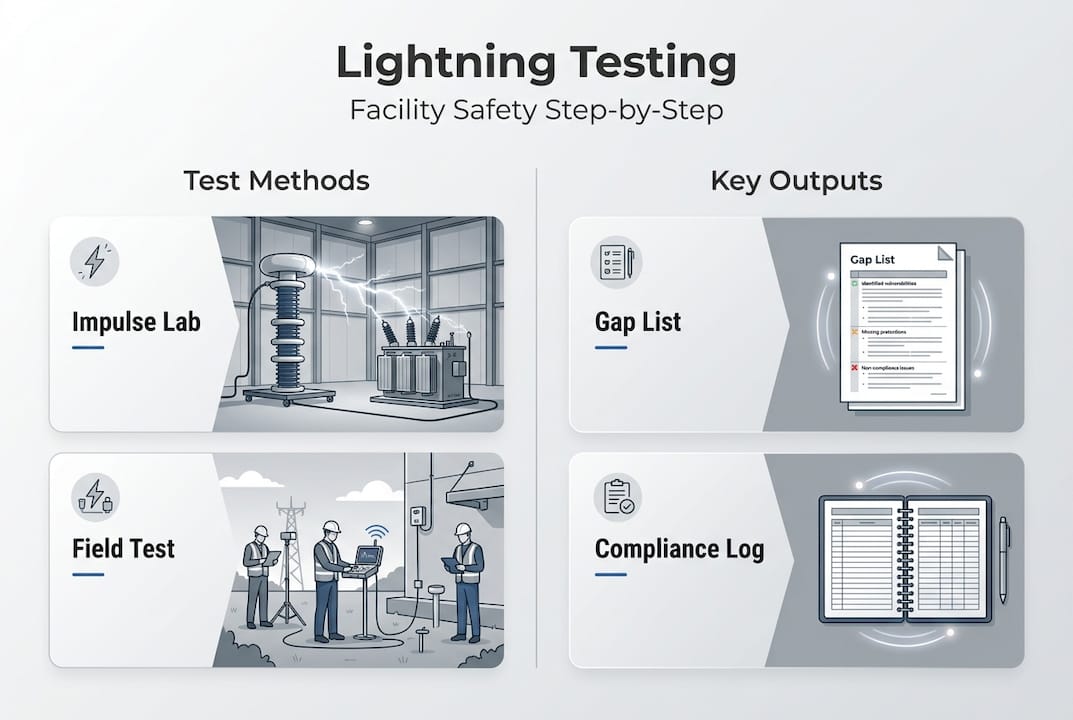
- Impulse testing replicates the electrical waveform of a direct lightning strike in a controlled laboratory environment. It stresses surge protective devices and cable insulation to verify they can absorb and redirect extreme energy without failure.
- Continuity testing checks that every conductor in the protection network forms an unbroken electrical path from the air terminal down to the earth electrode. A single break can render an entire system ineffective.
- Earth resistance testing measures how effectively the grounding system dissipates electrical energy into the soil. Resistance values above the standard threshold indicate inadequate grounding, which is one of the most common compliance failures.
- Real-world field testing evaluates the integrated system under actual site conditions, accounting for soil composition, building geometry, and installed equipment interactions that lab tests cannot replicate.
| Method | Environment | Accuracy | Cost | Best for |
|---|---|---|---|---|
| Impulse testing | Laboratory | Very high | High | SPD and equipment validation |
| Continuity testing | Field | High | Low | Conductor and bonding checks |
| Earth resistance | Field | High | Moderate | Grounding system performance |
| Real-world field test | Field | Contextual | Moderate | Full system integration review |
Field testing is generally more practical for routine compliance cycles, while lab-based impulse testing is reserved for equipment certification or post-incident analysis. For most industrial facilities, a combination of continuity and earth resistance testing on an annual basis, supplemented by impulse testing when new SPDs are installed, provides a defensible compliance posture.
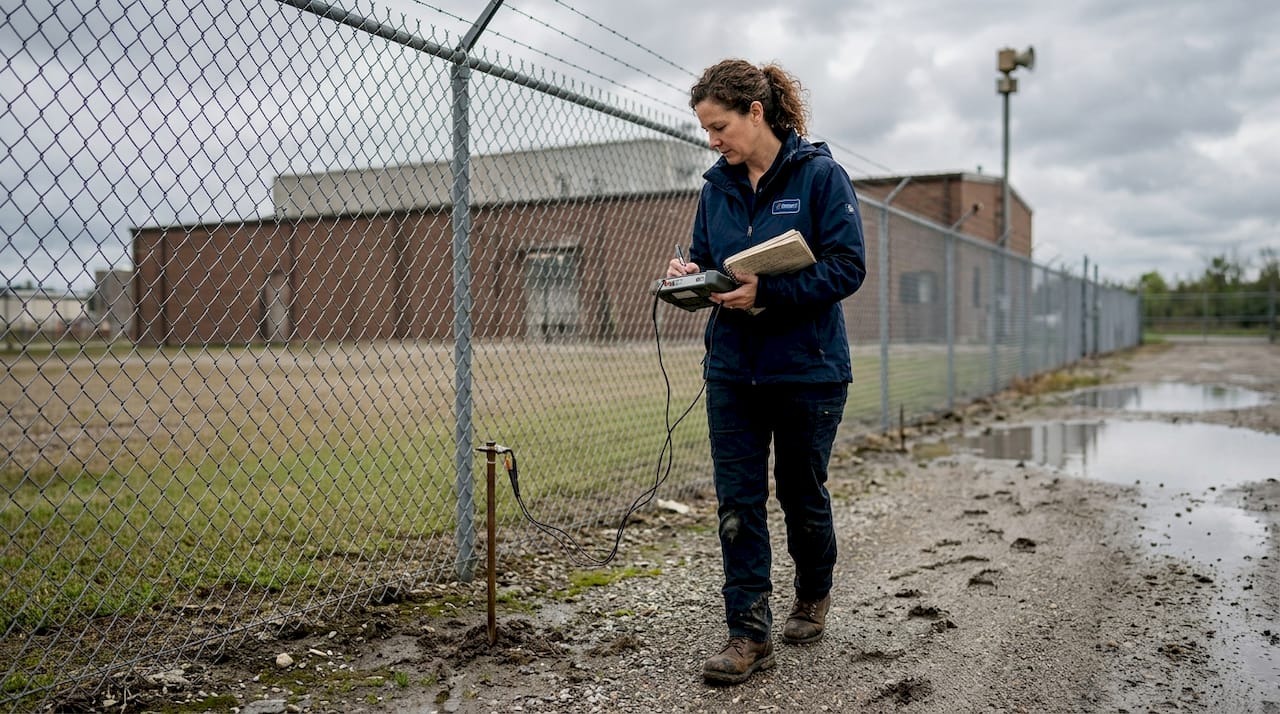
Pro Tip: Earth resistance values above 10 ohms in most industrial standards signal a grounding problem. Test after wet and dry seasons separately, since soil moisture dramatically affects readings.
For a structured approach to protecting complex sites, the infrastructure protection steps outlined for different facility types provide a useful planning baseline.
Step-by-step process: How lightning testing is performed
Testing ensures facility-specific risks are addressed systematically, which means the process must be tailored to each site rather than applied as a generic checklist. Here is how a professional lightning testing engagement typically unfolds.
- Preparation and documentation review. The testing team collects existing as-built drawings, previous test reports, installation certificates, and the site’s lightning risk assessment. This step identifies gaps before any physical testing begins.
- Risk scope definition. Based on the facility’s classification, occupancy type, and local lightning density data, the team defines which systems require testing and which standards apply.
- On-site measurement and simulation. Technicians conduct earth resistance tests at each electrode, continuity checks along all down conductors, and SPD functionality verification at each distribution panel.
- Data recording and anomaly flagging. Every measurement is logged against the applicable standard threshold. Readings that fall outside acceptable ranges are flagged immediately for engineering review.
- Analysis and vulnerability ranking. The team ranks identified failures by severity, distinguishing between critical deficiencies that require immediate remediation and lower-priority items that can be scheduled.
- Certification or corrective action report. If the system passes, a compliance certificate is issued. If it does not, a corrective action report specifies required upgrades with timelines.
| Testing phase | Key output | Responsible party |
|---|---|---|
| Preparation | Documentation gap list | Facility manager |
| Scope definition | Test plan and standards map | Safety engineer |
| On-site execution | Raw measurement data | Testing technician |
| Analysis | Vulnerability ranking report | Safety engineer |
| Certification | Compliance certificate or action plan | Certifying body |
Retesting is triggered by several conditions: a direct lightning strike on or near the facility, major structural modifications, installation of new electrical systems, or simply the passage of the standard-mandated interval. Connecting with a team experienced in risk assessment and maintenance helps facilities stay ahead of these triggers rather than react to them.
Pro Tip: Always retain raw measurement data, not just summary reports. Auditors and insurers increasingly request original readings to verify that testing was genuinely performed rather than administratively generated.
Common pitfalls and best practices for facility compliance
Misinterpretation of test results and skipped periodic tests are leading causes of compliance failure, and both are entirely preventable with the right processes in place. The gap between facilities that maintain genuine compliance and those that only appear compliant usually comes down to discipline and documentation.
Here are the most frequent mistakes safety engineers and facility managers encounter:
- Treating initial certification as permanent. A certificate issued three years ago reflects the system’s condition three years ago. Corrosion, structural changes, and equipment additions all alter system performance over time.
- Substituting visual inspection for measurement-based testing. A conductor that looks intact can have internal corrosion or a loose connection that only a continuity test will detect.
- Filing test reports without acting on findings. Receiving a report that flags a 15-ohm earth resistance and scheduling remediation for “next quarter” is a compliance failure waiting to happen.
- Failing to update documentation after system changes. Every modification to the electrical or structural system should trigger a documentation update and, in many cases, a partial retest.
“Compliance is not a moment in time. It is a continuous state that requires active maintenance, not passive assumption.”
Best practices that distinguish high-performing facilities include establishing a fixed annual testing schedule, maintaining a centralized log of all test results and corrective actions, and conducting internal reviews between formal testing cycles. Reviewing guidance on facility lightning safety and electrical infrastructure protection provides additional frameworks for building these habits into standard operating procedures.
Pro Tip: Assign a named owner for lightning compliance within your safety team. Shared ownership almost always means no ownership when audit time arrives.
Rethinking lightning testing: What most compliance strategies overlook
Most compliance programs treat lightning testing as a box to check. Pass the audit, file the certificate, move on. That mindset is understandable given the volume of regulatory demands facing facility managers, but it misses a significant opportunity.
Facilities that approach lightning testing as a data-gathering exercise rather than a compliance formality gain something their peers do not: a real-time picture of system degradation. Grounding resistance that climbs from 4 ohms to 8 ohms over three annual tests is not a compliance problem yet. But it is a trend that predicts a future failure. Reactive compliance programs miss this entirely.
Waiting for a lightning event or an insurance mandate to trigger serious investment in testing is genuinely costly. Equipment replacement, operational downtime, and insurance premium increases after an incident consistently exceed the cost of proactive testing programs by a wide margin. The math is not close.
Facilities that treat lightning protection as a strategic necessity rather than a regulatory obligation build a culture where safety and uptime reinforce each other. That culture is measurable. It shows up in fewer unplanned outages, lower insurance exposure, and faster audit cycles. Lightning testing, done well, is not overhead. It is operational intelligence.
Explore expert solutions for lightning risk management
For those committed to leadership in facility safety, a range of advanced lightning protection solutions and resources is available to support every stage of your compliance program.

Whether you are evaluating system application solutions for a new installation, reviewing up-to-date lightning standards to confirm your compliance framework, or exploring why essential protection is a non-negotiable for high-risk facilities, Indelec’s team of specialists is ready to support your next steps. From technical consulting and system design to certification and maintenance, we provide the expertise that facility managers and safety engineers rely on to keep their operations protected and compliant.
Frequently asked questions
How often should lightning testing be performed in industrial facilities?
Regular testing is mandated by multiple national and international standards, and most recommend annual testing or after any major system change or lightning event for ongoing compliance.
What documents are needed to pass a lightning testing audit?
Documentation should include recent test reports, certification records, and action logs from any corrective maintenance or upgrades performed since the last audit cycle.
Does lightning testing require power shutdowns?
Many tests can occur with minimal interruption, but certain test types may affect regular operations, requiring scheduled shutdowns, particularly for high-voltage simulations or system upgrades.
Is third-party certification necessary or can in-house teams conduct lightning tests?
While initial assessments can be done in-house, third-party testing is often required for full regulatory acceptance, formal compliance records, and insurance validity.
What is the main difference between field and laboratory lightning testing?
Field testing analyzes real-world system integrity under actual site conditions, while lab tests simulate extreme strike scenarios under controlled conditions where variables can be precisely managed.