4 Metals for Lightning Rods: Match Material to Site Risk and NF/IEC
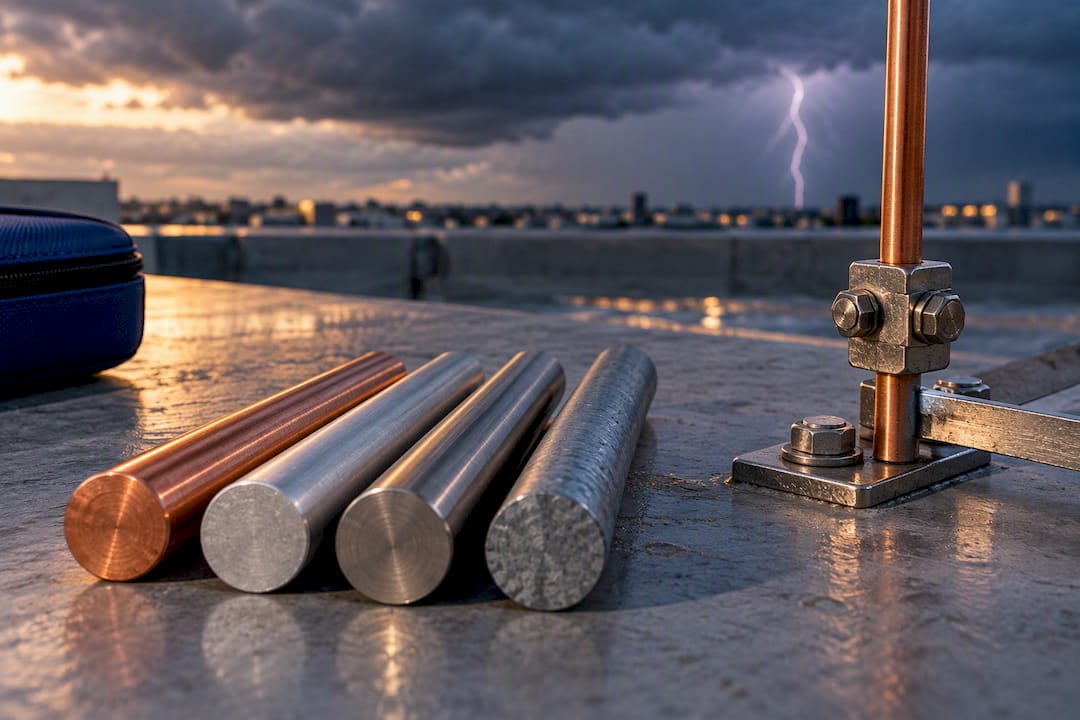
Choose copper for general-purpose installations, stainless steel or copper-clad steel where corrosion is severe, and aluminum when weight and cost dominate but with larger cross-sections and protected joints. The right call depends on factors such as the corrosion environment at the site, the conductor sizing the load requires, and whether the connectors you plan to use are compatible with the metals they join. Standards and verification requirements, covered further down, narrow the choice even more.
TL;DR:
- Copper provides the highest conductivity and ease of joining but is heavier and more expensive than aluminum or steel options.
- Corrosion environment significantly influences material choice, with stainless steel favored for coastal and chemical zones, and copper for rural air; dissimilar metals require approved connectors to prevent galvanic corrosion.
- Proper sizing, routing, and connector use are crucial; large cross-sections for aluminum, generous bend radii, and bi-metallic connectors help maintain conductor performance.
- Standards such as NF C 17-102, NF C 17-100, and IEC 62561-2 set minimum dimensions, material verification, and testing requirements that must be followed for compliance.
- Installation quality, including placement, bonding, and thermal considerations, directly impacts system effectiveness and longevity, requiring thorough inspection and documentation.
Table of Contents
- 1. Comparing conductivity and durability across metals
- 2. How environment and galvanic risk should drive material decisions
- 3. Sizing, joints and connectors that protect conductor performance
- 4. Standards and testing that govern material selection
- 5. Installation practices that make or break material performance
- 6. A quick checklist for matching materials to site conditions
- 7. Keeping a system verified through inspection and maintenance
- 8. INDELEC’s role in specifying and supplying compliant materials
- 9. Why material choice is a system decision, not a shopping decision
- How INDELEC turns material selection into a working system
- Sources
- FAQ
1. Comparing conductivity and durability across metals
Copper remains the default air terminal and conductor material because its conductivity lets designers use smaller cross-sections for the same current-carrying capacity, and it solders and welds cleanly to most connector types. Aluminum conducts less efficiently gram for gram than copper but weighs roughly a third as much, which matters on long roof runs or lightweight structures, though it needs bigger cross-sections and cannot touch soil or concrete directly without protection. Stainless steel trades conductivity for mechanical toughness and near-total corrosion resistance, making it the choice for coastal sites, chemical plants, and anywhere aesthetics or vandalism resistance matter. Copper-clad steel combines a steel core for tensile strength with a copper skin for conductivity, giving a lighter, cheaper alternative to solid copper for down-conductors that still need to survive decades outdoors.
- Copper: highest conductivity of the common choices, easiest to join, but heavier and pricier per meter.
- Aluminum: light and economical, but corrodes badly against damp masonry or dissimilar metals.
- Stainless steel: best corrosion and mechanical resistance, weakest conductivity of the four.
- Copper-clad steel: near-copper conductivity with steel-level tensile strength at lower weight and cost.
Mixed-material systems are acceptable when a project pairs, say, copper air terminals with copper-clad steel down-conductors, provided every transition point uses an approved bi-metallic connector and the choice is documented in the design file with the reasoning behind it. Undocumented mixing is where most premature failures start.
2. How environment and galvanic risk should drive material decisions
Site environment often matters more than raw conductivity when predicting how long a system will last.
- Rural or low-pollution atmospheres: standard copper or aluminum performs well for decades with only routine visual checks.
- Industrial atmospheres: acidic or sulfur-laden air accelerates corrosion on aluminum and untreated steel, so copper or stainless steel grades resistant to chemical attack are preferred.
- Coastal or high-salinity zones: salt mist attacks aluminum and mild steel fastest, making marine-grade stainless steel or tinned copper the safer specification.
Galvanic corrosion appears whenever two dissimilar metals touch in the presence of moisture, and mixing copper with aluminum or untreated steel without approved bi-metallic connectors is a documented cause of premature joint failure, so isolation washers, tinned interfaces, or certified transition connectors are required at every dissimilar-metal junction.
3. Sizing, joints and connectors that protect conductor performance
Material choice only pays off if the cross-section, routing, and connectors are specified correctly alongside it. Copper down-conductors typically run at minimum cross-sections in the range used for standard lightning protection conductors, with aluminum sized larger to compensate for its lower conductivity, and parallel down-conductor runs on larger structures reducing the per-conductor loading. Routing without sharp bends matters as much as the metal itself: the Lightning Protection Institute notes that poor routing and bonding can produce side-flashing regardless of what the conductor is made from, since tight radii concentrate stress and encourage arcing at the bend rather than along the intended path.
- Keep bend radii generous and avoid loops that trap mechanical stress at a single point.
- Use bi-metallic connectors, never bare dissimilar-metal clamps, wherever copper meets aluminum or steel.
- Apply anti-oxidation compound at every mechanical joint before final tightening.
- Request material certificates and salt-mist test reports at delivery, not after installation is complete.
Pro Tip:Keep every delivery note and test certificate in one file from day one, since it becomes the evidence a certifier will ask for at commissioning.
4. Standards and testing that govern material selection
In lightning protection design, the applicable standards actually dictate minimum dimensions, not just performance targets. NF C 17-102 governs early streamer emission air terminal (PDA) systems, while NF C 17-100 covers passive rod and mesh-cage systems, and both set out material, dimension, and verification clauses that a designer must follow when specifying conductors, air terminals, and earthing arrangements, as summarized in AFNOR’s own documentation. At the component level, IEC 62561-2 sets requirements and tests for metallic conductors and earth electrodes.
IEC 62561-2:2025 includes updated salt-mist tests and new annexes covering material configuration and cross-sectional testing for conductors and electrodes, which tightens what a supplier now has to demonstrate before a component can be called compliant.
- Material test reports referencing IEC 62561-2 for each conductor and electrode batch.
- Salt-mist treatment records where the site sits in a corrosive zone.
- Full traceability from mill certificate to installed component.
5. Installation practices that make or break material performance
Even the right material underperforms if it is installed badly, so site drawings should specify these points explicitly.
- Air terminal placement follows a rolling-sphere or mesh method that determines how many terminals a roof needs and at what height, not guesswork.
- Down-conductor routing should follow the shortest practical path with no sharp bends, reducing both side-flash risk and mechanical fatigue over time.
- Bonding to metal roofing, vents, and rails must be equipotential, tying every conductive element into the same reference potential.
- Roof penetrations and fixings should match the conductor’s expansion characteristics so thermal cycling does not loosen clamps over years of service.
The Lightning Protection Institute treats correct routing and bonding as equally decisive as conductor material for overall system effectiveness.
6. A quick checklist for matching materials to site conditions
Before specifying, record the exposure class, maintenance access, and roof finish for the site, since each pushes the decision in a different direction.
- Coastal or industrial exposure: specify stainless steel or copper-clad steel with bi-metallic connectors at every joint.
- Rural, low-pollution exposure: standard copper conductors with routine visual inspection are usually sufficient.
- Difficult maintenance access: favor corrosion-resistant grades over cheaper metals that need frequent replacement.
- Historic or sensitive roof finishes: aluminum or copper chosen to match existing metalwork, with isolation at any contact point.
- Budget-constrained projects: aluminum with larger cross-sections and protected joints can meet requirements at lower material cost, provided connectors are not where the budget gets cut.
7. Keeping a system verified through inspection and maintenance
A compliant material choice only stays compliant if it is checked on a schedule.
- An initial verification after installation confirms conductor continuity, joint integrity, and earth resistance before the system is signed off.
- Periodic visual inspections catch corrosion, loose clamps, or physical damage early, before they become electrical failures.
- Full electrical testing on the schedule set by the applicable NF standard confirms the system still performs as designed.
- Any conductor showing pitting, discoloration consistent with galvanic attack, or a loosened joint should be replaced rather than patched.
A complete execution dossier, including supplier certificates and inspection records, should move to the facility owner at handover so the material choice remains defensible for the system’s lifetime, a practice covered in more detail in this grounding maintenance guide.
8. INDELEC’s role in specifying and supplying compliant materials
A specialist company has developed expertise in lightning protection for decades and maintains innovation efforts to keep material and system specifications current with evolving standards. Its services span risk analysis, technical study, installation, and ongoing verification and maintenance, covering the full lifecycle a material decision needs to survive: ARF and technical study, installation, and verification and maintenance.

9. Why material choice is a system decision, not a shopping decision
Specifying a conductor material in isolation from routing, connectors, and maintenance access is how systems underperform on paper-perfect metals. The stronger habit is to bring the installer and the material supplier into the design conversation early, with test certificates attached before anything ships.
*— INDELEC
How INDELEC turns material selection into a working system
Picking the right metal only pays off when the risk assessment, the technical study, and the installation all line up around it, and that is the gap a specialist closes. Indelec’s risk assessment and technical study services size the system to the site before a single conductor is ordered, then carry that specification through installation and into scheduled verification and maintenance.

- L’analyse du risque foudre (ARF) et l’étude technique (ET): sizes the system to the actual site risk before materials are chosen.
- L’installation: puts the specified materials, joints, and routing in place to the standard.
- Vérification & Maintenance: keeps the installed system compliant and documented over its service life.
Reach out through Indelec’s services page to request a site assessment or a specification review before your next tender goes out.
Sources
For procurement or certification packages, attach NF C 17-102 for PDA systems, NF C 17-100 for passive systems, and IEC 62561-2 for conductor and electrode testing requirements. These three documents are what a certifier or reviewer will expect to see referenced by name.
- NF C 17-102 — Wikipedia
- IEC 62561-2:2025 — IEC webstore
- Lightning Protection FAQ — Lightning Protection Institute (LPI)
- NF C 17-100 — AFNOR
FAQ
What are the different types of lightning rods?
The main categories are passive rod and mesh-cage systems built to NF C 17-100 and early streamer emission (PDA) air terminals built to NF C 17-102. Both rely on down-conductors and grounding electrodes, and material choice within each type follows the same conductivity and corrosion logic covered above.
What is the best protection against lightning?
There is no single best system: the right choice depends on the structure’s size, risk exposure, and existing risk assessment, which is why a formal risk analysis usually precedes any material or system decision. A correctly specified and grounded system, regardless of type, performs better than an oversized system installed without proper bonding, according to Lightning Protection Institute guidance.
What is the standard for lightning rods?
In France, passive systems follow NF C 17-100 and PDA systems follow NF C 17-102, both of which set material, dimension, and verification requirements. Component-level testing, including for conductors and electrodes, falls under IEC 62561-2.
What rules must be followed to install a lightning rod?
Installation must follow the placement, routing, and bonding rules set out in the applicable NF standard, including equipotential bonding to other metal building elements and correct connector selection at every joint. A licensed installer should carry out initial verification and periodic testing afterward, a routine detailed in this grounding maintenance guide.