Meet June 1, 2026 Rules: IRVE and Photovoltaics for Facility Managers
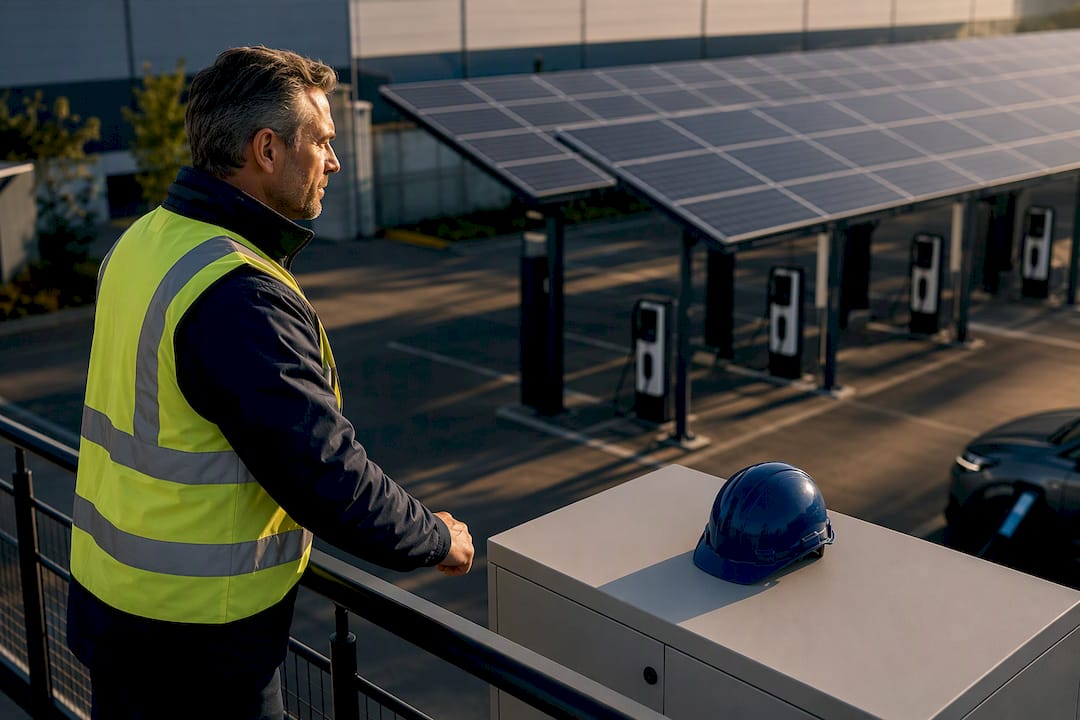
Yes: integrating IRVE with photovoltaic generation is technically feasible and usually cost-effective when you coordinate connection capacity, use smart charging or an EMS, and align procurement with current regulatory deadlines. Before signing anything, confirm your site’s available grid connection capacity, combine PV and IRVE scope in a single tender, and require a smart charging or energy management system in the specification. Watch installer qualification and eligibility rules tied to recent arrêtés, since they affect who can install and what gets paid for injected electricity.
TL;DR:
- Proper coordination between PV and IRVE installation requires confirming site connection capacity, integrating procurement in a single tender, and specifying smart charging or EMS systems from the start.
- Self-consumption benefits are maximized at sites with predictable, daytime charging patterns, such as fleets or parking canopies, reducing grid reliance and costs.
- Regulations now require installer qualification and net-measurement metering for PV systems up to 500 kW, influencing project timelines, contracts, and eligibility.
- The optimal system architecture depends on load timing and grid capacity, with PV direct with smart charging suitable for daytime use, while batteries and grid upgrades serve evening charging needs.
- Effective protection design must be integrated early, including lightning risk assessment, surge protection, and shared grounding, to avoid costly rework and ensure safety.
Table of Contents
- Benefits and business case for coupling IRVE and photovoltaic generation
- Regulatory framework and recent French updates that affect PV and IRVE projects
- System architectures: PV direct, battery storage, microgrid, and EMS options
- Design and safety considerations: protection, grounding, and commissioning
- Charger compatibility and control strategies for maximizing self-consumption
- Practical installation checklist and procurement coordination
- Cost, timeline, and permitting: realistic ranges and delay drivers
- When to choose storage versus upgrading grid connection
- Indelec’s technical perspective on protecting combined PV and IRVE sites
- How Indelec helps with audits, protection, and EV mobility services
- Sources
- FAQ
Benefits and business case for coupling IRVE and photovoltaic generation
The financial logic is straightforward. Every kilowatt-hour a facility produces and consumes on site is a kilowatt-hour it does not buy from the grid at a variable market price. ADEME describes self-consumption as a strategic shift for tertiary, industrial, and agricultural sectors, offering cost-competitive power and a hedge against price volatility. That logic gets stronger, not weaker, once you add EV charging, because chargers are one of the few loads flexible enough to shift toward the hours when panels actually produce.
Some site profiles fit this better than others. Fleets that charge during business hours, parking canopies serving daytime visitors, and buildings where charging load can be scheduled alongside other electrical demand all see the highest self-consumption gains. A retail site with overnight-only charging gets much less benefit from PV pairing than a logistics depot where vans return and charge at midday.
Beyond direct savings, several non-financial drivers push facility managers toward integration anyway. Parking owners face growing solar obligations tied to site size, insurers and ESG programs increasingly expect on-site renewable generation, and coupling PV with IRVE can reduce how much grid reinforcement a site needs when charging load grows. Fleet sizing decisions that account for on-site generation from the start tend to avoid expensive retrofits later.
Where PV and IRVE pairing pays off fastest:
- Fleets or visitor parking with predictable, daytime charging windows.
- Sites facing parking-canopy solar obligations that already require PV installation.
- Facilities anticipating grid capacity constraints as charging demand grows.
A commercial project can approach cost parity between produced solar kilowatt-hours and grid electricity, according to ADEME’s self-consumption guidance, which means every charging session run on self-produced power avoids a purchase at the prevailing tariff rather than at a fixed, favorable rate.
Regulatory framework and recent French updates that affect PV and IRVE projects
Two legal texts shape almost every PV and IRVE project timeline right now. The first is the law accelerating renewable energy production, which requires photovoltaic installation on parking areas above defined size thresholds and sets compliance timelines tied to that surface area. Project owners managing larger lots need to check where their site falls against those thresholds before assuming PV is optional.
The second is the Arrêté du 1er juin 2026, which modifies the conditions for purchasing electricity from rooftop and canopy PV installations up to 500 kW. It tightens eligibility in two concrete ways: installers must hold recognized qualifications or certification, and metering must measure production net of self-consumption using a network manager’s counting device. For installations at or below 9 kW, only surplus-injection sales remain eligible, which changes how smaller canopy projects should be metered and contracted.
What project teams need to track:
- Parking surface area thresholds that trigger PV obligations and their associated deadlines.
- Installer qualification requirements now written into eligibility for the purchase tariff.
- Metering specifications: net-of-self-consumption measurement through an approved counting device.
- The 9 kW threshold separating surplus-injection-only eligibility from broader purchase arrangements.
These rules have direct procurement consequences. Contract and purchase order dates matter because eligibility windows tied to parking surface area can shift what a project qualifies for if signing slips past a deadline. Practically, that means the CCTP (technical specification document) should name the required installer certifications explicitly, require documented proof of qualification before award, and specify the exact metering equipment needed to satisfy net-measurement rules. Keep copies of installer certifications, metering equipment datasheets, and the signed contract date on file, since these are the documents an eligibility review will ask for later.
System architectures: PV direct, battery storage, microgrid, and EMS options
Four architectures cover most PV and IRVE projects, and the right one depends on load timing and grid headroom rather than preference.
PV direct with smart charging suits daytime fleets best. Panels feed chargers directly through an EMS that throttles charging to match live production, with no battery in between. It is the lowest-capex option and delivers strong self-consumption when vehicle schedules line up with sunlight hours, but it does nothing for a site that charges mostly at night.
PV plus stationary storage earns its cost when the site has limited grid connection capacity or wants to shift solar production into evening charging windows. A rough sizing heuristic is to size storage against the gap between daytime production and evening demand, not against total daily energy, since oversizing batteries for peak shaving alone rarely pays back.
Grid-upgrade versus battery is a decision worth running through a lifecycle lens rather than a sticker-price comparison. ADEME’s lifecycle analysis of storage use cases found that for one six-charger, 100-kW-per-point peri-urban scenario, connecting at higher voltage produced better environmental indicators than adding a large local battery bank. That result will not hold for every site, but it argues against defaulting to storage without checking the alternative.
V2G and V2H remain early-stage in practical deployment. Vehicle-to-grid and vehicle-to-home setups need bidirectional chargers, compatible vehicle onboard electronics, and utility agreements that many grid operators still handle case by case, so most projects should treat V2G as a future upgrade path rather than a day-one requirement.
- PV direct suits daytime, predictable charging with minimal capital outlay.
- Battery storage earns its cost against connection limits or evening charging needs, not general resilience.
- A grid-connection upgrade can outperform batteries environmentally at certain site scales.
- V2G and V2H remain technically promising but limited by hardware and utility readiness today.
Pro Tip:Model your site’s actual charging time distribution before choosing an architecture. A battery sized for a fleet that charges at noon is money spent solving a problem you do not have.
Design and safety considerations: protection, grounding, and commissioning
Combining PV canopies with EV chargers concentrates electrical risk in one footprint, so protection design has to happen at the same stage as electrical layout, not after. A canopy structure raises the exposure profile for lightning strikes, and a charging point wired into the same distribution board as PV inverters creates new paths for surge energy to travel if protection is not coordinated from the start.
Core design and safety checks:
- Assess lightning risk for the combined canopy and charging structure before finalizing the electrical layout, not after installation.
- Place surge protection devices (SPDs) at the PV inverter, the main distribution board, and the charging point itself, following NF C 15-100 requirements for IRVE circuits.
- Verify ground continuity between the PV structure, the charger enclosure, and the building’s main earthing system to prevent potential differences during a fault.
- Test earth resistance against a defined target value and document the result before energizing the system.
- Route conductors to keep charger cabling separated from PV DC runs where practical, reducing induced fault risk.
- Request as-built drawings, SPD datasheets, and earth resistance test records as a condition of commissioning sign-off.
Grounding failures are one of the most common causes of rework on combined sites, because PV installers and IRVE installers often size and place earthing independently, then discover during commissioning that the two systems do not share a common reference the way the design assumed. Requiring a single grounding design owner across both scopes, even when different contractors do the physical installation, avoids this.
Pro Tip:Ask for the earth resistance test report and SPD placement diagram as separate, signed deliverables, not folded into a general handover pack. They are the two documents most often missing when a warranty claim comes up later.
Commissioning should include a functional test of the EMS or supervision system alongside the electrical checks: confirm that the charger actually throttles when PV production drops and that the protection devices show correct status indicators before the site goes live.

Charger compatibility and control strategies for maximizing self-consumption
Not every charger delivers the same self-consumption result on a PV-coupled site, even at identical power ratings. The features that matter are dynamic load management, a PV-follow charging mode that adjusts current draw to match live solar output, local metering accurate enough to feed an EMS, and OCPP compatibility so the charger can be supervised and updated independently of its manufacturer’s own platform.
Limiting charging power per point is often the better technical choice on PV-coupled sites, not just a cost-saving compromise. IEA-PVPS Task 17 recommends limiting charging and storage power to around 7 kW per point where feasible and prioritizing daily, slow charging patterns, since this profile matches typical PV output curves far better than a small number of high-power sessions. The same guidance recommends charging stationary batteries from PV before drawing from the grid, when storage is present.
An EMS ties this together by reading live PV output, storage state of charge, and charger demand, then adjusting charging current in real time to keep site consumption inside the available solar production whenever possible. That control loop needs telemetry from all three subsystems and a fast enough update cycle to react to cloud cover or sudden vehicle arrivals.
What to check before ordering chargers:
- Confirm firmware supports dynamic load management and PV-priority modes, not just fixed-schedule charging.
- Verify OCPP version compatibility with your intended supervision platform.
- Check metering accuracy specifications against what your EMS requires for control decisions.
- Ask whether the charger’s API is open enough to integrate with third-party EMS software, or locked to a single vendor.
Practical installation checklist and procurement coordination
Combined PV and IRVE projects lose the most time and money when the two scopes are procured separately and discover conflicts during installation. A joint checklist in the CCTP heads off most of it.
- Audit the physical site first: confirm roof or canopy structural capacity for PV, check for shading from nearby structures, map trench routing for charger cabling, and verify existing switchgear has capacity for the added load.
- Combine trenching and ducting in the tender so PV cabling and charger cabling share civil works instead of duplicating excavation, which industry reporting notes is a common source of avoidable cost when lots are split.
- Specify a single metering point wherever the regulatory framework allows it, to simplify both billing and eligibility documentation.
- Require installer qualification evidence in the tender response, since current eligibility rules tie purchase tariff eligibility to certified installers.
- Define commissioning acceptance criteria in advance: metering accuracy tests, protection coordination checks, and EMS functional tests, all signed off before final payment.
Coordinating PV and IRVE contractors under one combined scope, even with different subcontractors doing the physical work, keeps grounding, metering, and civil works consistent and avoids the finger-pointing that happens when a fault appears at the boundary between two separately procured systems.
Cost, timeline, and permitting: realistic ranges and delay drivers
Costs scale mainly with charger power and whether storage is included. A PV canopy paired with slow, 7 kW chargers sits well below the cost of the same canopy paired with fast chargers and a battery bank, since fast charging demands heavier cabling and switchgear while storage adds its own equipment and installation cost.
Typical schedule milestones run from grid connection request, through equipment procurement, to installation and commissioning, with grid connection requests usually representing the longest single wait in the sequence. Industrial IRVE projects often see grid-related delays stretch well beyond initial estimates when connection capacity upgrades are needed.
What most often pushes a project off schedule:
- Grid upgrade request queues at the local distribution operator.
- Procurement windows tied to purchase tariff eligibility deadlines.
- Charger and inverter supplier lead times, especially for higher-power units.
Regulatory shifts, including the June 2026 arrêté’s eligibility changes, can alter a project’s return on investment mid-planning, which is why locking in contract dates against known deadlines matters as much as the technical design.
When to choose storage versus upgrading grid connection
The instinct on many projects is to add batteries whenever connection capacity looks tight, but that is not always the better outcome once you look past the up-front bill. ADEME’s lifecycle comparison found that for a six-point, 100-kW-per-point peri-urban charging site, connecting at higher voltage produced better environmental outcomes than installing a large local battery bank.
Storage also carries obligations that a grid upgrade does not: fire-safety requirements, periodic maintenance, and eventual battery replacement, all of which add cost and operational overhead over the system’s life.
A defensible decision checklist:
- Compare the cost and lead time of a grid capacity upgrade against battery installation for your specific connection point.
- Weigh lifecycle environmental impact, not just up-front emissions, before defaulting to storage.
- Factor in the maintenance and fire-safety obligations storage adds over its service life.
- Reserve batteries for sites where connection upgrades are genuinely unavailable or where evening charging load cannot otherwise be served.
Indelec’s technical perspective on protecting combined PV and IRVE sites
Protection gets treated as an afterthought on too many PV and IRVE projects, and that is where the expensive mistakes happen. A company with decades of experience in electrical protection regards a canopy carrying both solar panels and EV chargers as a higher-risk structure than either system alone, deserving protection design at the same stage as electrical layout, not after.
The checks that matter most in practice are earth resistance against a defined target, correct SPD placement at the inverter, distribution board, and charger, and verified conductor continuity across the whole structure. Contracting lightning protection and surge coordination as one package with the PV and IRVE installation, rather than as a separate afterthought, removes a common source of rework: two installers assuming the other handled grounding continuity, and neither actually verifying it.
— INDELEC
How Indelec helps with audits, protection, and EV mobility services
A site combining solar generation and EV charging needs one coordinator who understands both the electrical protection risk and the charging infrastructure itself, not two separate contractors handing off a partially specified job. Indelec’s mobility services cover IRVE audit, installation, and supervision, alongside the company’s core grounding and lightning protection work, so a project brief can request both scopes from one technical team instead of stitching them together after the fact.

What to include in an initial brief:
- Request an IRVE audit covering site capacity, charger placement, and expected charging profile.
- Ask for a grounding and lightning protection assessment specific to the PV canopy and charger structure.
- Include commissioning supervision as a deliverable, not an optional extra.
Reach out through Indelec’s services page to scope a combined protection and EV mobility project before your tender goes out.
Sources
- ADEME — Avis sur l’autoconsommation photovoltaïque (Jan 2025)
- Loi n°2023-175 — Accélération de la production d’énergies renouvelables (Légifrance)
- Arrêté du 1er juin 2026 modifiant l’arrêté du 6 octobre 2021 (Légifrance)
- IEA-PVPS — PV powered EV charging stations (Task 17)
FAQ
What are the new rules for IRVE installations?
The Arrêté du 1er juin 2026 tightens eligibility for the PV purchase tariff on rooftop and canopy installations up to 500 kW: installers must be qualified or certified, and production must be metered net of self-consumption through an approved counting device. Installations at or below 9 kW are only eligible for surplus-injection sales under the revised rules.
Which EV chargers work well with solar panel systems?
Chargers with dynamic load management, a PV-follow mode, accurate local metering, and OCPP compatibility integrate best with an EMS controlling PV-coupled charging. IEA-PVPS guidance recommends limiting power to around 7 kW per point for slow charging, since this profile matches solar output curves more closely than high-power charging.
What does IRVE mean?
IRVE stands for “infrastructure de recharge pour véhicules électriques,” the French term for electric vehicle charging infrastructure, covering the charging points, wiring, and associated equipment installed at a site. It is the standard regulatory and technical term used across French permitting, procurement, and installer qualification rules.
What is the new law on solar panels?
The law accelerating renewable energy production requires photovoltaic installation on parking areas above defined surface thresholds and sets compliance deadlines tied to that area. Project owners should confirm where their parking lot falls against those thresholds before assuming solar installation is optional for their site.