IEC 62305: 4 Compliance Deliverables Engineers Must Produce After 2026

IEC 62305-2 sets the risk assessment that determines your protection class, and Parts 3 and 4 turn that class into physical measures. The immediate professional action is straightforward: run a documented risk assessment (ARF) first, then apply Part 3 for the lightning protection system and Part 4 for surge protection. The 2024 revisions changed how that risk gets calculated, so the sequence matters more than ever.
TL;DR:
- The 2024 revisions to IEC 62305-2 require using the single-risk aggregation method and strike-point density instead of separate checks and ground flash density, influencing every downstream protection decision.
- The scope excludes offshore, maritime, nuclear, and transportation infrastructure, making site-specific standards or national annexes critical for compliance.
- Conducting the risk assessment first with a documented ARF is essential, as it determines the entire protection class and influences design choices for LPS and surge protection devices.
- Design decisions like air-termination placement, conductor spacing, and material thickness must cite specific clauses and tables, enabling traceability during audits.
- Proper documentation of risk calculations, detailed drawings, test reports, and maintenance records is crucial to ensure compliance and defend protection choices during inspections.
Table of Contents
- 1. Overview of the IEC 62305 series and what each part requires
- 2. What changed in the 2024 revisions and why it matters to compliance
- 3. Scope and explicit exclusions: when 62305 does and does not apply
- 4. Risk assessment essentials from IEC 62305-2: how to get from risk to required measures
- 5. Design and installation essentials from IEC 62305-3 for LPS
- 6. Surge protection and internal systems: what IEC 62305-4 requires for SPDs and coordination
- 7. Practical compliance checklist: steps, documents, tests and maintenance an engineer must produce
- 8. How Indelec applies IEC 62305 in practice
- Balancing prescriptive clauses and engineering judgment
- Indelec’s services for IEC 62305 compliance
- Sources
- FAQ
1. Overview of the IEC 62305 series and what each part requires
The series splits lightning protection into four documents, each with a distinct job. Part 1 sets general principles: lightning parameters, damage types and the logic that the rest of the series builds on. Part 2 covers risk evaluation, the calculation that decides whether protection is needed and to what class. Part 3 handles physical damage and life hazard, meaning the actual lightning protection system (LPS) design. Part 4 addresses protection of electrical and electronic systems inside the structure.
AFNOR’s product listing for the French edition notes that NF EN IEC 62305-2 flags certain clauses as imperative and others as recommendations, a distinction that matters when building an audit trail.
- Part 1: general principles and lightning parameters, mostly informative background.
- Part 2: risk assessment methodology, the normative gateway to everything else.
- Part 3: LPS design, materials and installation, heavily normative.
- Part 4: internal systems and SPD coordination, normative with extensive informative annexes.
Component standards like IEC 62561 and IEC 62793 are referenced throughout for hardware testing and thunderstorm warning systems respectively.
2. What changed in the 2024 revisions and why it matters to compliance
The 2024 editions rewrote parts of the risk logic rather than just updating formatting. IEC 62305-2:2024 introduces a single-risk concept that aggregates loss types into one calculation instead of treating them as separate parallel checks, which changes how you justify a given protection level to a client or auditor.
It also replaces the older NG (ground flash density) with NSG, a strike-point density measure that feeds directly into the expected number of dangerous events for a structure.
- Single risk: loss aggregation now flows through one risk figure rather than several independent ones.
- NSG replaces NG: strike-point density changes the expected-event calculation at the input stage.
- TWS recognized: thunderstorm warning systems under IEC 62793 count as a documented risk reduction measure, not just an operational add-on.
- New annexes: updated cross-references affect how SPDs get selected and verified downstream.
IEC 62305-2:2024 formally applies to risk management for structures exposed to lightning flashes to earth and builds its calculation on the single-risk concept and NSG, according to the IEC webstore entry. That single change cascades into every downstream decision, from LPS class to SPD energy rating.
3. Scope and explicit exclusions: when 62305 does and does not apply
The series covers structures and their contents, services and occupants, but it explicitly steps aside for several categories. Rail systems, ships, aircraft, offshore installations, high-pressure buried pipelines and nuclear facilities fall outside its scope and are governed by sector-specific standards instead.
- Wind turbines: covered separately under IEC 61400-24, not IEC 62305.
- Transport and marine: rail, aircraft and shipboard systems use their own protection codes.
- High-hazard industry: nuclear sites and high-pressure buried pipelines carry dedicated regulatory frameworks.
When a national annex exists, check whether it narrows or clarifies the international clause before defaulting to the base text. Some national practices add requirements beyond the international minimum, so the safer path is to confirm which document governs the specific installation before starting the assessment rather than assuming the general series applies.
4. Risk assessment essentials from IEC 62305-2: how to get from risk to required measures
The Part 2 process is a chain: define the structure and its losses, estimate expected events, compare against tolerable limits, then select measures that close the gap. Skipping a step tends to produce a protection class that cannot be defended later.
- Inventory the structure and its loss types: human life, fire, economic loss and service continuity each get evaluated separately before aggregation.
- Estimate expected dangerous events using NSG and the structure’s collection area, per the IEC 62305-2:2024 method.
- Set tolerable risk limits for each loss category and calculate the reduction needed to meet them.
- Select measures, choosing among LPS protection classes, surge protective devices, TWS or administrative controls, alone or combined.
Pro Tip:Run the ARF before specifying any hardware. The protection class it produces, not a client’s assumption about “a lightning rod,” is what determines the entire design.
A practical lightning risk assessment guide can help structure the inventory step for facilities with mixed occupancy or service-continuity requirements.
5. Design and installation essentials from IEC 62305-3 for LPS
Part 3 is where the risk assessment becomes steel, copper and concrete. The standard offers several air-termination positioning methods, including the rolling sphere, mesh and protection angle approaches, and the choice depends heavily on roof geometry and structure height.
- Air-termination placement: method choice shifts with complex rooflines, equipment clusters and height variation.
- Down-conductor spacing and continuity: routing must maintain electrical continuity with test joints and accessible test points for periodic verification.
- Material thickness and hot-spot limits: minimum metal thickness and temperature-rise criteria help prevent puncture or ignition risk at conductor surfaces.
- Separation distance: calculated using methods allowed by the standard, alongside equipotential bonding at defined points.
IEC 62305-3:2024 updated guidance on metal thickness and clarified the separation distance methods, with component requirements cross-referenced to IEC 62561. Design drawings should cite the specific clause and table used for each material choice, not just the general standard number, so a reviewer can trace every decision back to its source.
6. Surge protection and internal systems: what IEC 62305-4 requires for SPDs and coordination
Part 4 governs everything downstream of a direct strike: the surge energy that travels through cables and equipment. SPD placement and coordination between levels (service entrance, distribution boards, sensitive equipment) determines whether a facility’s electronics survive an event that its LPS otherwise handled correctly.
- SPD levels and coordination: each protection level must let through less energy than the next device downstream can absorb.
- Current sharing and PV guidance: new annex material models how surge current splits across parallel conductors, including PV strings.
- System-level testing: induced voltage guidance addresses how loop geometry and cable routing affect equipment exposure to LEMP.
IEC 62305-4:2024 added informative annexes on current sharing modelling, PV installations and a new annex on system test methods, which directly affects how engineers justify SPD selection for facilities with rooftop solar or sensitive control systems. Skipping the coordination check between SPD levels is one of the more common ways a technically compliant installation still fails in service.
7. Practical compliance checklist: steps, documents, tests and maintenance an engineer must produce
Compliance is a paper trail as much as a physical installation. A regulator or client audit will ask for records, not just a finished system.
- Run and retain the ARF: keep the full IEC 62305-2 calculation file, not just the summary conclusion.
- Produce LPS drawings and specs: reference the specific IEC 62305-3 clauses and tables behind each material and spacing decision.
- Specify SPDs with coordination rationale: document the IEC 62305-4 annex guidance used and attach test reports.
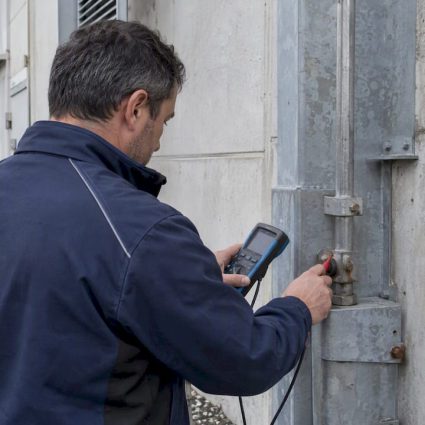
- Commission and schedule maintenance: record earth resistance measurements, test-joint checks and set a recurring inspection interval.
Pro Tip:Store the ARF, drawings and test reports together as one compliance package. A single missing document is often what turns a routine audit into a dispute.
The ARF guide covers documentation formats that hold up under later review.
8. How Indelec applies IEC 62305 in practice
Projects typically start with a documented ARF before specifying any hardware, following the process structure of IEC 62305-2. Complex sites raise questions the base standard does not answer in a single line: ATEX zones need isolated air-termination approaches, PV fields need current-sharing checks under the Part 4 annexes, and green roofs change both bonding and mechanical fixing choices.

Indelec’s ATEX site guidance and its green lightning protection notes walk through how those annex-level decisions get applied on real installations, drawing on the company’s R&D center and its record of installations across industrial and infrastructure sectors.
Balancing prescriptive clauses and engineering judgment

The standard gives you tables and formulas, but not every site fits them cleanly. National annexes sometimes refine or override an international clause, and knowing which one governs a given jurisdiction matters as much as the calculation itself.
A signed ARF with a traceable decision trail is what protects an engineer when a client later disputes a protection class. TWS and administrative measures can be legitimate, auditable risk reductions, but only when documented with the same rigor as a physical LPS component.
— INDELEC
Indelec’s services for IEC 62305 compliance
Turning these requirements into a working system means pairing the ARF with design, installation and ongoing verification, which is where Indelec’s lightning protection services come in: risk analysis and technical study, LPS installation, commissioning tests and scheduled maintenance, each producing the drawings, calculation files and test reports a compliance file needs.

Facility owners and engineering consultancies working through a Part 2 assessment or a Part 3 LPS design can request a site audit through Indelec’s services page to start the ARF and scope the technical study.
FAQ
What is the difference between IEC 62305-2 and IEC 62305-3?
IEC 62305-2 covers the risk assessment that determines whether protection is needed and at what class, while IEC 62305-3 covers the physical LPS design and installation that follows from that assessment. You always run the Part 2 calculation before applying Part 3 measures.
Does IEC 62305 apply to wind turbines or offshore structures?
No, wind turbines fall under IEC 61400-24 instead, and offshore installations, ships, aircraft and rail systems also use their own sector-specific standards. IEC 62305 explicitly excludes these categories from its scope.
What changed in the 2024 edition of IEC 62305-2?
The 2024 edition introduced a single-risk concept that aggregates loss calculations and replaced the older ground flash density (NG) with strike-point density (NSG), according to the IEC webstore description. It also formally recognized thunderstorm warning systems as a risk reduction measure.
Who needs to perform an IEC 62305-2 risk assessment?
Anyone responsible for a structure’s lightning protection compliance, typically a facility owner, engineering consultancy or contractor, needs a documented risk assessment before specifying an LPS or surge protection. Indelec’s ARF and technical study service covers this process for clients who prefer a turnkey assessment.
How often should an LPS be inspected under IEC 62305 practice?
The standard ties inspection frequency to the structure’s protection class and risk profile rather than a single fixed interval, so the maintenance schedule should be set during the ARF and documented alongside earth resistance and test-joint records. Regular verification, not a one-time installation check, is what keeps the compliance file valid over time.