Step Potential: Definition, Dangers, and Safety Actions
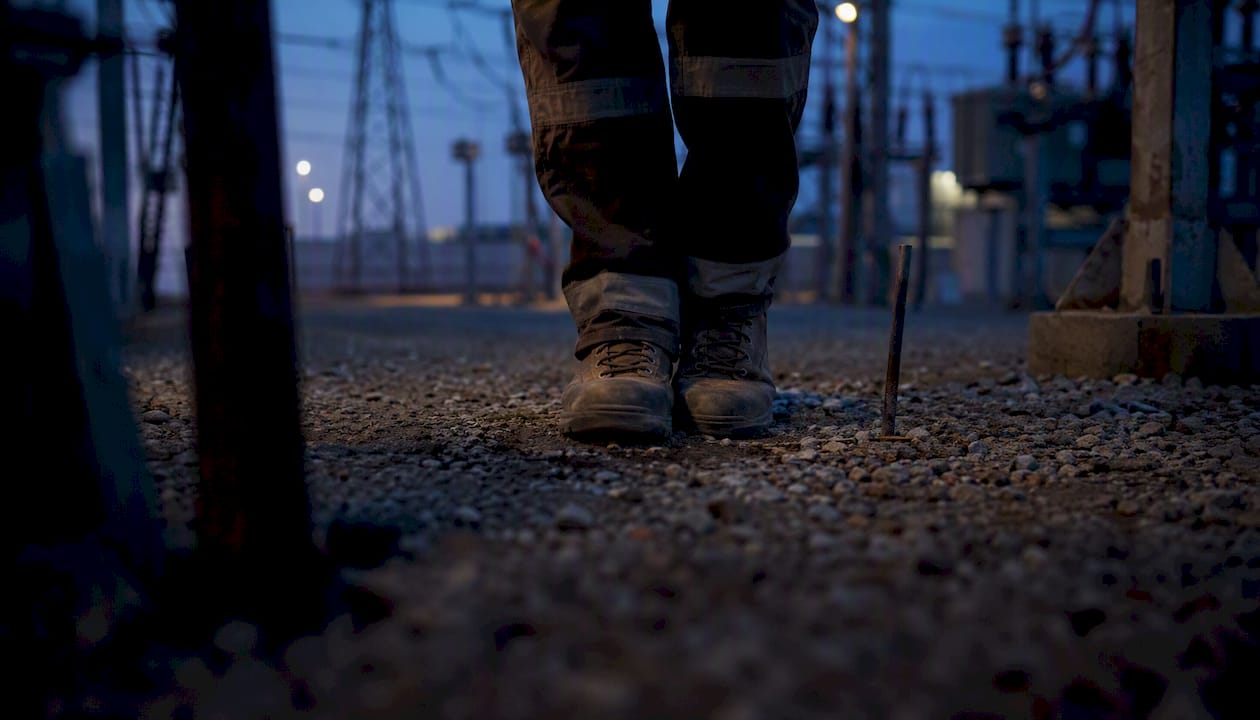
Step potential is the voltage difference between your two feet when you’re standing near an energized grounded object, and the single most important thing to know is this: if you suspect you’re in an energized zone, do not run — shuffle away with your feet together or hop out on one foot.
OSHA defines step potential as the result of fault current flowing into the soil and spreading outward from the contact point, creating a ground-potential gradient. The voltage between any two points on the ground can be lethal, and the wider your stride, the more voltage your body bridges.
Emergency do’s and don’ts:
- Call 911 and your local utility immediately — do not attempt to handle the situation yourself.
- Stay in your vehicle if it contacts a downed line; the vehicle’s tires and frame isolate you from the ground.
- Warn others to stay back — bystanders approaching from any direction face the same hazard.
- Do not touch anything in contact with the line, including fences, guardrails, or vehicles.
- Do not try to rescue someone in contact with an energized object until the utility confirms the line is de-energized.
Pro Tip:If you feel a tingling sensation in your feet or legs near a downed line, that sensation is step potential already acting on your body. Freeze, then shuffle or hop away immediately.
Key Takeaways
Step potential is the voltage difference between your two feet near an energized ground contact, and keeping your feet together while moving away is the single most effective immediate action you can take.
| Point | Details |
|---|---|
| Step potential definition | Voltage difference between two foot positions (~1 meter apart) caused by current spreading through soil. |
| Immediate safety action | Shuffle with feet together or hop away; never run or take large strides near a downed line. |
| Safe distance rule of thumb | ~22 feet for 13.8 kV distribution lines; ~34 feet for 230 kV transmission; double both in wet soil. |
| Stay in your vehicle | If your vehicle contacts a line, remain inside until the utility confirms de-energization. |
| Engineering mitigation | Grounding grids, deep rods, and equipotential mats designed to IEEE Std 80 keep step voltages within safe limits at facilities. |

Table of Contents
- What is step potential and how does it form?
- Why step potential can injure or kill
- Common situations where step potential appears
- What the public should do near a downed line or energized area
- Guidance for equipment operators, emergency responders, and workers
- How touch potential differs from step potential
- How grounding design reduces step potential at facilities
- A practical 60-second checklist for any energized-area incident
- The part most safety guides skip
- Protect your facility with qualified grounding expertise
- Sources
What is step potential and how does it form?
When a conductor, such as a downed power line or a lightning strike, contacts the ground, current flows outward through the soil in all directions. The result is a series of concentric voltage zones radiating from the contact point, each zone at a lower potential than the one inside it. Picture a stone dropped in still water: the ripples spread outward and lose energy as they go. Voltage in soil behaves the same way.

A person standing with feet apart bridges two of those voltage zones. Current then flows up one leg, through the torso, and down the other leg to complete the circuit. The wider the stance, the larger the voltage difference, and the greater the current through the body.
Key terms:
- Electrode: any conductor that contacts the earth and injects or receives current (a downed line, a grounding rod, a struck tower).
- Ground-potential gradient: the rate at which voltage changes across the soil surface away from the electrode.
- Step potential: the voltage difference between two foot positions roughly one step apart (approximately 1 meter or 3 feet), as described in AEMC Instruments’ testing guidance.
- Touch potential: the voltage between a person’s hand touching an energized object and their feet on the ground — covered in detail later.
Soil conductivity and moisture level both shape how steep the gradient is. Dry, sandy soil resists current flow and concentrates voltage near the contact point. Wet, clay-rich soil conducts more freely, spreading the hazard zone farther outward. Higher fault current, such as from a transmission line versus a distribution line, raises the absolute voltage at every point in the gradient.
Why step potential can injure or kill
The human body needs only a small amount of current to cause serious harm. Currents above roughly 10 milliamps can cause sustained muscle contraction, making it impossible to let go of an energized object or to stop walking into a hazard zone. Currents above 100 milliamps through the chest can trigger ventricular fibrillation. Step potential drives current through the legs and lower torso, a path that still intersects the heart.
The U.S. DOE safety advisory SA_2010_05 states that the voltage gradient around a downed conductor can be large enough to cause serious injury or death, and that the hazard extends well beyond the immediate contact point.
Wet soil makes this worse in two ways: it lowers soil resistivity, spreading the gradient farther from the contact point, and it reduces the resistance of a person’s footwear, allowing more current into the body. A person standing on wet grass near a downed 13.8 kV distribution line faces a meaningfully larger danger radius than someone on dry pavement.
A tingling sensation in the feet is an early warning sign that you are already within an energized zone. That feeling means current is flowing. The correct response is immediate, controlled movement away from the source, not a panicked sprint that widens your stride and increases the voltage your body bridges.
Common situations where step potential appears
Step potential is not limited to dramatic accidents. It shows up in a range of everyday and worksite scenarios:
- Downed overhead distribution or transmission lines: the most common public hazard; the line itself becomes the electrode, and the danger zone can extend 30 feet or more depending on voltage and soil conditions.
- Towers or poles contacting equipment: a crane or aerial lift that clips a line transfers fault current to the vehicle’s tires and then to the ground, energizing the surrounding soil.
- Energized vehicles: a truck or excavator in contact with a live conductor becomes a new electrode; anyone stepping off the vehicle bridges the potential between the vehicle and the surrounding ground.
- Substation faults: a fault at a substation grounding electrode or transformer neutral can raise the local ground potential significantly, creating step and touch hazards across the entire yard.
- Construction sites: metallic rebar mats, water-saturated soil, and multiple grounding points create complex gradient patterns that are difficult to predict without testing.
Environmental amplifiers matter. Wet ground after rain, metallic surfaces like chain-link fences connected to a grounded structure, and crowded worksites with multiple conductive paths all increase the likelihood that someone will inadvertently bridge a voltage zone. Grounding system integrity is the first line of defense against these scenarios becoming injuries.
What the public should do near a downed line or energized area
Distance is your primary protection. The voltage gradient drops steeply close to the contact point, so every foot you move away reduces your exposure.
Do:
- Keep a safe distance from a downed line; more is better.
- Call 911 and your utility’s emergency line before doing anything else.
- Warn others approaching from any direction, including drivers who may not see the line.
- Shuffle away by keeping your feet close together and sliding them along the ground without lifting them, or hop away on one foot to avoid bridging two voltage zones simultaneously. Oncor’s safety guidance explicitly recommends this technique and warns against walking or running.
When to stay in your vehicle: if your vehicle contacts a line or you drive over one, stay inside. The vehicle’s tires and body provide isolation from the ground. Only exit if the vehicle catches fire and staying inside is more dangerous than the step potential outside. If you must exit, jump clear with both feet together and land without touching the vehicle simultaneously.
Do not:
- Touch any object in contact with the line, including fences, guardrails, or other vehicles.
- Attempt to move the line with any object, conductive or not.
- Use water to fight a fire near an energized conductor.
- Try to rescue someone in contact with a line until the utility confirms de-energization.
Pro Tip:Save your utility’s emergency outage number in your phone now, before you need it. In a real incident, searching for it costs time you may not have.
Guidance for equipment operators, emergency responders, and workers
OSHA Appendix C to §1910.269 is direct: equipment operators whose vehicle contacts an energized line should remain inside unless an immediate life-safety hazard, such as fire, makes staying more dangerous than exiting. Exiting the vehicle bridges the potential between the vehicle and the surrounding ground, which can be fatal.
The DOE advisory provides rule-of-thumb minimum safe distances based on system voltage. These are conservative starting points; actual safe distances depend on soil resistivity, fault current magnitude, and site conditions. In wet soils, double these distances.
| System voltage | Approximate safe distance (dry soil) | Wet soil adjustment |
|---|---|---|
| 13.8 kV (distribution) | a safe distance of at least about 22 feet | roughly double that distance |
| transmission-level voltages | a safe distance of at least about 34 feet | roughly double that distance |
Responder on-scene checklist:
- Do not approach the contact point on foot until the utility confirms de-energization.
- Establish a perimeter using the distances above as a minimum; expand it if soil is wet or voltage is unknown.
- Contact the utility’s emergency dispatch immediately and request de-energization.
- Prevent bystanders and other responders from entering the perimeter.
- If a victim is inside an energized vehicle, communicate verbally and instruct them to stay put.
- Use only insulated rescue equipment rated for the voltage present, and only after the utility confirms the line is de-energized or a qualified lineman is on scene.
- Document the contact point, line owner, and time of contact for the incident report.
How touch potential differs from step potential
Touch potential is the voltage between a person’s hand touching an energized object and their feet on the ground. Step potential runs foot-to-foot; touch potential runs hand-to-foot. The hand-to-foot path passes directly through the chest and heart, which generally makes touch potential more immediately lethal at the same voltage level.
Common touch-potential scenarios include grabbing a vehicle that has contacted a line, touching a chain-link fence bonded to an energized structure, or placing a hand on a transformer housing during a fault. The object does not need to be visibly sparking or damaged to be energized.
Practical protection:
- Never touch a vehicle, fence, or piece of equipment near a downed line, even if it looks undamaged.
- Trained personnel working on or near energized equipment use equipotential bonding, which connects all conductive surfaces to the same potential so no current flows between them.
- Insulated gloves, boots, and mats rated for the voltage present reduce the current path through the body.
- De-energize and verify absence of voltage before any physical contact with potentially affected equipment.
How grounding design reduces step potential at facilities
Engineering controls are the long-term answer to step and touch potential at substations, industrial sites, and infrastructure installations. IEEE Std 80 provides the foundational methodology for calculating allowable step and touch voltages and sizing grounding grids accordingly.
Common mitigation methods:
- Grounding grids: buried conductor meshes that distribute fault current across a large area, flattening the voltage gradient at the surface.
- Additional ground rods: deep-driven rods lower the overall ground resistance and reduce the peak voltage at the electrode.
- Soil treatment: conductive backfill materials around electrodes lower local resistivity where deep rods alone are insufficient.
- Equipotential mats: surface mats bonded to the grounding grid that equalize potential under a worker’s feet and hands simultaneously.
- Gradient control conductors: conductors buried just outside a substation fence that extend the equipotential zone and reduce the step potential at the perimeter.
Sites with high soil resistivity, such as rocky terrain or arid regions, often require deep earth grounding drilling to reach lower-resistivity strata and achieve acceptable ground resistance values. Testing step and touch voltages after installation, using the methods described in the AEMC application note, confirms that the design meets the calculated limits before the site is energized.
When a facility has persistent high ground resistivity, complex fault scenarios, or aging grounding infrastructure, the right call is a qualified grounding engineer. Indelec provides grounding system design, installation, and testing services for industrial and infrastructure clients who need compliant, site-specific solutions.
A practical 60-second checklist for any energized-area incident
Keep this list on a safety card or phone screenshot:
- Stop. Do not take another step until you assess the situation.
- Look. Identify the downed line, energized object, or contact point.
- Call. Dial 911. Then call your utility’s emergency line.
- Warn. Signal others to stay back from all directions.
- Move (if necessary). Shuffle with feet together or hop on one foot away from the contact point. Never run or stride.
- Stay put (if in a vehicle). Do not exit unless fire forces you to.
What not to do: no touching conductive objects, no long strides, no attempting rescue until the utility confirms de-energization.
The part most safety guides skip
Step potential gets treated as a fringe hazard, something that happens to linemen and construction crews. The reality is that any downed line in a residential neighborhood, a flooded street, or a parking lot after a storm creates the same physics. The gradient does not care whether the bystander is a trained worker or a curious neighbor.
What concerns us most, from years of working on grounding systems across industrial and infrastructure sites, is how often the engineering side of this problem gets deferred. A properly designed grounding grid, sized to IEEE Std 80 and verified with field testing, does not eliminate fault current, but it keeps step and touch voltages within survivable limits for anyone on the site. That is the difference between a near-miss and a fatality.
The shuffle-and-hop technique saves lives in the moment. But the grounding design is what determines whether the moment happens at all. If your facility has aging ground electrodes, high soil resistivity, or no documented step/touch potential testing, that gap is worth closing before the next fault event.
Protect your facility with qualified grounding expertise

Step and touch potential hazards are manageable with the right grounding design and regular testing. Indelec’s engineering team provides site-specific grounding assessments, deep earth grounding drilling for high-resistivity soils, and full installation and certification services for industrial, commercial, and infrastructure clients across the United States. Whether you need a new grounding grid designed to IEEE Std 80 or an audit of an existing system, Indelec’s services cover the full scope.
Contact Indelec to schedule a grounding assessment for your site.
Sources
Use these for deeper reading or to share with safety teams and responders:
For the general public and first responders:
- Appendix C to §1910.269: Protection from Step and Touch Potentials (OSHA archive)
- SA_2010_05: Contact with Overhead Lines and Ground Step Potential (U.S. DOE advisory)
- Touch and Step Potential Testing (AEMC Instruments application note)
- Keep away from a fallen power line (Oncor safety guidance)
For engineers and technical personnel: