Infrastructure Lightning Protection Solutions: 8 Real Examples

TL;DR:
- Effective lightning protection combines interception, surge control, and grounding tailored to each facility’s needs. EGLAs improve transmission line reliability, while layered protection and proper grounding protect data centers from surges. Autonomous solar lighting and adaptive systems enhance safety and efficiency for remote infrastructure, with regular inspections ensuring ongoing protection.
Infrastructure lightning protection solutions are specialized systems that intercept strikes, control electrical surges, and provide grounding to prevent damage to critical facilities. The industry standard term is “lightning protection system” (LPS), governed by frameworks including IEC 62305, IEEE standards, and CIGRE technical bulletins. Facility managers and safety consultants who understand the full range of available technologies make better decisions about where to invest and what compliance gaps to close. This article covers eight concrete examples of infrastructure lightning solutions, from transmission line arresters to adaptive roadway lighting, with real deployment data behind each one.
1. What are the key criteria for effective infrastructure lightning solutions?
Every effective lightning protection system addresses three core functions: interception, surge control, and grounding. A solution that handles only one of these functions leaves the other two as failure points. Facility managers who evaluate solutions against all three criteria avoid the most common compliance gaps.
Reliability under high strike frequency matters most for facilities in high-keraunic zones, where ground flash density exceeds several strikes per square kilometer per year. Solutions must perform consistently across temperature extremes, humidity, and corrosive environments without requiring frequent recalibration.
Integration with existing infrastructure determines whether a solution is practical. A technically superior arrester that requires full line shutdown for installation creates unacceptable downtime for operational facilities. Compliance with IEC 62305, IEEE 998, and CIGRE TB 855 is non-negotiable for facilities subject to regulatory audit.
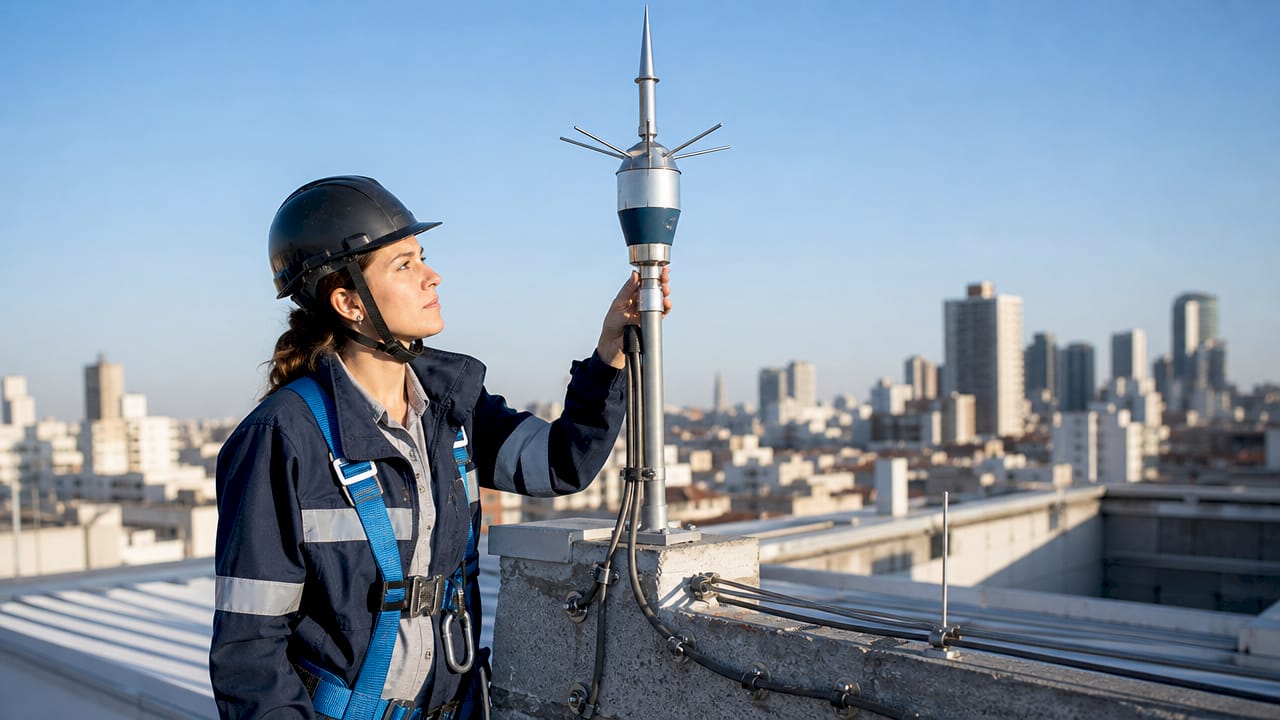
- Interception layer: Air terminals, lightning rods, or early streamer emission (ESE) devices capture the strike before it reaches the structure.
- Surge protection layer: Dedicated AC surge protection devices (SPDs) clamp transient overvoltages on incoming power lines.
- Grounding and bonding layer: Low-impedance earth connections safely dissipate surge current away from sensitive equipment.
- Maintenance accessibility: Components must be inspectable and replaceable without major civil works.
- Longevity: Materials and coatings must resist corrosion over a service life of 20 or more years.
Pro Tip:Request a site-specific risk assessment per IEC 62305-2 before specifying any solution. The risk calculation determines the required protection level (LPL I through IV) and prevents over- or under-engineering.
2. Examples of infrastructure lightning solutions: EGLAs on transmission lines
Externally Gapped Lightning Arresters (EGLAs) are the most proven technology for reducing lightning-caused outages on overhead transmission lines. Unlike conventional metal oxide varistors (MOVs) housed in sealed porcelain, EGLAs use an external air gap that isolates the arrester body from power frequency follow current. This design eliminates thermal runaway and extends service life significantly on lines up to 150 kV.
The clearest real-world proof comes from Indonesia. Installing 79 EGLAs on the 70 kV Parakan-Kadipaten overhead line reduced lightning-related outages to only 3 after deployment starting december 2022. That result demonstrates a dramatic improvement in line reliability for a system that previously suffered repeated weather-related interruptions.
EGLA installation per CIGRE TB 855 requires removing arcing horns and designing the external gap to handle lightning overvoltage without nuisance trips from switching events. Both top-phase and bottom-phase configurations are used depending on the line geometry and the dominant strike exposure angle.
| Configuration | Best application | Key requirement |
|---|---|---|
| Top-phase EGLA | Lines with high direct strike exposure | Gap sized for system voltage up to 150 kV |
| Bottom-phase EGLA | Lines with induced overvoltage risk | Coordination with line insulation level |
| Full-span EGLA | High-keraunic zones with frequent outages | CIGRE TB 855 gap design compliance |
Pro Tip:EGLAs are not suitable above 150 kV. For higher voltage transmission, consult a specialist on gapless MOV arrester configurations designed for ultra-high-voltage systems.
3. Multi-layered lightning protection for data centers
Data centers require a multi-layered approach because a single strike can propagate damage through power feeds, network cables, and cooling control systems simultaneously. Combining strike prevention with surge protection and grounding is the only method that addresses all three damage pathways at once.
UPS systems are not a substitute for dedicated surge protection. UPS units protect against power interruptions but offer limited clamping capability against high-magnitude transient surges. Standalone AC surge protection devices installed at the service entrance and at distribution panels are the correct tool for surge clamping.
“Facility experts recommend combining strike prevention with surge protection and grounding rather than relying on a single solution for comprehensive data center safety.” — Facility Executive Magazine
Grounding design is where most data center LPS projects fall short. A ground loop around the facility perimeter tied into the main earth grid, targeting resistance of approximately 5 ohms, gives surge current a low-impedance path to earth before it reaches server racks or network switches. For a practical guide on integrating these layers, Indelec’s resource on surge protection installation covers the full facility workflow.
- Air terminal or ESE device on the roof intercepts direct strikes.
- Bonding conductors connect all metallic building elements to a common reference point.
- SPDs at the service entrance clamp incoming surges on power feeds.
- SPDs at distribution panels protect individual circuits serving servers and cooling units.
- Perimeter ground loop tied to the main earth grid achieves target resistance below 5 ohms.
4. Autonomous solar street lighting for bridges and remote roads
Autonomous solar street lighting is a lighting solution for infrastructure that eliminates grid dependency entirely. Each luminaire integrates a photovoltaic panel, battery storage, and LED light source in a single self-contained unit. The result is zero grid energy consumption and dramatically reduced installation complexity compared to trenched cable systems.
The Puente de la Amistad bridge in Costa Rica demonstrates this approach at scale. Installing 26 solar street lights on the bridge improved safety with zero grid energy consumption, avoiding the civil works that a conventional wired system would require on an active bridge structure. That outcome matters for facility managers working on aging infrastructure where cable trenching is either impractical or cost-prohibitive.
Solar street lights significantly reduce infrastructure modifications and accelerate deployment timelines compared to grid-tied alternatives. For remote roads where grid extension costs are prohibitive, autonomous solar lighting is often the only financially viable option. The technology also removes the risk of power outages affecting road safety lighting during storms, which is precisely when reliable illumination matters most.
5. Smart adaptive lighting systems for roadway infrastructure
Smart adaptive lighting adjusts illumination levels in real time based on traffic density and environmental conditions. This approach delivers the safety benefits of full-brightness lighting only when traffic is present, reducing energy consumption during low-traffic periods without compromising driver or pedestrian safety.
Liverpool’s connected lighting network is a documented example of this technology at city scale. The system uses sensor data and central management to optimize street lighting output across the network, linking individual luminaires to a central platform that responds to real-time traffic conditions. That level of coordination was not achievable with conventional fixed-output street lighting.
For facility managers overseeing large campuses, parking structures, or access roads, adaptive lighting reduces both energy costs and lamp replacement frequency. Luminaires running at reduced output during off-peak hours accumulate fewer operating hours per year, extending service intervals. The central management platform also provides fault detection, alerting maintenance teams to failed luminaires before they become safety incidents.
6. Grounding and bonding networks as standalone protection layers
Low-impedance grounding and bonding systems forming perimeter loops tied into the facility ground grid are fundamental for minimizing damage to sensitive electronics during lightning events. This is not a secondary measure. It is the mechanism that actually dissipates surge energy safely into the earth after interception hardware has done its job.
Facility managers often treat grounding as a code compliance checkbox rather than a performance-critical system. The consequence is facilities with correctly specified air terminals and SPDs that still experience equipment damage because the ground path resistance is too high to handle peak surge current. A ground resistance above 10 ohms can cause dangerous potential differences across bonded equipment during a strike event.
Deep earth grounding is the solution when surface soil resistivity is too high to achieve target resistance with conventional driven rods. Indelec’s deep earth grounding drilling service reaches low-resistivity soil layers that surface installations cannot access, achieving the sub-5-ohm targets required for sensitive facility protection. This approach is particularly relevant for facilities on rocky terrain or in arid climates where surface soil dries out seasonally.
7. ESE lightning rods for complex facility rooftops
Early Streamer Emission (ESE) lightning rods extend the protection radius of a single air terminal beyond what a conventional Franklin rod achieves at the same mounting height. This matters for facility managers protecting large, irregular rooftops where multiple conventional rods would otherwise be required to achieve full coverage.
ESE devices work by triggering an upward leader earlier than a conventional tip, increasing the probability that the strike terminates on the air terminal rather than on the structure. Indelec’s Prevectron3 uses patented OptiMax technology to optimize this triggering mechanism. The protection radius calculation follows NFC 17-102 and IEC 62305 standards, giving safety consultants a documented, auditable basis for coverage claims.
For facilities with rooftop mechanical equipment, HVAC units, and communications antennas, ESE rods reduce the number of down conductors required, simplifying the overall system layout. Fewer conductors mean fewer penetrations through the building envelope and lower installation cost. The step-by-step guide to infrastructure lightning protection from Indelec covers how to integrate ESE devices into a compliant system design.
8. How to choose the right lightning protection setup for your facility
The right lightning protection setup depends on three variables: infrastructure type, strike exposure level, and operational sensitivity. A transmission line in a high-keraunic zone needs EGLAs. A data center needs layered SPDs and a low-resistance ground grid. A remote bridge needs autonomous solar lighting. No single solution fits all three scenarios.
| Infrastructure type | Primary risk | Recommended solution |
|---|---|---|
| Overhead transmission line | Direct strike outages | EGLAs per CIGRE TB 855 |
| Data center | Surge damage to electronics | Layered SPDs plus ground loop |
| Bridge or remote road | Lighting reliability and safety | Autonomous solar street lighting |
| Large facility rooftop | Incomplete strike interception | ESE lightning rod with extended radius |
| Industrial campus | Multiple simultaneous risk vectors | Integrated LPS with all three layers |
Budget allocation should follow risk priority. Interception hardware is visible and easy to specify, but grounding and surge protection deliver more damage prevention per dollar in facilities with sensitive electronics. Compliance with lightning protection standards sets the minimum acceptable specification and provides legal protection in the event of an insurance claim after a strike event.
Pro Tip:Commission a ground resistance test after installation and repeat it every two years. Soil conditions change seasonally and with construction activity nearby, and a ground resistance that met spec at installation may degrade over time.
Key takeaways
Effective infrastructure lightning protection requires integrating interception, surge control, and grounding into a single coordinated system tailored to the specific facility type and risk profile.
| Point | Details |
|---|---|
| Three-layer protection is mandatory | Interception, surge protection, and grounding must all be present for a complete system. |
| EGLAs reduce transmission line outages | Installing EGLAs on a 70 kV line cut lightning-related outages to just 3 after deployment. |
| Grounding is the most underrated layer | A perimeter ground loop targeting 5 ohms or less protects electronics more than interception hardware alone. |
| Autonomous solar lighting suits remote infrastructure | Zero grid dependency makes solar street lighting the practical choice for bridges and remote roads. |
| Solution selection must match facility type | Transmission lines, data centers, and roadways each require a different primary protection approach. |
Indelec’s perspective on lightning protection in practice
The most common mistake facility managers make is treating lightning protection as a one-time installation rather than a system that needs periodic verification. After 70 years of working on protection projects across industrial, commercial, and infrastructure sectors, Indelec has seen this pattern repeatedly. A facility installs a compliant system, passes the initial inspection, and then does not test ground resistance or inspect bonding connections for a decade. By the time a strike causes damage, the system has degraded below its original specification.
The second misconception is that a lightning rod alone constitutes adequate protection. A well-placed air terminal intercepts the strike. It does not protect the electronics inside the building from the surge that travels in on the power feed from a strike 500 meters away. That is the job of the SPD at the service entrance, and it is the component most often missing from facility protection plans.
Indelec’s position is that site-specific assessment is non-negotiable before specifying any solution. The risk calculation per IEC 62305-2 determines the required protection level and identifies which layers are most critical for that specific facility. Generic specifications copied from another project create gaps that only become visible after a damaging event.
— Indelec
Indelec’s lightning protection solutions for infrastructure projects
Facility managers and safety consultants who need a proven, compliant lightning protection system have a direct path forward with Indelec’s product and service portfolio.

Indelec’s Prevectron3 air terminal uses patented OptiMax technology to maximize protection radius on complex rooftops and large infrastructure sites, reducing the number of down conductors and simplifying system layout. For facilities requiring specialized grounding, Indelec’s deep earth drilling service achieves the low-resistance earth connections that surface installations cannot deliver on rocky or arid terrain. The full range of lightning protection system applications covers transmission infrastructure, data centers, industrial campuses, and linear infrastructure. Contact Indelec for a site-specific risk assessment and a compliant system specification.
FAQ
What are examples of infrastructure lightning solutions?
Examples include Externally Gapped Lightning Arresters (EGLAs) on transmission lines, layered surge protection systems for data centers, ESE lightning rods for large rooftops, autonomous solar street lighting for bridges, and smart adaptive roadway lighting networks.
How do EGLAs differ from conventional lightning arresters?
EGLAs use an external air gap that isolates the arrester body from power frequency follow current, eliminating thermal runaway. They are most effective on systems up to 150 kV and must be installed per CIGRE TB 855 guidelines.
Why is grounding more important than most facility managers realize?
Grounding and bonding networks provide the low-impedance path that safely dissipates surge current into the earth. Without a ground resistance at or below approximately 5 ohms, even correctly specified interception hardware and SPDs cannot prevent damage to sensitive electronics.
What is the best lighting solution for a remote bridge?
Autonomous solar street lighting is the best option for remote bridges because it operates with zero grid energy consumption, requires minimal civil works, and maintains reliable illumination even during grid outages caused by storms.
How often should a lightning protection system be inspected?
A lightning protection system should be inspected at least every two years, with ground resistance testing at each inspection. Soil conditions and nearby construction activity can degrade ground resistance below the original specification over time.