Types of Industrial Surge Solutions: 2026 Engineer’s Guide

TL;DR:
- Industrial surge solutions are classified into three types, each targeting a specific point in an electrical system to provide effective protection. A layered, three-stage system with Type 1 at the entrance, Type 2 at distribution points, and Type 3 at point-of-use equipment ensures comprehensive surge mitigation. Proper coordination, including adequate cable separation and system management, is essential for protecting costly equipment and maintaining reliable operations.
Types of industrial surge solutions are categorized into three essential classes, Type 1, Type 2, and Type 3 surge protective devices (SPDs), each providing targeted protection at a distinct point in an industrial electrical system. The industry standard term for these devices is “surge protective device,” defined under IEC 61643, which governs testing waveforms, installation requirements, and performance ratings. A facility that deploys only one type leaves critical gaps. Inadequate surge protection causes equipment damage, unplanned downtime, and replacement costs that can reach tens of thousands of dollars per event. The sections below break down each type, explain how they coordinate, and give engineers the practical detail needed to build a complete surge protection strategy.
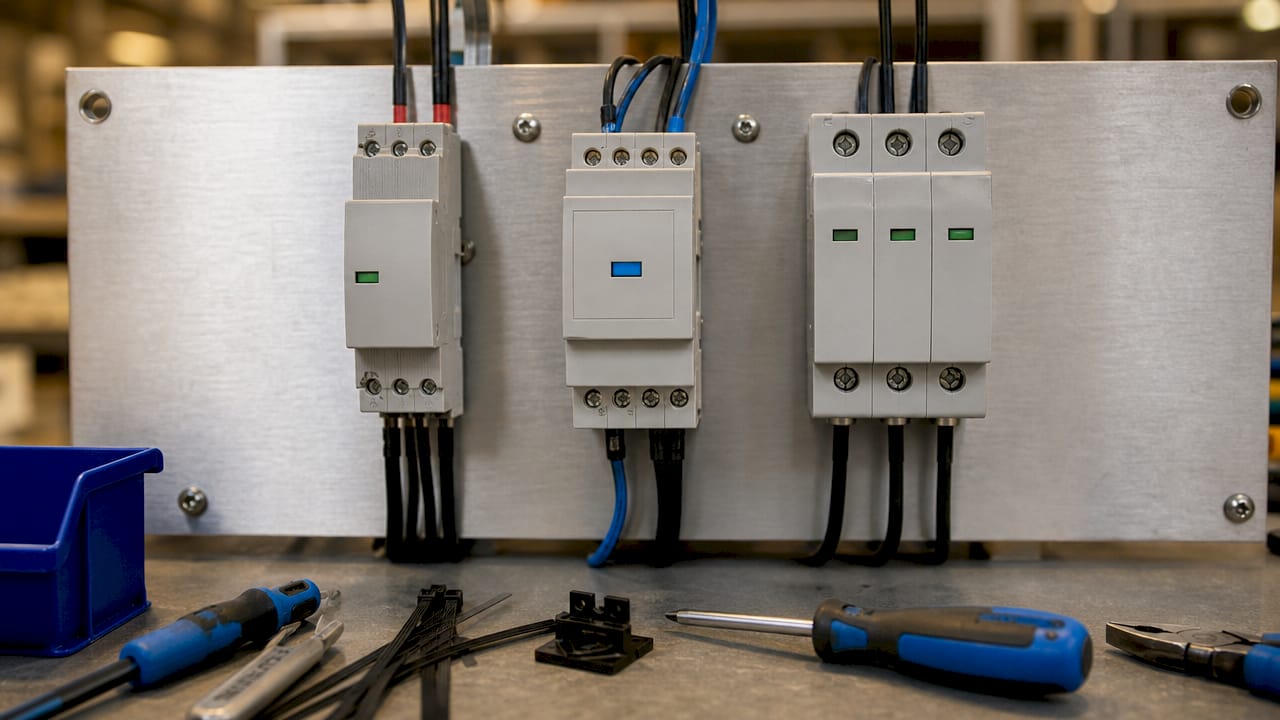
1. What are the types of industrial surge solutions?
Industrial surge protection requires a layered, three-stage system. Each stage targets a different threat level and a different location in the electrical network.
- Type 1 SPD: Installed at the main service entrance. Handles direct lightning currents and high-energy external surges.
- Type 2 SPD: Installed at sub-distribution boards and motor control centers (MCCs). Handles switching transients and residual surges.
- Type 3 SPD: Installed at the point of use, directly adjacent to sensitive equipment. Handles low-energy residual surges and fast voltage transients.
This three-stage cascade is the architecture defined by IEC 61643-11, the primary international standard for low-voltage SPDs. Each type differs in energy capacity, test waveform, and clamping voltage. Skipping any stage leaves downstream equipment exposed to surges that the upstream device cannot fully absorb.
2. What is Type 1 surge protection and where is it installed?
Type 1 SPDs are the first line of defense in any industrial facility. They handle the highest energy surges, including direct lightning strike currents conducted through an external lightning protection system (LPS) into the building’s electrical network.
Key characteristics of Type 1 devices:
- Test waveform: 10/350 μs, which simulates the long-duration, high-energy profile of a direct lightning current.
- Impulse current (Iimp): Rated between 12.5 kA and 50 kA, depending on the facility’s lightning risk classification.
- Installation point: Main low-voltage distribution board or service entrance panel.
- Mandatory requirement:When an external LPS exists, a Type 1 SPD at the service entrance is required, not optional.
- IEC classification: Class I test per IEC 61643-11, certified to the 10/350 μs waveform.
The 10/350 μs waveform carries far more energy than the 8/20 μs waveform used for Type 2 testing. A device rated only for 8/20 μs will fail catastrophically if exposed to a direct lightning current. Facilities in high-keraunic zones, those with rooftop equipment, or those connected to overhead utility lines face the greatest exposure and should treat Type 1 installation as non-negotiable.
Pro Tip:If your facility has an external lightning rod or LPS, verify that a Type 1 SPD is installed at the main board. An LPS without a coordinated Type 1 SPD at the entrance can actually increase conducted surge energy into the building’s wiring.
3. What is Type 2 surge protection and its role within distribution panels?
Type 2 SPDs are the workhorses of industrial surge mitigation. They handle the medium-energy surges that Type 1 devices pass through, plus the internal switching transients that never reach the entrance SPD at all.
Key characteristics of Type 2 devices:
- Test waveform:8/20 μs, which simulates the shorter, faster profile of switching and residual surges.
- Nominal discharge current (In): Typically 20 kA, the current the device handles repeatedly without degradation.
- Maximum discharge current (Imax): Ranges from 40 kA to 80 kA, the single-event maximum the device can survive.
- Installation point: Sub-distribution boards, MCCs, HVAC panels, and capacitor bank circuits.
- IEC classification: Class II test per IEC 61643-11.
Internal switching transients from motors, HVAC compressors, and capacitor banks are injected directly onto sub-distribution circuits. These surges bypass the entrance SPD entirely because they originate inside the facility. A Type 2 SPD at the MCC or sub-panel intercepts them before they reach sensitive downstream equipment. The In and Imax ratings are the key performance parameters to match against the facility’s switching load profile.
Pro Tip:When physical space or cable routing prevents the required separation distance between a Type 1 and Type 2 device, use a combined Type 1+2 unit. These devices handle both 10/350 μs and 8/20 μs waveforms in a single enclosure and are fully IEC-compliant for compact or retrofit installations.
4. Why is Type 3 protection critical at point-of-use sensitive equipment?
Type 3 SPDs protect the equipment that matters most: PLCs, variable frequency drives (VFDs), HMIs, and CNC controllers. These devices are sensitive to voltage spikes that Type 1 and Type 2 units reduce but do not eliminate entirely.
Key characteristics of Type 3 devices:
- Test waveform: Combined 1.2/50 μs (voltage) and 8/20 μs (current), simulating fast, low-energy transients.
- Clamping voltage (Up):≤ 1.0 kV, tight enough to protect sensitive electronics rated for standard industrial voltages.
- Installation point: Directly at the equipment terminal or within the control panel housing the sensitive device.
- Coordination requirement: Requires a minimum of approximately 10 meters of cable separation from the upstream Type 2 device for proper energy decoupling.
The financial case for Type 3 protection is straightforward. Replacing a damaged CNC or PLC control panel can exceed $50,000 per event, and that figure excludes production downtime, labor, and expedited parts costs. A Type 3 SPD costs a fraction of that. Facilities running highly sensitive installations such as automated production lines or process control systems face the highest exposure to this category of loss.
Pro Tip:Do not install a Type 3 SPD directly next to a Type 2 device without the required cable separation. Without at least 10 meters between them, the two devices compete rather than coordinate, and neither performs to its rated specification.
5. How do these three types coordinate to form a complete surge protection strategy?
The three SPD types work as a cascade, not as independent devices. Each stage absorbs a portion of the surge energy, passing a reduced residual to the next stage. The system only works when the stages are properly coordinated.
| Parameter | Type 1 | Type 2 | Type 3 |
|---|---|---|---|
| Test waveform | 10/350 μs | 8/20 μs | 1.2/50 + 8/20 μs |
| Typical current rating | 12.5–50 kA (Iimp) | 20–80 kA (Imax) | Low energy, Up ≤ 1.0 kV |
| Installation point | Main service entrance | Sub-distribution / MCC | Point of use |
| IEC classification | Class I | Class II | Class III |
| Primary threat | Direct lightning current | Switching surges, residual | Residual transients |
Coordination between stages depends on physical cable separation. A minimum of 10 meters of cable between the Type 2 and Type 3 devices is required for proper energy decoupling. That cable length acts as an impedance that forces the upstream device to absorb the bulk of the surge before the residual reaches the downstream unit. Without that separation, both devices see the full surge simultaneously and neither clamps effectively.
For facilities without an external LPS, a Type 2 SPD at the main distribution board is the minimum acceptable configuration. Facilities with an external LPS must add a Type 1 at the entrance. Compact facilities or retrofit projects where cable routing cannot achieve the 10-meter separation between Type 1 and Type 2 should use a combined Type 1+2 unit at the entrance, then place Type 3 devices at each sensitive load.
Facility size and lightning exposure drive the final configuration. A large manufacturing plant in a high-lightning region needs all three stages deployed at multiple sub-panels. A smaller facility in a low-risk zone may operate adequately with a Type 2 at the main board and Type 3 devices at critical control panels. The industrial lightning protection guide from Indelec provides a structured framework for matching system configuration to site-specific risk.
6. What are the best surge protection strategies beyond device selection?
Selecting the right SPD types is necessary but not sufficient. A facility-wide surge protection strategy requires ongoing management, coordination with the building’s lightning protection system, and regular maintenance.
Practical strategies for facility managers and engineers:
- Treat SPDs as a filter system, not a one-time purchase. SPDs degrade with each surge event. A device that absorbed a major surge may still appear functional but have reduced capacity. Schedule regular inspection and replacement cycles.
- Coordinate with the building LPS per IEC 62305. Surge protection and lightning protection are two parts of the same defense system. An LPS that conducts lightning current to ground without a coordinated Type 1 SPD at the service entrance creates a conducted surge path into the electrical network.
- Map internal switching transient sources. Motors, HVAC compressors, and capacitor banks generate surges on startup and shutdown. Mapping these sources identifies which sub-panels need Type 2 coverage beyond what the entrance SPD provides.
- Budget for retrofit upgrades. Many older industrial facilities have entrance-only SPDs installed years ago. Retrofitting Type 2 and Type 3 devices at MCCs and control panels is a cost-effective upgrade compared to the cost of a single equipment failure.
- Train facility managers on surge risk indicators. Unexplained equipment resets, nuisance tripping, and shortened component life are all signs of unmitigated surge activity. Early recognition prevents larger failures.
Pro Tip:Install SPDs with remote monitoring or status indicators where possible. A failed SPD with no visual indicator provides zero protection while appearing fully operational. Monitoring removes that blind spot.
The step-by-step power grid surge control framework from Indelec offers a practical sequencing guide for implementing these strategies across an industrial site.
Key takeaways
A coordinated three-stage SPD system, Type 1 at the entrance, Type 2 at distribution, and Type 3 at point of use, is the only electrical surge solution that fully protects an industrial facility from external lightning to sensitive control electronics.
| Point | Details |
|---|---|
| Three-stage architecture is mandatory | Type 1, Type 2, and Type 3 SPDs each cover a distinct threat level and location. |
| Type 1 is required with any external LPS | Facilities with lightning rods must install a Type 1 SPD at the main service entrance. |
| Internal surges need local Type 2 coverage | Switching transients from motors and HVAC bypass entrance SPDs and require sub-panel devices. |
| Type 3 protects against costly equipment loss | PLC and CNC controller replacement can exceed $50,000, making point-of-use SPDs a clear investment. |
| Coordination distance is non-negotiable | At least 10 meters of cable separation between Type 2 and Type 3 devices is required for proper energy decoupling. |
Indelec’s perspective on layered surge protection
The most common mistake I see in industrial facilities is treating surge protection as a box-checking exercise. A facility installs a Type 1 SPD at the entrance during construction, and no one revisits the system for a decade. Meanwhile, the facility adds motors, expands its MCC, installs new PLCs, and the entrance SPD sits there absorbing surges that never fully reach the sensitive equipment it was never designed to protect alone.
The three-stage architecture is not a theoretical framework. It reflects how surges actually behave in real electrical networks. A direct lightning strike injects energy at the entrance. Switching transients originate inside the facility. Residual surges reach control panels even after upstream devices have done their job. Each of those threats requires its own response at the right location.
The cost argument is equally clear. A single PLC failure from an unmitigated surge can cost more than a complete three-stage SPD installation across an entire facility. The investment in proper coordination pays for itself the first time it prevents a production shutdown.
Regular system audits matter as much as the initial installation. SPDs degrade silently. Integrating SPD inspection into your standard electrical safety protocol, alongside thermal imaging and insulation testing, is the practice that separates facilities with genuine surge defense from those with the appearance of it.
— Indelec
Indelec’s industrial surge and lightning protection solutions
Indelec has specialized in electrical protection since 1955, with a focus on lightning and surge protection systems that meet IEC 61643 and IEC 62305 standards. For industrial facilities looking to audit, upgrade, or build a complete layered protection system, Indelec provides technical consulting, installation, and certification services across all three SPD stages.

Indelec’s lightning protection system applications cover the full scope of industrial surge and lightning defense, from entrance-level Type 1 coordination to point-of-use protection for sensitive control systems. Whether you are retrofitting an existing facility or designing protection for a new site, Indelec’s engineering team provides site-specific guidance aligned with current IEC requirements. Contact Indelec to schedule a risk assessment and system review for your facility.
FAQ
What are the three types of industrial surge protective devices?
The three types are Type 1, Type 2, and Type 3 SPDs. Type 1 handles direct lightning currents at the service entrance, Type 2 handles switching surges at sub-distribution panels, and Type 3 provides low-energy clamping at point-of-use equipment.
Is a Type 1 SPD always required in industrial facilities?
A Type 1 SPD is mandatory when an external lightning protection system is present. Facilities without an external LPS require at least a Type 2 SPD at the main distribution board.
Why can’t a single SPD protect an entire industrial facility?
A single entrance SPD cannot absorb internal switching transients from motors and HVAC, which originate inside the facility and bypass the entrance device entirely. Only a layered system with devices at each distribution level provides complete coverage.
How far apart must Type 2 and Type 3 SPDs be installed?
A minimum of approximately 10 meters of cable separation between Type 2 and Type 3 devices is required for proper energy decoupling. Without that separation, the two devices do not coordinate correctly and surge attenuation is reduced.
What is a combined Type 1+2 SPD and when should it be used?
A combined Type 1+2 SPD handles both 10/350 μs and 8/20 μs waveforms in a single unit. It is the correct solution for compact or retrofit installations where physical cable routing cannot achieve the required separation distance between separate Type 1 and Type 2 devices.