How to Prioritize Protection Upgrades for Facilities

TL;DR:
- Prioritizing protection upgrades involves assessing vulnerabilities based on impact, exploit likelihood, and physical exposure.
- A dynamic, tiered model incorporating environmental risks and real-time data ensures effective and continuous security improvements.
Prioritizing protection upgrades means ranking your facility’s vulnerabilities by combining impact severity, exploit likelihood, and physical exposure status. Facility managers who skip this step waste budget on low-risk fixes while critical gaps stay open. The industry term for this process is risk-based vulnerability prioritization, and it applies equally to cybersecurity patches and physical protection systems like lightning defense. Standards from CISA and frameworks like CVSS, EPSS, and KEV give you the data signals to rank upgrades with confidence. Indelec’s experience across global infrastructure projects confirms that environmental exposure, particularly lightning risk zones, must sit alongside IT metrics in any complete prioritization model.
How to prioritize protection upgrades: the key ranking criteria
The most defensible way to rank upgrades combines four variables: vulnerability severity, exploit likelihood, known exploitation status, and asset exposure. Relying on severity alone produces a distorted picture. 62% of critical CVEs identified sit in unreachable code paths, meaning a high severity score does not automatically translate to real-world risk. That statistic exposes the core flaw in single-signal prioritization.
Vulnerability severity (CVSS)
The Common Vulnerability Scoring System (CVSS) rates vulnerabilities on a 0–10 scale. A CVSS score of 9.0 or above signals a critical weakness, but context determines whether it actually threatens your facility. A critical score on an isolated, air-gapped system carries far less urgency than the same score on an internet-exposed asset.
Exploit likelihood (EPSS)
The Exploit Prediction Scoring System (EPSS) estimates the probability that a vulnerability will be exploited in the wild within 30 days. An EPSS score above 0.6 indicates high exploit likelihood and should trigger immediate action. Blending CVSS, EPSS, and KEV scores yields a prioritization model that reduces wasted effort while increasing real security coverage.
Known Exploited Vulnerabilities (KEV) and asset exposure
CISA’s Known Exploited Vulnerabilities catalog lists flaws actively exploited by threat actors. Any vulnerability on the KEV list demands the fastest response, regardless of its CVSS score. For physical infrastructure, asset exposure works the same way. A facility in a high lightning-density zone carries elevated exposure that must factor into protection system upgrade decisions alongside technical metrics.
Key risk signals to evaluate for every upgrade:
- CVSS score (severity baseline)
- EPSS score (real-world exploit probability)
- KEV catalog status (confirmed active exploitation)
- Asset exposure (internet-facing, lightning-prone zones, perimeter position)
- System reachability (is the vulnerable component actually accessible to an attacker or environmental threat?)
How to implement a tiered model for ranking security upgrades
A tiered prioritization model converts raw risk signals into scheduled action. A tiered approach reduces patch queues by 70–85% compared to severity-only models. That reduction frees engineering and maintenance resources for the upgrades that actually move the needle.

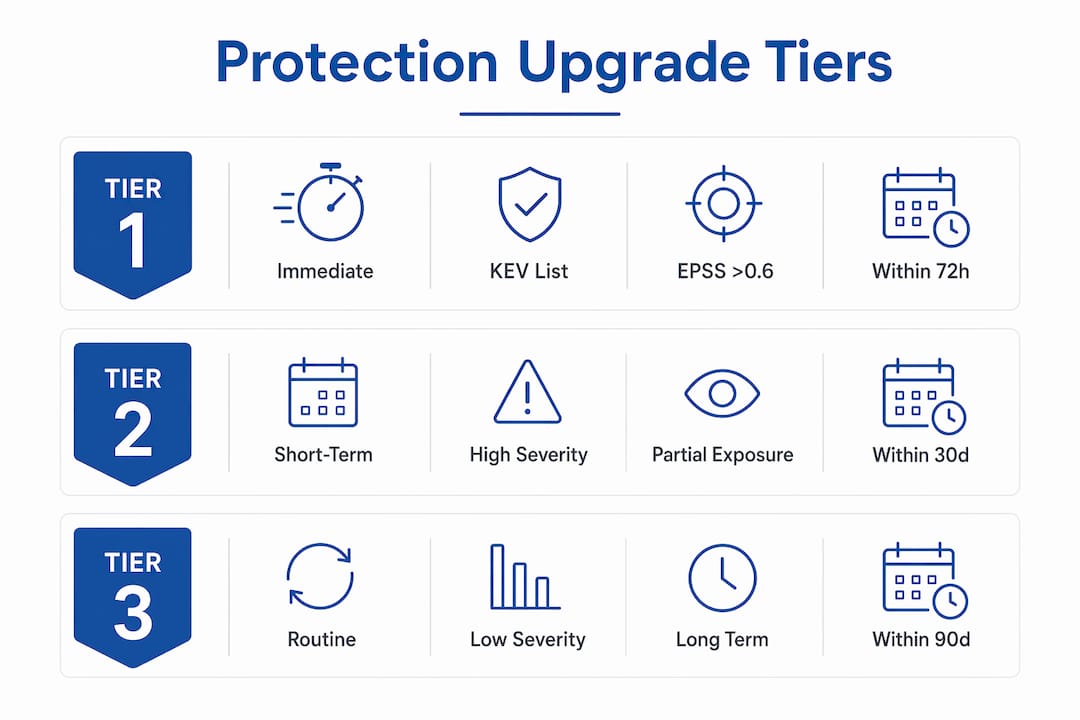
Tier 1: Immediate action (within 72 hours)
Tier 1 covers any vulnerability on the CISA KEV list, any asset with an EPSS score above 0.6, or any internet-exposed system with a CVSS score of 9.0 or above. CISA BOD 26-04 mandates remediation within 3 days for the highest-risk vulnerabilities, and requires forensic triage alongside patching. For physical facilities, Tier 1 includes lightning protection gaps in high-risk zones where a strike could disable critical operations.
Tier 2: Short-term action (within 30 days)
Tier 2 covers high-severity vulnerabilities with moderate exploit likelihood and assets with partial exposure. This tier typically includes outdated grounding systems, aging surge protection equipment, and access control weaknesses at secondary entry points. Resources allocated here should follow a clear remediation schedule, not an open-ended queue.
Tier 3: Routine maintenance (within 90 days)
Tier 3 addresses low-severity issues, redundant systems, and improvements that reduce long-term risk without urgent operational impact. Routine inspections, firmware updates on non-critical devices, and documentation reviews belong here.
| Tier | Trigger Criteria | Remediation Window |
|---|---|---|
| Tier 1 | KEV listed, EPSS above 0.6, CVSS 9.0+ on exposed asset | 72 hours |
| Tier 2 | High CVSS, moderate EPSS, partial exposure | 30 days |
| Tier 3 | Low severity, no active exploit, non-critical asset | 90 days |
Prioritization models must also incorporate environmental factors like lightning zone classifications and physical exposure risks, not just IT vulnerability metrics. A data center in a region with frequent thunderstorm activity faces a materially different risk profile than the same building in a low-lightning area.
Pro Tip:Set up automated alerts tied to daily EPSS and KEV updates. Risk scores change frequently, and a vulnerability that sits in Tier 3 on Monday can move to Tier 1 by Thursday if a new exploit surfaces.
What operational practices enable effective upgrade execution?
Effective prioritization fails without the operational structure to execute it. A 90-day phased upgrade plan delivers measurable improvements without disrupting daily operations. The structure works as follows: conduct full facility audits in month 1, reposition and upgrade hardware in month 2, and integrate systems with analytics and monitoring in month 3.
Facility audits in month 1 should map every asset, identify exposure levels, and document current protection status. This baseline drives every subsequent decision. Without it, you are ranking upgrades against an incomplete picture of your actual risk surface.
Month 2 focuses on physical changes. Facility managers should target high-risk entry points and perimeter vulnerabilities first. Replacing entire systems at once is inefficient and costly. Repositioning existing hardware, upgrading the highest-exposure components, and closing the most critical gaps delivers faster risk reduction per dollar spent.
Month 3 ties the upgraded components together. System integration, sensor data feeds, and analytics platforms create continuous visibility. Effective prioritization requires continuous data gathering from sensors and exposure monitoring tools, feeding automated ranking algorithms that keep your tier assignments current.
Operational practices that support ongoing prioritization:
- Assign clear role-based ownership for each upgrade tier so accountability is never ambiguous
- Schedule quarterly reassessments as a standing calendar event, not a reactive response
- Document every upgrade with before-and-after risk scores to build an auditable record
- Use integrated access control and video monitoring to validate that physical upgrades are functioning as intended
- Brief leadership on tier status monthly so budget decisions align with current risk priorities
Pro Tip:Eliminating 10–20% of unnecessary access permissions often delivers higher immediate risk reduction than a full system replacement. Start there before committing capital to new hardware.
How to troubleshoot common obstacles in upgrade prioritization
The most common mistake in evaluating protection upgrade needs is patching by severity score alone. Organizations that rely solely on severity scores waste engineering resources on vulnerabilities that pose little real-world threat. A CVSS 9.5 vulnerability in an unreachable system is less urgent than a CVSS 7.0 flaw on a publicly exposed, actively targeted asset.
“Static annual reviews lead to stale priorities and missed threats. Prioritization rankings must be reassessed routinely as exploit likelihood scores and KEV catalog contents change daily.”
Budget constraints push many facility managers toward all-or-nothing decisions. That thinking produces the wrong outcome. Phased, incremental upgrades starting with operational hygiene yield measurable security improvements without major disruptions. Removing redundant access credentials, updating firmware on exposed devices, and adding surge protection to critical circuits each cost a fraction of a full system replacement and reduce risk immediately.
A second common pitfall is treating prioritization as a one-time project. Risk scores and KEV catalog contents change daily, which means a priority list built in january can be dangerously outdated by march. Build reassessment into your operational calendar as a recurring task, not a project milestone.
The third pitfall is ignoring environmental exposure when ranking upgrades. A facility in a lightning-prone region that focuses exclusively on software patches while leaving its lightning protection gaps unaddressed has misread its actual risk profile. Physical and digital threats require a unified prioritization view.
Key Takeaways
Effective protection upgrade prioritization requires combining severity scores, exploit likelihood, known exploitation status, and environmental exposure into a tiered, continuously reassessed framework.
| Point | Details |
|---|---|
| Use three risk signals | Combine CVSS, EPSS, and KEV status to rank upgrades accurately and avoid wasted effort. |
| Apply a tiered model | Assign 72-hour, 30-day, and 90-day remediation windows based on actual risk, not severity alone. |
| Include environmental exposure | Lightning zone classifications and physical exposure must factor into every prioritization decision. |
| Phase your execution | A 90-day audit-to-integration plan delivers measurable improvements without operational disruption. |
| Reassess continuously | Update priority rankings as EPSS scores and KEV catalog entries change, which happens daily. |
Indelec’s perspective on prioritization in practice
The three-signal model combining CVSS, EPSS, and KEV works in practice, but only when facility managers treat it as a living process rather than a one-time exercise. At Indelec, we have seen facilities invest heavily in software patching while leaving physical protection systems years out of date. That imbalance creates real exposure, particularly in regions where lightning activity is increasing due to shifting climate patterns.
The most effective facility managers we work with share one habit: they maintain a dynamic risk register that includes both digital and physical threats on the same document. That unified view forces honest conversations about where the next dollar of protection budget delivers the most risk reduction.
Cost and compliance are not opposites. A well-structured tiered model satisfies regulatory requirements like CISA BOD 26-04 while keeping upgrade costs predictable. The facilities that struggle most are those that treat compliance as the ceiling rather than the floor. Compliance tells you the minimum. Risk-based prioritization tells you what actually protects your operations.
The future of facility protection will demand faster reassessment cycles and tighter integration between physical and digital monitoring. Facilities that build that discipline now will adapt far more easily than those that wait for a mandate to force the change.
— Indelec
Indelec solutions for standards-aligned protection upgrades
Indelec has delivered lightning protection systems across industrial, commercial, and infrastructure facilities since 1955. The Prevectron3 air terminal uses OptiMax patented technology to provide verified protection performance, backed by a certificate of guarantee. For facility managers building a prioritized upgrade plan, Indelec’s site assessment services identify the highest-exposure zones and recommend targeted improvements aligned with current lightning standards.

Survey data confirms the higher efficiency of ESE lightning rods in protecting critical infrastructure. Indelec’s full service offering covers installation, grounding, maintenance, and certification, giving facility managers a single point of accountability for their physical protection upgrades. Contact Indelec to schedule a site assessment and build a prioritized upgrade plan grounded in real exposure data.
FAQ
What is risk-based protection upgrade prioritization?
Risk-based protection upgrade prioritization ranks facility vulnerabilities by combining severity scores, exploit likelihood, known exploitation status, and physical exposure. This method focuses resources on the threats most likely to cause real harm.
How do CVSS, EPSS, and KEV work together in upgrade planning?
CVSS measures severity, EPSS estimates the probability of active exploitation, and KEV confirms confirmed real-world attacks. Using all three together produces a far more accurate upgrade priority list than severity alone.
How often should facility managers reassess upgrade priorities?
Reassessment should happen continuously, not annually. EPSS scores and KEV catalog entries change daily, so a static priority list becomes outdated within weeks.
What is the fastest way to reduce facility risk with a limited budget?
Target high-risk entry points and perimeter vulnerabilities first, and eliminate unnecessary access permissions before committing to full system replacements. These steps deliver significant risk reduction at a fraction of the cost of new hardware.
Why does lightning exposure belong in a protection upgrade priority model?
Lightning strikes cause direct physical damage, power surges, and operational downtime that no software patch can prevent. Facilities in high-lightning zones must include physical protection gaps in their upgrade priority rankings alongside digital vulnerabilities.