Top Electrical Protection Standards: Real-World Examples

TL;DR:
- Electrical protection standards establish safety, equipment, and regulatory requirements for facilities.
- NFPA 780 and IEC 62305 are key standards for lightning protection, with different approaches.
- Applying standards effectively requires understanding site hazards, legal mandates, and real-world conditions.
Navigating electrical protection standards is one of the more demanding responsibilities facility managers face. Choose the wrong benchmark, misread a jurisdiction’s requirements, or skip a maintenance cycle, and you’re looking at equipment failure, regulatory penalties, or worse. Lightning alone causes billions in infrastructure damage each year across commercial and industrial sites. The good news: the standards landscape, while broad, follows a clear logic once you understand the key frameworks. This guide breaks down the most important electrical protection standards, compares them with real-world examples, and gives you a practical path to selecting and applying the right one for your facility.
Table of Contents
- What are electrical protection standards?
- NFPA 780: The benchmark for lightning protection
- IEC 62305: International approach and EX zones
- Transmission line lightning standards: Performance and measurement
- How to choose the right standard for your facility
- Why real-world application beats theoretical compliance
- Expert lightning protection solutions for your compliance journey
- Frequently asked questions
Key Takeaways
| Point | Details |
|---|---|
| Understand key standards | NFPA 780 and IEC 62305 set the benchmark for facility lightning protection. |
| Special care for EX zones | Explosion-prone areas require isolated lightning protection to avoid sparking. |
| Transmission line benchmarks | Class A lines must achieve fewer than 0.5 outages per 100km per year. |
| Integrated maintenance is vital | NFPA 70B now makes electrical equipment maintenance legally enforceable. |
| Customize your compliance | Match your standard choice with your facility’s unique risks and priorities. |
What are electrical protection standards?
Electrical protection standards are formal, documented frameworks that define minimum safety requirements for electrical systems, equipment, and facilities. They exist to protect people, assets, and operations from hazards including overvoltage, arc flash, short circuits, and lightning strikes. For industrial and commercial facility managers, these standards are the backbone of every maintenance plan, equipment procurement decision, and compliance audit.
The main objectives these standards serve are:
- Safety: Preventing injuries and fatalities from electrical faults
- Equipment protection: Reducing damage to critical systems and machinery
- Regulatory compliance: Meeting legal requirements from local authorities and insurers
- Operational continuity: Minimizing downtime from electrical incidents
Several organizations publish and maintain these standards globally. In the United States, the National Fire Protection Association (NFPA), Underwriters Laboratories (UL), and the Institute of Electrical and Electronics Engineers (IEEE) are the primary bodies. Internationally, the International Electrotechnical Commission (IEC) sets the benchmark.
Not all standards carry equal legal weight. Some are mandatory, adopted into law by state or local jurisdictions. Others remain recommended practices, meaning they guide best behavior without being legally binding. That distinction matters enormously during audits. You need to know which category applies in your jurisdiction before assuming compliance.
A significant shift happened recently: NFPA 70B is now enforceable as an electrical equipment maintenance standard, moving it from a recommended guide to a legal obligation in many jurisdictions. That change has broad implications for how facilities schedule and document maintenance.
Understanding the difference between a code (legally binding) and a standard (often voluntary unless adopted) is the first step in building a defensible compliance program.
For a structured overview of lightning protection standards as they apply to facility design, it helps to see how these frameworks connect rather than viewing each one in isolation. And for practical site-specific context, building lightning safety resources can bridge theory and practice quickly.
NFPA 780: The benchmark for lightning protection
NFPA 780, the Standard for the Installation of Lightning Protection Systems, is the default reference for commercial and industrial lightning protection in the United States. It covers every major system type used to protect structures and the people inside them.
Specifically, NFPA 780 covers integral, catenary, and mast systems, and mandates surge protective devices (SPDs) at service entrances. Here’s what that looks like across system types:
- Integral systems: Strike termination devices (air terminals) bonded directly into the building structure
- Catenary systems: Suspended cables above open areas like substations or transformers
- Mast systems: Freestanding poles used to protect open yards or isolated equipment
- SPDs at service entrances: Devices that clamp transient overvoltages before they reach internal wiring
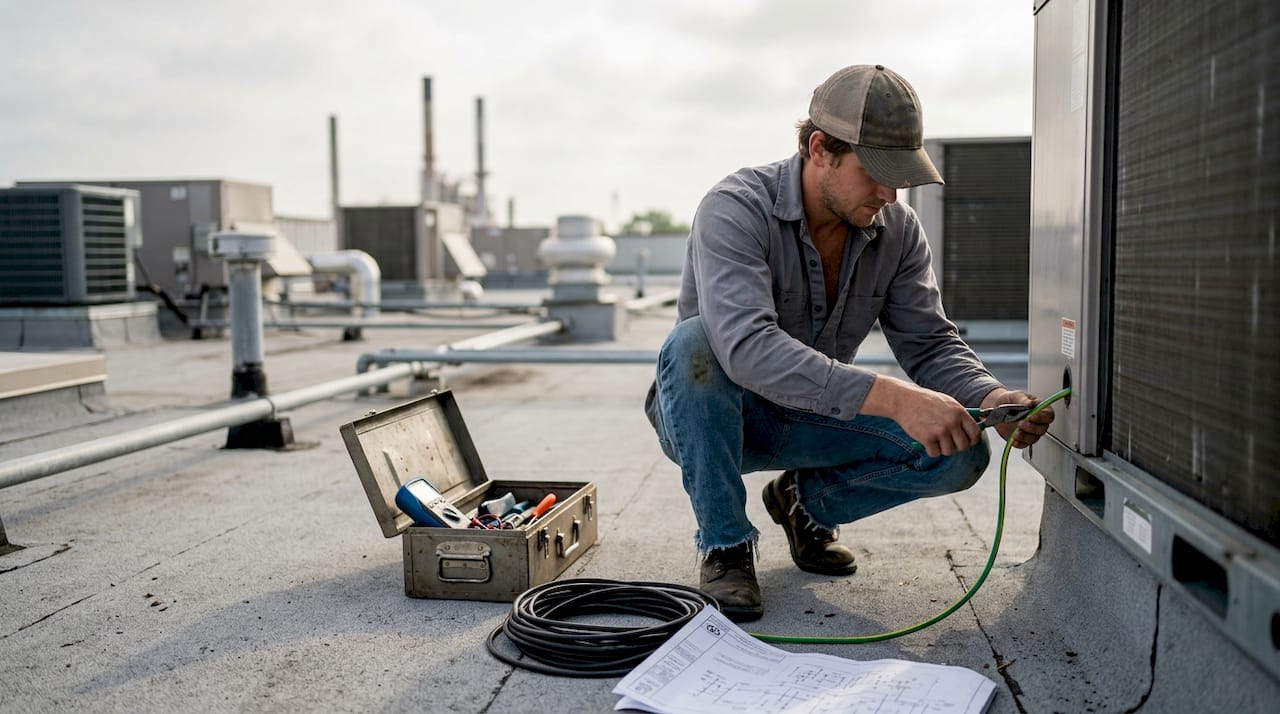
Consider a mid-size manufacturing facility with rooftop HVAC units, large metal structures, and sensitive process control equipment. Under NFPA 780, the facility needs a complete air terminal network, proper bonding to all metallic roof elements, and SPDs protecting every major panel. An office tower in the same city follows a similar logic but focuses more on protecting data centers and communication systems from indirect lightning effects.
NFPA 780 doesn’t operate in isolation. Integrating it with NFPA 70B for equipment maintenance scheduling and NFPA 70E for arc flash safety creates a complete electrical safety program. Risk-based maintenance scheduling, now supported by the updated 70B framework, means inspecting lightning protection components based on how often the facility is actually exposed to lightning activity, not just on a fixed annual calendar.
For facilities following NFPA 780 guidance and looking for tested system designs, the standard’s annexes provide design examples that map directly to common industrial configurations. Studying proven lightning safety methods alongside the standard helps you translate abstract requirements into concrete installation decisions.
Pro Tip: Always verify whether your state or local jurisdiction has formally adopted the current edition of NFPA 780. Some jurisdictions lag by one or two editions, which affects which provisions are actually enforceable on your site.
IEC 62305: International approach and EX zones
For facilities operating internationally, or dealing with hazardous materials, IEC 62305 provides the framework. Unlike NFPA 780’s prescriptive system-type approach, IEC 62305 builds its requirements around risk management, separation distances, and the rolling sphere method for calculating protection zones.
The rolling sphere method imagines a sphere of defined radius rolling over a structure. Any point the sphere can touch is exposed to a potential strike. Designers use this to position air terminals with mathematical precision, not guesswork.
Where IEC 62305 gets particularly specific, and controversial, is explosion hazard (EX) zones. Explosion hazard zones require insulated LPS to prevent sparking, though the standard’s approach to current division in EX areas has raised concerns among specialists. In petrochemical plants, this typically means using isolated lightning protection systems with air-insulated separation and armored cables to mitigate transfer impedance.
Armored cables in EX zones are not just about mechanical protection. They reduce the transfer impedance that causes dangerous equipotential bonding failures during a strike event.
Here’s a quick comparison of how the two major standards handle key design decisions:
| Feature | NFPA 780 | IEC 62305 |
|---|---|---|
| Protection zone method | Fixed geometry | Rolling sphere method |
| Risk assessment | Optional annex | Mandatory Part 2 |
| EX zone guidance | Limited | Detailed |
| SPD requirements | Mandatory at service entrance | Tiered by risk class |
| Global applicability | Primarily U.S. | Worldwide |
For lightning protection system design in specialized environments, IEC 62305 provides a more rigorous foundation than NFPA 780 alone. Facilities handling flammable gases, explosive dusts, or reactive chemicals should treat IEC 62305 Part 3 as a minimum starting point, not an optional layer.
Pro Tip: For sites that span both U.S. and international jurisdictions, design to the more stringent requirement between NFPA 780 and IEC 62305 for each specific zone. This simplifies audits and reduces re-engineering costs. For infrastructure lightning safety at complex sites, a highly sensitive site example can illustrate how these decisions play out in real designs.
Transmission line lightning standards: Performance and measurement
Facility-level protection matters, but your operation’s reliability also depends on the grid supplying your power. Lightning outages on high-voltage transmission lines can cascade into costly production shutdowns, even when your internal protection is flawless.
Transmission line lightning performance is measured in outages per 100 kilometers per year. Class A transmission lines must achieve less than 0.5 lightning outages per 100km per year, and systems designed to withstand critical currents above 200kA are considered effectively lightning proof under this framework.
| Performance class | Max outages per 100km/year | Critical current threshold |
|---|---|---|
| Class A (Ultra High Voltage) | < 0.5 | > 200kA |
| Class B (High Voltage) | < 1.0 | > 100kA |
| Class C (Standard) | < 2.0 | > 60kA |
Backflashover, where lightning energy jumps from a grounded tower back onto the energized conductor, is one of the most common failure mechanisms. Compliance testing for transmission lines uses backflashover models to verify that tower footing resistance, insulator string length, and shield wire placement meet performance targets.
For commercial and industrial facilities, understanding the classification of your local grid infrastructure helps you assess realistic supply reliability. If your plant sits downstream of Class C transmission infrastructure in a high lightning density region, your internal protection system needs to compensate for more frequent voltage transients at the service entrance. Managing lightning hazards effectively means accounting for both your building’s exposure and the quality of your incoming power supply.
How to choose the right standard for your facility
Selecting the right standard is not purely a technical decision. It involves legal, operational, and financial factors that all intersect. Here is a structured decision process:
- Identify legal mandates first. Check which standards your state, local authority, or insurer requires. Mandatory codes always come before voluntary standards.
- Assess your hazard exposure. Is your site in a high lightning density zone? Does it have EX areas, flammable storage, or critical processes?
- Evaluate business criticality. How much does one hour of downtime cost? Data centers, hospitals, and continuous-process plants require higher protection levels than general warehousing.
- Review existing maintenance cycles. Maintenance standards must integrate with your broader electrical protection cycles for optimal safety. Selecting a standard without a maintenance plan attached is incomplete compliance.
- Engage stakeholders early. Facilities, engineering, legal, and insurance teams all have a stake in which standard governs your lightning protection design.
Pro Tip: Document your selection rationale. When an inspector, insurer, or auditor asks why you chose NFPA 780 over IEC 62305 for a particular zone, a written risk-based justification is far more defensible than a verbal explanation.
For industrial sites where contractors are involved in lightning protection work, the contractor lightning safety guide provides practical checklists that align contractor scope with facility compliance requirements.
Why real-world application beats theoretical compliance
Standards provide the floor, not the ceiling. After decades of installations across industrial and commercial sites worldwide, one pattern holds consistently: facilities that treat standards as a minimum starting point and then customize based on their actual risk profile outperform those that simply check the compliance boxes.
A manufacturing plant we supported in a high-keraunic zone followed NFPA 780 precisely, yet continued experiencing surge-related equipment losses. The issue wasn’t code compliance. It was that the standard didn’t account for the plant’s unusual proximity to a high-voltage line and its outdated grounding mesh. The fix required exceeding the standard, not just meeting it.
Periodic field reviews, genuine stakeholder engagement, and the willingness to combine NFPA and IEC provisions when stakes are high yield better real-world outcomes than any rigid standard-by-the-book approach. The sensitive site implementation framework we use reflects this: start with the standard, then adapt to the site’s actual measured conditions.
Expert lightning protection solutions for your compliance journey
Applying these standards correctly takes more than reading the code. It takes field experience, technical precision, and the right products engineered to exceed minimum requirements.

Indelec has supported industrial and commercial facilities with lightning protection compliance since 1955. Our flagship Prevectron3 lightning rods are designed to meet and exceed both NFPA 780 and IEC 62305 requirements, with documented performance in demanding environments. For facilities navigating complex multi-standard requirements, our system application consulting team provides site-specific design support. Start with detailed standards advice to align your facility’s protection strategy with the right regulatory framework.
Frequently asked questions
What is the main purpose of electrical protection standards?
Electrical protection standards ensure safety, minimize equipment damage, and reduce operational disruptions from hazards like lightning. NFPA 780 and IEC 62305 are the primary standards minimizing risk in commercial and industrial facilities.
How do NFPA 780 and IEC 62305 differ?
NFPA 780 focuses on specific system types and mandatory SPDs in U.S. facilities, while IEC 62305 applies globally with a stronger emphasis on risk management and hazard zone risk in EX environments.
Are there special standards for hazardous areas like EX zones?
Yes. EX zones require insulated external LPS to prevent sparking, with IEC 62305 providing the most detailed framework for explosion hazard area protection.
What does ‘Class A lightning performance’ mean for transmission lines?
It means annual lightning-related outages must stay below 0.5 per 100km per year, with critical current designs capable of handling over 200kA without causing a line outage.
Is electrical maintenance now a legal requirement?
In many U.S. jurisdictions, yes. NFPA 70B is now enforceable as a formal maintenance standard, requiring documented periodic and risk-based electrical equipment inspections.