Why Environmental Responsibility Matters in Electrical Protection
TL;DR:
- Conventional electrical protection materials like SF6 and non-recyclable solids significantly contribute to climate damage.
- Sustainable alternatives such as natural grounding fillers and bio-based insulators are effective and eco-friendly.
- Integrating environmental considerations into procurement and design enhances system longevity, compliance, and corporate sustainability.
Electrical protection decisions carry consequences far beyond safety compliance. The materials inside your lightning rods, grounding systems, and insulators can quietly accelerate climate damage at a scale most facility managers never consider. SF6 gas, widely used in electrical insulation, carries a global warming potential 24,300 times greater than carbon dioxide. That single fact reframes every procurement decision you make. This article walks you through the environmental risks of conventional materials, the proven alternatives available today, and the practical steps to build a protection strategy that is both technically sound and environmentally responsible.
Table of Contents
- The environmental impact of conventional electrical protection materials
- Sustainable alternatives for electrical protection
- Why facility managers prioritize environmental responsibility
- Implementing sustainable lightning protection: practical steps
- A new mindset for responsible electrical protection
- Explore sustainable lightning protection solutions
- Frequently asked questions
Key Takeaways
| Point | Details |
|---|---|
| SF6 gas is highly polluting | SF6 used in electrical protection has a global warming potential over 24,000 times greater than CO2. |
| Natural alternatives available | Sustainable grounding fillers and recyclable materials can minimize environmental harm without compromising safety. |
| Facility benefits from sustainability | Prioritizing green solutions reduces costs, ensures compliance, and supports ESG goals for facility managers. |
| Practical steps enable change | Auditing material use, benchmarking, and sourcing certified products help transition to sustainable electrical protection. |
The environmental impact of conventional electrical protection materials
Most facility managers evaluate electrical protection on performance, cost, and compliance. Environmental impact rarely makes the shortlist. But the materials powering your systems are doing measurable damage, and understanding that damage is the first step toward fixing it.
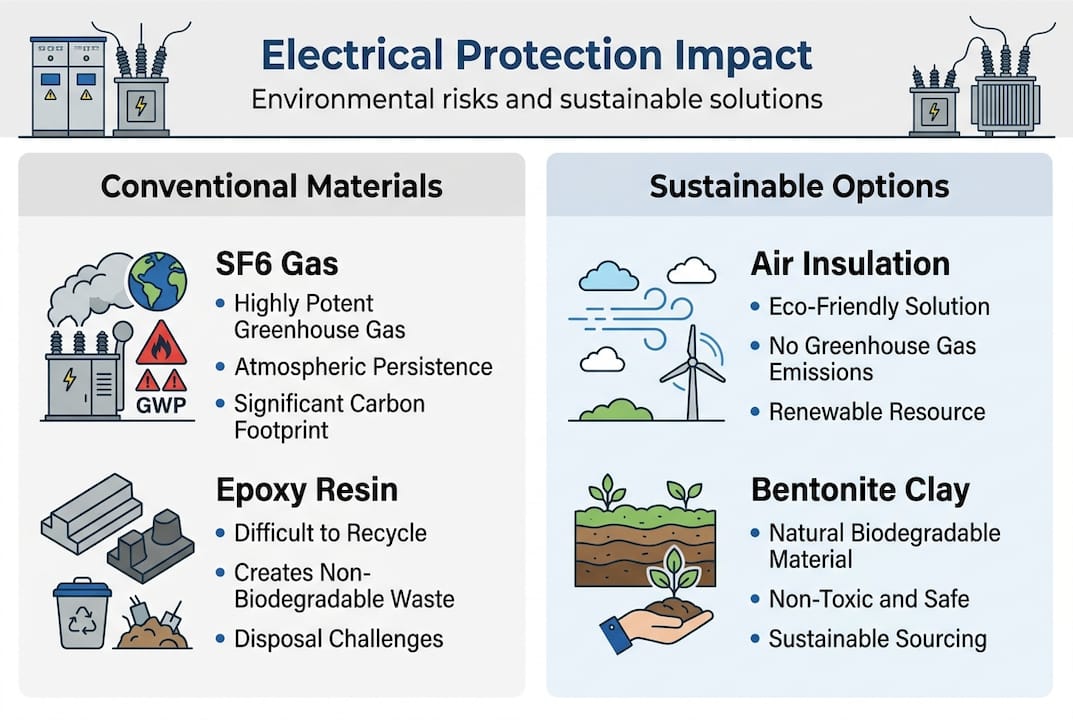
SF6 (sulfur hexafluoride) gas is the clearest example. It is the standard insulating medium in high-voltage switchgear and circuit breakers, prized for its electrical properties. The problem is its GWP of 24,300, meaning a single kilogram released into the atmosphere traps as much heat as 24.3 metric tons of CO2 over a 100-year period. Even small leaks during maintenance or decommissioning create outsized climate damage.
Beyond SF6, two other material categories deserve attention:
- Non-recyclable solids: Epoxy resins and cross-linked polyethylene (XLPE) are used extensively in cable insulation and enclosures. Neither degrades safely, and both present significant end-of-life disposal challenges. The global epoxy resin market exceeds $10 billion annually, reflecting just how embedded these materials are across industrial infrastructure.
- Petroleum-based oils: Transformer oils derived from petroleum are common in legacy systems. Spills contaminate soil and groundwater, and their production carries a heavy carbon footprint.
Copper sits in a different category. It is highly recyclable and an excellent conductor, which makes it the go-to material for grounding and bonding in lightning protection systems. But copper mining is resource-intensive, generating significant habitat disruption and carbon emissions before a single meter of cable reaches your facility.
| Material | Primary concern | End-of-life recyclability |
|---|---|---|
| SF6 gas | GWP 24,300 | Requires specialist handling |
| Epoxy resin | Non-biodegradable | Very limited |
| XLPE insulation | Disposal challenges | Minimal |
| Petroleum-based oil | Spill risk, carbon footprint | Partial |
| Copper | Mining impact | High |
“The insulating materials used in power systems today, including SF6 gas, petroleum-based oils, and non-recyclable solids, represent some of the most significant environmental liabilities in industrial infrastructure.”
Facility managers who understand climate-adaptive protection methods are already ahead of this curve. They recognize that material selection is not just a technical question; it is an environmental one.
Pro Tip: Conduct a materials audit of your current protection systems. List every insulating medium, grounding filler, and cable sheath in use. You may find that a handful of materials account for the majority of your environmental exposure.
Sustainable alternatives for electrical protection
The good news is that the industry has moved well beyond the binary choice between performance and sustainability. Proven alternatives exist, and many are already in use at facilities that have made environmental responsibility a procurement priority.
For grounding systems, natural materials for grounding fillers such as bentonite clay and carbon-based compounds offer effective soil conductivity enhancement without the toxicity risks of synthetic chemicals. These materials are biodegradable, widely available, and compatible with standard installation practices.
For insulation, vacuum and air-insulated switchgear eliminate SF6 entirely. Solid dielectric materials derived from natural or bio-based sources are advancing rapidly, offering comparable dielectric strength with a fraction of the climate impact.
| Solution | GWP compared to SF6 | Recyclability |
|---|---|---|
| SF6 gas (baseline) | 24,300x CO2 | Specialist only |
| Vacuum insulation | Near zero | High |
| Natural grounding fillers | Near zero | Fully biodegradable |
| Bio-based dielectrics | Significantly lower | Moderate to high |
Here is how to begin evaluating and switching to sustainable protection materials:
- Inventory existing materials: Document every insulating medium and grounding compound currently in service.
- Identify high-impact swaps: Prioritize SF6-containing equipment and non-recyclable insulators for replacement first.
- Evaluate certified alternatives: Request environmental product declarations (EPDs) from suppliers for any proposed replacement.
- Pilot on lower-risk systems: Test sustainable alternatives on secondary or non-critical circuits before full rollout.
- Track and report results: Measure the reduction in environmental impact after each replacement cycle and feed that data into your ESG reporting.
For lightning protection specifically, eco-friendly lightning protection systems are now designed with lifecycle impact in mind, from material sourcing through to decommissioning. Reviewing relevant lightning standards will help you confirm that sustainable choices still meet all required performance thresholds.
Pro Tip: Partner with suppliers who provide third-party certified environmental impact data for their products. A supplier who cannot quantify their product’s footprint is a supplier who has not thought seriously about it.
Why facility managers prioritize environmental responsibility
Sustainability in electrical protection is not just an ethical position. It is a business strategy backed by measurable returns.
Energy waste is one of the most direct cost drivers. Facility managers prioritize sustainability to cut energy costs, comply with regulations, and reduce carbon footprint, and the financial case is compelling. Inefficient systems, poor insulation, and aging equipment can account for significant operational waste, with some facilities recovering up to 30% in energy costs after systematic upgrades.
Regulatory pressure is also accelerating. Environmental regulations governing SF6 use, hazardous waste disposal, and carbon reporting are tightening across most major markets. Facilities that wait for mandatory compliance deadlines will face rushed procurement, higher costs, and potential operational disruption. Those that act early build compliance into their standard workflows.
ESG (Environmental, Social, and Governance) targets are now a board-level concern at most large organizations. Facility managers who can demonstrate measurable reductions in environmental impact from their protection systems contribute directly to corporate sustainability goals, which increasingly influence investor decisions, insurance premiums, and public perception.
| Sustainability motivator | Benefit type | Time horizon |
|---|---|---|
| Energy cost reduction | Financial | Short to medium term |
| Regulatory compliance | Risk reduction | Immediate and ongoing |
| Carbon footprint reduction | Environmental and ESG | Medium to long term |
| Reputation and stakeholder trust | Strategic | Long term |
The benefits of sustainable protection choices compound over time:
- Reduced liability from hazardous material incidents
- Lower total cost of ownership through longer-lasting, recyclable components
- Stronger positioning during regulatory audits and insurance reviews
- Alignment with supply chain sustainability requirements from clients and partners
For facilities managing complex infrastructure, understanding the full lightning protection workflow helps connect these sustainability decisions to real operational outcomes.
Implementing sustainable lightning protection: practical steps
Knowing why sustainability matters is one thing. Building a system that delivers on it requires a structured approach.
Start with a baseline assessment. Before you can improve, you need to know where you stand. Map every component in your lightning protection and grounding system, noting material type, age, and any available environmental data. This gives you a factual foundation for prioritization rather than guesswork.
Next, apply empirical benchmarks. Replacing traditional insulators with sustainable alternatives is not just a preference; it is increasingly recognized as essential for facilities targeting net-zero operational profiles. Use those benchmarks to build a business case for procurement decisions.
Follow these steps to move from assessment to action:
- Set measurable targets: Define what a 20% or 30% reduction in material-related environmental impact looks like for your facility.
- Engage your supply chain: Request environmental data from every vendor. Make it a standard part of your procurement checklist.
- Specify sustainable materials in new installations: For any new step-by-step lightning protection projects, write sustainability requirements into the specification from day one.
- Address indirect impacts: Copper is recyclable, but sourcing matters. Specify recycled-content copper where possible to reduce upstream mining impact.
- Review sensitive site requirements: For highly sensitive sites, sustainable materials must meet stricter performance criteria. Verify compatibility before specifying.
Common pitfalls to avoid:
- Assuming sustainable means lower performance without checking current technical data
- Overlooking supply chain impacts by focusing only on installed materials
- Failing to document changes, which undermines ESG reporting accuracy
- Treating sustainability as a one-time project rather than an ongoing procurement standard
Pro Tip: Use lifecycle assessment (LCA) tools before procurement decisions. Many are available free through industry bodies and give you a quantified comparison of environmental impact across competing products.
A new mindset for responsible electrical protection
Here is the uncomfortable truth most industry conversations avoid: technical excellence and environmental responsibility are not competing priorities. They are the same priority, just measured differently.
For decades, the electrical protection industry optimized for performance and cost. Environmental impact was someone else’s problem. That model is no longer viable. Sustainable insulators are not a compromise; they are the benchmark for net-zero-aligned infrastructure.
The facility managers who will lead their organizations through the next decade are those who treat environmental stewardship as a technical discipline, not a communications exercise. They track material footprints the same way they track system uptime. They specify eco-friendly lightning products not because it looks good in a sustainability report, but because it reflects a genuine understanding of lifecycle impact.
The shift is not about sacrifice. It is about recognizing that a protection system designed with environmental responsibility in mind is also a better-engineered, longer-lasting, and more defensible system. That is the competitive edge smart facility managers are already building.
Explore sustainable lightning protection solutions
At Indelec, we have spent decades engineering lightning protection systems that do not force you to choose between performance and environmental responsibility. Our solutions are designed with material efficiency, recyclability, and long-term impact in mind.
The Prevectron3 air terminal represents our commitment to both technical reliability and sustainable design. Independent research confirms the higher efficiency of ESE lightning rods, and our team is ready to help you apply that efficiency to your specific facility profile. Explore our lightning protection application services to connect with experts who understand both the technical and environmental dimensions of modern protection systems.
Frequently asked questions
What are the most environmentally harmful materials in electrical protection?
SF6 gas, petroleum-based oils, and non-recyclable solids like epoxy and XLPE are the worst offenders due to high global warming potential and serious end-of-life disposal challenges.
How can facility managers start implementing sustainable electrical protection?
Begin with a material audit of existing systems, then seek natural and recyclable alternatives and align all new procurement with verified environmental certifications.
What motivates facility managers to adopt sustainable lightning protection?
Cost savings, regulatory compliance, reduced carbon footprint, and meeting ESG targets are the four most consistent motivators driving adoption across industrial and public infrastructure sectors.
Are sustainable solutions as effective as traditional electrical protection?
Empirical evidence confirms that modern sustainable materials can match or exceed the performance of traditional insulators and grounding systems when correctly specified and installed.