Climate-adaptive lightning protection: key methods explained
TL;DR:
- Traditional lightning protection systems are inadequate against evolving storm patterns and climate variability.
- Modern climate-adapted approaches combine smart monitoring, hybrid infrastructure, and risk-based standards for resilience.
- Regular inspection, data-driven maintenance, and expert partnership are essential for effective lightning hazard management.
Lightning-related facility disruptions are rising faster than most infrastructure teams expect. Lightning risk and protection standards are rapidly evolving as climate impacts intensify storm frequency and severity across industrial regions. Conventional lightning rods, installed decades ago and rarely revisited, are no longer adequate for the threat environment facilities face today. Climate-adapted protection combines smart monitoring, hybrid mitigation strategies, and risk-based compliance to close the gaps traditional systems leave open. This article walks facility managers and infrastructure engineers through the core limitations of legacy approaches, the principles behind modern climate-adapted systems, and the practical steps to implement and maintain them effectively.
Table of Contents
- Why traditional lightning protection falls short
- Core principles of climate-adapted protection
- Modern systems: Smart, ESE, and hybrid solutions compared
- Implementing and maintaining climate-adapted protection
- Why most climate-adapted lightning protection efforts fall short
- Partner with experts for climate-adapted lightning protection
- Frequently asked questions
Key Takeaways
| Point | Details |
|---|---|
| Traditional limits | Standard lightning rods and legacy standards are no longer enough as climate risks intensify. |
| Smart adaptation | Modern lightning protection blends predictive tech, hybrid design, and compliance for stronger resilience. |
| Critical verification | Annual inspections and ongoing adjustment are essential for true climate adaptation success. |
| Practical upgrades | Facility managers should prioritize phased upgrades and integrate smart features to future-proof protection. |
Why traditional lightning protection falls short
Conventional lightning protection relies on three core components: air-termination rods, mesh conductors, and down-conductors routed to a grounding electrode. These systems were designed around fixed geometric rules, placing rods at prescribed intervals and assuming predictable storm behavior. For many decades, that approach was adequate. Climate variability has changed the equation.
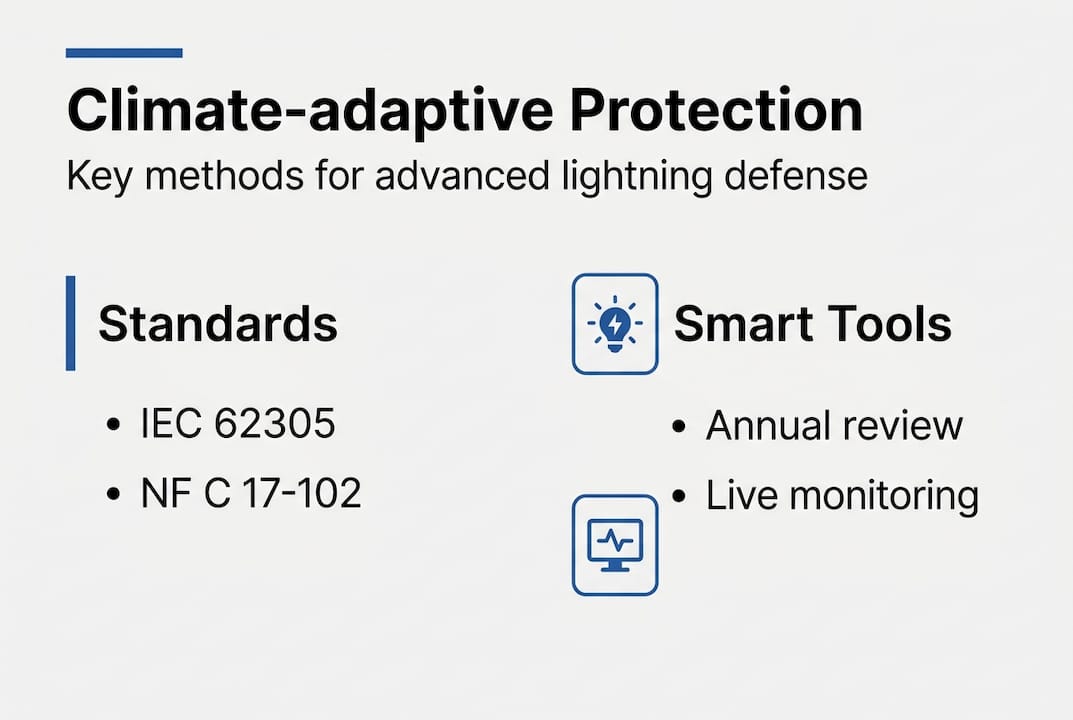
The two dominant standards represent very different philosophies. NF C 17-102 is prescriptive, defining exactly where and how components must be placed. IEC 62305, on the other hand, is risk-based, requiring engineers to calculate the actual probability and consequence of a strike before selecting a protection level. As traditional rods, ESE systems, and evolving standards continue to diverge in capability, facilities relying solely on prescriptive compliance are accepting hidden risk.
| Feature | Traditional rod system | ESE system | Risk-based (IEC 62305) |
|---|---|---|---|
| Coverage radius | Fixed, limited | Extended, dynamic | Calculated per site |
| Standard basis | Prescriptive | NF C 17-102 compliant | Risk-assessed |
| Maintenance cycle | Often ad hoc | Structured | Mandatory periodic |
| Climate adaptability | Low | Moderate | High |
Several specific limitations stand out for industrial facilities:
- Fixed geometry assumes uniform strike distribution, which is not supported by current meteorological data
- No real-time feedback means failures or degradation go undetected between inspection cycles
- Grounding resistance drift over time reduces system effectiveness without triggering any alert
- Single-point design ignores the cumulative impact of multiple nearby strikes during severe storm events
- No integration with facility management systems or weather data platforms
Proper lightning hazard management requires more than meeting a minimum standard at installation. It requires ongoing verification that the system still performs as designed. Reviewing your system capacity against current lightning standards annually is not optional for high-risk infrastructure.
Pro Tip: Schedule a capacity review every year, not just after a visible strike event. Grounding resistance, conductor continuity, and surge protection coordination all degrade silently over time.
Core principles of climate-adapted protection
Climate-adapted lightning protection is not a single product. It is a design philosophy that treats risk as a dynamic variable rather than a fixed parameter calculated once at installation. As storm patterns shift and facility footprints evolve, the protection system must evolve with them.
One of the most effective frameworks emerging in the field is the hybrid green-grey approach. Grey infrastructure refers to engineered components: rods, conductors, surge protective devices, and grounding systems. Green infrastructure refers to vegetative and landscape-based mitigation, such as strategic tree placement and permeable surfaces that reduce ground potential rise. Hybrid and advanced compliance solutions tailored to changing risks give facility engineers a more resilient, layered defense than either approach alone.
Smart and IoT-connected features are now central to climate-adapted design. These include:
- Predictive storm monitoring integrated with local meteorological feeds to trigger pre-strike alerts
- Continuous grounding resistance measurement that flags degradation before it becomes a failure
- Strike counters and event loggers that feed data into facility management platforms
- Automated surge protection coordination that adjusts sensitivity thresholds based on seasonal risk profiles
- Remote diagnostics allowing engineers to assess system status without on-site visits
Risk-based compliance under IEC 62305 is a core pillar of this approach. Rather than applying a one-size-fits-all geometry, engineers calculate the Lightning Protection Level (LPL) required for each zone of a facility based on occupancy, asset value, and consequence of failure. LPL I and LPL II sites face the most stringent requirements and demand annual verification cycles.
| LPL category | Annual inspection required | Smart monitoring recommended | Hybrid approach applicable |
|---|---|---|---|
| LPL I (highest risk) | Yes | Strongly | Yes |
| LPL II | Yes | Recommended | Yes |
| LPL III | Every 2 years | Optional | Situational |
| LPL IV | Every 3 years | Optional | Rarely |
Exploring climate adaptation strategies and understanding the critical factors in industrial lightning protection are essential starting points for any facility upgrading its protection posture.
Modern systems: Smart, ESE, and hybrid solutions compared
With the principles established, the practical question becomes: which next-generation system fits your facility’s specific profile? Three categories dominate the current market for industrial applications.
Early Streamer Emission (ESE) rods generate an upward leader earlier than a conventional rod, extending the effective protection radius. A single ESE device can cover an area that would otherwise require multiple traditional rods. ESE rods have a larger radius and require fewer devices, which directly reduces installation complexity and long-term maintenance points.
Smart monitoring systems add a data layer on top of any physical protection. They do not replace rods or conductors but make the entire system observable and auditable in real time. Hybrid solutions combine ESE hardware with smart sensors and, where applicable, green infrastructure elements.
| System type | Protection radius | Device count needed | Real-time data | Best use case |
|---|---|---|---|---|
| Traditional rod | Standard (fixed) | High | None | Low-risk, simple structures |
| ESE rod | Extended (up to 107m at LPL I) | Reduced | None (unless added) | Large industrial footprints |
| Smart monitoring | N/A (overlay) | N/A | Yes | Any site needing audit trails |
| Hybrid ESE + IoT | Extended | Reduced | Yes | Critical infrastructure |
Key performance considerations when comparing options:
- Coverage per device is the most direct cost driver; ESE systems typically reduce device count by 30 to 60 percent versus traditional arrays
- Alert latency in smart systems must be under 30 seconds to be operationally useful during fast-moving storms
- Integration depth with SCADA or BMS platforms determines how actionable the data actually is
- Certification traceability matters for insurance and regulatory compliance; not all smart sensors carry the same certification weight
Reviewing the evidence around ESE rod efficiency and exploring the Prevectron3 technology platform gives engineers a concrete benchmark for evaluating performance claims from any vendor.
Implementing and maintaining climate-adapted protection
Selecting the right system architecture is only the beginning. Implementation quality and ongoing maintenance discipline determine whether a climate-adapted system actually delivers its promised protection level over time.
A structured implementation process for industrial facilities should follow these steps:
- Conduct a site-specific risk assessment using IEC 62305 methodology, mapping all structures, assets, and occupancy zones
- Define LPL requirements for each zone and document the basis for each classification decision
- Select system components that meet or exceed the required LPL, prioritizing ESE rods for large open areas and smart sensors for critical asset zones
- Integrate IoT sensors with existing facility management or SCADA infrastructure during installation, not as a retrofit afterthought
- Commission and test all grounding connections, surge protection coordination, and data feeds before declaring the system operational
- Establish a verification schedule tied to LPL classification, with LPL I and II sites requiring annual inspection and testing
- Document every event including strikes, near-miss alerts, and maintenance actions in a centralized log accessible to engineering and compliance teams
Upgrading legacy systems requires particular care. Older grounding electrodes may have corroded or shifted, and their actual resistance must be measured, not assumed. Integrating new IoT sensors into legacy conductor networks requires careful bonding to avoid introducing new fault paths.
Predictive monitoring and periodic verification are not optional extras. They are the mechanism by which a climate-adapted system remains adapted as conditions change. A thorough risk assessment and maintenance program, combined with attention to proven lightning protection safety practices, keeps facilities ahead of evolving risk rather than reacting to incidents.
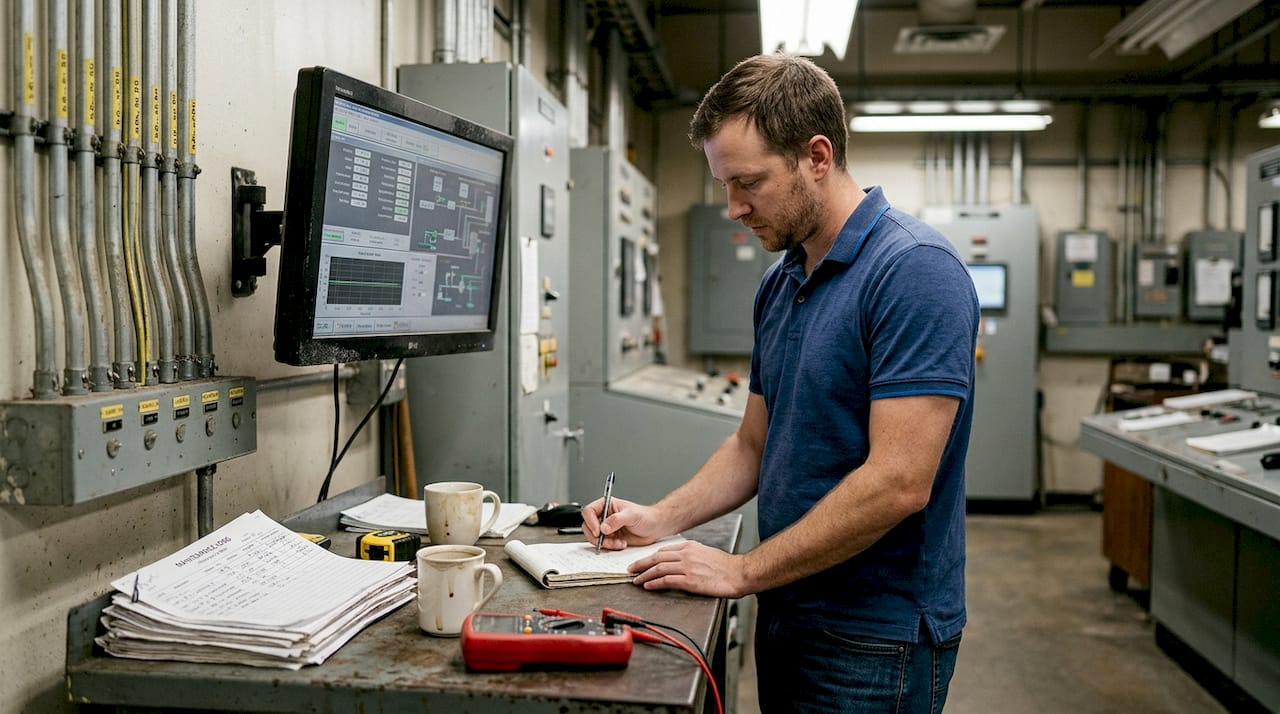
Pro Tip: Maintain a strike event log with timestamps, storm data, and any anomalies observed in facility systems after each event. Trends in this log reveal whether your protection level is keeping pace with actual storm intensity at your site.
Why most climate-adapted lightning protection efforts fall short
After working across industrial sectors for decades, we have observed a consistent pattern: facilities invest in advanced hardware, then treat installation as the finish line. The system gets commissioned, the compliance certificate gets filed, and the lightning protection program effectively goes dormant until the next incident or audit.
This is where most efforts fail. Smart systems generate data. That data has no value unless someone reviews it, interprets it, and acts on it. Predictive monitoring features are only as useful as the verification processes behind them. Facility engineers must pair high-tech adoption with rigorous verification to meet real safety benchmarks, and that pairing requires organizational commitment, not just capital investment.
Independent audits, cross-standard reviews comparing NF C 17-102 and IEC 62305 compliance simultaneously, and third-party grounding tests consistently uncover risks that internal teams miss. The most resilient facilities we work with treat their lightning protection program the same way they treat pressure vessel inspection: scheduled, documented, and never deferred. Reviewing safe solutions for industrial sites with an external perspective is one of the most underused tools available to facility managers today.
Partner with experts for climate-adapted lightning protection
Advancing your facility’s resilience against evolving lightning risks requires more than off-the-shelf hardware. It demands a partner with deep standards expertise, proven installation experience, and the technical range to integrate smart monitoring with physical protection systems.

Indelec has been engineering lightning protection solutions since 1955, with installations across industrial, infrastructure, and critical asset sectors worldwide. From system application solutions designed for complex industrial footprints to detailed guidance on lightning protection standards and the latest evidence behind ESE lightning rod efficiency, Indelec provides the technical foundation your team needs to make confident, compliant decisions. Explore our solutions and connect with our engineering team to assess your current protection posture.
Frequently asked questions
What is climate-adapted lightning protection in simple terms?
It is a protection system that uses smart and IoT-enabled monitoring alongside advanced standards to continuously adjust to changing weather risks, rather than relying on a fixed design installed once and rarely reviewed.
How often should climate-adapted lightning systems be inspected?
For LPL I and LPL II sites, annual verification and maintenance are the minimum recommended frequency to ensure the system remains effective as conditions and facility configurations evolve.
What standards apply to modern climate-adapted protection?
NF C 17-102 and IEC 62305 are the primary global standards, with NF C 17-102 taking a prescriptive approach and IEC 62305 applying risk-based methodology that better suits dynamic industrial environments.
Do ESE rods really cover more area than traditional rods?
Yes. ESE rods provide larger protection radii and typically reduce the number of devices needed across a facility, lowering both installation complexity and long-term maintenance burden.