How to Structure Protection Teams for Industrial Sites
TL;DR:
- Effective protection teams are best structured using the Incident Command System, which provides clear roles and scalable accountability across various incident sizes. Assigning dedicated functions such as command, operations, planning, logistics, and finance ensures coordination, especially during complex emergencies; training and explicit documentation prevent confusion and gaps. Scaling teams effectively relies on process automation, comprehensive runbooks, and regular communication protocols to maintain structure and operational efficiency under pressure.
Security managers at industrial and commercial facilities know the problem well. An incident unfolds, multiple responders mobilize, and within minutes you have role confusion, duplicated effort, and accountability gaps that put people and assets at risk. Knowing how to structure protection teams before an incident is what separates a coordinated response from a chaotic one. This guide applies proven frameworks, including the Incident Command System, wildfire structure protection models, and cybersecurity SOC architectures, to give you a practical blueprint for building, organizing, and scaling protection teams that actually hold up under pressure.
Table of Contents
- Key takeaways
- How to structure protection teams: foundational elements
- Building and deploying your protection team
- Common challenges and how to solve them
- Comparing team structure models and scaling strategies
- My take on protection team structures
- How Indelec supports your protection strategy
- FAQ
Key takeaways
| Point | Details |
|---|---|
| Use ICS as your foundation | The Incident Command System gives protection teams a common hierarchy that scales from small sites to multi-agency operations. |
| Separate triage from on-scene roles | Assign dedicated coordination personnel to prioritize resources system-wide while field specialists handle on-site assessment. |
| Accountability is operational, not administrative | Tracking personnel status and location in real time prevents uncoordinated actions and keeps teams safe during hazardous operations. |
| Match structure to complexity | Simple flat teams work for low-risk sites; tiered or functional structures are necessary as risk profiles and team size grow. |
| Document and automate to scale | Runbooks, status reports, and automation tools maintain team efficiency when headcount and incident volume increase. |
How to structure protection teams: foundational elements
Before you assign a single role or draft an org chart, you need a structural framework that everyone on your team can use. The most proven starting point is the Incident Command System, a standardized hierarchy designed for command, control, and coordination across multi-role, multi-agency incidents.
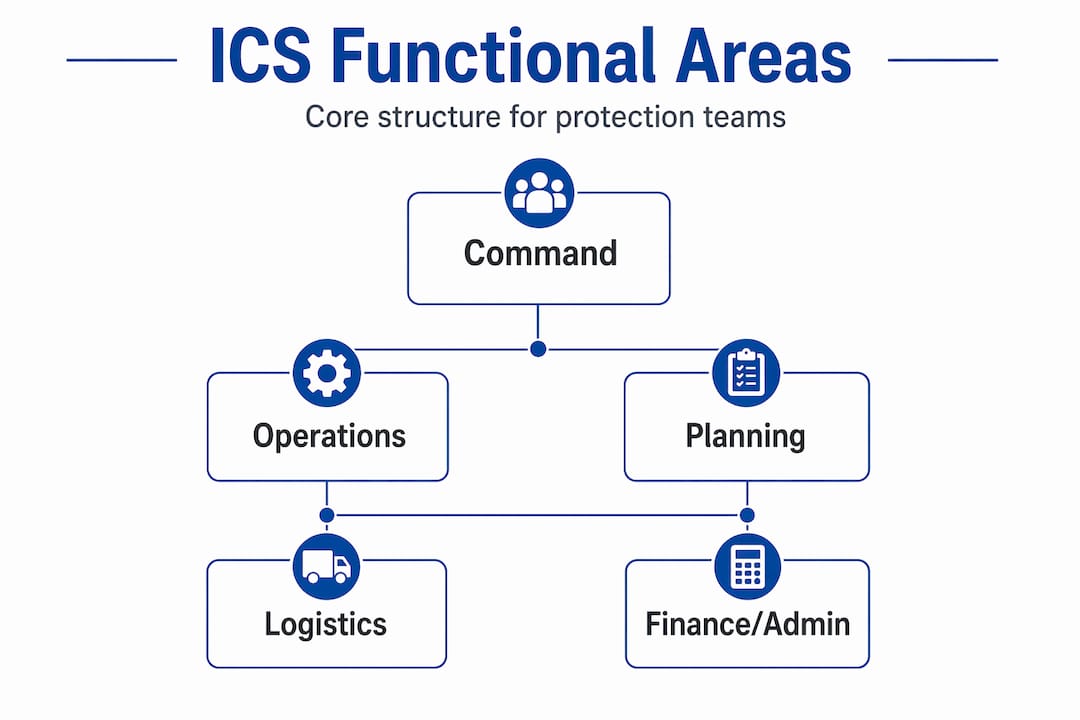
The ICS organizes protection operations into five functional areas: Command, Operations, Planning, Logistics, and Finance/Admin. Each area has a distinct ownership boundary, which is exactly what prevents role overlap during high-pressure situations. For industrial security managers, this framework translates directly into how you assign team leads, manage resources, and track accountability from the moment an incident is declared.
Core ICS roles and their responsibilities
Here is how the five functions map to a protection team context:
| ICS Function | Role on a protection team | Key responsibility |
|---|---|---|
| Command | Incident Commander / Security Director | Overall accountability, decisions, external communication |
| Operations | On-scene Protection Lead | Direct supervision of field personnel and tactical execution |
| Planning | Situation Analyst / Risk Assessor | Threat assessment, resource tracking, incident documentation |
| Logistics | Equipment and Facilities Coordinator | Supplies, access control, communications infrastructure |
| Finance/Admin | Cost and Compliance Officer | Budget tracking, record keeping, regulatory compliance |
Before you build the team, confirm that you have qualified personnel for each function. An Incident Commander without a Planning function is flying blind. A strong Operations lead without Logistics support will run out of resources mid-incident. You need all five areas covered, even if one person covers two functions on a smaller team.
Pro Tip:On sites with fewer than 15 protection personnel, it is acceptable for one person to hold both Planning and Logistics functions during low-complexity incidents. Document this dual assignment explicitly so accountability does not fall through the gaps during handoffs.
Building and deploying your protection team
With your framework in place, the next step is translating it into a functioning team. Here is a structured process that works for both new team builds and reorganizations of existing security groups.
Define your protection objectives. Identify what assets, people, and processes you are protecting, and rank them by criticality. A refinery has different priorities than a commercial data center. Your structure has to reflect those specifics.
Assign roles to match skills, not just availability. Map each team member’s qualifications to the ICS function they will own. A former first responder may be a natural fit for Operations. A detail-oriented analyst belongs in Planning.
Establish an accountability system from day one. The FIRESCOPE Incident Management Accountability System defines five accountability areas: Personal, Single Resource, Supervisor, Scene, and Functional. Integrate these into your team’s standard operating procedures so that status tracking is automatic, not reactive.
Separate your triage function from on-scene operations. The BC Wildfire Service model uses Structure Protection Specialists in the field while a Structure Protection Coordination Officer manages resource prioritization at the system level. This separation prevents local optimization, where on-scene teams hold resources that are more urgently needed elsewhere.
Conduct communication runs before deployment. A communication run is a quick test of every radio channel, contact list, and escalation pathway before an operation begins. It takes ten minutes and prevents hours of confusion.
Brief and cross-brief all team members. Every person on your protection team should be able to name their supervisor, their functional assignment, and the two people they report status to. If anyone cannot answer those three questions, you have a structure problem, not a personnel problem.
Deploy with a published accountability plan. Before anyone goes on-site, distribute a written accountability report that lists personnel names, assigned roles, locations, and check-in intervals.
Pro Tip:Role confusion spikes during shift changes. Schedule a fifteen-minute overlap between outgoing and incoming personnel where both supervisors are simultaneously on-site to conduct a verbal handoff. This single practice eliminates most accountability gaps.
Common challenges and how to solve them
Even well-designed protection teams run into operational friction. The following issues appear repeatedly across industrial security operations and have known solutions.
Unclear command lines. When two team leads believe they own the same function, neither one acts decisively. Resolve this with a single-page org chart posted at the command post and distributed digitally before every operational period.
Role overlap between Planning and Operations. On-scene leads sometimes start making resource decisions that belong to the Planning function. Correct this immediately. The accountability procedures in FIRESCOPE are explicit: supervisors report proactively and document accountability checks rather than making unilateral resource calls.
Crew cohesion breaks under stress. Supervisors must maintain constant awareness of personnel status and location to avoid uncoordinated actions. This is not a soft skill. It is a structural requirement.
Accountability gaps during escalation. When an incident escalates, teams expand quickly and new personnel arrive without clear role assignments. Designate a check-in point where every incoming resource receives a role brief, a supervisor name, and a location assignment before joining operations.
Communication failure at transition points. Most information loss happens at the seam between functions, not within them. Require written status updates at every handoff between Planning, Operations, and Command. Verbal-only handoffs are a documented risk factor in multi-agency incident reviews.
The difference between a protection team that holds together under pressure and one that fractures is not talent. It is structure. Teams that have documented roles, clear accountability lines, and tested communication pathways perform consistently. Teams that rely on informal coordination collapse at exactly the moment you need them most.
Comparing team structure models and scaling strategies
Not every industrial or commercial site has the same threat profile or staffing depth. The right protection team organization depends on your operational complexity, the number of concurrent threats you face, and how quickly your team needs to expand.
| Model | Best fit | Team size | Accountability structure |
|---|---|---|---|
| Flat ICS (single tier) | Low-complexity sites, single facility | 3 to 8 personnel | Incident Commander directly supervises all functions |
| Modular ICS (functional) | Mid-size industrial sites with concurrent threats | 8 to 25 personnel | Section Chiefs under IC, each owning one ICS function |
| Wildfire SPCO model | Multi-site or campus-wide protection operations | 10 to 40 personnel | Field Specialists plus dedicated Coordination Officer |
| SOC tiered model | Cybersecurity or blended physical/digital teams | 15 to 60 personnel | Three operational tiers: monitoring, response, and threat engineering |
The SOC model is worth examining even if your primary threat is physical. Its tiered structure draws a clear distinction between ongoing monitoring (Tier 1), active incident response (Tier 2), and proactive threat analysis and engineering (Tier 3). Security managers running blended protection programs at industrial facilities with both physical and cyber threats can map this directly onto a combined protection team structure.
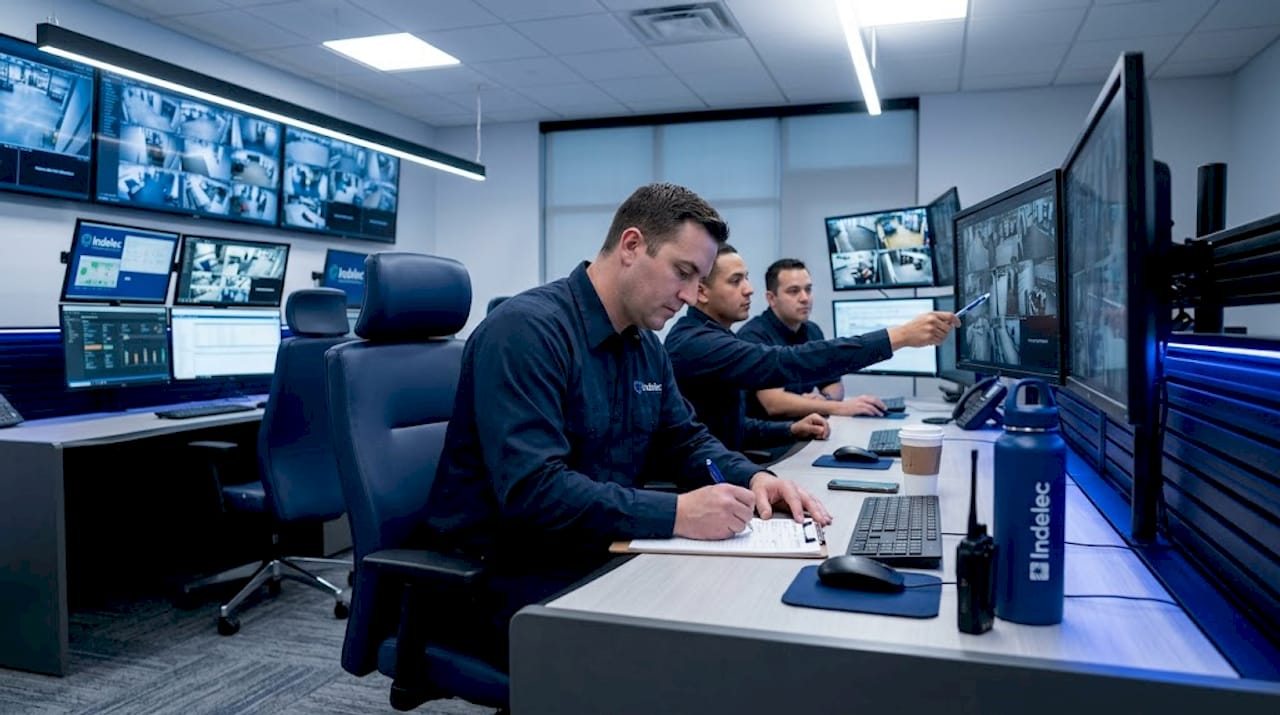
Scaling any of these models requires deliberate planning across three dimensions: people, processes, and technology. Scaling a protection team means balancing recruitment and training with automation integration and cultural resilience. Teams that scale headcount without updating their processes end up with more people creating more confusion.
The most practical scaling tool is the runbook. A runbook is a documented procedure for a specific incident type that tells the responding team member exactly what to do, who to notify, and what thresholds trigger escalation. When you have runbooks for your ten most common incident types, new team members can reach operational effectiveness in days rather than weeks.
Pro Tip:Before investing in new personnel during a scale-up, audit your documentation first. Most teams discover they have undocumented processes that only two or three senior members know. Capturing those processes in writing often has the same effect as hiring one additional person, without the onboarding time.
My take on protection team structures
I have worked alongside security managers at energy infrastructure, chemical plants, and large commercial campuses, and the single most common mistake I see is treating team structure as a one-time deliverable. A manager designs an org chart, trains to it once, and then files it away. When an actual incident hits six months later, the team reverts to informal habits and the structure evaporates.
The ICS principles remain the most reliable foundation I know for complex security environments. Not because they are mandated by any particular authority, but because they were stress-tested in exactly the kind of high-pressure, multi-agency scenarios that industrial sites face during major incidents. The insight about separating field assessment from coordination is one that translates perfectly from wildfire operations to refinery security to campus protection programs.
What I push back on is the idea that more layers equal more control. I have seen teams with eight management tiers where no one had real authority to make a call during an incident. Flatter, clearly defined structures with explicit accountability checkpoints outperform bloated hierarchies every time. The goal is not a complex org chart. It is a structure where every person knows their role, their supervisor, and their reporting interval without having to ask.
Tailor the model to your site. A single-facility manufacturer does not need a three-tier SOC structure. A multi-site energy campus absolutely does. The smartest thing you can do is start with the flat ICS model, run a tabletop exercise against your most likely incident scenarios, and let the gaps in that exercise tell you where your structure needs to grow.
— Indelec
How Indelec supports your protection strategy
Structuring your protection team is only one layer of a facility’s defense. The physical infrastructure your team is protecting needs its own layer of built-in safety. Lightning strikes are among the most underestimated threats at industrial and commercial sites, capable of triggering fires, equipment failures, and cascading shutdowns in seconds.
Indelec has been designing and deploying lightning protection systems for industrial and commercial facilities since 1955. From lightning rods and grounding systems to full technical consulting, installation, and maintenance programs, Indelec’s solutions are engineered to meet the protection demands that security teams rely on every day. Well-structured protection teams and certified industrial lightning safety systems work together, and getting both right is what turns a safety program into a genuinely protected facility. Contact Indelec to discuss a lightning protection assessment tailored to your site.
FAQ
What is the best framework for structuring protection teams?
The Incident Command System is the most proven framework for protection team organization. It defines five functional areas, Command, Operations, Planning, Logistics, and Finance/Admin, that give teams clear roles and scalable accountability structures.
How many people do you need to form an effective protection team?
A functional protection team can operate with as few as three to five people using a flat ICS structure, where one Incident Commander directly supervises all functions. Larger or more complex sites require section chiefs and dedicated functional roles as team size and incident volume increase.
How do you prevent role confusion during incidents?
Distribute a written accountability plan before every operational period that lists each person’s role, supervisor, location, and check-in interval. Verbal-only role assignments are the leading cause of coordination failures during high-pressure operations.
When should you separate triage from on-scene protection roles?
Any time your team is responding to concurrent threats or managing protection requests across multiple locations, a dedicated coordination function should be separated from field operations. This mirrors the BC Wildfire Service model, where on-scene specialists and a system-level coordination officer work as distinct functions.
How do you scale a protection team without losing structure?
Scaling requires updating people, processes, and technology simultaneously. Document runbooks for your most common incident types, assign explicit accountability ownership for new roles before adding headcount, and use automation to reduce manual status tracking as volume grows.