Types of Lightning Arresters: A Facility Manager’s Guide

TL;DR:
- Choosing the wrong lightning arrester can lead to equipment damage, costly downtime, and safety hazards. Modern facilities favor MOV arresters for low maintenance and voltage control, while ESE systems provide broader protection for large sites. Proper selection requires evaluating voltage compatibility, operating principles, maintenance needs, and application environments within a layered protection strategy.
Choosing the wrong lightning arrester for your facility does not just mean a code violation. It means equipment damage, costly downtime, and potential safety incidents that could have been prevented. With so many types of lightning arresters available, including rod gap, expulsion, valve, metal oxide varistor, and active Early Streamer Emission (ESE) systems, the decision requires more than a catalog search. Each technology has a different operating principle, maintenance profile, and application fit. This guide breaks down each type in practical terms so you can match the right protection device to your specific infrastructure.
Table of Contents
- Key takeaways
- 1. Criteria for evaluating lightning arresters
- 2. Rod gap, horn gap, and multi-gap arresters
- 3. Expulsion and valve type lightning arresters
- 4. Metal oxide varistor (MOV) arresters and active ESE systems
- 5. Comparison of lightning arrester types
- My take on selecting the right arrester type
- How Indelec protects industrial and commercial facilities
- FAQ
Key takeaways
| Point | Details |
|---|---|
| MOV dominates modern facilities | Metal oxide varistor arresters set the standard for substations and critical infrastructure due to low maintenance and superior voltage control. |
| Air-gap types suit legacy networks | Rod gap and expulsion arresters remain cost-effective for medium-voltage distribution but require more frequent inspection and maintenance. |
| ESE systems extend protection radius | Active ESE lightning rods cover far larger areas than passive Franklin rods, making them the smart choice for large industrial sites. |
| Layered protection is non-negotiable | No single arrester type addresses all surge risks; combining arrester types with surge protective devices reduces equipment failure significantly. |
| Maintenance cycle drives lifecycle cost | Your long-term cost depends as much on inspection frequency and replacement intervals as on the initial unit price. |
1. Criteria for evaluating lightning arresters
Before you can select the right arrester, you need a clear framework for comparison. Not all lightning protection devices are built to the same standard, and the “best lightning arrester” depends entirely on your application context.
The core evaluation criteria for facility managers and engineers include:
- Voltage rating and system compatibility. Arresters are rated for distribution (1 to 36 kV), substation (36 to 245 kV), and transmission class (above 245 kV). Using a distribution-class unit in a substation application is a reliability failure waiting to happen.
- Operating principle. Air-gap types (rod gap, expulsion) rely on ionization and arc interruption. Solid-state types (MOV) clamp voltage electronically. Active ESE systems initiate upward streamers to intercept strikes before they occur.
- Maintenance intensity. Some types need annual inspection and physical replacement after each discharge event. Others are virtually maintenance-free for 20-plus years.
- Application environment. Outdoor overhead lines, indoor substations, data centers, and industrial plants each have different thermal, pollution, and moisture exposure profiles.
- Cost versus lifecycle value. Initial unit cost rarely reflects true cost. Factor in replacement parts, inspection labor, and downtime risk over a 15 to 25-year horizon.
Pro Tip:When evaluating arrester types for a new facility, request the discharge class and energy handling rating from the manufacturer, not just the voltage rating. Two units rated at the same voltage can have wildly different performance under actual surge conditions.
You should also check alignment with lightning protection standards in your jurisdiction. IEC 60099 and ANSI/IEEE C62.11 govern most arrester selections in industrial contexts.
2. Rod gap, horn gap, and multi-gap arresters
These are the original lightning protection devices. Crude by modern standards but still deployed in specific scenarios, air-gap arresters work by ionizing the air between two electrodes when voltage exceeds the gap breakdown threshold.
Rod gap arresters are the simplest design possible. Two metal rods face each other across a calibrated air gap. When a surge hits, the gap sparks over and the energy dissipates. The problem is poor voltage control and no self-restoring capability. Every discharge event requires a manual inspection to confirm the electrodes have not eroded.
Horn gap arresters improve on the basic rod gap by using flared, horn-shaped electrodes. The arc moves upward along the widening gap under thermal convection, which helps extinguish it faster and reduces electrode damage. They are common in older medium-voltage overhead line protection.
Multi-gap arresters string multiple small gaps in series to distribute the voltage stress more evenly across the arrester body. This increases reliability and allows for better coordination with fuses. However, they are bulkier and require more careful calibration to avoid pre-arcing.
Key characteristics of air-gap type arresters:
- Lowest initial purchase cost of all lightning arrester types
- No voltage clamping capability, meaning the system sees the full arc voltage during operation
- Medium-voltage networks (11 to 33 kV) are their most practical application today
- Require periodic manual inspection, especially after known storm events
- Not suitable for sensitive electronic loads or high-value equipment protection
These technologies are still found in rural distribution networks and older industrial plants where they were grandfathered into the protection scheme. If your facility is upgrading, they are rarely the right choice for new installations.
3. Expulsion and valve type lightning arresters
These two types represent a step up from basic air-gap technology, addressing some of its limitations while introducing their own trade-offs.
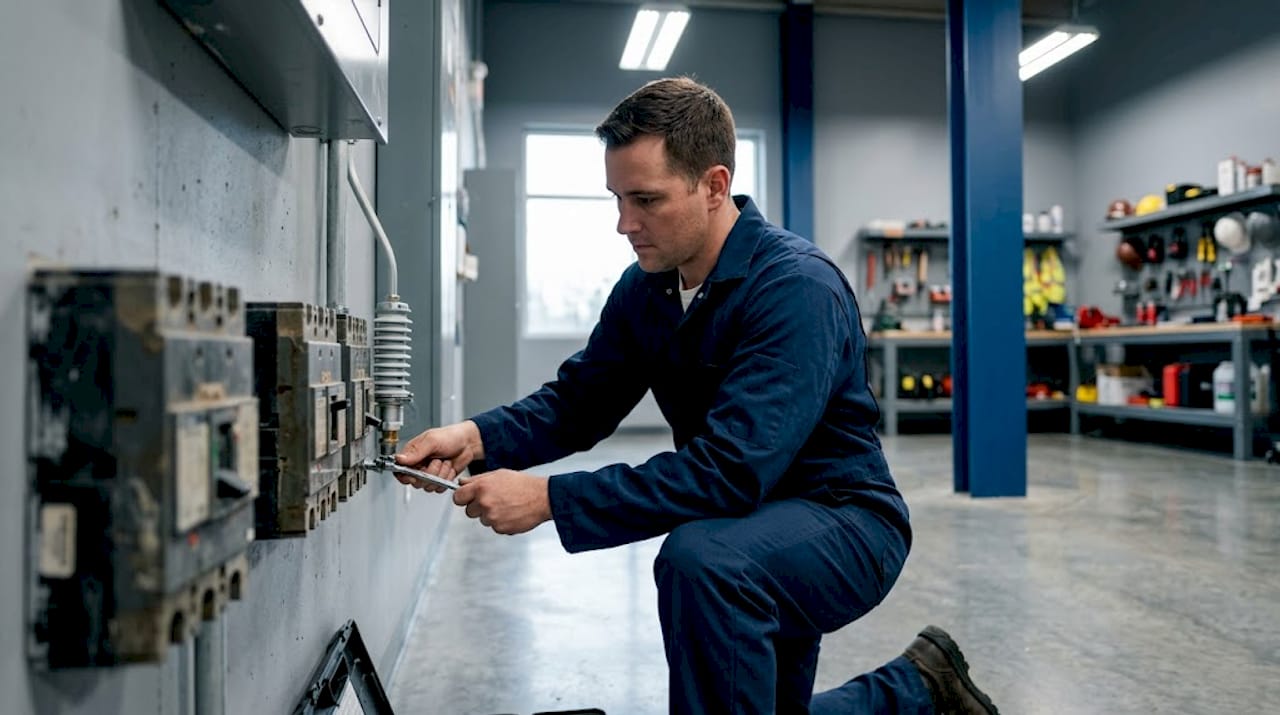
Expulsion type arresters operate by venting ionized gases through a fiber tube after a discharge. The gas expulsion cools the arc path and forces deionization, allowing the power system to recover quickly. They are common in distribution transformer protection on rural feeders and are well suited for outdoor overhead environments where clearance for gas venting exists. You cannot install them indoors, and they require a clear zone around the vent to avoid secondary arc hazards.
Specific characteristics worth noting:
- Self-restoring after most discharge events, reducing inspection burden compared to rod gap types
- Must be mounted at a downward angle to allow gas venting, which constrains installation flexibility
- Not suitable for indoor or enclosed switchgear applications
- Rated primarily for distribution voltage levels (up to 33 kV)
Pro Tip:If you are using expulsion arresters on overhead feeder lines, coordinate their spark-over voltage with the fuse rating upstream. An uncoordinated arrester can cause fuse blowing on every lightning event, creating far more outage time than the strike itself would have.
Valve type arresters use a series combination of spark gaps and silicon carbide (SiC) discs. The gaps fire under surge conditions, and the SiC discs provide nonlinear resistance that limits the follow-on current to a manageable level. This was a major advance over pure air-gap devices and made valve arresters the standard for transformer protection through the 1980s and 1990s. Today they have been largely superseded by MOV types, but they remain in service across many older industrial facilities.
4. Metal oxide varistor (MOV) arresters and active ESE systems
This is where modern lightning arrester technology lives. MOV arresters and active ESE lightning rods represent the current state of the art for industrial and commercial facilities.
MOV lightning arresters replace the spark gaps and SiC discs of older valve types with zinc oxide (ZnO) varistor blocks. These blocks are highly nonlinear. Under normal operating voltage, they pass almost no current. The moment voltage exceeds the protection level, resistance drops sharply and the surge energy is absorbed and dissipated as heat. MOV arresters deliver superior voltage control and require virtually no maintenance under normal operating conditions, which explains why they dominate substation protection globally.
MOV arrester advantages for facility applications:
- Gapless design eliminates arc interruption problems and improves response speed
- Excellent energy absorption capacity, especially in station-class units
- Suitable for indoor and outdoor installation
- Available across all voltage classes from distribution to ultra-high-voltage transmission
- Zero-downtime environments like data centers and telecom facilities increasingly specify premium station-class MOV units
Active ESE lightning arresters take a fundamentally different approach. Rather than reacting to a surge after it arrives, ESE systems generate an upward leader earlier than a passive rod would, intercepting the lightning channel before it terminates on the structure. ESE systems installed 4 to 30 meters above ground provide a far larger protection radius than a traditional Franklin rod of equivalent height. A passive rod gives roughly 5 meters of protection per meter of height. ESE units can extend this coverage area dramatically.
For large industrial sites, refineries, airports, and commercial campuses, ESE technology means fewer air terminals covering more area. This reduces installation complexity and the number of down-conductors required. Indelec’s Prevectron3 platform is a prime example, combining ESE air terminal technology with IoT connectivity so facility teams receive real-time discharge event data.
5. Comparison of lightning arrester types
The table below condenses the critical decision factors for facility managers comparing different lightning arresters side by side.
| Type | Voltage range | Maintenance level | Typical application | Relative cost |
|---|---|---|---|---|
| Rod gap | Up to 33 kV | High (manual post-event) | Rural overhead lines, temporary systems | Very low |
| Horn gap | Up to 33 kV | Moderate | Older overhead distribution lines | Low |
| Expulsion | Up to 33 kV | Low to moderate | Distribution feeders, transformers | Low to moderate |
| Valve (SiC) | Up to 245 kV | Moderate | Older substation transformer protection | Moderate |
| MOV (gapless) | All classes | Very low | Substations, switchgear, critical infrastructure | Moderate to high |
| Active ESE | Structural protection | Very low | Industrial sites, commercial buildings, campuses | High |
A few things this table does not show but you need to factor in. First, combining surge protective devices with your primary arrester selection reduces equipment failure rates by up to 90 percent. A substation-grade MOV arrester on your main transformer does not protect the VFDs, PLCs, and communication systems downstream. Cascaded SPD protection at the panel and equipment level is a separate and equally critical layer.
Second, about 80% of power disturbances in industrial facilities originate not from direct lightning but from internal switching surges generated by motors, HVAC systems, and elevators. Your arrester selection addresses the direct strike hazard, but the internal surge problem requires a parallel strategy.
Pro Tip:Do not let a single data or communication line bypass your protection perimeter. Energy from a strike travels through grounding conductors and signal wiring just as readily as through power cables. Treat every conductor entering a protected zone as a potential intrusion path.
For budget-constrained projects, expulsion types remain a defensible choice on rural distribution feeders where load criticality is low. For any facility with sensitive electronic systems, mission-critical processes, or high equipment replacement costs, MOV or ESE technology is the only financially rational long-term choice.
My take on selecting the right arrester type
I’ve worked with facility managers and engineers across dozens of industrial sites over the years. The most consistent mistake I see is treating lightning protection as a single-device problem. Someone specifies a good MOV arrester on the main switchboard, declares the site protected, and then watches an induced surge travel through a poorly bonded instrument ground loop and destroy a control system three buildings away.
No single arrester type solves the full problem. What actually protects a facility is a coordinated system where the external lightning protection intercepts the strike, the grounding network disperses energy safely, and layered SPDs catch what gets through into the building systems. The arrester type matters, but it is one component in that chain.
My other consistent observation is that maintenance discipline matters more than the technology choice for most facilities. A well-maintained rod gap arrester on a low-criticality feeder outperforms a neglected MOV unit on a critical transformer. If your team does not have the capacity for frequent inspection cycles, design toward low-maintenance technologies like MOV and ESE from the start. Specify what your organization can actually support over a 20-year horizon, not just what looks best on paper at commissioning. You can explore critical factors for industrial sites to develop a realistic maintenance framework aligned with your staffing and budget constraints.
— INDELEC
How Indelec protects industrial and commercial facilities

Indelec has been designing and deploying lightning protection systems since 1955, with installations spanning industrial plants, commercial campuses, airports, and highly sensitive infrastructure worldwide. For facility managers who need more than a catalog solution, Indelec’s Prevectron3 air terminal combines patented OptiMax ESE technology with IoT monitoring, giving your team real-time discharge data and verifiable protection radius documentation for compliance purposes. For facilities where protection system design is complex, the Indelec team provides engineering assessments, installation services, and certification support. Explore ESE efficiency research or review lightning protection system applications to assess what your infrastructure requires.
FAQ
What are the main types of lightning arresters?
The primary types are rod gap, horn gap, expulsion, valve (SiC), metal oxide varistor (MOV), and active Early Streamer Emission (ESE) arresters. Each operates on a different principle and suits different voltage levels and application environments.
How do MOV lightning arresters work?
MOV arresters use zinc oxide varistor blocks that maintain high resistance under normal voltage and rapidly reduce resistance during a surge, absorbing and dissipating the excess energy before it damages connected equipment.
Are ESE lightning arresters better than traditional rods?
ESE systems offer a significantly larger protection radius than passive Franklin rods of equivalent height, making them more efficient for large industrial or commercial sites. The tradeoff is higher initial cost.
Which lightning arrester type requires the least maintenance?
MOV and ESE arresters require the least ongoing maintenance, with no moving parts or consumable elements in normal operation. Rod gap and expulsion types require post-event inspection and are more labor intensive over time.
When should expulsion type arresters still be used?
Expulsion arresters remain a cost-effective option for outdoor overhead distribution lines and rural feeders where load criticality is low, clearance for gas venting exists, and budget constraints make MOV units difficult to justify.