Role of Monitoring Systems in Facility Safety 2026

TL;DR:
- Monitoring systems enable proactive infrastructure management by detecting anomalies early and reducing downtime costs. They integrate various monitoring types to provide comprehensive visibility, supporting better incident response and maintenance planning. Continuous tuning and physical-digital integration are essential for effective monitoring in facility and industrial operations.
Monitoring systems are defined as continuous observation and measurement platforms that collect, analyze, and report on infrastructure performance data to detect anomalies before they become failures. The role of monitoring systems in facility and industrial operations goes far beyond passive data collection. Organizations with proactive monitoring resolve incidents 60% faster than those relying on reactive alerts. That single figure explains why facility managers, industrial operators, and engineers are treating monitoring as a core operational discipline, not an optional add-on. Tools built on Site Reliability Engineering (SRE) principles and observability frameworks are now the standard for any infrastructure that cannot afford unplanned downtime.
What are the primary advantages of monitoring systems for facility and industrial operators?
The advantages of monitoring systems are most visible when something goes wrong at 2 a.m. and your team already knows about it. Average downtime costs exceed $5,600 per minute, which means a two-hour outage can cost a mid-sized facility more than $670,000. Monitoring converts that reactive emergency into a managed response.
Proactive monitoring reduces Mean Time to Detection and Mean Time to Resolution by eliminating the manual device interrogation that slows every incident. Instead of technicians polling systems one by one, automated alerts surface the right signal at the right time. That shift alone changes the economics of incident response.
The benefits of monitoring systems extend well beyond speed. Long-term utilization trend analysis lets facility teams reconfigure assets running above or below expected capacity, cutting waste and extending equipment life. The importance of monitoring systems for compliance is equally significant. Continuous data logs provide the audit trail regulators require, reducing exposure during safety inspections.
Key advantages for facility and industrial operators include:
- Faster incident detection: Automated alerts catch anomalies in seconds, not hours.
- Reduced unplanned downtime: Early warning prevents minor faults from cascading into full outages.
- Cost control: Trend data identifies over-provisioned or underused assets before they drain budget.
- Safety improvement: Continuous monitoring of electrical systems, HVAC, and critical machinery flags hazardous conditions before personnel are at risk.
- Compliance support: Continuous logs satisfy audit requirements for safety standards and regulatory frameworks.
- Strategic planning: Capacity data informs capital expenditure decisions with evidence, not guesswork.
Pro Tip:Set a baseline for every critical asset during normal operating conditions. Without a baseline, your monitoring system cannot distinguish a genuine anomaly from routine variation, and every alert becomes a coin flip.
How do different types of monitoring systems compare?
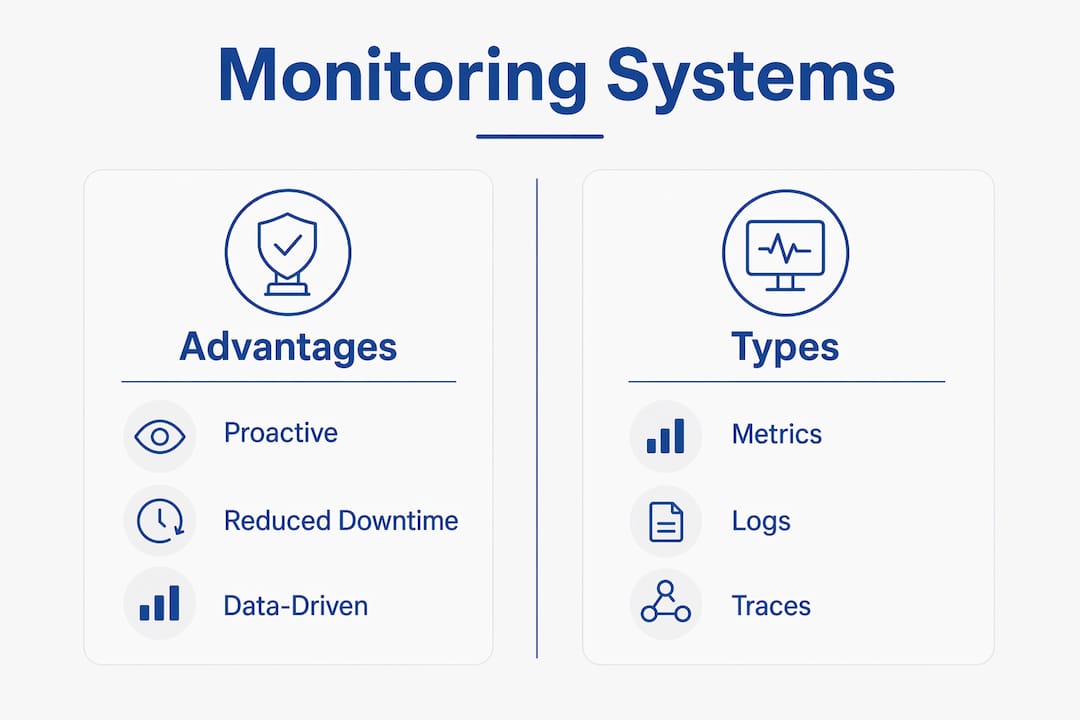
Monitoring systems are not a single category. Four distinct types serve different functions, and mature infrastructure teams deploy all four in layers.
| Monitoring Type | What It Tracks | Primary Benefit | Typical Use Case |
|---|---|---|---|
| Metrics monitoring | Numeric time-series data (CPU, temperature, power draw) | Fast trend detection and threshold alerting | Server load, electrical panel health |
| Log monitoring | Event records and error messages from systems | Root cause investigation and audit trails | Application errors, access logs |
| Trace monitoring | End-to-end transaction paths across distributed systems | Pinpoints latency and failure in complex workflows | Multi-system industrial control networks |
| Security monitoring | Network traffic, access patterns, and threat indicators | Detects unauthorized activity and intrusions | Facility access control, OT/IT networks |
Monitoring tells you what is wrong; observability explains why. That distinction matters in complex distributed systems where a single symptom can have dozens of root causes. Monitoring maintains the safety net for known failure modes. Observability enables ad-hoc investigation of failures you have never seen before.
Mature teams combine metrics, logs, and traces to achieve full observability. Missing any one of the three leaves root cause diagnosis incomplete. A facility that monitors power draw metrics but ignores event logs will know a transformer is stressed but not why.
The second distinction worth understanding is the difference between technical metrics and user-impact symptoms. Service Level Objectives (SLOs) define what “good” looks like from the user or process perspective. Aligning alerts to SLOs means your team responds to conditions that actually affect operations, not to low-level signals that are technically abnormal but operationally irrelevant.
Pro Tip:Before adding a new alert, ask one question: “If this fires at 3 a.m., would I act on it immediately?” If the answer is no, the alert belongs in a dashboard, not a pager queue.
What are best practices for implementing effective monitoring?
Implementation quality determines whether a monitoring system becomes a genuine operational asset or a source of noise that teams learn to ignore. The following steps reflect SRE best practices and real-world facility deployments.
Define Service Level Indicators (SLIs) and SLOs first. Identify the metrics that directly reflect operational health from the perspective of the process or end user. Build every alert around these indicators. Technical metrics that do not connect to an SLO are candidates for dashboards only.
Integrate monitoring into incident response workflows.Effective monitoring feeds runbooks and automation to reduce alert fatigue and improve decision-making. Every alert should link to a documented response procedure. Teams that receive an alert and a runbook simultaneously resolve incidents faster and with fewer errors.
Audit dashboards and alert rules on a fixed schedule. Over-instrumenting creates noise; effective monitoring focuses selectively on indicators tied to business impact. A quarterly review that prunes stale alerts and consolidates redundant dashboards keeps the system sharp.
Prioritize symptom-based alerts over causal alerts.Alert fatigue undermines monitoring effectiveness. A user-facing latency spike is a symptom. A memory utilization threshold at 78% is a cause. Symptom-based alerts demand action. Causal alerts often resolve themselves and, when they fire constantly, train teams to ignore them.
Apply continuous improvement cycles. Use monitoring data from each incident to refine detection thresholds, update runbooks, and inform infrastructure planning. Monitoring is not a one-time configuration. It is a living system that improves with every incident it helps resolve.
How do monitoring systems apply to facility management and industrial operations?
The monitoring systems applications most relevant to facility managers and industrial operators center on physical infrastructure health. Electrical systems, HVAC units, critical machinery, and network infrastructure all generate continuous data streams that, when monitored correctly, reveal degradation long before failure.
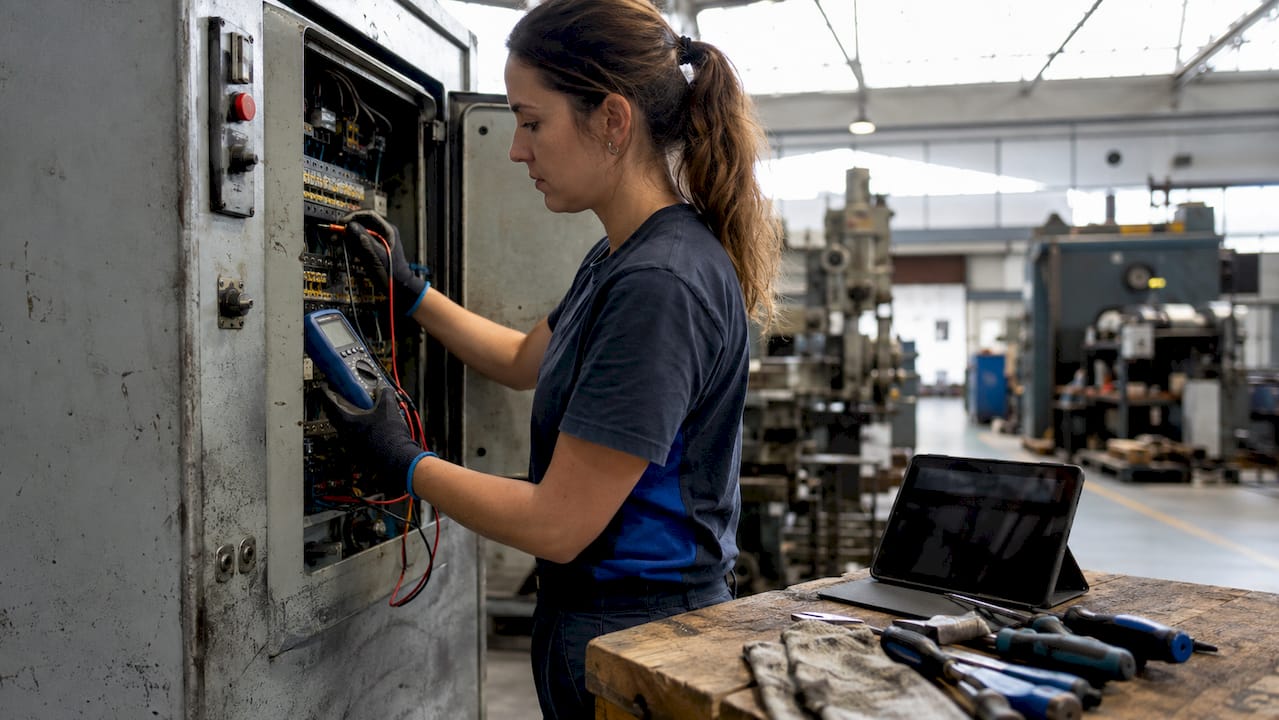
Early detection of storage failures and unauthorized network traffic prevents outages in energy company networks and sensitive installations. The same principle applies to any facility with critical electrical infrastructure. A power quality anomaly detected at 11 p.m. is a maintenance ticket. The same anomaly discovered after a transformer failure is a multi-day outage.
Specific applications where monitoring delivers measurable impact include:
- Electrical system health: Continuous voltage, current, and power factor monitoring catches degradation in switchgear, transformers, and distribution panels before faults occur.
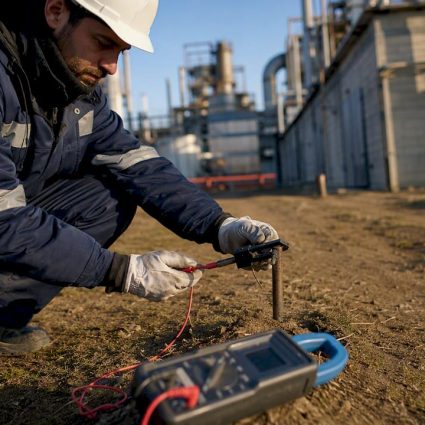
- Lightning protection system integrity:Monitoring improves maintenance schedules by providing data that supports predictive and preventive strategies, reducing operational disruptions in industrial facilities.
- HVAC and environmental controls: Temperature, humidity, and airflow monitoring protects sensitive equipment and ensures regulatory compliance in controlled environments.
- Network and OT security: Continuous traffic analysis detects unauthorized access attempts and anomalous device behavior in operational technology networks.
- EV charging infrastructure: Monitoring electric vehicle charging stations for load balance and fault conditions prevents service interruptions and fire risks in facility parking structures.
The impact of monitoring systems on maintenance planning is equally significant. Data collected over months reveals wear patterns that no inspection schedule can match. A facility running predictive maintenance on monitored assets typically sees fewer emergency callouts and longer equipment service life.
| Application Area | Monitored Parameter | Risk Prevented |
|---|---|---|
| Electrical distribution | Voltage deviation, harmonic distortion | Transformer failure, equipment damage |
| Lightning protection | Continuity, grounding resistance | Strike-induced outages, fire risk |
| HVAC systems | Temperature, airflow, refrigerant pressure | Equipment overheating, regulatory breach |
| OT/IT networks | Traffic volume, access patterns | Cyberattack, unauthorized control access |
Pro Tip:For lightning protection systems specifically, pair continuous monitoring with annual maintenance inspections to validate that monitored data reflects actual physical system condition. Sensors can drift; physical checks confirm what the data implies.
Key takeaways
Monitoring systems deliver operational value only when they are integrated into incident response workflows, tuned to user-impact indicators, and maintained as a continuous discipline rather than a static configuration.
| Point | Details |
|---|---|
| Speed of detection matters most | Proactive monitoring resolves incidents 60% faster and prevents the $5,600-per-minute cost of unplanned downtime. |
| Four monitoring types work together | Metrics, logs, traces, and security monitoring each cover distinct failure modes; removing any one leaves gaps. |
| Alert quality beats alert quantity | Symptom-based alerts tied to SLOs reduce fatigue and keep teams focused on conditions that actually affect operations. |
| Physical infrastructure needs monitoring too | Electrical systems, lightning protection, and HVAC all benefit from continuous data collection and predictive maintenance strategies. |
| Monitoring requires ongoing tuning | Quarterly audits of dashboards and alert rules prevent over-instrumentation and keep the system aligned with current operational priorities. |
Indelec’s view: monitoring is infrastructure, not a feature
After nearly seven decades of protecting critical infrastructure from lightning, Indelec has observed a consistent pattern. Facilities that treat monitoring as a checkbox during commissioning eventually face the incidents that monitoring was designed to prevent. The ones that treat it as ongoing infrastructure rarely do.
The most common mistake we see is deploying a monitoring system and then leaving it alone. Alert thresholds set during installation reflect the conditions of day one. Facilities change. Load profiles shift. New equipment gets added. A monitoring configuration that was accurate in year one is often dangerously outdated by year three.
The second mistake is separating physical monitoring from digital monitoring. A lightning protection system with perfect grounding resistance data means nothing if the physical conductor has corroded at a junction that no sensor covers. Viewing monitoring as part of the incident lifecycle, not a standalone tool, is what separates facilities that catch problems early from those that discover them after the damage is done.
The facilities we work with that achieve the best safety outcomes combine continuous sensor data with scheduled physical inspections and integrate both into a single incident response workflow. That combination is not complicated. It requires discipline and a clear decision about who owns the monitoring function and what they are expected to do with it.
— Indelec
How Indelec supports facility monitoring and protection
Indelec has designed lightning protection systems with integrated monitoring capabilities since 1955, serving industrial, commercial, and infrastructure clients across the globe. Our solutions connect physical protection hardware to continuous monitoring frameworks that detect grounding degradation, conductor integrity loss, and strike activity in real time.
Facility managers and industrial operators working with Indelec gain access to lightning protection solutions that combine proactive risk detection, compliance with international standards, and documented maintenance records that satisfy regulatory audits. Whether you are protecting a data center, an energy facility, or a manufacturing plant, Indelec’s technical team provides risk assessment, installation, and ongoing monitoring support tailored to your infrastructure. Contact Indelec to discuss a monitoring and protection strategy built around your specific operational requirements.
FAQ
What is the role of monitoring systems in infrastructure management?
Monitoring systems continuously observe, measure, and analyze infrastructure performance data to detect anomalies early, support incident response, and prevent unplanned downtime. Their core value is converting reactive emergency responses into proactive, managed interventions.
How do monitoring systems reduce downtime in industrial facilities?
Proactive monitoring detects degradation signals before they escalate into failures, reducing Mean Time to Detection and Resolution. Organizations using proactive monitoring resolve incidents 60% faster than those relying on reactive alerts.
What is the difference between monitoring and observability?
Monitoring identifies what is wrong by tracking known metrics and thresholds. Observability explains why a failure occurred by enabling root cause analysis across metrics, logs, and traces in complex or unfamiliar failure scenarios.
Why do lightning protection systems require continuous monitoring?
Lightning protection systems degrade over time through corrosion, physical damage, and grounding resistance changes. Continuous monitoring paired with scheduled inspections catches these changes before a lightning strike exposes the gap in protection.
How often should monitoring alert rules be reviewed?
Alert rules and dashboards should be audited at least quarterly. Regular reviews remove stale alerts, consolidate redundant signals, and realign thresholds with current operational conditions to prevent alert fatigue.