Facility Protection Guide for Industrial Managers

TL;DR:
- Effective facility protection relies on comprehensive risk assessments, integrating operational pillars, and employing layered security measures. Proper environmental hazard controls, such as lightning protection, must be systematically designed, tested annually, and managed as part of an overall security program. Assigning clear ownership and treating security as an ongoing operational discipline ensures resilience against environmental and security threats.
Facility protection is the strategic safeguarding of industrial and public infrastructures from environmental and security threats using integrated physical, technological, and procedural measures. This facility protection guide addresses the full spectrum of risks that facility owners and managers face: lightning strikes, unauthorized access, contractor negligence, and operational gaps that standard safety protocol manuals rarely cover in one place. The layered defense model, which stacks environmental controls, physical security, and operational procedures, is the only approach that consistently holds up under audit and real-world incident conditions. What follows is a structured framework built for decision-makers managing industrial plants, substations, public buildings, and critical infrastructure.
What does a facility protection guide actually require to work?
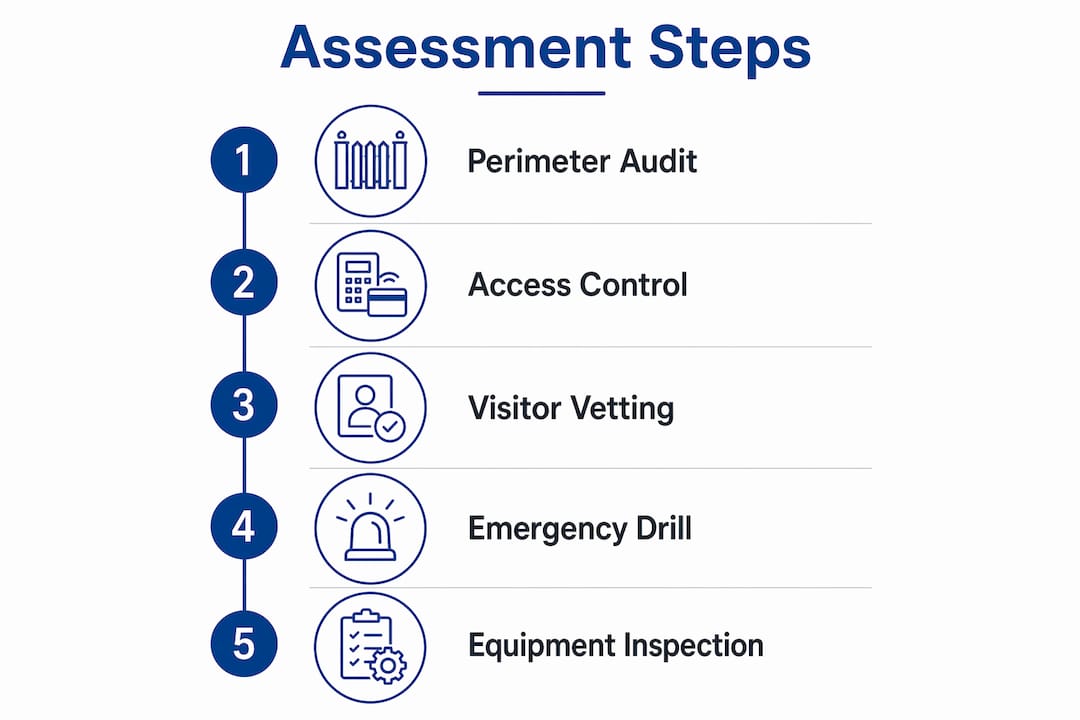
The most critical failure in facility security design is skipping formal, site-specific threat assessments, which results in generic protection plans that leave known vulnerabilities unaddressed. Before purchasing a single camera or installing a single sensor, a facility manager must complete a documented Threat and Vulnerability Assessment (TVA). This is not a walkthrough. It is a structured analysis of every asset, access point, environmental exposure, and operational condition at the site.
COPE analysis, which stands for Construction, Occupancy, Protection, and Exposure, is the standard framework insurers and risk engineers use to evaluate a facility’s physical risk profile. Presenting a completed COPE analysis to your insurer does more than satisfy a checkbox. It directly influences your premium structure and coverage terms. Facilities that skip this step often discover their coverage excludes the exact scenarios that caused a loss.
The tools required at this stage include:
- A formal security audit covering perimeter, entryways, internal zones, and data infrastructure
- A facility layout analysis that maps asset locations against threat vectors
- Documentation of all existing protection systems and their maintenance records
- A risk assessment framework calibrated to your industry, whether energy, manufacturing, or public infrastructure
Pro Tip:Schedule your TVA during a shift change or maintenance window. These transitions expose access control gaps that standard business-hours audits miss entirely.
| Assessment component | What it reveals |
|---|---|
| Perimeter audit | Fence integrity, lighting gaps, and vehicle access vulnerabilities |
| Entryway analysis | Credential verification failures and tailgating risks |
| Environmental exposure review | Lightning strike probability, flood zones, and surge risk |
| Internal zone mapping | Unauthorized movement paths and asset proximity to access points |
What are the five pillars of a modern facility security program?
Five core pillars form the foundation of any protection program that can withstand both operational pressure and external audit: visitor management, contractor compliance, emergency preparedness, logistics oversight, and physical identity and access management (PIAM). Treating any one of these as optional creates a gap that the other four cannot compensate for.
- Visitor management requires pre-registration, identity verification at entry, and a real-time accountability log. A visitor who enters without verification is an untracked liability inside your perimeter.
- Contractor compliance means verifying certifications before site access is granted, not after work begins. Unverified contractor credentials at entry points leave facilities exposed regardless of how strong the outer perimeter is.
- Emergency preparedness covers documented evacuation routes, real-time personnel visibility during an incident, and scheduled drills. A plan that exists only on paper fails the moment it is needed. Reviewing standby power options for emergency continuity is part of this pillar for energy-dependent facilities.
- Logistics oversight tracks chain of custody for materials entering and leaving the site, monitors internal asset movement, and flags anomalies before they become incidents.
- PIAM centralizes access control across all zones, generates audit trails for every credential use, and allows instant permission revocation when personnel status changes.
Pro Tip:Run a tabletop emergency drill that simulates a simultaneous lightning strike and perimeter breach. Most facilities discover their emergency and security response plans were never designed to operate at the same time.
| Pillar | Common gap | Integrated fix |
|---|---|---|
| Visitor management | No pre-registration system | Digital check-in with ID scan and host notification |
| Contractor compliance | Credentials checked verbally | Automated certification database linked to access control |
| Emergency preparedness | Evacuation plan not tested | Quarterly drills with real-time headcount technology |
| Logistics oversight | No internal movement tracking | RFID or barcode asset tracking with zone alerts |
| PIAM | Shared access credentials | Individual biometric or card-based access with audit logs |

How do security technologies and operational practices work together?
Physical security measures must be complemented by operational procedures, documented post orders, and regular drills to prevent unauthorized access. Hardware alone does not stop incidents. A camera that records but is never monitored provides post-incident footage, not security. This distinction separates facilities that prevent incidents from those that document them.
Security technology falls into four functional categories: detection (motion sensors, perimeter alarms, environmental monitors), patrol (drone surveillance, guard tour systems), deterrence (lighting, signage, visible camera placement), and documentation (video management systems, access logs). Integrated systems that enable automated event responses outperform passive setups by reducing the time between detection and intervention.
A 24/7 Remote Security Operations Center (RSOC) transforms passive monitoring infrastructure into an active defense layer. Without human oversight tied to automated alerts, even the most sophisticated detection system defaults to a documentation tool.
The financial case for this investment is concrete. Security technology ROI typically pays back within 18 to 24 months when insurance premium reductions are factored in alongside incident cost avoidance. Framing security upgrades as financial risk mitigation, rather than operational overhead, consistently improves leadership approval for budget requests.
Pro Tip:Request a line-item breakdown of your current insurance premium that separates physical security credits from base rate. This gives you a direct dollar figure to attach to each proposed security upgrade.
Operational best practices that must accompany any technology deployment include documented post orders for every security position, verified patrol logs with timestamped checkpoints, and a structured incident reporting process that feeds back into the TVA cycle. Technology without these procedures is infrastructure without a program.
What are best practices for equipment, environmental hazards, and ongoing security management?
Environmental hazard protection, particularly against lightning, is a non-negotiable component of any protection strategy for buildings that house sensitive equipment or critical operations. Lightning protection is not a single device. It is a layered system comprising air terminals, down conductors, grounding networks, and surge protection devices (SPDs) working in sequence.
The deployment sequence for a compliant lightning protection system follows this order:
- Site risk assessment using IEC 62305 or NFC 17-102 standards to calculate the annual probability of a damaging strike
- Air terminal selection based on the protection radius required. Indelec’s Prevectron3 early streamer emission terminal, for example, is engineered for large-radius coverage on industrial and public infrastructure
- Down conductor routing that minimizes step voltage risk and avoids parallel runs with electrical conduit
- Deep earth grounding to dissipate strike energy safely. Soil resistivity testing determines whether standard ground rods are sufficient or whether specialized grounding solutions are required
- SPD installation at every electrical panel and sensitive equipment connection point to block conducted surges
Pro Tip:Test your grounding system resistance annually, not just after a strike. Soil conditions, corrosion, and construction activity near the facility can degrade grounding performance without any visible sign of damage.
| Equipment category | Selection criteria | Inspection frequency |
|---|---|---|
| Air terminals | Protection radius, strike probability, structure height | Annual visual + post-storm |
| Grounding systems | Soil resistivity, fault current capacity | Annual resistance measurement |
| Surge protection devices | Equipment sensitivity, installation category | Biennial or after major surge event |
| Access control hardware | Zone criticality, credential technology | Quarterly functional test |
After-hours and maintenance period risks require dynamic access permission audits and the ability to revoke credentials instantly. Security failures during shift changes and planned outages are disproportionately common because permission sets are not updated to reflect the changed operational state. A physical security checklist that does not include a maintenance-mode access review is incomplete.
Staff training, visitor vetting, and contractor oversight must be treated as recurring operational activities, not one-time onboarding steps. Quarterly retraining on updated procedures, combined with unscheduled inspection cycles, keeps security posture from drifting between formal audits. The commercial building protection model applies here: treat every review cycle as an opportunity to find what changed since the last one.
Key takeaways
Effective facility protection requires layered integration of formal risk assessment, five operational security pillars, technology with active oversight, and environmental hazard systems including lightning protection.
| Point | Details |
|---|---|
| Risk assessment comes first | Conduct a documented TVA and COPE analysis before selecting any hardware or system. |
| Five pillars must all be active | Visitor management, contractor compliance, emergency preparedness, logistics oversight, and PIAM each close gaps the others cannot. |
| Technology requires operational procedures | Cameras, sensors, and access systems only perform as security tools when paired with post orders, drills, and active monitoring. |
| Lightning protection is a system, not a device | Air terminals, grounding, and SPDs must be deployed in sequence and tested annually to remain effective. |
| After-hours access is a distinct risk | Permissions must be dynamically updated during maintenance periods, with instant revocation capability built into the access control system. |
What Indelec has learned from 70 years of infrastructure protection
Most facility managers approach security as a procurement problem. They identify a gap, select a product, and consider the issue resolved. After seven decades of working on industrial plants, substations, airports, and public infrastructure across dozens of countries, Indelec’s experience points to a different conclusion: the gap almost always reopens within 18 months because the procedure that should govern the hardware was never written.
The facilities that hold up under both incident conditions and third-party audits share one characteristic. They treat security as an operational discipline with scheduled reviews, documented procedures, and accountability structures. The hardware is almost secondary. A Prevectron3 air terminal installed on a building with no grounding maintenance schedule will eventually fail to protect. A visitor management system with no enforcement culture becomes a sign-in sheet.
The other pattern worth naming is the tendency to treat environmental hazard protection and physical security as separate programs with separate budgets and separate owners. Lightning protection sits with the electrical team. Access control sits with facilities. Emergency preparedness sits with HR. No single person owns the integrated picture. That fragmentation is where incidents find their path. The facilities that perform best assign a single accountable owner to the integrated protection program and give that person authority across all five pillars.
Framing every security investment as a financial risk mitigation decision, not a compliance cost, changes the conversation at the leadership level. The numbers support it. The operational reality demands it.
— Indelec
Protect your facility with Indelec’s lightning protection systems
Indelec has designed and installed lightning protection systems for industrial facilities, public infrastructure, and sensitive installations since 1955. The company’s lightning protection solutions cover the full system: Prevectron3 early streamer emission air terminals, down conductor networks, and deep earth grounding drilling for sites where standard grounding is insufficient. Every system is engineered to comply with IEC 62305 and NFC 17-102 standards, and Indelec’s technical team provides site-specific risk assessments, installation, and certification services.

If your facility protection program includes environmental hazard controls, Indelec’s technical consultants can assess your current lightning risk exposure and specify a compliant, site-calibrated protection system. Contact Indelec to schedule a site assessment or explore the full range of lightning protection standards that apply to your infrastructure type.
FAQ
What is a facility protection guide?
A facility protection guide is a structured framework covering risk assessment, physical security, environmental hazard controls, and operational procedures for industrial and public infrastructure. It integrates technology, personnel protocols, and systems like lightning protection into a single, auditable program.
What are the five pillars of facility security?
The five pillars are visitor management, contractor compliance, emergency preparedness, logistics oversight, and physical identity and access management (PIAM). Each pillar addresses a distinct vulnerability category, and all five must be active for the program to close operational security gaps.
Why is lightning protection part of a facility security program?
Lightning is a direct environmental threat to facility infrastructure, equipment, and personnel. A compliant lightning protection system, including air terminals, grounding, and surge protection devices, prevents strike damage that would otherwise cause operational downtime, equipment loss, and safety incidents.
How often should a facility security assessment be updated?
Formal risk assessments should be reviewed at least annually and immediately after any significant operational change, construction activity, or security incident. After-hours and maintenance periods require dynamic permission audits each time the operational mode changes.
What is the ROI timeline for security technology investments?
Security technology investments typically pay back within 18 to 24 months when insurance premium reductions and incident cost avoidance are included in the calculation. Presenting a formal COPE analysis to your insurer accelerates that timeline by directly reducing your premium structure.