How Building Codes Protect People and Property in the US

TL;DR:
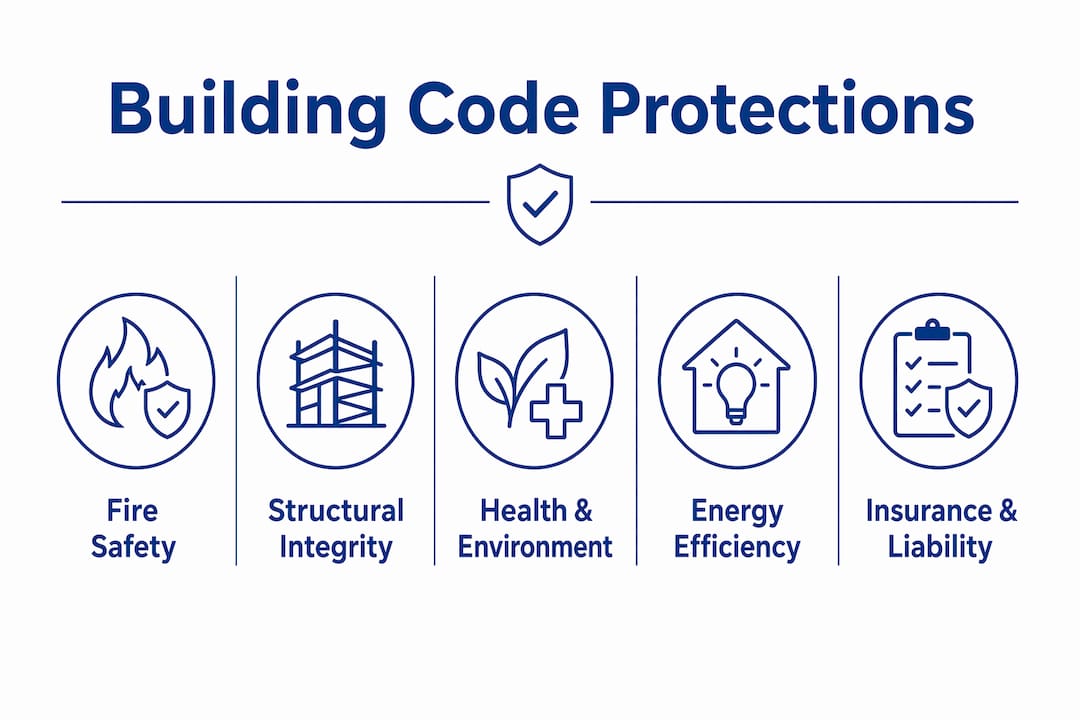
- Building codes are essential for ensuring building safety and resilience against natural disasters in the United States. They regulate design standards for fire, structural integrity, and environmental health, saving lives and reducing property damage. Compliance and enforcement vary across jurisdictions, making proper implementation crucial for effective hazard mitigation.
Building codes are the legal backbone of construction safety in the United States. They set minimum requirements for how buildings must be designed, built, and maintained, covering everything from fire suppression systems to foundation depth to indoor air quality. The role of building codes in protection goes far beyond paperwork: they are the reason a house in Florida can survive a Category 3 hurricane and why a commercial building fire doesn’t kill everyone inside.
At their core, codes protect by:
- Limiting occupant load to reduce fire and evacuation risk
- Requiring fire-resistant materials, barriers, and sprinkler systems
- Setting structural standards for wind, seismic, and flood loads
- Mandating safe egress routes and emergency lighting
- Regulating ventilation, air quality, and energy performance
- Enforcing accessibility standards for people with disabilities
How building codes address fire safety
Fire protection is where building codes have the longest track record. Codes regulate occupant load limits in commercial spaces, which directly controls how many people are at risk when a fire starts. They require fire-resistant construction materials, rated fire barriers between units, and compartmentalization that slows the spread of flames and smoke.
Sprinkler systems, smoke detectors, and fire alarm requirements are not optional features. In most jurisdictions, they are code minimums for commercial buildings and increasingly for multi-family residential construction. Egress requirements specify corridor widths, stairwell pressurization, and the maximum travel distance to an exit, all calibrated to give occupants enough time to escape before conditions become unsurvivable.
Pro Tip:In high-rise buildings, the combination of compartmentalization and pressurized stairwells is what makes a “stay put” evacuation strategy viable. Without both, a single floor fire can compromise the entire escape route.
Structural integrity and hazard resilience in building codes
Structural codes do the work you never see. Foundation requirements, framing specifications, and envelope standards are set to handle the worst predictable loads a building will face over its lifetime. And because foundations typically remain fixed for 50 or more years, getting the initial code compliance right is not recoverable later.
Regional hazard adaptation is where structural codes get specific:
- California’s codes prioritize seismic bracing, base isolation, and soft-story retrofits
- Florida’s post-Andrew hurricane codes require impact-resistant glazing and stronger roof connections
- Flood-prone areas follow FEMA’s National Flood Insurance Program standards for elevated foundations
- Wildfire interface zones mandate ignition-resistant cladding and ember-resistant vents
California wildfire codes reduce individual structure loss risk during wildfires by approximately 40%, with a 6% reduction in risk to adjacent properties. That spillover benefit matters: a code-compliant house protects its neighbors, not just its owner. Retrofitting older buildings to current standards is generally only economical in the highest-hazard zones, which means the gap between new and old construction persists for decades.
Health, environmental, and energy protection through building codes
Building codes protect more than physical safety. Ventilation standards, daylighting requirements, and acoustic controls all shape whether a building is genuinely livable. The EPA reports that Americans spend roughly 90% of their lives indoors, which means indoor air quality is a public health issue at scale. Codes that mandate minimum air exchange rates and restrict volatile organic compound emissions in materials directly affect respiratory health and cognitive performance.

Energy codes have become increasingly consequential. Requirements tied to insulation values, window performance, and HVAC efficiency reduce both operating costs and carbon output. Energy-related code improvements can pay back their initial investment within 1–2 years through reduced utility bills. For building owners, that is not an abstract environmental benefit; it shows up on the monthly statement. Solar panel installations and EV charging infrastructure are now appearing in updated codes as well, reflecting how compliant solar installations are becoming a standard part of the building safety conversation.
How building codes evolve and their national impact
Building codes are not static documents. NIST has investigated building failures for more than 50 years, and its technical findings feed directly into code revisions. After the 2021 Surfside condominium collapse in Florida, which killed 98 people, officials immediately examined whether existing codes were adequate. That pattern repeats after every major disaster.
The process works like this:
- The International Code Council (ICC) publishes model codes, primarily the International Building Code (IBC) and International Residential Code (IRC)
- Standards committees operating under American National Standards Institute (ANSI) guidelines develop the underlying technical standards
- State and local governments adopt model codes in whole or in part, often with regional modifications
- Local inspectors and plan reviewers then enforce those codes on the ground
Key figure: FEMA’s nationwide study found that cities and counties with modern building codes would avoid at least $32 billion in losses from natural disasters over a 20-year period, with cumulative avoided losses projected to exceed $132 billion by 2040.
Enforcement quality is the variable that determines whether a code delivers its intended protection. A well-written code enforced by undertrained inspectors produces worse outcomes than a simpler code enforced rigorously.
Research insights on the effectiveness and economic benefits of building codes
The economic case for hazard-resistant codes is well-documented. FEMA’s landmark study examined 18.1 million buildings constructed between 2000 and 2016 and found that roughly half, built to ICC model codes, would avoid average annualized losses of approximately $1.6 billion in 2020 dollars. The California wildfire data reinforces this: a 40% reduction in structure loss risk translates directly into lower insurance payouts, faster community recovery, and fewer displaced households.
Statistic: Communities that adopt modern building codes avoid losses from earthquakes, floods, and hurricane winds at a rate that makes code adoption one of the most cost-effective disaster mitigation tools available, according to FEMA’s Building Codes Save study.
Pro Tip:When evaluating the cost of code compliance for a new build, factor in the insurance premium reduction and the avoided retrofit cost over a 30-year mortgage horizon. The upfront delta is almost always smaller than it looks.
The harder problem is existing stock. Retrofitting older buildings to current hazard codes is generally unjustifiable economically except in the highest-risk zones, which leaves a persistent safety gap in communities with aging housing. That gap is where local enforcement programs, incentive-based retrofit grants, and updated insurance underwriting standards do their most important work.
How building codes affect insurance and liability
Insurers use building codes as a primary risk-assessment tool. A structure built to current ICC standards carries a measurably lower loss probability than one built to a 1980s code, and underwriters price that difference into premiums. FEMA’s National Flood Insurance Program explicitly requires homeowners to follow flood-resistant design standards from recent model code editions to qualify for coverage, making code compliance a financial prerequisite, not just a legal one.
Liability flows in both directions. Contractors who deviate from code expose themselves to civil liability when failures occur. Building owners who fail to maintain code-compliant conditions, particularly in fire safety and egress, face liability for occupant injuries. Courts routinely treat code violations as evidence of negligence, which means the legal system reinforces what the regulatory system requires.
Who actually sets and enforces building codes in the US?
The United States has no single national building code. Authority is distributed:
- Federal level: NIST develops technical research and proposes standards; FEMA administers flood insurance requirements; Congress can direct agencies to assist states in code adoption
- State level: Legislatures adopt model codes, sometimes with amendments that strengthen or weaken specific provisions
- Local level: Municipalities and counties enforce codes through building departments, plan review, and inspection programs
This structure means code quality varies significantly by jurisdiction. Some states limit local amendments to prevent communities from adopting stricter requirements. Others allow localities to exceed state minimums. The result is a patchwork where a building in one county may face meaningfully different requirements than one 20 miles away.
Key Takeaways
Building codes are the single most cost-effective tool for reducing death, injury, and property loss from fires, natural disasters, and structural failures in the United States.
| Point | Details |
|---|---|
| Economic impact | Modern codes help communities avoid at least $32 billion in natural disaster losses over 20 years, per FEMA. |
| Wildfire resilience | California wildfire codes reduce individual structure loss risk during wildfires by approximately 40%. |
| Energy payback | Energy-related code improvements typically recover their upfront cost within 1–2 years. |
| Enforcement gap | Even strong codes fail without adequately trained local inspectors and plan reviewers. |
| Retrofit limits | Full retrofits to current hazard codes are economically viable only in the highest-risk zones. |
Building codes set the floor for safety, but lightning protection sits above that floor as a specialized requirement that general codes often address only at a minimum level. Indelec has spent decades helping facilities meet and exceed those minimums. Whether you need a certified lightning rod system for a commercial structure or guidance on protecting sensitive installations, Indelec’s engineering team works within the framework of current standards to deliver protection that holds up when it counts.