Lightning Protection for Hospitals: A French Guide
A hospital cannot switch off when a storm arrives. Protecting it means combining four things: a documented lightning risk analysis, an external system (air terminals, down conductors, earthing), internal protection (equipotential bonding and coordinated surge protection), and a scheduled inspection routine with a logbook. This guide explains each layer for facility managers, engineering consultancies and contractors working on French healthcare sites, and where the regulations bite.
TL;DR
- Hospitals are treated as high-risk structures because they cannot stop critical functions, and the international reference for the protection system is IEC 62305.
- Protection has two sides: external (rods, down conductors, low-resistance earthing) and internal (equipotential bonding plus cascaded surge protection).
- In France, the 2002 standards remain the regulatory reference, and where the ICPE rules apply, they set a precise cycle of checks and a logbook.
- Backup power, communications and alarms must be connected to the protection system, not treated as separate islands.
- Start with a lightning risk analysis: it defines what needs protecting and to what level.
Table of Contents
- Why hospitals are a special case for lightning
- What French rules apply to a hospital
- Step 1: Start with a lightning risk analysis
- Step 2: External protection and earthing
- Step 3: Internal protection, bonding and surge protection
- Step 4: Keep backup power and communications inside the protection scheme
- Step 5: Inspect, test, and record
- Writing the tender: what to ask for
- How Indelec supports hospital projects
- FAQ
- Sources
Why hospitals are a special case for lightning
Most buildings can tolerate a few hours without electronics. A hospital cannot. The Pan American Health Organization (PAHO) considers hospitals at high risk from lightning because they are unable to halt critical operating functions, and recommends a comprehensive lightning protection system (LPS) following IEC 62305.
The consequences are rarely a dramatic fire. They are the quiet failures of the equipment a ward depends on. Reported impacts after strikes on hospitals include postponed surgeries, failures of sensitive equipment and disruption to communications, patient attendance systems and resuscitation alarm buttons. The same source points out that imaging systems, patient monitors and electronic records are the equipment at stake, and that surges can knock out power and threaten patient care.
A Belgian academic study of hospital functions adds the security side: lightning-induced surges can disable communications, fire alarm systems and electronic entrance controls. A strike does not need to hit the roof to cause this. A nearby impact induces overvoltages in cables, which then travel into the building through power, data and telephone lines.
That is why a hospital approach differs from an office or warehouse approach. The question is not only “will the building survive?” but “which functions must never be interrupted, and how does a surge reach them?”
What French rules apply to a hospital
There is no single “hospital lightning law” that answers every question. Several texts overlap, and which ones bind you depends on what your site contains. Here is how to read them.
The electrical installation standard
For low-voltage installations, the NF C 15-100 series is the reference. AFNOR states that the 2024 series is not yet cited in regulations, so the 2002 standards and their amendments remain mandatory under the order of 3 August 2016. In practice, your electrical designer should confirm which version your project is built to and what it requires for surge protection in a health establishment. Our lightning standards page and our summary of IEC 62305 and its 2024 edition help you map the international series to French practice.
The ICPE regime, when part of your site falls under it
A hospital is not an ICPE (classified installation) by default, but some sites host installations that are, for example certain storage or technical plants. Where that applies, the order of 15 January 2008 on lightning protection of certain classified installations sets the method. For installations subject to authorization and listed in its annex, a lightning risk analysis (ARF) is required and is based on NF EN 62305-2.
The amending order of 19 July 2011 adds the timing. Protection measures must follow the technical study and be installed within two years of the ARF, except for installations authorized from 24 August 2008, where they must be in place before operation. The same text required radioactive-source lightning rods to be removed before 1 January 2012 and sent to the radioactive-waste channel. If you inherit an old site, check the roof for any such device.
For a deeper read on how this plays out on site, see our compliance guide for ICPE sites and our note on the two-year rule insurers apply.
Buildings open to the public
Hospital buildings usually fall under the rules for establishments receiving the public (ERP). The Code de la construction et de l’habitation says constructors, installers and operators must ensure that installations are maintained in accordance with the regulations and that periodic checks are carried out by approved bodies (article R*123-43). This is the legal anchor for treating maintenance and verification as a continuing duty, not a one-time commissioning step.
Step 1: Start with a lightning risk analysis
Every sound protection design begins with an analysis, not a catalog. In the ICPE framework, the ARF follows NF EN 62305-2, identifies the equipment that needs protection and defines protection levels, and a technical study then specifies the measures. Even where the regime does not formally apply, the method is the sensible one for a hospital.
For a healthcare campus, a useful analysis answers these questions:
- Which services are critical? Operating theaters, intensive care, emergency, imaging, sterilization, pharmacy cold chain, data rooms.
- Which buildings and utilities serve them? Main low-voltage switchboards, generator sets, UPS rooms, medical gas plants, telecom risers.
- Where do lines enter and leave? Power, telephone, data, nurse-call, building management, and fire alarm cables between buildings are all paths for surges.
- What is the strike exposure of each structure? Height, isolated position, roof equipment, antennas and masts.
- What would a failure cost? In patient safety first, then in operations, data and repair.
The result is a protection level for the external system and a map of where surge protection is needed. The technical study that follows turns this into drawings, product lists and an installation schedule. Our team carries out the lightning risk analysis and technical study as the first step of a project, so that what gets installed answers a documented need.
Step 2: External protection and earthing
External protection intercepts a strike and drives the current safely to ground. PAHO describes it as air terminals (lightning rods) on roofs connected to grounding systems through down conductors so that a strike is intercepted and dispersed safely.
On a hospital, three practical points matter.
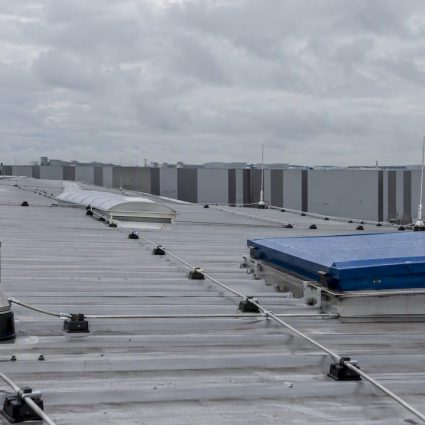
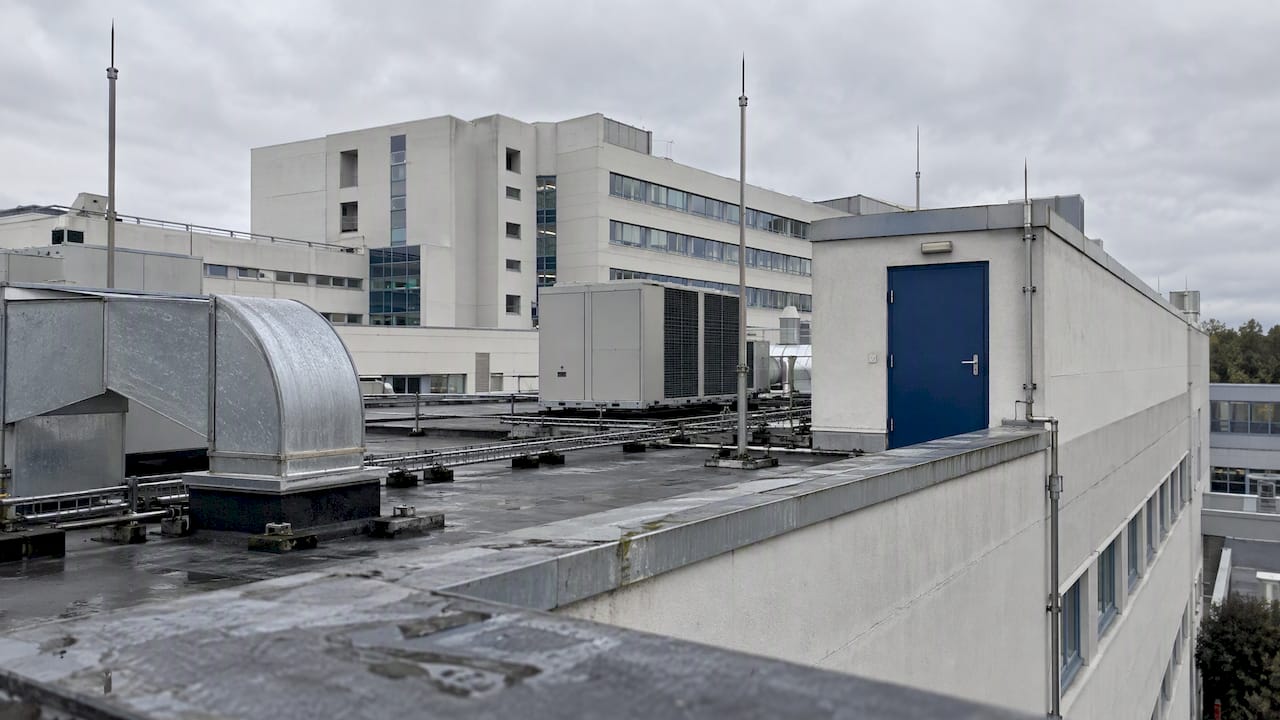
Roofs are crowded. Air handling units, chillers, antennas, helipads and photovoltaic arrays share the same surface. The air terminals must be positioned so that the protected volume covers this equipment, with masts and fixings that suit the roof structure. Our range includes lightning rods, masts and mast fixings, galvanized or stainless elevation masts and conductor clamps and fixings. Where a roof layout does not suit a single rod, a meshed cage can be the better answer.
Down conductors must be routed with care. A conductor that passes near sensitive rooms, or that is badly connected, becomes a problem rather than a protection. Connection quality matters as much as the conductor itself, which is why we wrote a site guide on down conductor connections. Our down conductor line is designed to be used with matching connections.
Earthing is the foundation. Effective protection depends on a low-resistance grounding system. Whatever the rod does above, the current must find a path into the ground. Our earthing range covers rods, plates and connections, and for sites with difficult soil, deep earth grounding drilling reaches layers where resistivity is more favorable. Foundation-level earthing for new builds is covered in our guide to foundation trench grounding under NF C 15-100, and ongoing care in how to maintain grounding systems.
A lightning strike counter on the main down conductor is a small addition with a large operational value: it tells you when a strike has actually occurred, which triggers the inspection cycle described below. See our lightning strike counters.
Step 3: Internal protection, bonding and surge protection
External protection controls the strike. Internal protection controls what the strike does to everything inside. It rests on two ideas.
Equipotential bonding
Internal protection focuses on equipotential bonding, which interconnects metallic structures and conductive components to neutralize voltage differences and prevent dangerous sparking. In a hospital this includes structural steel, pipework, medical gas lines, cable trays, lift rails and the protective conductors of the electrical system. Lines that cannot be bonded directly, such as live conductors, are connected through surge protective devices.
Cascaded surge protection
Surge protective devices (SPDs) limit the overvoltage that enters through cables. Professional guidance on healthcare facilities describes a staged, or cascaded, approach: SPDs at the service entrance, at distribution panels, and at critical points of use, so that each stage handles a manageable share of the energy.
For a hospital this typically means:
| Location | Purpose | What to consider |
|---|---|---|
| Main low-voltage switchboard | First barrier against energy entering from the grid or from a strike | Coordination with the external lightning protection system |
| Sub-distribution boards (wards, theaters, imaging) | Second stage, closer to the equipment | Selection by the sensitivity of the loads served |
| Critical equipment outlets and racks | Final stage at the point of use | Short connections, coordinated with upstream stages |
| Data, telephone, nurse-call and building management lines | Protect signal circuits that carry no power but still carry surges | Protection suited to each line type |
Connection length is a practical detail that often decides results. Installers commonly aim for bonding connections as short as possible, ideally under 50 cm, because long leads add impedance and let more of the surge through to the equipment. Ask your contractor to show how this is achieved on each board.
We supply a range of surge protection devices, including low voltage surge protection cabinets, and explain the principles in surge protection for industrial facilities and the installation guide. The product page for protection against overvoltages lists the French catalog.
Step 4: Keep backup power and communications inside the protection scheme
Continuity of service depends on backup systems, and backup systems are exposed to the same surges. PAHO recommends connecting every device, including energy backup systems, to the hospital’s lightning protection system.
In practice, review these points during design or an audit:
- Generator sets and their control panels. Their cables to the main switchboard are long, often outdoors, and a common entry point for surges.
- UPS and battery rooms. A UPS protects against supply quality problems, not necessarily against a lightning surge on its input or on the output lines.
- Transfer switches and building management. If the system that switches to backup power is itself damaged, the backup is useless.
- Fire alarm, access control and communications. These were the functions affected in the Belgian study cited above, and they are often protected last because they are low-voltage and easy to overlook.
- Rooftop and outdoor equipment. Antennas, cameras and lighting poles connect the outdoors to the interior and need both bonding and line protection.
The goal is a single, coherent scheme, with the external system, earthing, bonding and SPDs designed together, rather than a patchwork of devices installed separately over the years.
Step 5: Inspect, test, and record
A lightning protection system degrades. Conductors corrode, connections loosen, roofs are modified and new equipment is added. The French ICPE framework gives a clear model of how often to check. For covered installations, the order of 15 January 2008 requires a full check within six months, a visual check annually and a full check every two years. When a strike is recorded, a visual check must follow within one month. Strike events on sites covered by the 2011 order must be registered.

The operator must also keep a logbook, with its chapters drafted during the technical study.
Even on a hospital site that is not formally under this regime, this cycle is a reasonable benchmark, and article R*123-43 mentioned earlier supports the expectation of periodic checks by approved bodies for public-access buildings. A workable routine looks like this:
- After installation: a full check, with results recorded in the logbook.
- Every year: a visual inspection of rods, conductors, fixings and bonding on roofs and in technical rooms.
- Every two years: a full check including earth resistance measurements and SPD status.
- After any recorded strike: a visual inspection within one month, sooner for critical areas.
- After any works: new roof equipment, extensions or changes to cabling trigger a review of the risk analysis.
Our inspection and maintenance service covers these checks. For the paperwork side, our articles on the deliverables facility managers must keep and on closing six-month, annual and two-year gaps give practical checklists.
Writing the tender: what to ask for
When you issue a call for tenders for a hospital project, vague specifications produce vague systems. Ask bidders to provide:
- The lightning risk analysis and the protection level it leads to, with the method named (NF EN 62305-2).
- A technical study with drawings of rods, down conductors, earthing and bonding.
- A surge protection scheme showing every stage, location and the lines covered, not just a product list.
- An installation plan that respects clinical continuity: work phased by area, with agreed shutdown windows.
- Commissioning checks and a logbook template.
- A maintenance and verification offer with the intervals above.
Our note on what to put in an NF EN 62305 call for tenders goes into more detail for French projects.
Our perspective: protect the function, not just the building
After decades of installations, we see the same pattern on healthcare sites. The roof gets a rod, and the wards keep running on cabling that nobody mapped. When a storm comes, the rod does its job, and the damage appears in a switchboard, a nurse-call line or a server room.
We design lightning protection as a chain: risk analysis, external system, earthing, bonding, surge protection, then verification. Each link depends on the others, and a gap in any of them is where the energy goes. That is why we handle the analysis, the technical study, the installation and the maintenance as one continuous service, so that the person who designed the system is accountable for how it performs over time.
Our R&D center works on air terminals and earthing solutions that adapt to changing standards and climate conditions, and our experience covers over 280,000 installations worldwide. For a hospital, we think that experience should serve one aim: a clinical team that never has to think about the weather.
INDELEC
How Indelec supports hospital projects
We work with facility owners, contractors, architects, engineering consultancies and public infrastructure agencies. For healthcare sites, we can carry out the lightning risk analysis and technical study, supply rods, masts, down conductors, earthing and surge protection, install the system, and then verify and maintain it under a recorded schedule. If your site has difficult soil, we also offer deep earth grounding drilling.

To discuss a hospital or healthcare campus, start with our lightning protection services or contact our team through indelec.com. Our lightning protection system application page shows how we approach a project from analysis to commissioning.
FAQ
Is lightning protection mandatory for a hospital in France?
There is no single rule that settles it for every hospital. The obligations depend on the site: ICPE installations on the premises trigger a mandatory risk analysis and technical study, and public-access buildings are subject to maintenance and periodic check duties under the construction code. Your risk analysis and a conversation with the authorities and your insurer will show what binds your site.
Which standard should the design follow?
The IEC 62305 series, published in France as NF EN 62305, is the reference for lightning protection design and risk assessment. For the electrical installation, the 2002 NF C 15-100 standards and amendments remain the mandatory reference until the 2024 series is cited in regulations, according to AFNOR. Ask your designer to state the editions used in the study.
Do surge protective devices replace a lightning rod?
No. A rod and its earthing handle a direct strike on the structure, while SPDs limit the surges that travel along cables, including those induced by nearby strikes. A hospital needs both, designed to work together, plus equipotential bonding between them.
How often should the system be checked?
For installations covered by the ICPE order, the cycle is a full check within six months of installation, a visual check every year and a full check every two years, with a visual check within one month after a recorded strike. Many hospitals adopt the same cycle as good practice, and record each check in a logbook.
Sources
- How the Risk of Lightning Strikes Affects Hospitals, EC&M
- Lightning Strikes, PAHO
- Impact of lightning strikes on hospital functions
- AFNOR: Installations électriques à basse tension, série NF C 15-100
- Arrêté du 15 janvier 2008 relatif à la protection contre la foudre de certaines installations classées
- Article 2, Arrêté du 19 juillet 2011, Légifrance
- Article R*123-43, Code de la construction et de l’habitation, Légifrance
- Protecting Security Systems in a Healthcare Facility from Surges, Interference Technology