Earthing for EV Charging Stations (IRVE) in France
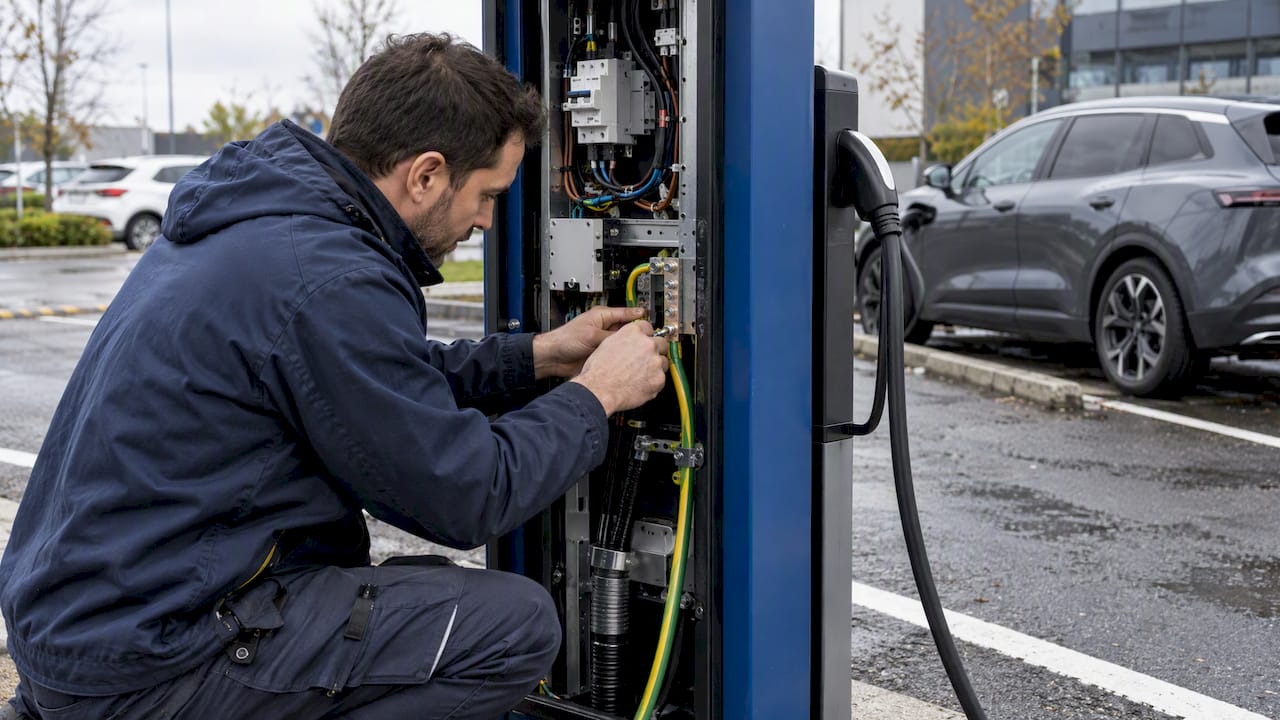
Every IRVE (charging infrastructure for electric vehicles) in France needs a protective earth connection: each circuit downstream of the delivery point must carry a protective conductor tied to earth. That earth is what protects people from indirect contact, and what lets some vehicles charge correctly. This guide explains what the rules require, how earthing works with the 30 mA residual-current device, how the connection is verified at commissioning, and what to check when a charger faults or refuses to charge.
TL;DR
- The French order of 23 December 2020 requires a protective conductor connected to earth on every circuit of the charging infrastructure downstream of the delivery point.
- Without earthing, there is a risk of electric shock or electrocution, and some electric vehicles may not recharge correctly.
- Each charging point needs its own residual-current device (DDR) of 30 mA maximum, correctly matched to the charging mode and the type of fault current.
- Commissioning checks include continuity of the protective conductors and, for a direct TT connection, a recorded earth resistance.
- When a charger refuses to charge, check the earthing installation first, before replacing hardware.
Table of Contents
- Why earthing is the first safety layer of an IRVE
- What French regulation requires
- Earthing arrangement and earth electrode
- Earthing and the residual-current device
- Commissioning: how the earth connection is verified
- Who may carry out the work
- When a charger reports an earth fault or will not charge
- Designing for a whole car park
- Perspective
- Earthing, surge protection and verification for your charging site
- FAQ
- Sources
Why earthing is the first safety layer of an IRVE
An EV charger is a high-power, long-duration load, often outdoors, often in a car park where users touch a metal bodywork while standing on wet ground. The earth connection gives a fault current a controlled path to ground, so the protective device trips instead of letting the vehicle or the charger enclosure sit at a dangerous potential.
Promotelec, the French electrical safety body, states that an earthing installation must be present on a charging point installation. According to its professional guidance, the absence of earthing creates a risk of electrification or electrocution, and some electric vehicles may not recharge correctly. That second point matters to facility teams: a missing or degraded earth is not only a safety issue, it is also a cause of chargers that simply do not deliver.
For an operator, this means earthing is not a line item to minimize. It conditions safety, availability of the service and the ability to obtain a conformity certificate.
What French regulation requires
The legal basis: the order of 23 December 2020
Article 3 of the order of 23 December 2020, in force since 27 December 2020, requires every electrical circuit of the charging infrastructure downstream of the delivery point to include a protective conductor connected to earth. It is a legal obligation, not a good practice.
The standards: NF C 14-100 and NF C 15-100
Promotelec explains the split: NF C 14-100 applies to the connection installation upstream of the delivery point, and NF C 15-100 to the circuits downstream. A conformity certificate visaed by Consuel is required in specified cases (Promotelec, 2023).
NF C 15-100 is the primary reference for low-voltage installations in France. Its 2024 update, mandatory since 1 September 2025, addresses new safety and performance challenges, including electric-vehicle charging. Any design or audit done today should be checked against the current edition, not against the one a previous project used. Promotelec describes the standard’s triple purpose: safety of people, protection of property and long-term functioning of the installation.
For tertiary buildings, our guide to IRVE standards for tertiary buildings places these rules in the context of offices, retail and public sites.

Earthing arrangement and earth electrode
TT, TN: the supply system decides
The earthing arrangement of the site shapes how the charger’s protective conductor is referenced. In the industrial and tertiary buildings we work on, you will meet two situations:
| Situation | What it means for the IRVE |
|---|---|
| Site supplied directly from the public network | Typically a TT arrangement: the site has its own earth electrode, and its resistance must be compatible with the residual-current device protecting the circuit |
| Site fed by a private transformer | The arrangement is chosen at design stage and documented; the charger circuit must follow it |
Before adding a charging bay, find out which arrangement your site really uses and where its earth electrode is. Plans from the original building are often incomplete, and extensions over the years can leave several earth electrodes that are not interconnected.
When the earth resistance is too high
A high earth resistance is the most common reason a TT installation is hard to protect. Promotelec’s guidance on lowering the resistance of an earth electrode describes a practical option: several galvanized-steel earth stakes at least 2 m long and at least 2 m apart, linked by an insulated conductor of at least 16 mm² or a bare copper conductor of at least 25 mm².

On sites where soil is dry, rocky or covered with asphalt, surface stakes may not be enough. Deep drilling reaches wetter, more conductive layers. That is the purpose of deep earth grounding drilling, and of self-coupling earth rods when the electrode has to be driven to depth in several sections. For a new building, a foundation trench earth electrode that meets NF C 15-100 is much cheaper to build during the works than to retrofit afterward.
Do not forget bonding
The protective conductor of the charging circuit is only one element. Exposed conductive parts of the building, metal structures near the charging bays and the main earthing terminal must be consistently bonded. A charger with a perfect earth stake but a poorly bonded canopy still leaves a potential difference people can touch.
Earthing and the residual-current device
Earthing and the DDR (residual-current device) work as a pair. The earth gives the fault current somewhere to go, and the DDR detects the leak and cuts the supply.
Per Promotelec’s guidance and NF C 15-100-7-722, each charging point must be protected individually by a DDR with a sensitivity not exceeding 30 mA. For mode 3 charging, the same source specifies either:
- a Type A or Type F device combined with a device that cuts supply above 6 mA of DC fault current, or
- a Type B device.
In practice, this means a shared DDR for a row of chargers is not acceptable, and the choice of Type A, F or B must be written in the design file. A charger can leak small DC components into the circuit, and a wrongly chosen DDR can be blinded to a real fault.
There is a third protective layer: surge protection. Chargers are exposed outdoors and connected to long cables, so a lightning or switching surge can damage power electronics and communication boards. Our articles on surge protection for French EV chargers and Consuel and on NF C 15-100 surge rules and retrofit costs detail when it is required and how to avoid rework. Surge protective devices also need a low-impedance earth path to work, which brings us back to the quality of the earth electrode.
Commissioning: how the earth connection is verified
The earth must be proven, not assumed. Consuel’s checklist for its conformity inspection, DRE 148-3, includes electrical continuity checks on the installation’s exposed conductive parts. For a direct TT connection, the earth resistance is recorded.
A sound commissioning file for the earthing of a charging point generally holds:
- the location and type of the earth electrode, with a drawing or photographs before backfilling;
- the measured earth resistance, with the date, the method and the instrument;
- continuity measurements of the protective conductors to the charger and to the exposed conductive parts;
- the reference and type of the DDR protecting each charging point;
- the conformity certificate, when required.
When a certificate of conformity is required
According to Enedis guidance, a certificate of conformity is mandatory for all new IRVE installations in collective housing, or when the IRVE power exceeds 36 kW. For many professional sites with several chargers, that threshold is quickly reached, so plan the Consuel step into the project schedule rather than discovering it at handover.
Who may carry out the work
Earthing for charging points is electrical work on a safety-critical installation. It should be done by a qualified, authorized electrician, and the IRVE qualification of the installer is a point to check before signing. Our article on why to check IRVE qualification before you sign explains what to ask for. Ask also who will measure the earth and who signs the report: the person who builds the electrode and the person who verifies it should preferably not be the same on a large site.
When a charger reports an earth fault or will not charge
Treat it as a diagnostic sequence, not as a hardware replacement decision.
- Confirm an earthing installation is present and connected. Promotelec notes that without earthing some vehicles may not recharge correctly. A loose or missing protective conductor is the first suspect.
- Check the protective conductor continuity from the charger to the main earthing terminal, with a calibrated instrument.
- Measure the earth resistance and compare it with the commissioning record. A value that has drifted points to corrosion, a broken link or seasonal drying of the soil.
- Check the DDR: type, rating, and whether it has tripped on a real leakage.
- Inspect the environment: water ingress at connections, damaged cables, rodent damage, or recent civil works near the electrode.
- Document what you found and fixed.
Maintenance contracts should include these checks at fixed intervals. Our guide to enterprise EV charger maintenance levels MA1, MA2 and MA3 helps you choose the right scope, and the practical guide to maintaining grounding systems covers the electrode side.
Designing for a whole car park
A single home wallbox and a 40-bay car park are different problems. With many chargers, the protective conductors, the earth electrode and the DDR coordination must be designed as a system. Voltage drop in long cable runs, the electrode’s ability to carry combined fault currents and the future extension of the bays all weigh on the design. If the parking will grow, the 20% rule for sizing IRVE in French parking lots is a useful starting point, and laying a well-sized earth network at the start avoids opening the ground twice.
Perspective
Since 1955, we have designed earthing for sites where a fault has real consequences: industrial plants, infrastructure, tall structures exposed to lightning. What we see on EV charging projects is that earthing is often treated as the last detail of the electrical package, when it should be the first.
Our view is simple. A charging installation is only as safe as the path its fault current takes. That path has to be designed for the soil of the site, measured when it is built and measured again as the years pass. Where the ground is difficult, we use deep earth electrodes rather than hoping that surface stakes will do.
We also look at the whole picture. The same site that hosts chargers is exposed to lightning and surges, and the earth electrode serves both. Our approach is to join risk analysis, earthing, surge protection and verification in a single file, so that the facility manager holds one coherent set of documents instead of four. With more than 280,000 installations behind us, this is how we aim to keep charging points both available and safe.
INDELEC
Earthing, surge protection and verification for your charging site
If you are preparing or upgrading a charging site, we can help with the parts that sit around the charger: earthing design, deep earth electrodes, surge protection, and inspection and maintenance of the installation. Our electric mobility solutions are delivered with the same engineering approach as our lightning protection work, and you can browse our earthing product range and surge protection devices.

To discuss a specific site, start from our services page and describe your car park, your supply arrangement and the number of charging points planned.
FAQ
Is earthing mandatory for an EV charging station in France?
Yes. The order of 23 December 2020 requires every electrical circuit of the charging infrastructure downstream of the delivery point to include a protective conductor connected to earth. Promotelec adds that without it there is a risk of electric shock and some vehicles may not charge correctly.
Does each charging point need its own residual-current device?
Yes. Each charging point must be protected individually by a DDR of 30 mA maximum, according to Promotelec guidance and NF C 15-100-7-722. For mode 3, use Type A or F with a device cutting supply above 6 mA DC fault current, or Type B.
What is checked on the earth connection at commissioning?
The Consuel checklist DRE 148-3 includes continuity checks on the exposed conductive parts of the installation. For a direct TT connection, the earth resistance is recorded. Keep these measurements in the installation file.
What can I do if the earth resistance is too high?
Promotelec describes adding several galvanized-steel stakes, at least 2 m long and at least 2 m apart, linked by a suitable conductor. On difficult soils, a deep earth electrode may be the more reliable solution. Have the measurement redone once the work is finished.
Is a Consuel certificate always needed for an IRVE?
Not always, but it is mandatory for new IRVE installations in collective housing or when the IRVE power exceeds 36 kW, according to Enedis guidance. Check the case of your project with your installer and the Consuel documentation.
Sources
- Promotelec: following good installation practices for a charging point
- Order of 23 December 2020, Article 3
- Promotelec: what is new with NF C 15-100
- Promotelec: fundamentals of NF C 15-100
- Promotelec: lowering the earth electrode resistance
- Consuel: DRE 148-3 installation examination
- Enedis: Consuel certificate of conformity