How to Maintain Lightning Rods: A Practical 2026 Guide
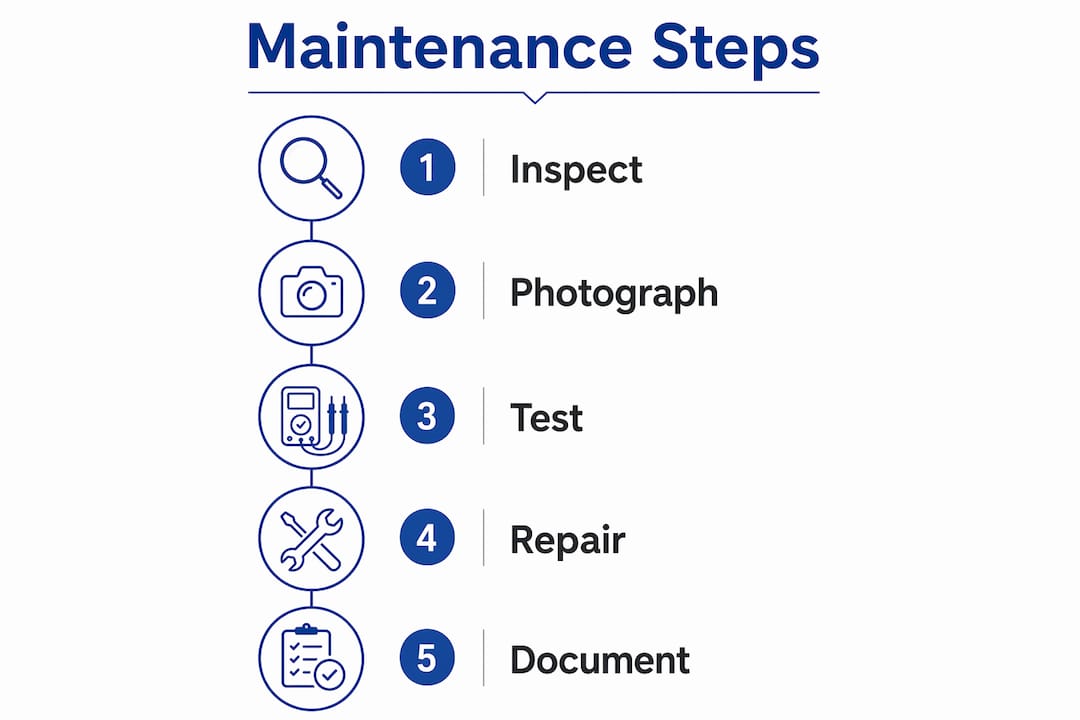
Proper lightning rod upkeep comes down to three non-negotiable habits: annual visual inspections, comprehensive system testing every three years, and prompt repair of anything that looks wrong. NFPA 780, IEC 62305, and the Lightning Protection Institute’s LPI-175 standard all align on this schedule, and for good reason. A lightning protection system (LPS) that looks fine from the ground can have corroded connections, loosened conductors, or compromised grounding electrodes that may fail when a strike occurs. The core maintenance tasks cover air terminals, bonding conductors, connectors, and the grounding system. Documentation of every inspection and repair is not optional; it is what keeps you compliant and gives you a defensible record if something goes wrong.
- Annual visual inspection: check air terminals, conductors, connectors, and surge protective devices for corrosion, damage, and loose fittings
- Comprehensive testing every three years: continuity testing and ground resistance measurement below 10 ohms
- Critical facilities (hospitals, airports, EMS centers): annual full inspections, not just visual checks
- Post-strike inspection: required after any known lightning event, even when no visible damage is apparent
- Documentation: log every inspection, test result, repair, and structural change for compliance and recertification
What standards govern lightning rod maintenance?
Three frameworks set the baseline for maintaining lightning protection in the United States, and knowing which one applies to your facility shapes everything from inspection frequency to who is qualified to sign off on the work.
NFPA 780 is the primary American standard. Its Annex D defines two inspection levels: an internal visual inspection performed annually by on-site personnel, and a testing inspection conducted every few years by an industry professional. Annex L adds a risk assessment methodology to determine whether other structures on a property also need protection.
IEC 62305 is the international counterpart, widely referenced for industrial and infrastructure projects. It uses a risk-based approach to classify structures into protection levels, which in turn determines inspection rigor and frequency.
LPI-175, published by the Lightning Protection Institute, is the standard most directly tied to certification in the U.S. It specifies that a Certified Designer Inspector or Certified Master Installer must conduct the three-year inspection, which includes continuity testing and a ground resistance check using a calibrated ohms-measuring device. LPI-IP Master Certificates carry an expiration date, timed to align with NFPA’s code review cycle.
- Hospitals, EMS facilities, and airports may require more frequent inspections depending on occupancy and environment
- Any structural alteration, re-roofing, or addition of protruding equipment typically triggers a system recertification, since new geometry affects air terminal placement and bonding requirements
- The LPI 177 Inspection Guide provides a sample visual inspection format and a glossary of system requirements
- Indelec’s overview of lightning protection standards maps these frameworks to real-world compliance scenarios
What does a routine lightning rod inspection actually cover?
A thorough annual inspection is not a casual walk around the building. It follows a structured checklist, and the order matters because some faults only become visible once you have already confirmed the condition of adjacent components.
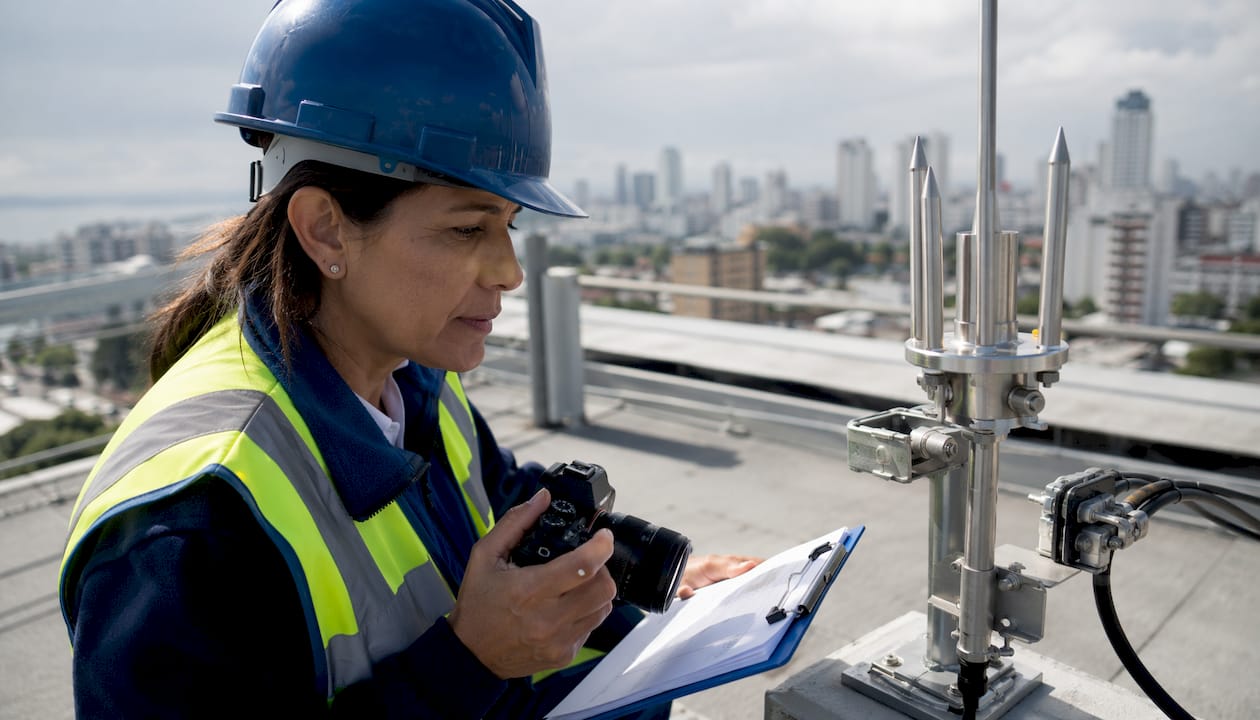
Visual inspection checklist
Work from the top of the system down:
Air terminals: Look for bending, cracking, or breakage. A bent terminal shifts the zone of protection and may leave parts of the structure exposed.
Bonding conductors: Check for cuts, kinks, corrosion, or sections where the cable has been pulled away from its anchors. Workers from other trades are a common cause of damage here; they disconnect components and do not reinstall them.
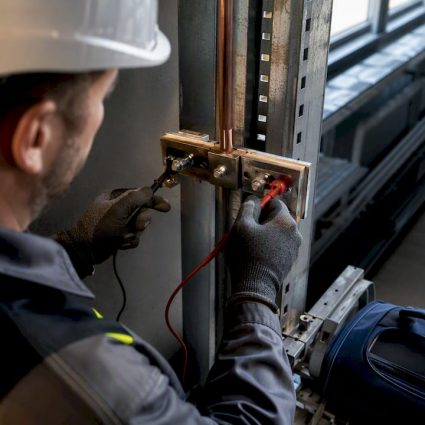
Connectors and splice fittings: Tighten any loose connections. Confirm that all leads are firmly seated with no exposed or dangling ends.
Through-roof connectors: Verify they are firm against both the roof surface and the conductor below, and that cable holders maintain proper spacing.
Surge protective devices (SPDs): Inspect for physical damage and test per manufacturer guidance.
Grounding electrodes: While the buried portion requires testing to assess, check any accessible access wells or junction boxes for moisture intrusion or corrosion.
After severe weather
Post-storm inspections catch damage that a scheduled annual check might miss by months. High winds can dislodge anchors, shift conductors, and crack air terminal bases without leaving obvious signs at ground level. Add a post-storm walkthrough to your maintenance calendar as a standing task, not an optional one.
Pro Tip:Photograph every component during each inspection. A dated photo library makes it easy to spot gradual corrosion or movement between visits and gives you concrete evidence for recertification applications.
Common problems found during maintenance and how to fix them
Most lightning rod failures trace back to a short list of recurring issues. Catching them early is straightforward; ignoring them is not.
- Corrosion on metal components: Copper and aluminum terminals resist corrosion well under normal conditions, but industrial emissions, salt air, or chemical exposure can accelerate degradation. Corroded connections increase resistance and can break the conductive path entirely. Clean affected surfaces and replace any component where corrosion has penetrated the base metal.
- Loose or damaged connectors: Vibration from wind, HVAC equipment, or nearby construction gradually loosens fittings. Re-tighten with calibrated torque where the manufacturer specifies it, and replace any connector that shows cracking or deformation.
- Physical damage from storms or construction traffic: Bent terminals, severed conductors, and dislodged anchors are the most visible faults. Straightening a bent terminal is rarely sufficient; replace it, since metal fatigue from the original impact compromises its structural integrity.
- Degraded grounding electrode performance: Soil composition, moisture levels, and chemical contamination all affect ground resistance over time. When resistance climbs above 10 ohms, the grounding system needs attention, whether through soil treatment, additional electrodes, or deep earth grounding methods.
- Aged or compromised components: Timely replacement of worn parts is not optional. A system with one weak link can fail to conduct a strike safely to ground, defeating the entire installation.
Older buildings present a specific challenge: if no installation records exist, there is no baseline to compare against. In that case, schedule a full professional inspection before assuming the system is functional.
How do you test a lightning rod system for electrical performance?
Visual checks confirm what you can see. Electrical testing confirms what you cannot, and that is where most hidden failures live.
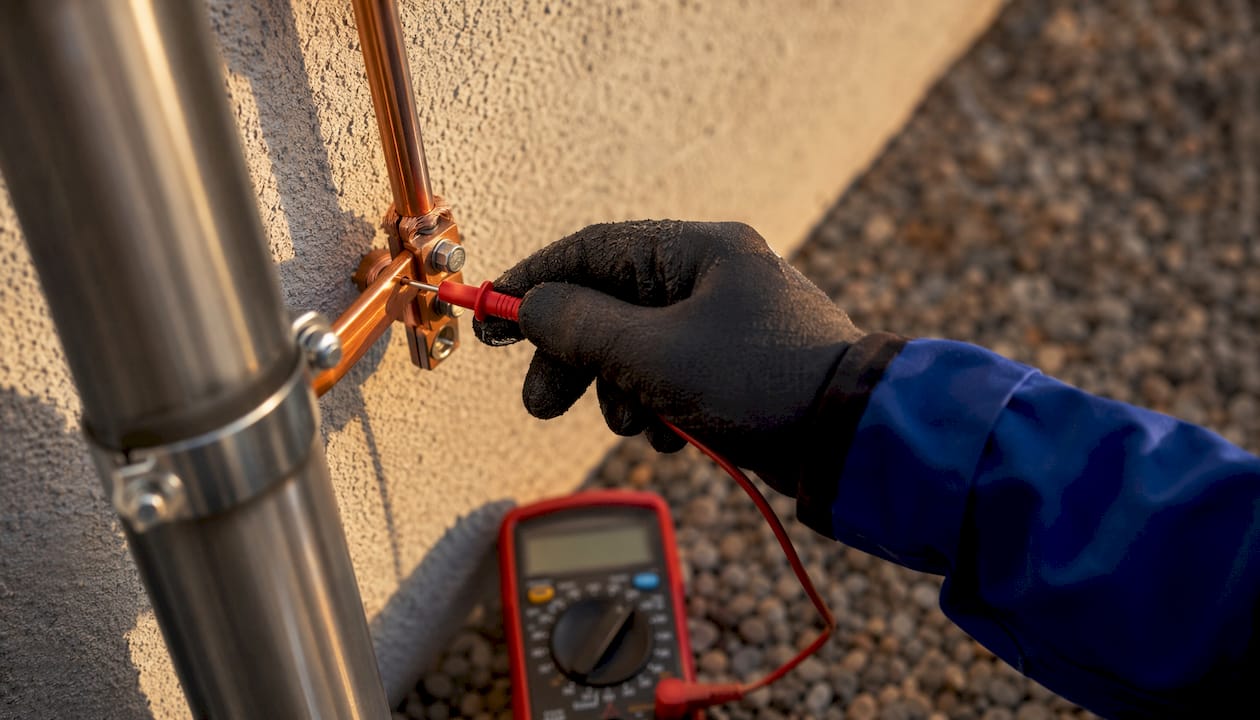
Continuity testing
Continuity testing verifies that a complete conductive path exists from every air terminal down through the bonding conductors to the grounding electrodes. A break anywhere in that chain means a strike could arc to an unintended path, causing structural damage or fire. Technicians use a calibrated ohmmeter to measure resistance across each segment of the system. Any reading that deviates significantly from the baseline established at installation warrants investigation before the test is signed off.
Ground resistance measurement
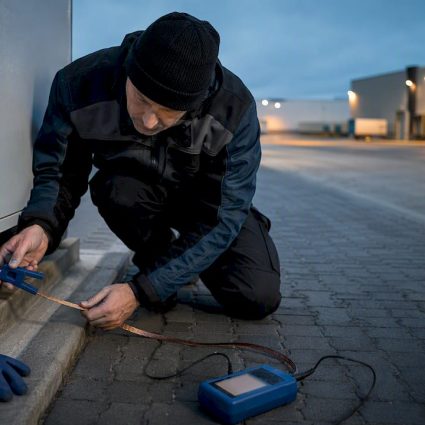
Ground resistance should be kept low to meet standard compliance thresholds. Measurement uses a calibrated ground resistance tester, often a three-point fall-of-potential method, with the results logged against previous readings to track trends. A single reading above 10 ohms does not automatically mean the electrode is failing; soil moisture conditions affect results. Repeat the test under different conditions before concluding the electrode needs replacement or supplementation.
- Testing frequency: every few years per LPI-175 and NFPA 780, more frequently for critical facilities
- All test results must be documented with the date, instrument used, and technician name
- Provisions for concealed systems, such as access wells at downlead locations, should be built in at installation; retrofitting them later is costly
- A Certified Master Installer or Certified Designer Inspector must sign off on the three-year testing inspection for LPI recertification
What should you do immediately after a lightning strike?
A direct strike does not always leave obvious damage. That is the problem. Systems may appear intact after a strike while connections have been loosened, conductors partially melted, or grounding electrodes thermally stressed in ways that compromise the next event’s protection.
- Conduct an immediate visual inspection of all accessible components, focusing on air terminals, conductors, and connectors
- Look for scorch marks, melted insulation, cracked terminals, or any component that has shifted position
- Check connectors for loosening caused by the thermal expansion and contraction during the strike event
- Arrange professional continuity and ground resistance testing before declaring the system operational again
- Document all findings in writing, including photographs, and log the date and estimated strike location
- Schedule repairs immediately; a compromised system offers reduced or no protection for the next strike
The Lightning Protection Institute recommends professional evaluation after any confirmed strike, even when the visual inspection looks clean. The thermal and electromagnetic stresses involved can damage components in ways that only electrical testing will reveal.
How property owners can handle basic lightning rod upkeep
You do not need to be a certified installer to keep your system in good shape between professional inspections. The LPI-175 standard explicitly allows trained building owners and maintenance technicians to perform annual visual inspections, provided they use a checklist and have received basic guidance from a lightning protection provider.
- Walk the perimeter of the building and visually scan all visible conductors for physical damage or displacement
- Check that cable anchors and holders are still firmly attached to the building surface
- Look at air terminals from ground level or a safe vantage point for obvious bending or breakage
- Inspect accessible connectors for visible corrosion or looseness without disassembling the system
- After any re-roofing, antenna installation, or HVAC addition, contact a certified specialist before assuming the existing system still covers the new geometry
Pro Tip:Ask your lightning protection installer to walk you through the system at the time of installation or last inspection. A 30-minute orientation makes your annual visual checks far more effective and helps you spot anomalies that would otherwise look normal.
Safety precautions for maintenance personnel
Never perform inspections on or near a lightning protection system during a storm or when lightning is in the area. Use appropriate personal protective equipment when working at height, including a harness and non-conductive footwear. Treat all conductors as potentially energized if the system’s integrity is unknown. For any work beyond visual inspection, including tightening connectors or replacing components, assign the task to a qualified technician.
Keeping your records straight
Documentation is what separates a compliant system from a liability. Log every inspection with the date, the name of the person who performed it, findings, and any repairs made. When structural changes occur, note them immediately and flag the need for recertification. These records support certification renewal and demonstrate adherence to NFPA 780 requirements if an insurer or authority having jurisdiction (AHJ) requests them. Indelec’s maintenance workflow guide outlines a practical recordkeeping structure that works for both single-building owners and multi-site facility managers.
Training and certification for maintenance staff
Knowing who is qualified to do what prevents both under-inspection and the false confidence that comes from an unqualified sign-off.
The Lightning Protection Institute offers two primary credentials relevant to maintenance work. The Certified Master Installer (CMI) designation qualifies a technician to perform full testing inspections, including continuity and ground resistance checks, and to sign off on LPI recertification applications. The Certified Designer Inspector (CDI) credential covers system design review and inspection authority. Both require passing examinations and demonstrating field experience, and both must be renewed periodically.
For facility managers overseeing in-house maintenance teams, the practical standard is clear: train staff to perform annual visual inspections using a structured checklist, and contract a CMI or CDI for the three-year testing inspection. Trying to handle electrical testing in-house without the right credentials and calibrated instruments creates compliance gaps that an AHJ or insurer will find.
NFPA 780 and LPI-175 both recognize that on-site personnel can handle routine visual checks. What they do not authorize is self-certification. The recertification application for a previously certified system, the Reconditioned Master Installation Certificate, must be submitted by a qualified LPI-IP inspector. Facility managers should build that cost into their maintenance budget as a fixed three-year line item, not an unexpected expense.
Indelec’s professional services team supports facilities through the full inspection and certification cycle, from initial assessment through recertification, with documentation that satisfies NFPA 780, IEC 62305, and LPI-175 requirements.
Why Indelec should be your partner for lightning protection maintenance

Maintaining a lightning protection system to the letter of NFPA 780 and LPI-175 requires more than a checklist. It requires the right equipment, certified personnel, and a documentation trail that holds up under scrutiny. Indelec has been engineering and servicing lightning protection systems since 1955, with installations across industrial, commercial, and infrastructure sectors worldwide. The Prevectron 3 air terminal represents Indelec’s current benchmark for reliable strike termination, backed by a certificate of guarantee and designed for long service life with minimal maintenance burden. Whether you need a first-time inspection, a recertification after structural changes, or a full system upgrade, Indelec’s certified specialists deliver the technical depth and compliance documentation your facility requires.
Key Takeaways
Effective lightning rod maintenance combines annual visual inspections with professional electrical testing every three years, and no component of that cycle is optional.
| Point | Details |
|---|---|
| Annual visual inspections | Check air terminals, conductors, connectors, and SPDs every year per NFPA 780 and LPI-175. |
| Testing every 3 years | A Certified Master Installer must perform continuity and ground resistance testing at three-year intervals. |
| Ground resistance threshold | Keep ground resistance below 10 ohms; readings above that level require immediate investigation. |
| Post-strike protocol | Inspect and professionally test the system after any confirmed lightning strike, even when no visible damage appears. |
| Structural changes trigger recertification | Re-roofing, antenna additions, or any structural modification requires a new system certification before resuming normal operation. |