France Lightning Rod Cost: €11,088.84 Baseline and NF C17-102 Pitfalls
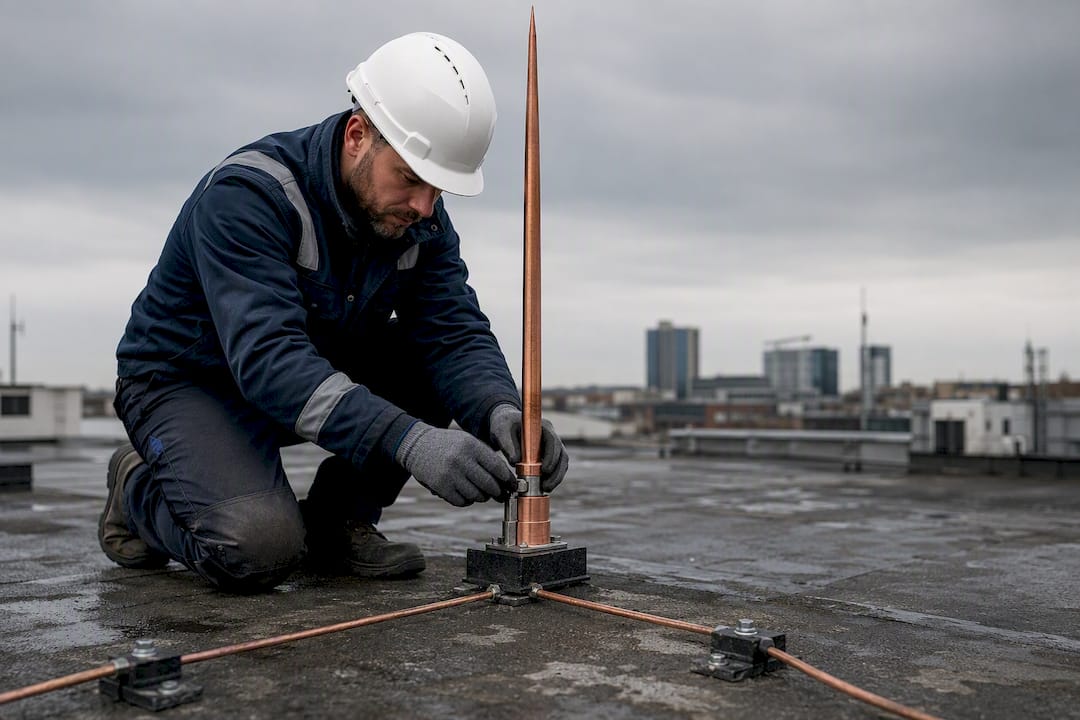
A turnkey lightning protection system for an industrial, commercial, or public infrastructure site in France can vary widely in cost depending on complexity, from relatively modest for simple single-mast installations to significantly higher for complex sites with deep earthing and multiple air terminals. That range covers the full scope: risk assessment, design, air terminals, downconductors, equipotential bonding, grounding, testing, and certification under NF C17-102. Deep earthing needs, roof access constraints, and the required protection level are what push a project from the low end to the high end.
TL;DR:
- Deep earthing and site access constraints can significantly increase costs, often doubling or tripling basic project estimates.
- Soil resistivity testing before finalizing designs can prevent costly adjustments, as poor conductivity leads to more expensive deep-drilled earthing solutions.
- The protection level required under NF C17-102 is the main cost driver, with higher risk sites demanding more air terminals, conductors, and stricter earthing tolerances.
- Certification, verification, and qualified technician credentials are mandatory and must be explicitly confirmed in all quotes to ensure compliance.
- A full risk assessment, detailed design, and on-site audit are essential to avoid unexpected expenses and secure an accurate, reliable turnkey lightning protection system.
Table of Contents
- What Drives the Cost of a Lightning Protection Installation
- What Affects the Cost of a Lightning Rod System
- NF C17-102 Compliance and Who Is Qualified to Install Your System
- Timeline from Audit to Certification
- Maintenance and Periodic Verification Costs
- How to Compare Quotes Without Getting Burned
- What Twenty Years of Turnkey Projects Teaches You About Budgeting
- Get an On-Site Audit and a Real Turnkey Quote
- Standards and Guidance Worth Consulting
- Sources
What Drives the Cost of a Lightning Protection Installation
Every turnkey quote breaks down into a handful of recurring line items, and understanding them is the only way to compare bids fairly instead of just comparing bottom-line numbers.
- Study and risk assessment: a technical evaluation of the structure, its contents, and its exposure, which determines the required protection level and the design that follows.
- Air terminals and masts: the early streamer emission (PDA) rods, their supports, and the masts that hold them at the right height above the protected zone.
- Downconductors and bonding: the cabling that carries a lightning strike safely to ground, plus the equipotential bonding connections to metal structures, pipework, and rooftop equipment.
- Earthing works: ground rods, meshes, or deep-drilled electrodes, sized to hit a target resistance value that depends heavily on soil conditions.
- Civil works and access: scaffolding, lift rental, roof penetrations, and any structural work needed to mount equipment safely.
- Testing and verification: continuity checks, earth resistance measurements, and the documentation package required for certification.
- Project management and site safety: coordination, permits, and the safety measures required for working at height or in hazardous zones.
A construction industry pricing reference lists an indicative unit price of €11,088.84 for a standard PDA lightning protection system, covering the mast, supports, conductors, earthing materials, an impact counter, and basic installation labor. Treat that figure as a generator estimate for a single, relatively simple installation, not as a firm quote for your site. A real industrial project usually involves several air terminals, longer conductor runs, and site-specific earthing work, all of which add to that baseline.
Optional extras worth budgeting for separately include surge protection coordination between the lightning protection system and your electrical panels, lightning impact counters for monitoring strike activity, and remote monitoring systems for critical infrastructure where downtime carries a real financial cost.
What Affects the Cost of a Lightning Rod System
The protection level required under NF C17-102 is the single biggest lever on price. A Level I system, reserved for the highest-risk structures, demands tighter mesh spacing, more air terminals, and stricter earthing tolerances than a Level IV system on a lower-risk building. Move up one protection level and you are not just adding a bit of hardware. You are often adding entire additional air terminal positions and their associated conductor runs.
Site characteristics matter just as much as the paperwork:
- Building height and shape: taller or more irregular roof lines need more terminals and longer conductor runs to keep every point within the calculated protection radius.
- Roof type and access: a flat industrial roof with clear access is cheap to work on; a steep slate roof, a listed building facade, or a site with restricted crane access adds scaffolding and labor hours fast.
- Soil resistivity: poor soil conductivity forces contractors toward deep-drilled earth electrodes rather than a shallow grid, and that single decision is one of the largest cost swings on an industrial project.
- Hazardous or explosive areas: ATEX zones and chemical storage sites require specialized bonding and intrinsically safe equipment, which raises both material and labor costs.
- Number of air terminals: more masts mean more conductors, more roof penetrations, and more testing points.
- Rooftop services: antennas, HVAC units, and solar panel arrays all need equipotential bonding into the system, and each one adds a connection point to design and verify.
Pro Tip:Commission a soil resistivity test during the initial audit, before the design is finalized. Finding out you need deep-drilled earthing after the quote is signed is the single most common source of budget overruns on industrial projects.
NF C17-102 Compliance and Who Is Qualified to Install Your System
NF C17-102 is the French standard governing lightning protection systems built around early streamer emission air terminals. It prescribes the design calculations, conductor specifications, earthing arrangements, and equipotential bonding requirements your system must meet, and it mandates specific documentation: a dossier d’exécution describing exactly what was installed, plus a verification report confirming it works as designed.

An INERIS note addressed to lightning protection professionals states that technical studies produced from October 2011 onward must apply NF C17-102 in full, and that a 40% safety coefficient applies to calculated protection radii where the 2010 arrêté governs the site. That guidance also underscores why recognized professional competency, through schemes like F2C and QUALIFOUDRE, matters: an under-specified design that skips this coefficient may look cheaper on paper and fail verification later.
Before signing anything, ask bidders for:
- Written confirmation of NF C17-102 compliance for the specific protection level assigned to your site.
- A sample dossier d’exécution and verification report template.
- Proof of F2C or QUALIFOUDRE qualification for the technicians assigned to your project.
Timeline from Audit to Certification
A turnkey installation moves through a predictable sequence, though the pace depends heavily on site complexity.
- Risk assessment and audit: typically one to two weeks, including the site visit and soil resistivity testing.
- Design and dossier d’exécution: one to three weeks depending on protection level and number of air terminals required.
- Procurement and mobilization: one to four weeks, longer if scaffolding, cranes, or specialized access equipment need scheduling.
- Installation works: anywhere from a few days for a simple single-mast system to several weeks for a multi-terminal industrial site with deep earthing.
- Testing and verification: a few days to measure earth resistance and continuity and compile the verification report.
- Certification handover: delivery of the final dossier, typically within a week of successful testing.
Deep drilling for earthing, permitting delays, and seasonal access restrictions (frozen or waterlogged ground, for instance) are the most common reasons a project stretches beyond its initial estimate. Coordinating the installation window with other trades already on site, such as roofing or HVAC work, tends to cut both cost and disruption.
Maintenance and Periodic Verification Costs
NF C17-102 defines three types of verification: an initial verification after installation, routine visual verifications (commonly annual), and a full verification at longer intervals or after any lightning event or structural modification.
- Visual verifications are the cheapest recurring cost and catch corrosion, loose connections, or physical damage early.
- Full verifications involve resistance testing and a more detailed inspection, and cost more per visit but less often.
- The same pricing reference cited earlier lists an illustrative 10-year maintenance cost of €554.44 for a standard unit, a useful order-of-magnitude reference rather than a quote for your specific system.
- Keeping verification records current is often a contractual requirement for property insurers, and a lapsed inspection can complicate a claim after a strike.
How to Compare Quotes Without Getting Burned
Ask every bidder for the same package so you are comparing technical completeness, not just a number on the last page.
- Request the full risk assessment and its stated protection level.
- Require a written NF C17-102 compliance statement and a draft dossier d’exécution.
- Ask for soil resistivity results or a firm commitment to test before finalizing the earthing design.
- Get the target earth resistance value and the verification report template in advance.
- Confirm who signs off on verification and their F2C or QUALIFOUDRE credentials.
- Get itemized unit prices for optional extras like surge coordination or impact counters.
Pro Tip:Ask each bidder for one consolidated scope-and-unit-price appendix rather than a lump sum. It is the fastest way to spot which contractor priced the earthing work realistically and which one is planning to hit you with change orders later.
What Twenty Years of Turnkey Projects Teaches You About Budgeting
The costs that blow past initial estimates are almost never the mast and the wiring. They are deep earthing when soil resistivity comes back worse than assumed, hoisting equipment onto a roof with no crane access planned, and bonding a rooftop full of HVAC units and solar arrays nobody accounted for at quote stage. Indelec has worked on lightning protection systems since 1955, and every project that stays on budget shares one trait: the earthing and access questions got answered before the contract was signed, not after. Prioritize contractors who can document their F2C or QUALIFOUDRE qualifications and who build verification into the process from day one, not as an afterthought.
— INDELEC
Get an On-Site Audit and a Real Turnkey Quote
Indelec is the option for facility owners who want one contractor accountable for the entire job, not a study from one firm and installation from another. Indelec designs and installs NF C17-102 compliant systems from the initial risk assessment through certification, backed by an in-house R&D center and decades of industrial project experience.

That means one point of contact for the soil resistivity test, the design, the earthing method, and the final verification report, so nothing falls through the cracks between subcontractors. If your site has never had a formal risk assessment, or your existing system is due for a full verification, request an on-site audit and a detailed quote from Indelec’s lightning protection team and get a cost breakdown built around your actual roof, soil, and protection level, not a generic estimate.
Standards and Guidance Worth Consulting

Ask any bidder to reference NF C17-102 for design compliance, the INERIS/QUALIFOUDRE note for qualification proof, and Indelec’s standards overview for a plain-language summary.
Sources
- NF C17-102 — Protection contre la foudre – Systèmes de protection contre la foudre à dispositif d’amorçage
- Note d’informations aux professionnels de la protection contre la foudre (INERIS / QUALIFOUDRE guidance)
- Prix-construction