IRVE Energy Management: How to Control Charging Power
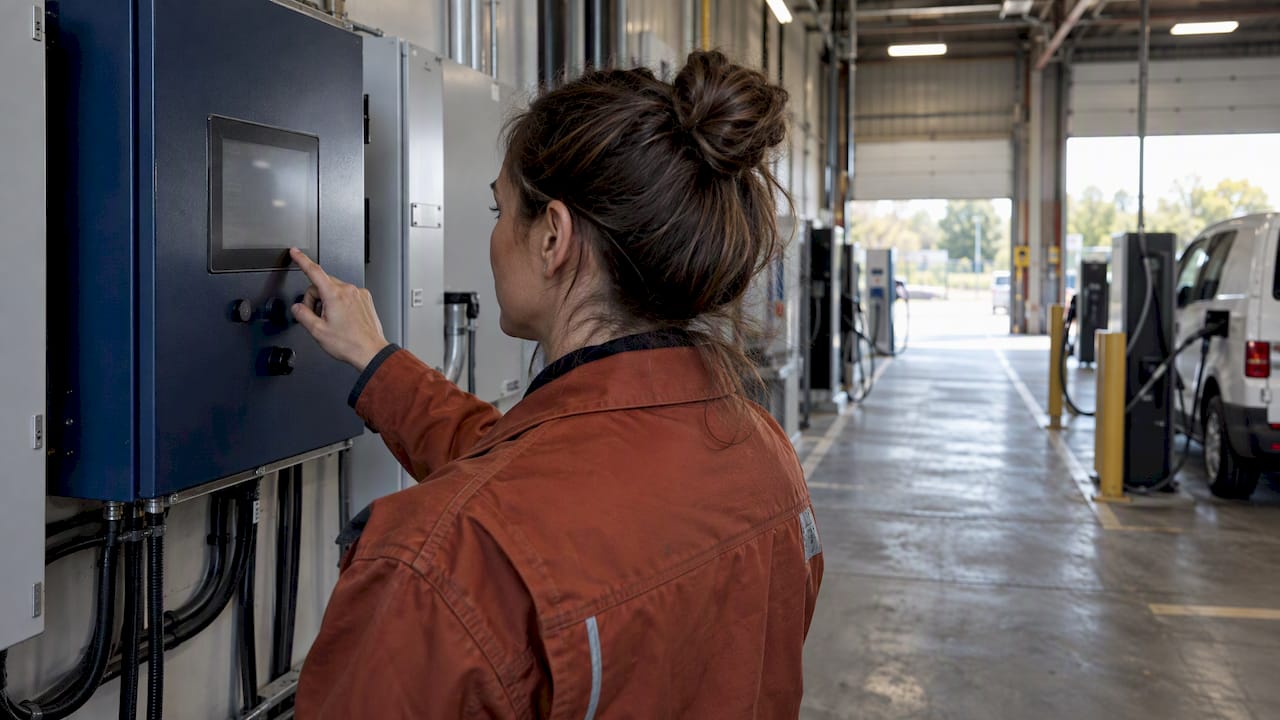
Energy management for an IRVE (the French term for EV charging infrastructure) is the set of functions that decide when each vehicle charges and how much power it draws, so the whole site stays within its available electrical capacity. It is a property of the installation, not of a single charger. If you are planning, extending or operating charging points in a building, a depot or an industrial site, this is the layer that determines whether you need a costly power upgrade, how large your bill gets and how well charging works with your solar panels.
Below, we cover what the French regulation means by “pilotage”, the difference between static and dynamic control, the equipment and protocols involved, how to link charging with photovoltaics, and what to assess before you commit.
TL;DR
- French law defines pilotage de la recharge as the ability to modulate the power drawn or to schedule charging. It applies to the infrastructure as a whole, including circuits, control cabinets and data links.
- Static control follows predictable rules (off-peak hours, subscribed power). Dynamic control reacts to live data from the building, the meter or the grid.
- A complete architecture combines current sensors or meters, a controller, chargers that can obey a setpoint, a communication network and a supervision system.
- Smart charging can also follow on-site solar production, and in some setups the vehicle can feed energy back (V2H, V2G).
- Design starts from usage and from subscribed power and connection capacity, not from the number of chargers you would like.
Table of Contents
- What “pilotage énergétique” means for an IRVE
- Static vs. dynamic control
- How dynamic load management allocates power
- Equipment and communication: what a complete architecture contains
- Four charging modes: from delayed charging to V2G
- Coordinating charging with solar production
- What to assess before you design, extend or maintain
- Common mistakes to avoid
- Our perspective
- Getting a project started with Indelec
- FAQ
- Sources
What “pilotage énergétique” means for an IRVE
The French regulation gives precise definitions. Decree no. 2021-546 of 4 May 2021 defines pilotage de la recharge as the capacity to modulate the power drawn or to schedule the charging of an electric vehicle. The same text defines the charging infrastructure as all the equipment needed for charging: circuits, charging points, control and management cabinets, and the devices for data transmission and, where relevant, supervision, control and payment.
Two consequences follow.
- Energy management is part of the infrastructure. It is not an accessory you add to a charger. The control cabinet, the communication links and the supervision layer belong to the same definition as the charging point.
- A charger is not a strategy. A charging point that can receive a power setpoint is one component. The strategy decides what that setpoint should be at any given minute, taking into account your subscribed power, your other loads, your vehicles and possibly your solar production.
The decree also provides that infrastructures must allow charging to be controlled, with an order from the ministers in charge of energy and transport setting the characteristics. Before you specify equipment, check the current text of that order with your installer or design office.
Static vs. dynamic control
In its 2024 report on controlling EV charging, Enedis separates two families.
- Static control relies on predictable rules: peak and off-peak hours, user-defined schedules, or staying under the subscribed power.
- Dynamic control uses external data that changes over time.
Enedis also describes static control as already largely industrializable and inexpensive. Dynamic control is more complex and more costly, but brings more value to the customer, the power system and the grid.
| Criterion | Static control | Dynamic control |
|---|---|---|
| Logic | Fixed rules and schedules | Live data: site load, tariffs, solar output, grid signals |
| Typical use | Overnight charging for a fleet, a fixed cap per charger | Mixed sites where charging competes with other loads |
| Complexity | Low | Higher: sensors, controller, communication |
| Cost | Low | Higher, but can avoid a larger connection |
| Main benefit | Predictable bill, simple to run | Maximum charging within real-time limits, solar self-consumption, grid flexibility |
Many sites start with static rules and move to dynamic control when they add chargers, add a photovoltaic plant or hit the limit of their subscribed power. Choosing hardware and a controller that can grow in that direction costs far less than replacing them later.
How dynamic load management allocates power
The principle is simple: the system continuously measures what the rest of the site is consuming, compares it with the maximum capacity of the connection or the subscribed power, and gives the remainder to the vehicles. A technical white paper from an electrical equipment manufacturer describes the dynamic approach as a digital model of the electrical installation and its other loads, adjusting the energy available so charging is as fast as possible without exceeding electrical limits.
Here is an illustration with round numbers of our own, not a client case. A building has 100 A available on its main supply for the shared services plus charging.
- At midday, the building draws 70 A. The controller leaves 30 A for the chargers and splits it among the connected vehicles.
- At 2 a.m., the building draws 15 A. The controller releases 85 A to charging.
- If a lift or a heat pump starts, the controller lowers the charging setpoint within seconds instead of letting the main breaker trip.
The chain works like this. A meter or current sensor measures the real load. A controller applies the allocation rule (equal split, priority to certain vehicles, departure-time logic). It sends each charging point a maximum available power, and the vehicle then reduces or increases its charging power automatically. This is also what lets you install more chargers than the connection could support if they all ran flat out.
For a step-by-step view of what this means for your capacity, see our guide on IRVE load shedding for owners and facility teams, and on parking lots, our article on sizing IRVE with the 20% rule.

Equipment and communication: what a complete architecture contains
The Avere-France white paper on charging control and vehicle-to-everything describes a complete architecture with the following blocks:
| Block | Role |
|---|---|
| Meters or current sensors | Measure site load and charging current |
| Controller or control cabinet | Applies the allocation rules and computes setpoints |
| Chargers able to apply a setpoint | Execute the power limit or schedule |
| Communication network | Carries data between sensors, controller and chargers |
| Supervision / CSMS | Monitors, configures and reports on the charging points |
| Interfaces | Link to the vehicle, the building, the meter or the energy supplier |
Two protocols come up in almost every specification. According to the same white paper, ISO 15118 covers the exchanges between the vehicle and the charging point, while OCPP covers, among other things, the link between charging point and supervision system. Ask any supplier which versions they support, and whether the controller works with chargers of different brands. That question tells you quickly how locked in you will be.
Do not forget the electrical protection of the whole chain. Chargers sit outdoors or in car parks and are exposed to overvoltages, which is one of the reasons commissioning checks can fail. Our article on surge protection for French EV chargers explains how to avoid Consuel rejections.
Four charging modes: from delayed charging to V2G
The Avere-France white paper distinguishes four modes:
- Delayed charging: the start is shifted in time.
- Variable power: the power drawn is modulated during the session.
- V2H (vehicle-to-home or building): the vehicle can discharge into the building.
- V2G (vehicle-to-grid): the vehicle can return energy to the grid.
The first two are unidirectional, the last two bidirectional. Enedis uses the shorthand V1G for a power modulation or time shift without energy being returned, and V2G for energy flowing from the vehicle battery to the building or the grid.
What each mode requires from the energy management layer differs:
- In V2H, according to Avere-France, the local energy manager talks with the charging point to optimize the building’s consumption, the battery charge or discharge, the subscribed power and variable tariffs.
- In V2G, the local manager must receive instructions from an aggregator or service provider: charge or discharge periods, limit power, tariffs and renewable production forecasts.
For most industrial and commercial sites today, delayed charging and variable power cover the real need. Bidirectional charging deserves a feasibility study when you have a stationary fleet, a high self-consumption target or a flexibility market in view, and the decree’s definition of a bidirectional charging point shows it is already part of the regulatory vocabulary.
Coordinating charging with solar production
If your site has or will have photovoltaic panels, energy management is how the two work together. Enedis notes that control can synchronize charging with local photovoltaic production, in particular to favor self-consumption. It adds that dynamic control can optimize the bill, synchronize charging with local renewable output and provide flexibility to the power system or the grid.
The national picture explains why this is encouraged. In a 2024 release on expert opinions, ADEME defines flexibility as the ability to change the timing or the power of injection or withdrawal, and says charging control can align consumption with periods of high solar output. It also cites RTE work with a 2035 scenario of 45 to 50% renewables, 65 GW of solar and 18 million electric vehicles, and presents charging control as a lever for integrating that production.
For a company car park, the practical translation is a charging policy that fills vehicles from rooftop or carport production during the day, falls back to the grid when the sun is low and respects the subscribed power at all times. Regulations on photovoltaics in parking areas affect how you plan this; our guide to IRVE and photovoltaic rules for facility managers covers the 1 June 2026 requirements.

What to assess before you design, extend or maintain
Enedis recommends that teams begin with usage and mobility needs, then look at subscribed power and connection capacity, and only then choose the type of control that fits. We would structure the assessment this way.
1. Usage profile
How many vehicles, how long do they stay, what daily energy do they need? A fleet parked from 6 p.m. to 7 a.m. rarely needs fast dynamic control. A visitor car park with unpredictable arrivals does.
2. Power available
Compare the subscribed power and the connection capacity with the other loads. If the 36 kVA threshold matters to you for fleet sizing, our article on staying under 36 kVA shows how control makes it possible.
3. Storage or bigger connection
Batteries can lower the connection power required, but they have their own footprint. An ADEME life-cycle study published in 2026 examines a fast-charging IRVE with and without storage. For a peri-urban site with six 100 kW chargers, it compares a 600 kVA medium-voltage connection with a low-voltage system using a 1.8 MWh battery and a 250 kVA connection, and finds all environmental indicators better for the medium-voltage option without battery. The lesson is to compare the battery with a stronger grid connection, not to assume it is the greener choice.
4. Grid timelines
A larger connection can take months. In industrial settings, control and good grounding design help you avoid waiting; see how to avoid 6 to 12 month grid delays.
5. Whole-installation view
Charging rarely stands alone. If your site also runs electric handling machines, trucks or construction equipment, the energy question extends beyond cars and vans, as this guide to electric heavy equipment for fleet decision-makers shows. Your controller should see all of those loads.
6. Maintenance and qualification
The control layer needs updates, communication checks and testing like any other equipment. Match the maintenance level to the criticality of your site with our article on MA1, MA2 or MA3 maintenance, and verify installer credentials using the IRVE qualification check before signing. For cost framing, see what French charging stations cost for fleets and sites.
Common mistakes to avoid
- Buying chargers first and control later. If the chargers cannot take a setpoint from an external controller, you may have to replace them.
- Measuring at the wrong point. The sensor must see the total load of the supply being protected, not only the charging circuits.
- Ignoring communication failures. Define what chargers do when they lose contact with the controller: fall back to a safe fixed limit rather than full power.
- Treating solar coordination as an afterthought. Plan the metering and the data link when you design the plant, not after.
- Forgetting protection. Overvoltage and earthing quality affect the availability of the whole system.
Our perspective
At Indelec we come to EV charging from the side of electrical protection: more than 280,000 installations and a history that goes back to 1955 have taught us that an installation is only as reliable as its weakest component. Energy management is no different. A well-tuned controller is of little use if the chargers drop out after an overvoltage or if the earthing is inadequate.
We see three habits that separate good projects from costly ones. First, size from the real usage and the real subscribed power, not from a target number of chargers. Second, treat control, protection and earthing as one design, with one owner. Third, plan maintenance from day one, because a control layer that nobody checks drifts away from the site it was configured for.
Our teams audit, install and supervise charging infrastructure for professional fleets, alongside our lightning and surge protection work, so the question of what happens during a storm is answered in the same study as the question of how power is shared.
— INDELEC
Getting a project started with Indelec
If you are planning charging for a fleet or a site, we can audit your existing electrical installation, define the right level of control, install the infrastructure and supervise commissioning, with protection against lightning and surges designed in from the start. Learn more about Indelec Mobility, or contact us through our services page to discuss your site.
FAQ
Is energy management mandatory for an IRVE in France?
Decree no. 2021-546 provides that infrastructures must make it possible to control charging, and an order from the energy and transport ministers sets the characteristics. The exact obligations depend on your type of site and building, so confirm them against the current texts with your installer or design office.
What is the difference between static and dynamic control?
Static control applies predictable rules such as off-peak hours, user schedules or a fixed cap tied to subscribed power. Dynamic control uses live external data, such as site load or solar output, to adjust power continuously. Static is simpler and cheaper; dynamic gives more value on complex sites.
Do I need OCPP and ISO 15118?
They serve different links. ISO 15118 covers communication between vehicle and charging point, and OCPP covers, among other things, communication between charging point and supervision system. Ask your supplier which versions their chargers support and whether they interoperate with your controller.
Can charging follow my solar production?
Yes. Enedis and ADEME both describe charging control as a way to match consumption with local photovoltaic output and favor self-consumption. It requires metering of production and consumption and a controller able to adjust charger setpoints.
Is a battery better than a bigger grid connection?
Not necessarily. A 2026 ADEME life-cycle study found that for a peri-urban site with six 100 kW chargers, the medium-voltage connection without battery performed better on every environmental indicator than the battery-based alternative. Compare both options for your own site.
Sources
- Décret n° 2021-546 du 4 mai 2021, Légifrance
- Enedis, Le pilotage de la charge des véhicules électriques (2024)
- Avere-France, Pilotage de la recharge et Vehicle-to-Everything (2023)
- ADEME, avis d’experts sur la flexibilité du système électrique (2024)
- ADEME, Analyse de cycle de vie de cas d’usages du stockage d’électricité IRVE (2026)