How to Coordinate Multi-Site Protection: A Manager’s Guide

TL;DR:
- Effective multi-site protection requires a full estate audit, centralized policy management, and integrated monitoring platforms. An RSOC provides scalable, cost-efficient security oversight, combining governance with site-specific hazard protocols. Addressing external risks like lightning and electrical surges is essential to maintaining operational resilience across all locations.
Multi-site protection coordination is the centralized management of security and safety systems across two or more physical locations to deliver consistent coverage against external hazards. Facility managers and safety officers at organizations with distributed sites face a specific challenge: fragmented systems create blind spots that local teams cannot resolve on their own. Over 60% of enterprise organizations with fragmented security systems struggle with visibility and control. That statistic explains why unified management platforms, tools like Genetec and Cobalt AI, and centralized monitoring services have become the standard approach for how to coordinate multi-site protection at scale.
What prerequisites and tools do you need before coordinating multi-site protection?
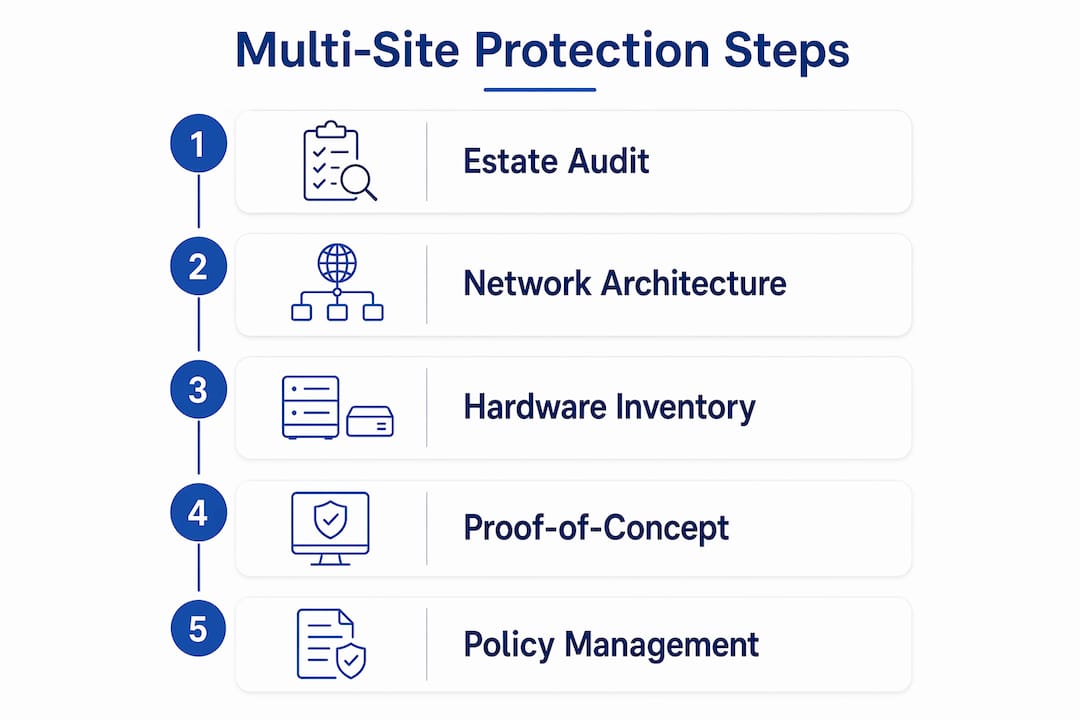
The single most important step before selecting any platform is completing a full estate audit. Skipping the estate audit is the most frequent cause of security project failures in multi-site estates. The audit maps every camera, access reader, alarm panel, and network switch across all locations. It identifies which hardware can be retained, what needs replacement, and where integration gaps exist.
Networking architecture is the second prerequisite most facility managers underestimate. VPN overlays on SD-WAN or MPLS fabrics isolate security traffic from operational data, preventing bandwidth congestion and timestamp mismatches that corrupt event correlation. NTP synchronization anchored to GPS sources keeps forensic logs accurate across every site. Without this foundation, even the best monitoring platform produces unreliable data.
The table below shows the core tools and prerequisites for a coordinated multi-site security program.
| Tool or Prerequisite | Purpose | Example |
|---|---|---|
| Estate audit | Inventory existing hardware and integration points | Site walkthrough with asset register |
| SD-WAN or MPLS with VPN overlay | Isolate and secure security network traffic | Cisco SD-WAN, Fortinet SD-WAN |
| Cloud video management system (VMS) | Centralize camera feeds across all sites | Genetec Security Center, Milestone XProtect |
| Access control platform | Manage badge and entry policies portfolio-wide | Genetec, Brivo, LenelS2 |
| Unified monitoring dashboard | Single view of alarms, events, and access logs | Cobalt AI, Immix |
Key capabilities to confirm before committing to a platform:
- API support for your existing camera and access control hardware
- Role-based access so local site managers see only their location
- Cloud gateway compatibility for sites without dedicated IT infrastructure
- Audit log export in a standard format for compliance reporting
Pro Tip:Run a lab proof-of-concept with your two most hardware-diverse sites before full rollout. If the platform handles those two, it will handle the rest.
How to implement centralized policy management across all locations
Portfolio-level policy standardization is the operational core of multi-site security management. Global settings for camera retention, badge expiration, and incident response can be pushed through cloud platforms to every site simultaneously. That eliminates the compliance drift that occurs when local administrators manage settings independently. One policy change in the central console propagates everywhere within minutes.
The steps below create a repeatable policy deployment process:
- Define the global baseline. Set minimum standards for camera retention periods, access badge expiration cycles, and alarm response times. These apply to every site without exception.
- Identify site-level variables. Some locations carry higher risk due to geography, occupancy, or hazard exposure. Document those differences before writing escalation protocols.
- Build escalation trees per site. Each location needs a named first responder, a backup contact, and a defined handoff to emergency services. The tree lives in the central platform but reflects local conditions.
- Push and verify. Deploy the global policy from the central console, then audit two or three sites manually to confirm settings applied correctly.
- Schedule quarterly reviews. Regulations change, staff turns over, and hazard profiles shift. A fixed review cycle prevents policy decay.
The “unified-but-local” model is the most effective governance structure for multi-site organizations. It creates a single security fabric for portfolio-level governance while giving local teams the flexibility to adapt procedures to their specific environment. A warehouse in a high-lightning-frequency zone, for example, needs lightning risk protocols that a downtown office building does not.
Pro Tip:Never apply identical escalation protocols to every site. A remote industrial facility and an urban office building face different response times and hazard types. Tailor the escalation tree, but keep the documentation format identical across all sites.
How do you integrate diverse security systems into one monitoring platform?
Modern multi-site security platforms support integration with diverse access control and VMS hardware through cloud gateways or APIs, without requiring hardware standardization across every site. That matters because most organizations have years of mixed-vendor installations. Replacing all hardware at once is cost-prohibitive and operationally disruptive.

The practical approach is phased migration. APIs and modular gateways allow incremental improvements without shutting down live security operations. A site running an older Bosch or Axis camera system can feed into a Genetec or Milestone cloud layer while newer sites run fully standardized hardware. The management layer becomes consistent even when the hardware layer is not.
Key integration capabilities that define a workable unified platform:
- Filterable event grid: Alerts sorted by site, time, incident type, and severity in a single view
- Bidirectional API connections: The platform can receive events and send commands back to field devices
- Cloud gateway support: Sites without on-premises servers connect through a lightweight gateway appliance
- Legacy encoder compatibility: Analog cameras convert to IP streams without full camera replacement
Platforms like Cobalt AI and Genetec Security Center both support this hybrid model. Cobalt AI’s multi-site solution specifically provides unified event filtering by location, date, and incident type, which reduces alarm fatigue for central operators managing dozens of sites.
Pro Tip:Before signing any integration contract, request a written interoperability matrix from the vendor. It should list every camera model, access reader, and alarm panel in your estate and confirm API support for each. Verbal assurances are not sufficient.
What role does a Remote Security Operations Center play in multi-site protection?
A Remote Security Operations Center, or RSOC, is a centralized monitoring facility that manages security feeds, alarms, and incident responses for multiple client sites from a single location. Adding a site to an RSOC requires integrating camera feeds and defining escalation protocols, not hiring new on-site guards. That distinction is the economic argument for RSOCs at scale.
The comparison below shows the practical difference between local guard staffing and a centralized RSOC model.
| Factor | Local site staffing | Centralized RSOC |
|---|---|---|
| Cost per added site | High (new hire, training, benefits) | Marginal (feed integration, protocol setup) |
| Documentation consistency | Varies by individual | Standardized across all sites |
| Coverage hours | Limited by shift schedules | Near continuous monitoring |
| Escalation protocol | Site-dependent | Uniform with site-specific variables |
| Audit trail quality | Inconsistent | Centralized and complete |
Standardized documentation and incident log formats combined with site-specific escalation protocols enable consistent portfolio-level reporting. Single-provider RSOC models eliminate the vendor inconsistency that plagues multi-vendor arrangements. For facility managers overseeing 30 or more locations, an RSOC is not a luxury. It is the only model that delivers near round-the-clock coverage without proportional cost increases.
How to troubleshoot common mistakes when coordinating site protection
Most multi-site security projects fail at predictable points. Recognizing those failure modes before they occur saves months of remediation work.
- Skipping the estate audit. Teams that jump directly to platform selection discover mid-deployment that half their hardware is incompatible. Complete the audit first, always.
- Over-relying on VPN without proper architecture. A VPN alone does not isolate security traffic from general operational data. Without SD-WAN or MPLS segmentation, bandwidth contention degrades video quality and corrupts timestamps.
- Applying identical escalation protocols everywhere. A protocol designed for a staffed urban office fails at an unstaffed remote facility. Site-specific escalation trees are not optional.
- Ignoring natural hazard risk in the security design.Integrating climate and natural hazard risk analysis into multi-site protection improves resilience and should be part of site lifecycle management. Lightning, flooding, and extreme wind each require specific protective measures layered into the broader security program.
- Fragmenting vendors without a governance plan. Using five different access control vendors across 20 sites without a unified management layer creates coordination overhead that grows with every new site.
Pro Tip:Engage an experienced systems integrator for the estate audit phase, not just the installation phase. Integrators who have worked across multiple industries will identify integration risks that internal teams miss.
For industrial site protection teams, the troubleshooting process also needs to account for external physical hazards like lightning and electrical surges, which fall outside the scope of most digital security platforms but cause significant operational disruption.
Key Takeaways
Coordinating multi-site protection requires a full estate audit, centralized policy management, integrated monitoring platforms, and an RSOC model to deliver consistent coverage without proportional cost increases.
| Point | Details |
|---|---|
| Start with an estate audit | Map all hardware and integration points before selecting any platform or vendor. |
| Isolate security network traffic | Use VPN overlays on SD-WAN or MPLS to prevent bandwidth issues and timestamp errors. |
| Standardize policies centrally | Push global settings for retention, badge expiration, and incident response from one console. |
| Use phased hardware integration | Connect legacy systems via APIs and cloud gateways before replacing hardware. |
| Deploy an RSOC for scale | Centralized monitoring adds sites at marginal cost versus hiring local guards at each location. |
Indelec’s perspective on coordinating multi-site protection
Multi-site protection is a governance problem before it is a technology problem. We have seen organizations invest in excellent monitoring platforms and still fail because no one defined who owns the escalation decision at 2 a.m. on a Sunday. The technology surfaces the event. The governance structure determines whether anyone acts on it.
The “unified-but-local” model reflects what actually works in practice. Central governance sets the floor: minimum retention periods, mandatory escalation contacts, standardized log formats. Local teams set the ceiling: site-specific hazard protocols, relationships with local emergency services, and adaptations for physical conditions that no central team can fully anticipate.
One area that multi-site security programs consistently underweight is external physical hazards. Digital intrusion gets most of the attention, but a direct lightning strike on an unprotected industrial site causes more immediate operational damage than most cyber events. Incorporating lightning risk, surge protection, and grounding into the site security design is not a separate workstream. It belongs in the same lifecycle management framework as access control and video surveillance.
The organizations that sustain effective multi-site protection over time are the ones that treat it as a continuous program, not a deployment project. Regular portfolio reviews, phased technology upgrades, and a clear relationship with a qualified integrator are what separate programs that hold up from programs that degrade quietly until something goes wrong.
— Indelec
Indelec’s solutions for multi-site external hazard protection
Physical hazards like lightning are among the most underestimated risks in multi-site facility management. Indelec has specialized in electrical protection since 1955, developing solutions that address the external hazard layer that digital security platforms do not cover.

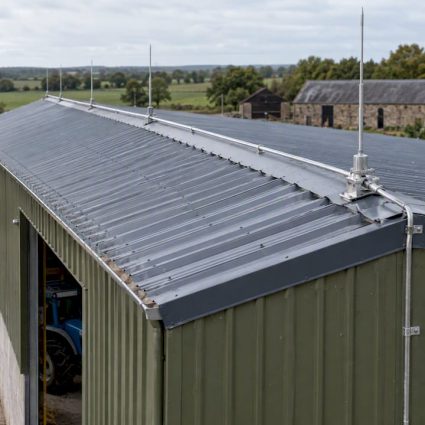
The Prevectron3 air terminal uses Indelec’s patented OptiMax technology to provide early streamer emission protection for industrial, commercial, and infrastructure sites. For facilities with challenging soil conditions, Indelec’s deep earth grounding drilling service delivers reliable grounding where standard installations cannot. Indelec also provides lightning protection system consulting to help facility managers design site-specific protection that integrates with their broader multi-site safety program. A preventive approach to electrical maintenance planning further reduces the risk of hazard-related downtime across your portfolio.
FAQ
What is multi-site security management?
Multi-site security management is the centralized oversight of security systems, policies, and monitoring across two or more physical locations. It uses unified platforms, standardized protocols, and often an RSOC to deliver consistent coverage.
Why do multi-site security projects fail?
Skipping the estate audit before platform selection is the most common cause of failure. Without a full hardware inventory, integration planning is based on incomplete information, leading to costly mid-project corrections.
How does an RSOC reduce costs for multi-site organizations?
An RSOC adds new sites by integrating camera feeds and defining escalation protocols, not by hiring additional guards. That model delivers coverage without linear cost growth as the number of locations increases.
Do all sites need identical hardware for unified monitoring?
No. Modern platforms like Genetec and Cobalt AI connect diverse hardware through APIs and cloud gateways. The management layer becomes consistent even when the underlying hardware varies by site.
How does lightning protection fit into multi-site security coordination?
Lightning and electrical surge protection address the external physical hazard layer that digital security platforms do not cover. Incorporating grounding systems and air terminals into site lifecycle management strengthens overall resilience across the portfolio.