Communication Tower Protection: A Complete 2026 Guide
TL;DR:
- Protection for communication towers is an integrated system of safety measures designed to prevent structural failure and injuries. It includes lightning protection, grounding, surge devices, and safety protocols that require continuous maintenance and compliance with standards. Failure to keep all components properly updated and documented increases the risk of damage and accidents.
Protection for communication towers is defined as an integrated system of physical, electrical, and procedural safeguards designed to prevent structural failure, equipment damage, and personnel injury. What is protection for communication towers, in practical terms? It is the combination of lightning protection systems, low-resistance grounding networks, surge protective devices, fall arrest protocols, and corrosion control measures that keep towers operational and compliant. Standards such as IEC 62305, NFPA 780, OSHA 29 CFR 1926 Subpart R, and FCC § 73.49 form the regulatory backbone of every credible protection program. For telecom engineers and facility managers, understanding each layer of this system is the difference between planned maintenance and unplanned outages.
What is protection for communication towers and why does it matter?
Protection for communication towers is not a single product or a one-time installation. It is a coordinated system where every component depends on the others to function correctly. A lightning rod without a proper grounding network is nearly useless. A grounding network without surge protection leaves sensitive electronics exposed. The system only works when all layers are present, correctly installed, and regularly maintained.
Communication towers are among the most lightning-prone structures on earth. Their height, isolated locations, and metal construction make them natural targets. A direct strike can destroy transmitters, disable emergency broadcast systems, and injure or kill workers on site. Beyond lightning, towers face RF radiation hazards, structural corrosion, and fall risks that require equally serious countermeasures.
Regulatory bodies recognize this complexity. IEC 62305 sets the international standard for lightning protection system design, covering risk assessment, component selection, and installation requirements. NFPA 780 serves the same role in the United States. OSHA governs worker safety during climbing and maintenance operations. FCC rules address RF exposure and site access. Compliance with all four frameworks is the baseline for any professionally managed tower site.
What are the essential components of lightning protection for communication towers?
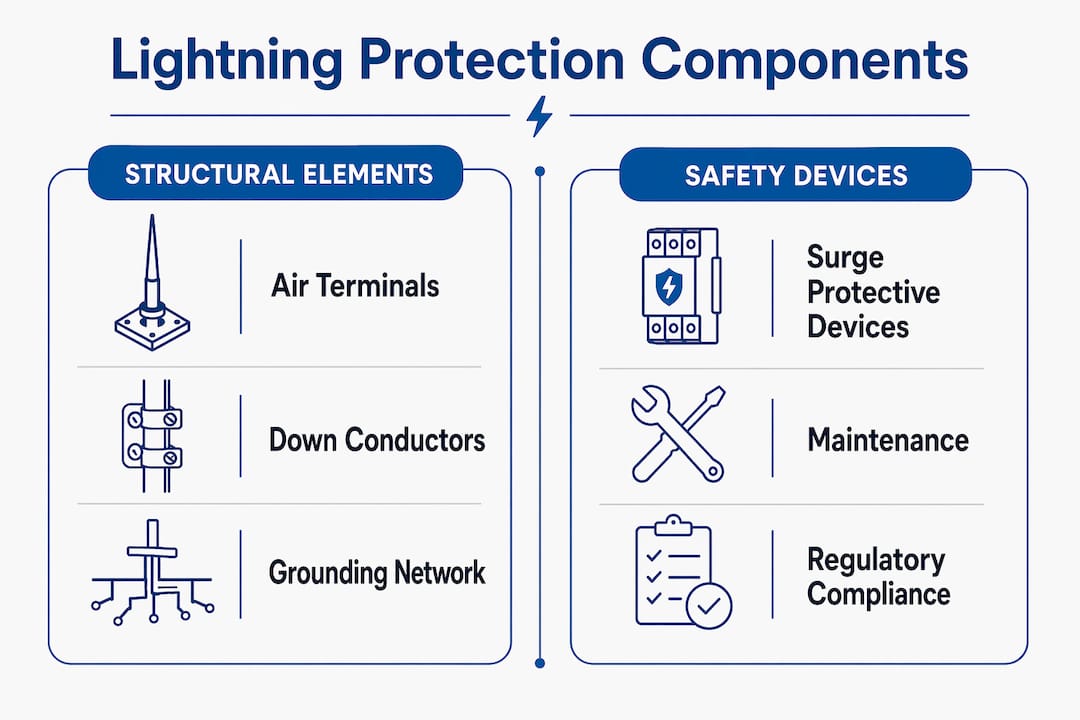
Effective lightning protection consists of four core components: air termination systems, down conductors, a grounding network, and multi-stage surge protective devices. Each component handles a specific part of the lightning event, from initial strike capture to safe energy dissipation into the earth.
Air termination systems
Air terminals, commonly called lightning rods, intercept the lightning strike before it reaches the tower structure or its equipment. Placement follows IEC 62305 protection angle and rolling sphere methods to calculate coverage zones. A single poorly placed rod leaves gaps that a strike will find. Engineers must model the full tower geometry, including antenna arrays and equipment cabinets, when designing the air termination layout.
Down conductors and grounding networks
Down conductors carry the captured lightning current from the air terminal to the grounding network. The conductor path must be as direct as possible, with no sharp bends that could cause side flashing to nearby equipment. The grounding network itself must achieve a resistance under 10 Ohms as specified by IEC 62305. That threshold matters because higher resistance forces more energy to dissipate through the tower structure rather than the earth, increasing equipment damage and fire risk.

Surge protective devices
Surge protective devices (SPDs) protect the power and data lines that connect tower equipment to the broader network. Lightning does not need to strike a tower directly to cause damage. A nearby strike induces voltage transients on power lines that can destroy transmitters and network hardware hundreds of meters away. Multi-stage SPDs, compliant with IEC 62305 or NFPA 780, filter these transients at the service entrance and at individual equipment cabinets.
Partial modifications or removal of lightning protection components without simultaneous grounding updates can introduce new hazardous current paths and increase risk. This is one of the most common and costly mistakes in tower maintenance.
Pro Tip:Before any antenna upgrade or equipment addition, commission a full lightning protection audit. New metallic structures change the electromagnetic environment and may require repositioning air terminals or adding SPD stages.
| Component | Primary function | Key standard |
|---|---|---|
| Air terminal (lightning rod) | Intercepts direct lightning strikes | IEC 62305, NFPA 780 |
| Down conductor | Routes strike current to ground | IEC 62305 |
| Grounding network | Dissipates energy safely into earth | IEC 62305 (<10 Ohms) |
| Surge protective device | Blocks transient voltages on power/data lines | IEC 62305, NFPA 780 |
How do grounding and surge protection safeguard tower infrastructure?
Grounding is the foundation of every electrical protection system on a communication tower. Without a low-resistance path to earth, lightning energy has nowhere to go except through the equipment. Achieving the target resistance of under 10 Ohms is straightforward in conductive soil but requires deep earth grounding techniques in rocky or dry terrain.
Surge protective devices work alongside the grounding system, not as a replacement for it. SPDs clamp transient voltages on incoming power and signal lines, but they discharge that energy through the ground. A high-resistance ground defeats the SPD’s function entirely. This interdependence is why grounding and surge protection must always be designed and tested as a single system.
Uninterruptible power supplies (UPS) combined with surge protectors safeguard sensitive electronic equipment from lightning-induced electrical surges on communication lines. A UPS provides an additional buffer against power interruptions that SPDs alone cannot prevent, particularly during extended outages following a nearby strike event.
Best practices for grounding and surge protection include:
- Test grounding resistance annually and after any significant soil disturbance or construction activity near the tower base.
- Install SPDs at every point where external lines enter the equipment shelter, including power feeds, coaxial cables, and Ethernet connections.
- Bond all metallic structures on site, including fencing, equipment racks, and cable trays, to the common grounding electrode system.
- Document all resistance measurements and SPD test results to support compliance audits under IEC 62305 and NFPA 780.
Pro Tip:When a facility modification changes the cable routing or adds new equipment shelters, retest the entire grounding system. New bonding connections can inadvertently create ground loops that degrade protection performance.
What safety protocols and regulatory requirements protect workers on communication towers?
Worker safety on communication towers is governed by OSHA 29 CFR 1910.269 and 1926 Subpart R. OSHA mandates 100% tie-off using personal fall arrest systems (PFAS) for all tower climbing operations, with anchor points rated to support 5,000 lbs per worker. Pre-established rescue plans are required to address suspension trauma, which can become life-threatening within minutes of a fall arrest event. These are not optional best practices. They are federal law.
RF radiation exposure is a separate and often underestimated hazard. Personal RF monitoring devices and regular site assessments help engineers manage radiation exposure. Never assuming a site is safe is the foundational principle of RF safety compliance. Transmitters may be active on frequencies that a worker’s standard RF meter does not cover, making comprehensive monitoring equipment non-negotiable.
FCC rule § 73.49 mandates fencing for AM tower structures to minimize RF exposure risk. AM towers act as radiators, meaning the structure itself carries RF energy. Locked perimeter fencing prevents public contact with the tower base and reduces site liability. FM towers do not carry the same regulatory requirement, but controlled access remains an industry best practice.
Essential worker safety practices for communication tower sites:
- Conduct pre-climb safety briefings covering weather conditions, active transmitter status, and emergency contact procedures.
- Verify PFAS equipment inspection dates before every climb. Harnesses and lanyards have defined service life limits.
- Post RF exposure warning signs at all site entry points and update them when new transmitters are added.
- Maintain a current site safety plan that reflects actual transmitter configurations and power levels.
- Train all personnel on rescue procedures for suspended workers, not just the primary climber.
How does routine maintenance and corrosion control extend tower life?
Tower maintenance is a risk management activity that prevents severe operational and financial consequences. Routine inspections prevent catastrophic tower failure and should follow a structured schedule: quarterly checks of lighting systems and perimeter fencing, plus detailed structural reviews every one to two years under ANSI/TIA-222. Skipping a quarterly check rarely causes immediate failure, but deferred maintenance compounds into structural deficiencies that are far more expensive to correct.
Corrosion control via resistant materials, specialized coatings, and cathodic protection is fundamental for multi-decade tower durability, especially in coastal, industrial, or high-humidity environments. Salt air accelerates galvanic corrosion at bolted connections. Industrial pollution deposits acids on tower surfaces. Without protective coatings and regular inspection, a tower that should last 40 years may require major structural repair within 15.
A thorough inspection program covers these areas in sequence:
- Grounding system: Measure resistance at all grounding electrodes and inspect bonding connections for corrosion or mechanical damage.
- Structural hardware: Check all bolts, guy wire anchors, and connection plates for corrosion, cracking, or loosening.
- Antenna and transmission line mounts: Inspect for corrosion at coaxial connectors, weatherproofing integrity, and secure mounting.
- Aviation lighting: Verify all obstruction lights are functional and compliant with FAA requirements for the tower’s height and location.
- Perimeter fencing and signage: Confirm fencing integrity, gate lock function, and legibility of all warning signs.
Corrosion control is fundamental for multi-decade tower durability. Integrating protective coatings and cathodic protection into the initial design is far less expensive than retrofitting corroded structures.
Pro Tip:Deploy drone-mounted inspection cameras and corrosion sensors for hard-to-reach tower sections. Drones reduce climber exposure during routine visual checks and produce photographic records that support insurance claims and regulatory audits.
Key Takeaways
Effective communication tower protection requires a fully integrated system of lightning protection, grounding, surge devices, worker safety protocols, and scheduled maintenance, all maintained together without exception.
| Point | Details |
|---|---|
| Lightning protection is a system | Air terminals, down conductors, grounding, and SPDs must all be present and coordinated to work. |
| Grounding resistance is the baseline | IEC 62305 targets under 10 Ohms; higher resistance defeats both grounding and SPD performance. |
| Worker safety has legal teeth | OSHA 29 CFR 1926 Subpart R mandates 100% tie-off and rescue plans for all tower climbing operations. |
| Partial upgrades create new risks | Modifying one protection component without updating the full system can introduce hazardous current paths. |
| Maintenance is not optional | ANSI/TIA-222 structural reviews every one to two years prevent compounding failures and reduce long-term costs. |
What Indelec has learned from decades of tower protection work
The most common failure mode Indelec sees is not a missing lightning rod. It is a protection system that was complete at installation and then quietly degraded through a series of small, undocumented changes. A new antenna mount gets added. A cable tray gets rerouted. A grounding bond gets disconnected during a shelter renovation and never reconnected. Each change seems minor. Together, they hollow out a system that looked compliant on paper.
The second pattern is treating compliance as a destination rather than a condition. A tower that passes its ANSI/TIA-222 inspection today will not automatically pass in three years. Corrosion, soil movement, and equipment additions change the risk profile continuously. The facilities that maintain the best safety records are the ones where engineers treat every site visit as a protection audit, not just a maintenance call.
Documentation is where most programs fall short. RF measurement records and inspection findings are not just safety tools. They are legal defense documents. When an incident occurs, the first question from regulators and insurers is always “show me your records.” Teams that cannot produce them face penalties that dwarf the cost of proper documentation.
The practical lesson from Indelec’s experience since 1955 is straightforward. Protection systems that are designed as integrated wholes, maintained on documented schedules, and updated whenever the site changes perform reliably for decades. Systems that are treated as one-time installations fail in ways that are both predictable and preventable.
— Indelec
Indelec’s lightning protection solutions for communication towers
Indelec has protected communication infrastructure across five continents since 1955, combining patented air terminal technology with deep technical expertise.

The Prevectron3 air terminal uses Indelec’s OptiMax technology to provide reliable strike interception for towers of all heights and configurations. For sites where standard grounding is insufficient due to soil conditions, Indelec’s deep earth grounding drilling service achieves the sub-10-Ohm resistance that IEC 62305 requires. Indelec also offers technical training programs that equip your engineering teams with the knowledge to maintain protection systems correctly between professional audits. Contact Indelec to discuss a protection assessment tailored to your tower site.
FAQ
What is the minimum grounding resistance for a communication tower?
IEC 62305 sets the target grounding resistance at under 10 Ohms for effective lightning protection. Higher resistance forces lightning energy through the tower structure rather than safely into the earth.
What does OSHA require for tower climbing safety?
OSHA 29 CFR 1926 Subpart R mandates 100% tie-off using personal fall arrest systems with anchor points rated at 5,000 lbs per worker, plus a pre-established rescue plan to address suspension trauma.
How often should a communication tower be inspected?
ANSI/TIA-222 calls for detailed structural reviews every one to two years, with quarterly checks of aviation lighting and perimeter fencing. More frequent checks are warranted after severe weather events.
Why does FCC require fencing around AM radio towers?
FCC § 73.49 mandates locked fencing around AM towers because the tower structure itself radiates RF energy. Direct contact with the base can cause RF burns, making physical access control a legal requirement.
Can a partial lightning protection upgrade increase risk?
Yes. Modifying or removing one component of a lightning protection system without updating the grounding network can create new hazardous current paths. Any upgrade must treat the system as a whole to maintain safety.