Lightning in Data Center Risk: A Protection Guide

TL;DR:
- Lightning causes both direct strikes and indirect surges that threaten data center equipment. Proper risk assessment, cascade surge protection, and grounding are essential to prevent costly failures. Regular system inspections ensure ongoing protection and compliance.
Lightning is the leading cause of unplanned electrical damage in data centers, generating surges that can destroy servers, corrupt data, and halt operations in milliseconds. The role of lightning in data center risk extends far beyond the visible flash. Both direct strikes and indirect effects, including voltage surges and ground fault transients, threaten the sensitive electronics that keep modern infrastructure running. Standards like IEC 62305-2 define the risk assessment framework, while surge protective devices (SPDs) and equipotential bonding form the technical backbone of any credible defense. Data center managers who treat lightning as a weather event rather than an engineering problem pay for that mistake in downtime.
How does lightning impact data center infrastructure?
Lightning threatens data centers through two distinct mechanisms: direct strikes and indirect effects. Each creates a different failure mode, and each demands a different layer of protection.
A direct strike delivers tens of thousands of amps and millions of volts into a structure in microseconds. That energy travels through power lines, grounding conductors, and metallic pathways, destroying anything in its path. Servers, switches, UPS systems, and PDUs are all vulnerable. The physical damage from a direct strike is often immediate and visible.
Indirect effects are less obvious but statistically more common. Indirect lightning effects can originate from strikes over a mile away, inducing voltage surges that enter through power feeds, data cables, and grounding systems. That reach means a storm that never touches your building can still take down your infrastructure.
“The most dangerous lightning threat to a data center is not the bolt that hits the roof. It is the transient overvoltage that travels silently through a power feed from a strike a kilometer away, reaching a server rack before any alarm triggers.”
Cascading failures compound the damage. A single transient overvoltage can propagate through interconnected systems, causing hardware failures across multiple racks, corrupting storage arrays, and triggering UPS faults simultaneously. The impact of lightning on data centers is rarely confined to one device or one circuit.
How does IEC 62305-2 guide lightning risk assessment for data centers?
IEC 62305-2 is the international standard for lightning risk assessment, and it gives data center managers a quantitative method to determine whether protection is required and at what level. The standard compares the annual frequency of dangerous lightning events (Nd) against a tolerable risk threshold (RT). When Nd exceeds RT, protection measures become mandatory.
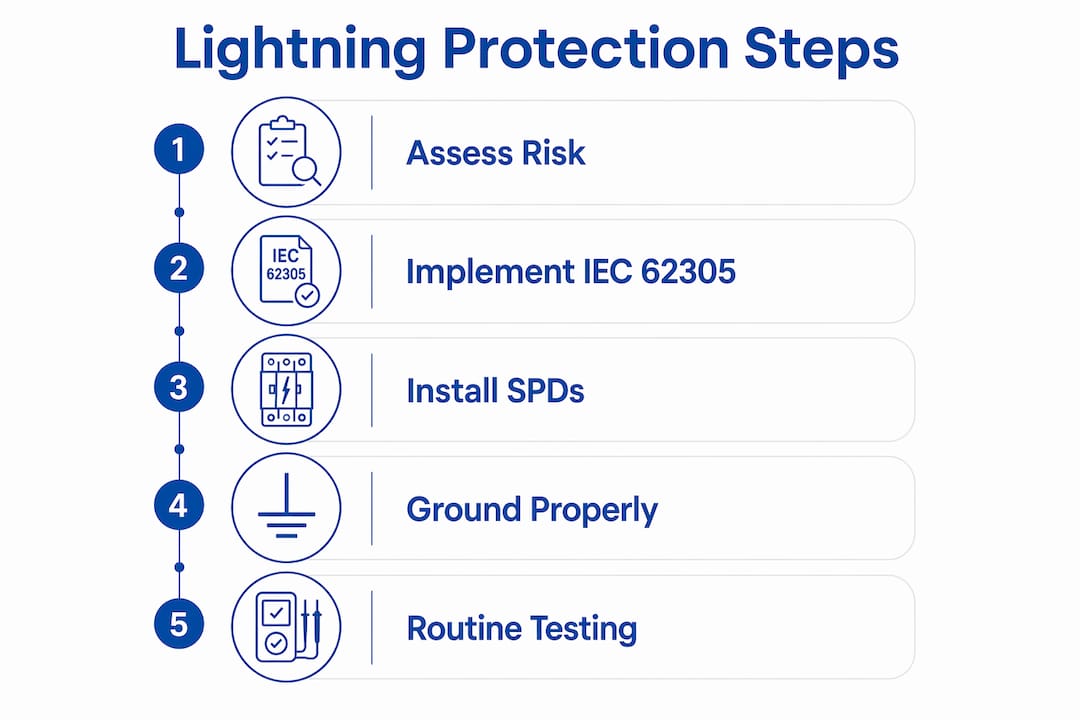
The tolerable risk threshold for human safety is set at 10^-5 per year. That figure means one loss event per 100,000 years is acceptable. For data centers, where economic loss and service disruption carry their own risk categories, the thresholds are applied across multiple risk components simultaneously.
IEC 62305-2 defines four Lightning Protection Levels (LPL I through IV). LPL I delivers 98% protection efficiency and applies to the highest-risk facilities. LPL IV offers lower efficiency and suits lower-risk structures. The standard assigns each level a minimum peak current value that the protection system must intercept.
The risk assessment process accounts for several site-specific variables:
- Ground flash density (Ng): The number of lightning strikes per square kilometer per year at the site location
- Structure dimensions and height: Larger and taller buildings present a greater collection area
- Type of content and occupancy: Data centers score high on loss-of-service risk due to operational criticality
- Shielding and line routing: Overhead power and data lines increase exposure to induced surges
- Soil resistivity: Affects grounding system performance and potential rise during a strike
| LPL | Protection efficiency | Minimum peak current (kA) |
|---|---|---|
| I | 98% | 3 |
| II | 95% | 5 |
| III | 90% | 10 |
| IV | 80% | 16 |
Combining IEC 62305-2 with NFPA 780 prescriptive methods produces the most complete lightning defense. IEC 62305 provides the quantitative risk framework; NFPA 780 specifies physical installation requirements. Using both eliminates gaps that either standard alone would leave open.
What is a multi-zone surge protection architecture for Tier III/IV data centers?
The Lightning Protection Zone (LPZ) concept, defined under IEC 62305-1, divides a facility into nested zones where electromagnetic severity decreases as you move inward. Zone LPZ 0 is the unprotected exterior. Zone LPZ 3 is the innermost protected space, such as a server rack. Each zone boundary requires a coordinated SPD to reduce transient energy before it reaches the next zone.
Tier III and Tier IV data centers require a 6-zone surge protection architecture using cascaded SPDs deployed at each major boundary. The deployment sequence follows the power distribution path:
- Main service board (MSB): Type 1 SPD handles direct strike energy and high-energy transients from the utility feed
- Automatic transfer switch (ATS): Type 1 or Type 2 SPD addresses residual energy after the MSB
- UPS input: Type 2 SPD protects the UPS from upstream transients
- UPS output / distribution board: Type 2 SPD handles transients generated by UPS switching
- Power distribution unit (PDU): Type 2 SPD manages downstream surges from load switching
- Rack-level protection: Type 3 SPD provides final-stage protection at the point of use
Type 1 SPDs are designed to handle the full energy of a direct strike. They are 4–5 times more expensive than Type 2 units. That cost difference reflects their higher discharge capacity and the specialized components required to absorb lightning-level currents.
Internal load switching events create a separate surge problem. CRAC unit cycling, UPS bypass switching, and generator transfers all generate high-frequency transient surges that a single SPD at the building entrance cannot address. A cascaded architecture per IEC 61643-11:2025 handles these internally generated transients at each zone boundary where they originate.
Pro Tip:Never rely on a single SPD at the utility entrance. Internal switching events generate surges downstream of that device, leaving racks unprotected. Deploy Type 2 SPDs at every PDU and Type 3 units at high-value rack positions.
For a detailed look at LPZ-based protection architectures, the zone-by-zone approach applies directly to data center floor planning and equipment layout.
How do grounding, bonding, and equipotentiality reduce lightning risk?
Grounding and bonding are the foundation of any lightning protection system. Without them, surge currents find unintended paths through sensitive equipment rather than safely dissipating into the earth.
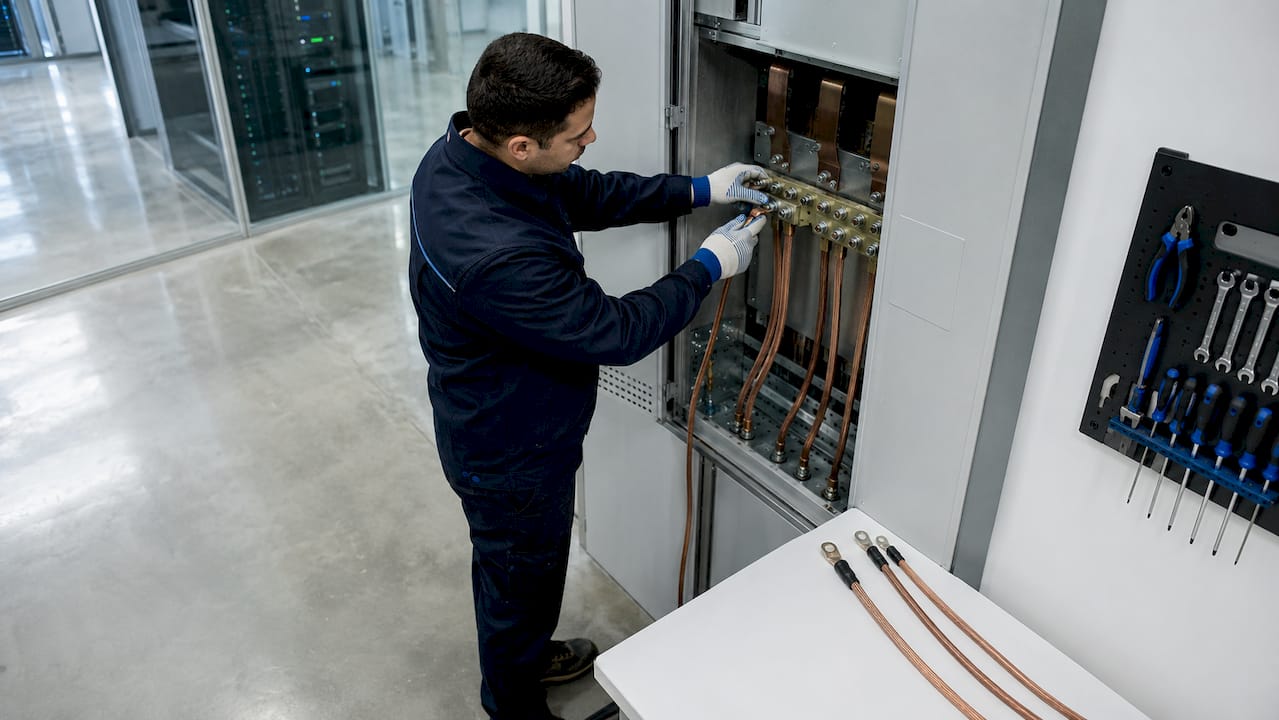
Proper equipotential bonding connects all metallic systems, including power earth, data earth, structural steel, and cable trays, to a single reference point. Improper separation of power earth and data earth creates damaging current loops during lightning events. When two earthing systems sit at different potentials during a strike, current flows between them through whatever conductive path is available. That path is often a server’s motherboard.
Achieving a ground resistance of 5 ohms or less minimizes ground potential rise during a strike. High ground resistance means the earth electrode rises to a dangerous voltage relative to other grounded systems, driving current through interconnected equipment. Low resistance keeps that potential rise small and the current path predictable.
Key grounding and bonding requirements for data centers include:
- Single integrated earth: Bond all earthing systems (power, data, structural) to one equipotential reference bar
- Low-impedance conductors: Use short, direct bonding conductors to minimize impedance at high frequencies
- Rooftop equipment bonding: HVAC units, antennas, and satellite dishes on the roof must be bonded and protected with Type 1 SPDs per IEC 62305-1 separation distance rules
- Communication cable protection: All external data and telecom cables entering the building require SPDs at the point of entry
Pro Tip:Commission a ground resistance test after installation and repeat it every two years. Soil conditions change, and a ground electrode that met the 5-ohm threshold at installation may degrade over time due to corrosion or soil drying.
Indelec’s deep earth grounding services address sites where surface soil resistivity makes achieving low ground resistance difficult, using drilled electrode systems that reach stable, low-resistivity soil layers.
What steps should data center managers take to mitigate lightning risk?
A formal, documented lightning risk assessment is the starting point. Without one, protection decisions are guesswork. The assessment must reflect site-specific conditions, not generic assumptions.
- Conduct a site-specific risk assessment using IEC 62305-2. Gather local ground flash density data, measure structure dimensions, catalog all incoming power and data lines, and calculate Nd versus RT for each risk category.
- Determine the required LPL. The risk assessment output defines whether LPL I, II, III, or IV applies. Do not default to the lowest level to save cost. A Tier IV data center in a high-Ng region almost always requires LPL I or II.
- Design the external lightning protection system. Install air terminals, down conductors, and earth electrodes per the required LPL. Protection level selection directly determines the spacing and geometry of the external system.
- Deploy cascaded SPDs across all six protection zones. Specify Type 1 at the MSB, Type 2 at intermediate distribution points, and Type 3 at rack level. Coordinate SPD ratings to ensure energy handoff between zones.
- Implement equipotential bonding throughout. Bond all metallic systems to a single earth reference. Verify separation distances for rooftop equipment per IEC 62305-1 and add bonding or Type 1 SPDs where distances are insufficient.
- Tailor the design to operational criticality. Ground flash density and site-specific factors should dictate protection level. A facility in a low-Ng region with redundant power feeds carries a different risk profile than a single-feed site in a high-storm corridor.
- Document and review annually. Record all protection measures, SPD ratings, test results, and inspection dates. Review the assessment whenever the facility expands, adds rooftop equipment, or experiences a lightning event.
Key Takeaways
Effective lightning protection for data centers requires a coordinated system of external air terminals, cascaded SPDs across six protection zones, and equipotential bonding, all sized to the facility’s IEC 62305-2 risk assessment outcome.
| Point | Details |
|---|---|
| Lightning risk is multi-vector | Both direct strikes and indirect surges from over a mile away can destroy data center equipment. |
| IEC 62305-2 sets the standard | Use probabilistic risk assessment to determine the required LPL before specifying any protection hardware. |
| Six-zone SPD architecture is required | Tier III/IV facilities need cascaded Type 1, 2, and 3 SPDs at every major power distribution boundary. |
| Grounding must achieve ≤5 ohms | High ground resistance drives surge current through equipment; test and maintain the earth electrode system regularly. |
| Internal surges demand internal protection | Load switching events inside the facility generate transients that bypass a single entrance SPD. |
Indelec’s perspective on lightning risk management
The most persistent misconception in data center protection is that a rooftop air terminal solves the problem. After decades of working on mission-critical sites, the pattern is clear: facilities that invest heavily in external lightning rods but neglect internal surge suppression still experience equipment failures. The internal SPD system is often more critical to uptime than the external air terminal.
The second misconception is that one protection standard is enough. IEC 62305 gives you the risk math. NFPA 780 gives you the installation rules. Neither is complete without the other. Data center managers who apply only one framework consistently find gaps when they audit their systems after an event.
The third issue is documentation. Protection systems degrade. SPDs absorb surges and lose capacity without triggering any visible alarm. Ground electrodes corrode. Bonding conductors loosen. A system that was compliant at commissioning may be significantly compromised three years later. Annual inspection and testing are not optional for a facility with a 99.999% uptime commitment.
The right approach is a tailored, risk-based design built on a current IEC 62305-2 assessment, reviewed every time the facility changes. That is not a one-size-fits-all solution. It is engineering.
— Indelec
Indelec’s lightning protection solutions for data centers
Data center managers who need a protection system built to IEC 62305 and NFPA 780 requirements have a clear starting point with Indelec’s end-to-end solutions.

Indelec’s Prevectron3 air terminal uses patented OptiMax technology to extend the protection radius and reduce the probability of a direct strike reaching the structure. For the internal system, Indelec’s certified engineers design and install cascaded SPD architectures, equipotential bonding networks, and grounding systems tailored to each facility’s LPL requirement. Indelec’s highly sensitive site protection service covers the full scope from risk assessment through commissioning, giving data center managers a documented, compliant system backed by a specialist with over 70 years of field experience.
FAQ
What is the role of lightning in data center risk?
Lightning causes direct physical damage through massive current surges and indirect damage through transient overvoltages that travel through power and data lines. Both mechanisms can destroy equipment, corrupt data, and trigger extended downtime.
How does IEC 62305-2 apply to data centers?
IEC 62305-2 provides a probabilistic risk assessment method that compares the annual frequency of dangerous lightning events to a tolerable risk threshold, determining whether protection is required and at which Lightning Protection Level.
Why is a single SPD at the building entrance not enough?
Internal load switching events from CRAC units, UPS systems, and generators generate high-frequency surges downstream of the entrance SPD. A cascaded, six-zone architecture addresses both external and internally generated transients.
What ground resistance should a data center target?
A ground resistance of 5 ohms or less is the accepted threshold. Higher resistance causes ground potential rise during a strike, driving surge current through interconnected equipment rather than safely into the earth.
How often should lightning protection systems be inspected?
Annual inspection and testing is the standard practice for mission-critical facilities. SPDs lose capacity after absorbing surges, and ground electrodes degrade over time, so regular verification is necessary to maintain compliance and protection integrity.