EV Charging Uptime: How to Measure and Protect It in France
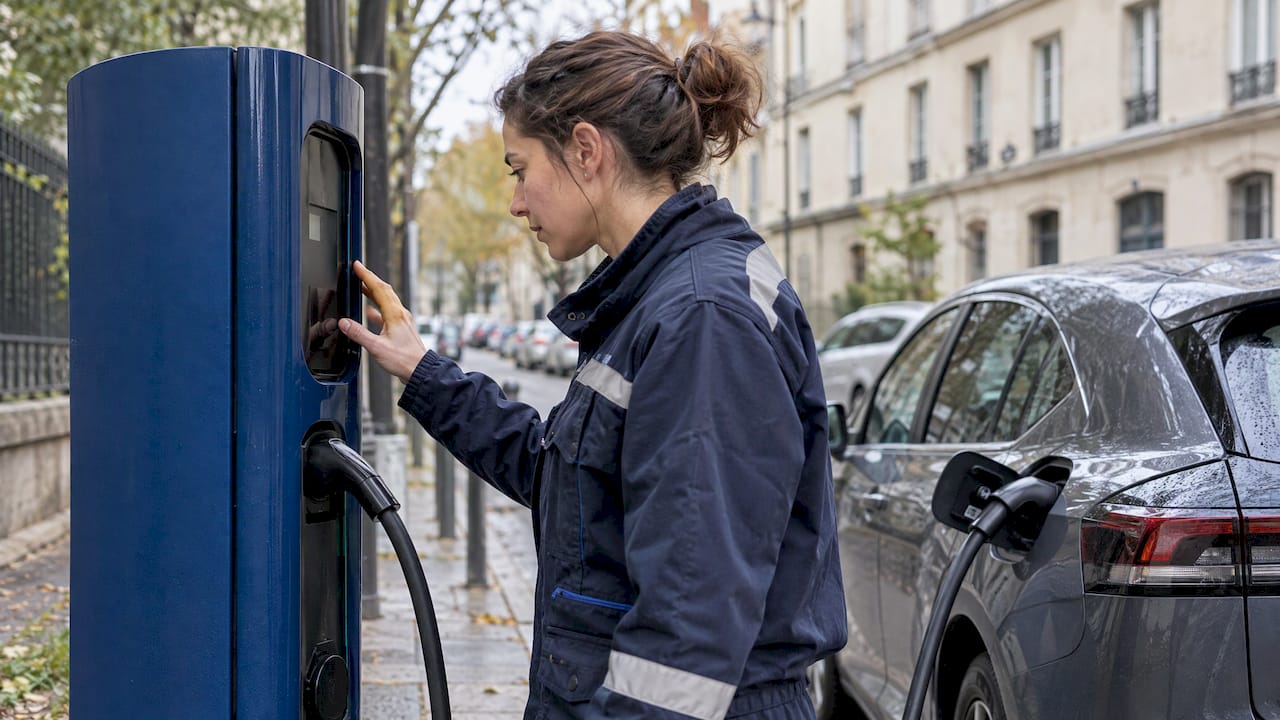
EV charging uptime is the share of time a charging point is able to deliver electricity to a driver who plugs in. In France it is a regulated indicator, and it is won or lost on three things: how you measure it, how fast you detect and repair faults, and how well the electrical installation under the charger is protected. If you own or manage a site with chargers, a specialist who handles the audit, installation, earthing, surge protection and supervision together keeps all three under one roof. That is what we do at Indelec for professional fleets and company sites.
TL;DR
- Uptime is measured per charging point, over the station’s opening hours. A charger that is online but cannot deliver energy is not “up”.
- French public charging points average roughly 93% availability, and about 70% reach 99% availability. Many drivers still meet an out-of-service point.
- French rules require real-time supervision and set maximum intervention and restoration times for operators of public charging infrastructure.
- Most avoidable downtime comes from connectivity, connector wear and electrical stress. Earthing, surge protection, supervision and a maintenance contract address each one.
- Set the uptime target, the measurement method and the repair deadlines before you sign, not after the first outage.
Table of Contents
- What uptime means for a charging point
- How France measures it, and what the numbers show
- What French and EU rules ask of you
- Why chargers go down
- Seven steps to protect uptime on your site
- A worked example: why the unit matters
- Perspective
- How Indelec supports charging uptime
- FAQ
- Sources
What uptime means for a charging point
The simplest definition is a ratio: hours during which a charging point can deliver energy, divided by the hours it is supposed to be open. The French method used by the national observatory follows this logic. Availability is calculated as the ratio of the charging point’s available time during the station’s commercial opening hours to the station’s total opening time. A point counts as unavailable if it is faulted or out of order, if it has lost communication (unknown status) for more than 24 hours, or if users cannot reach it for any reason.
Two details matter in practice.
The unit is the point, not the station. The same methodology averages the availability of each connector to get the availability of a charging point. A two-connector charger with one connector faulted is not 100% up. The Open Charge Alliance recommends calculating uptime per EVSE rather than per station or location, because data can always be aggregated upward but never split back down.
The hours that count are the opening hours. For a company car park open from 6 a.m. to 10 p.m., a fault at 2 a.m. does not count against the indicator. For a fleet depot that charges overnight, that is the wrong window for you, so define your own contractual hours.

Uptime, availability and reliability are not the same number
Three figures circulate under the same name:
| Figure | What it tells you | What it misses |
|---|---|---|
| Connectivity uptime | The charger is talking to the back office | A faulted connector, a failed payment terminal |
| Availability uptime | The connector can deliver energy | A blocked bay, a session that fails mid-charge |
| Successful session rate | Sessions that completed without an infrastructure interruption | Time when nobody tried to charge |
France tracks the last of these too. The regulatory indicators cover both the availability rate of charging points per operating unit and the successful charging-session rate. When a supplier quotes “99% uptime”, ask which of the three they mean. A charger can report a perfect heartbeat while the connector behind it cannot charge anything.
How France measures it, and what the numbers show
The arrêté of 27 October 2021 defines the regulatory indicators for the service quality of public charging networks. They must be calculated and published at least once a year, from 1 July 2022. The availability indicator is the average of each charging point’s availability: hours able to function over hours the station is open.
The Avere-France barometer gives the clearest picture of where the market stands:
- In the December 2024 barometer, average availability was 93.2% for AC chargers, 92.4% for DC chargers below 150 kW and 94.8% for DC chargers of 150 kW and above. 70% of points were available 99% of the time, and 5% were unavailable for more than 7 consecutive days.
- In the July 2025 barometer, 70% of points were again available 99% of the time, 6% were unavailable for more than 7 consecutive days, and the immediate access rate was 95%.
The average hides a long tail. Most points work nearly all the time, while a small group stays dead for weeks. That group is what drivers remember. In the 2024 observatory, 87% of users had met at least one out-of-service charging point in the previous six months, and successful charging sessions reached 85.5% in 2023.
For a site owner, the lesson is practical. Your uptime is not decided by the average. It is decided by how quickly you find a faulted point and how quickly someone fixes it.

What French and EU rules ask of you
If your chargers are open to the public, the decree on charging infrastructure (IRVE) already shapes your obligations. It requires public charging infrastructure to use an operator and a supervision system that monitors point status in real time, with an exception for certain small single-station installations. The aménageur must also guarantee maximum intervention and restoration times for anomalies, except those caused by a failure of the public electricity network.
At EU level, the picture is less defined. According to ChargeUp Europe, uptime is currently mentioned only in recital 12 of the AFIR regulation, while national and local tenders increasingly ask for 97% to 99%. Outside the EU, the benchmarks are explicit: California’s Clean Transportation Program, for example, sets a 97% uptime standard for DC fast chargers, calculated per port. It excludes vandalism, grid power loss, natural disasters and limited planned maintenance from the count.
What this means for a French company site: even where no fine applies to you, tenders, landlords and fleet customers are starting to write 97% to 99% into contracts. Defining the calculation method and the exclusions up front prevents disputes later.
Why chargers go down
Research on real charger fleets points to a consistent pattern. A January 2026 academic study of 98 chargers at a California institution proposed metrics that separate Fault Time, Fault-Reason Time and Unreachable Time. It found that persistent “zombie” chargers and frequent network instability were hidden inside standard annual uptime reports. Hardware faults and network problems are different failures with different fixes, and a single percentage blurs them.
For a facility manager, downtime usually traces back to four groups of causes:
- Connectivity. Lost signal, network drops, a back office that no longer sees the charger. The charger may still work, or it may not, and you cannot tell without supervision.
- Connector and cable wear. Latches, pins and cables take daily mechanical abuse.
- Electrical stress. Surges from the network or from nearby lightning, and a poor earthing connection, can damage electronics or trip protection. Charging stations are exposed outdoor equipment on long cable runs, which is where lightning protection knowledge applies.
- Site design. Undersized supply, no load management, or poor protection coordination cause trips under load.
The first two are about monitoring and maintenance. The last two are about the electrical installation, which is where Indelec’s background in earthing and surge protection is directly relevant.
Seven steps to protect uptime on your site
1. Define what “up” means before you buy
Write the definition into the contract: per charging point, over named hours, with listed exclusions (grid outage, vandalism, planned maintenance). Use the French indicator method as the reference, so your figures line up with what the observatory publishes. An audit of your site at this stage turns a vague promise into numbers you can check.
2. Size the installation for the real load
Chargers that trip under peak demand look like hardware failures but are design faults. Load management and correct sizing prevent them. Our guides on load management for IRVE in France and on sizing IRVE for parking lots with the 20% rule cover the rules behind it.
3. Get the earthing right
A charging point is only as stable as the earth connection behind it. Poor earthing creates nuisance trips and safety risks, and it is cheaper to build correctly than to chase intermittently. See our note on earthing for EV charging stations in France. Indelec supplies earthing systems and deep earth connections as part of its range.
4. Protect against surges
Surge protection shields the electronics that make a charger “available”. It is also a point of conformity: our guide to surge protection for French EV chargers explains how to avoid Consuel rejections. Indelec’s range includes surge protection devices and low voltage surge protection cabinets.
5. Supervise at the connector
The Open Charge Alliance lists eight actions to cut downtime. They include monitoring the websocket ping, setting the heartbeat interval to 15 minutes or 1 hour, monitoring status and error codes in OCPP 1.6 or NotifyEvent messages in OCPP 2.0.1, tuning back-off retry parameters, and enabling offline behavior at the charger. All of them are described in its uptime monitoring paper. Which protocol version you buy matters here, which is why we wrote about requiring OCPP 2.0.1 and a profile matrix before signing.
6. Set a maintenance level and repair deadlines
Supervision tells you a point is down. Maintenance brings it back. Choose a level of intervention that matches how critical charging is for your operation, and write down response and restoration times. Our article on enterprise EV charger maintenance in France compares the MA1, MA2 and MA3 levels.
7. Check the installer’s qualification
Uptime starts with a correct installation. Since the 2026 recoding, qualification matters when you choose who installs. Read what to check on IRVE qualification before you sign.
A worked example: why the unit matters
Take a depot with ten chargers, each with two connectors, open 24 hours a day over a 30-day month, which is 720 hours. Suppose one connector is faulted for 72 hours.
- Per connector: that connector is 90% available (648 of 720 hours). The other nineteen are at 100%.
- Per charging point: the affected point averages its two connectors, so it is 95% available. The nine others are at 100%.
- Site average over the ten points: 99.5%.
The site looks excellent on paper. Yet one of your twenty connectors was dead for three days. If your fleet relies on those ten chargers overnight, the useful question is not the 99.5% figure but how many vehicles could not charge. Contracts that name the unit, the hours and the maximum repair time protect you from the comfortable average.
Perspective
Uptime is often treated as a software problem. We see it first as an electrical one. A charging station is outdoor equipment connected to a network, exposed to surges and dependent on a sound earth connection. When those fundamentals are weak, no dashboard will keep the point available.
This is why we approach charging infrastructure from the protection side. Indelec was established in 1955 and works in lightning protection, earthing and surge protection, with a dedicated R&D center. We apply the same discipline to charging for professional fleets: audit the site, install, and supervise.
Our advice to facility owners is to treat uptime as a design requirement and not a service-level afterthought. Define the measurement per charging point, protect the installation, supervise it in real time and agree repair deadlines. Done together, these steps give you a number you can defend.
INDELEC
How Indelec supports charging uptime
Indelec offers electric mobility solutions that include the audit, installation and supervision of charging infrastructure for professional fleets. Alongside them we supply the protection layer: earthing systems, surge protection and verification and maintenance services. If you are planning a site or reviewing one that goes offline too often, start with our electric mobility services.

For the protection side of a charging site, our surge protection devices and earthing range are available to contractors and facility teams, and our services page lists the rest of what we do.
FAQ
What is a good uptime target for EV chargers in France?
The market reference is 99% availability per charging point. In the Avere-France barometers, about 70% of points reached it. Tenders in Europe increasingly ask for 97% to 99%. Whatever you choose, specify the unit, the hours counted and the exclusions in the contract.
How is charging uptime calculated?
Divide the hours a charging point can deliver energy by the hours the station is open, and average the result across the points on the site. In the French method, a point is unavailable if it is faulted, has been out of communication for more than 24 hours, or cannot be reached by users for any cause.
Is uptime the same as availability?
No. Uptime measures how consistently a point stays operational over a period. Availability, in the sense of a live status, tells you whether it is free, in use or reserved right now. Successful session rate is a third measure, which France publishes separately in its regulatory indicators.
What causes most charger downtime?
Connectivity loss and hardware faults, including connector wear, are the main groups. Electrical stress from surges and weak earthing adds to them. A study of 98 chargers showed that separating hardware faults from network unreachability exposes problems that a single annual percentage hides.
Do French rules require real-time monitoring?
For public charging infrastructure, yes, with an exception for certain small single-station installations. The decree requires an operator and a real-time supervision system, and maximum intervention and restoration times for anomalies.
Sources
- Méthodologie de calcul des indicateurs, AFIREV
- Déclarer des indicateurs de qualité, Afirev
- Improving Uptime Monitoring with OCPP, Open Charge Alliance
- Baromètre IRVE, Avere-France, December 2024
- Baromètre IRVE, Avere-France, July 2025
- Observatoire Avere-France/AFIREV 2024
- Décret 2017-26 modifié par 2021-546
- Understanding uptime in the EV charging industry, ChargeUp Europe
- EV Charger Performance Standards and Uptime Reporting, California Energy Commission
- Beyond Uptime: Actionable Performance Metrics for EV Charging, arXiv